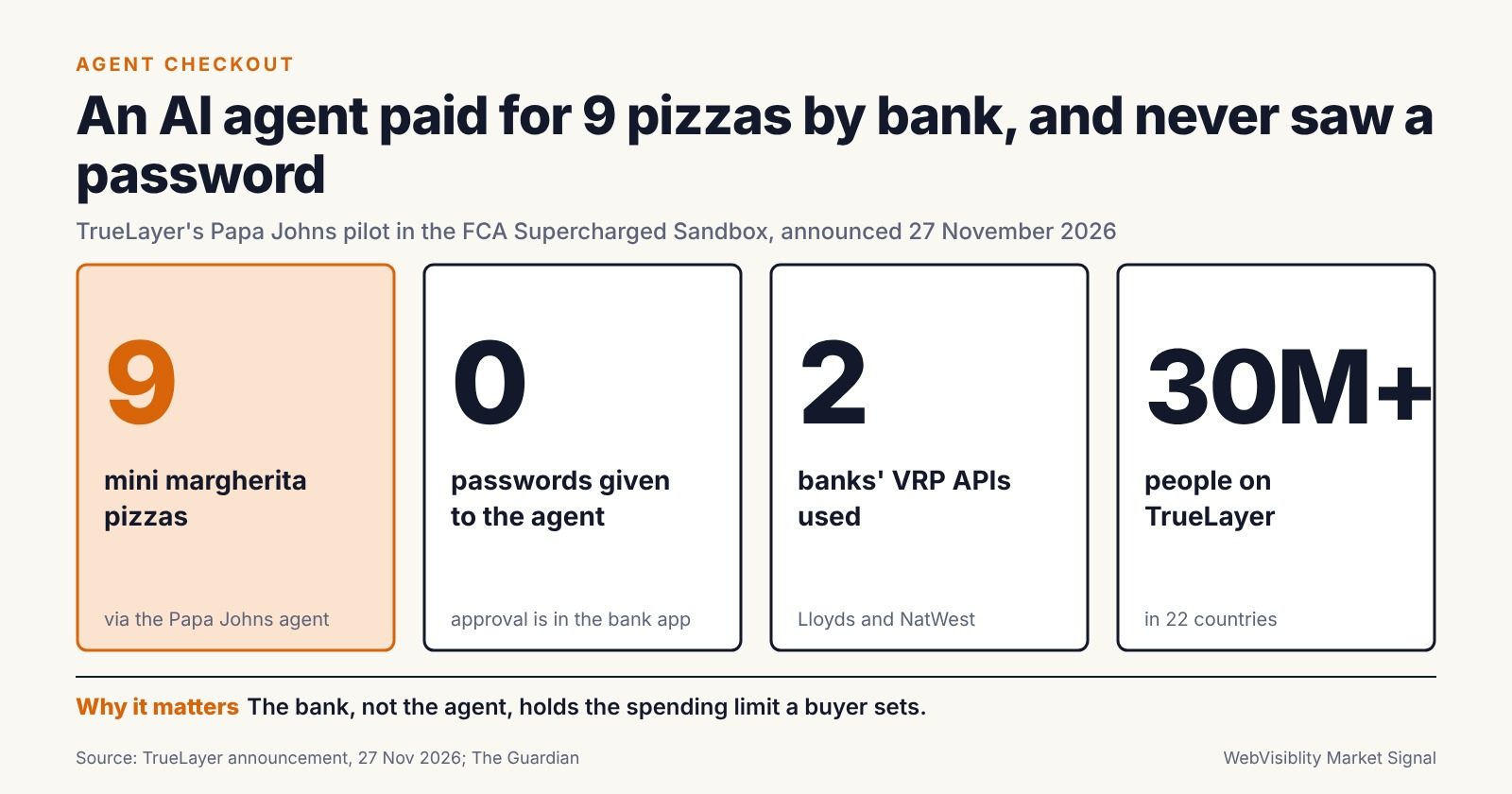
On Black Friday, TrueLayer said a Papa John's AI agent had paid a named UK retailer from a customer's bank account for the first time, with no card involved. The order was nine mini margherita pizzas. The test ran inside the Financial Conduct Authority's Supercharged Sandbox, and the agent never received the customer's bank security details.
At a glance
| What was bought | Nine mini margherita pizzas |
|---|---|
| How it was paid | Pay by Bank, not a card |
| Banks involved | Lloyds and NatWest payment APIs |
| Who sets the limit | The customer, with their own bank |
| Where it was tested | FCA Supercharged Sandbox, cohort 2 |
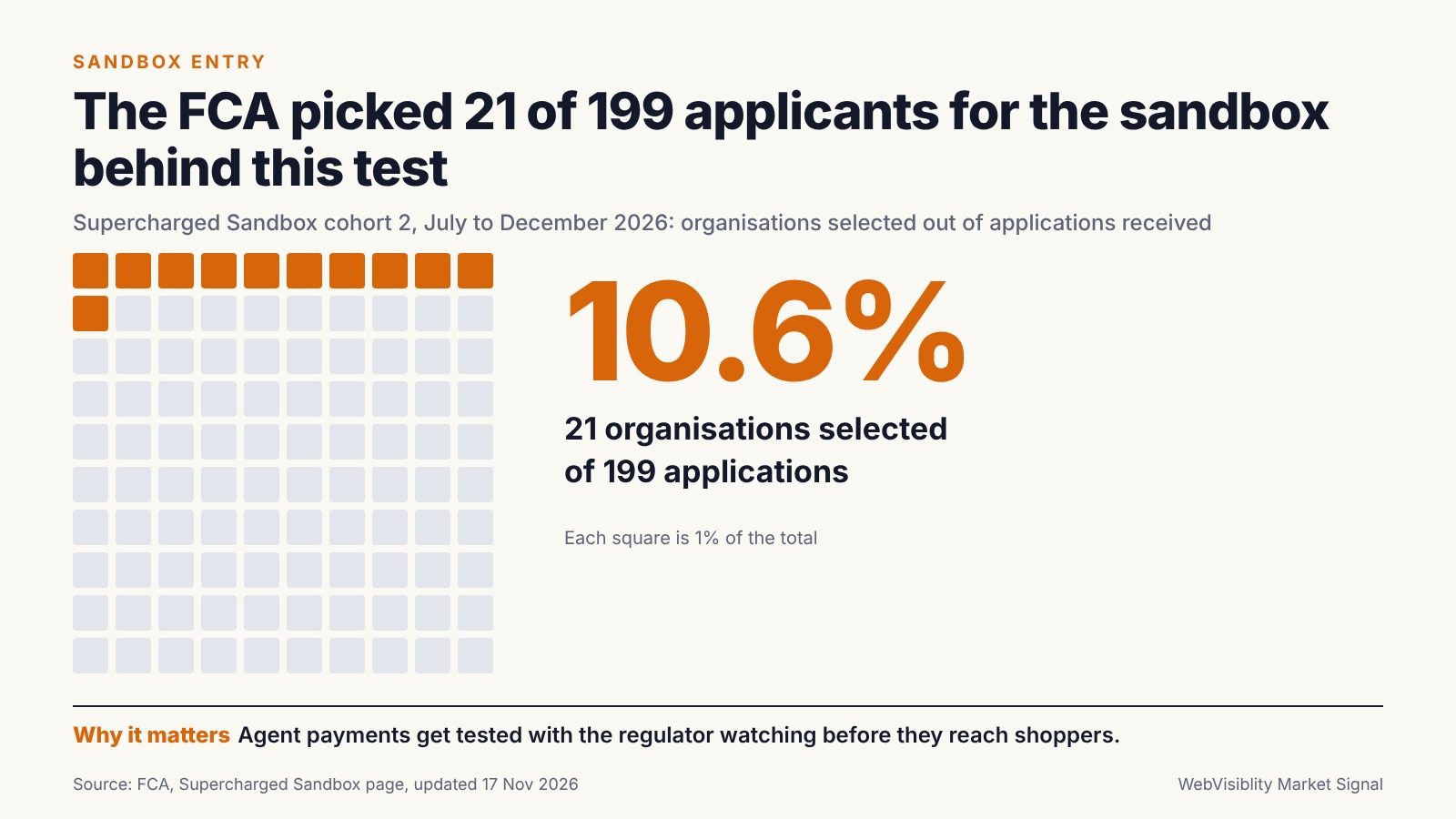
| Sandbox intake | 21 of 199 applications accepted |
Do this today
Tick each step as you do it. Your ticks stay on this device. See the full list.
For marketers
For software buyers and IT teams
The signal
- The customer links a bank account, not a card, to their Papa John's account, and the agent requests payment from that account.
- Spending limits are set per merchant or over set periods, and the bank declines any payment above them.
- Approval happens in the customer's banking app, so no credentials or passwords reach the agent.
- TrueLayer says it was the first use of Lloyds' and NatWest's VRP APIs for payments started by an agent.
- The customer can cancel the mandate from the merchant or the banking app at any time.
- It is a pilot. TNW notes it is not a service open to all Papa John's customers.
Which of these are you?
Tap the one that fits you best. We show what this story changes for you.
What happened
TrueLayer, a London payments company, announced on 27 November that it had run a pilot with Papa John's in which the chain's AI agent completed a Pay by Bank payment. Pay by Bank moves money directly between bank accounts through open banking, so no card number changes hands.
The Guardian described the order. The team told the agent about the occasion and their dietary needs, the agent suggested flavours and quantities, and the customer confirmed nine mini pizzas. TrueLayer's chief executive, Francesco Simoneschi, said on BBC Radio 4 that the payment went through with no account numbers and no password.
The payment ran on variable recurring payments, or VRPs, which let a provider take repeated payments of different amounts under one approval. TrueLayer's announcement names Lloyds and NatWest as the banks whose VRP systems were used. The Guardian and Tech.eu name only Lloyds Bank. This briefing follows TrueLayer's own account.
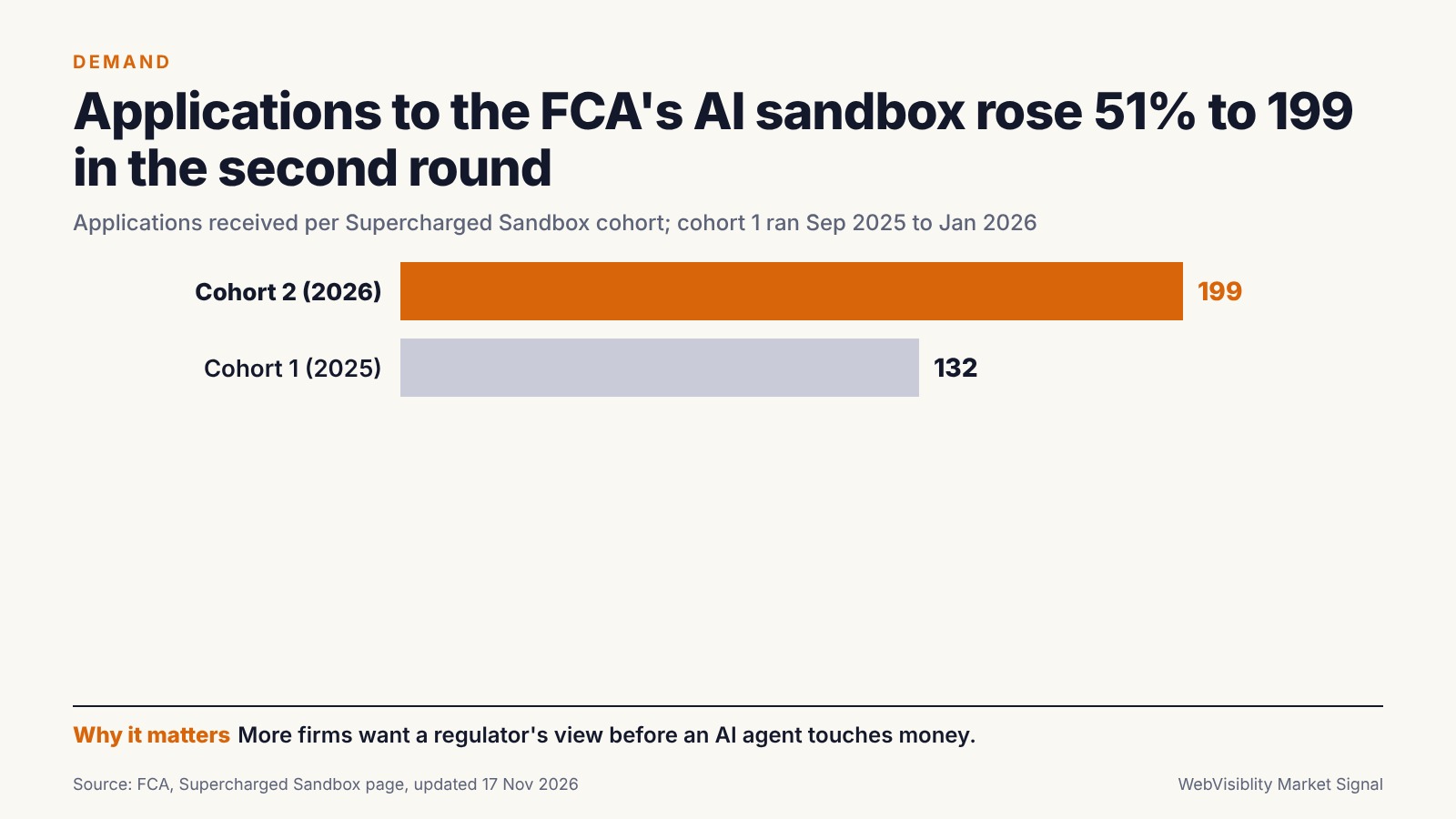
The work was done in the FCA's Supercharged Sandbox, a programme that gives firms computing power, data and expert support to test AI ideas. The regulator picked 21 organisations from 199 applications for its second group, which runs from 13 July to 31 December 2026 and includes safer agent-led payments among its themes. TrueLayer presented its findings at the FCA showcase on 26 November. Taking part does not mean FCA approval of a product.
By the numbers
| What | Figure | Source |
|---|---|---|
| Mini pizzas in the first agentic Pay by Bank order | 9 | The Guardian |
| Banks whose VRP APIs were used for agent payments | 2 | TrueLayer |
| Organisations selected for sandbox cohort 2 | 21 | Financial Conduct Authority |
| Applications to sandbox cohort 2 | 199 | Financial Conduct Authority |
| Rise in applications from cohort 1 | 51% | Financial Conduct Authority |
Figures exactly as published.
How the agent's payment worked
- 1Link
The customer links a bank account to their Papa John's account.
- 2Limit
They set spending limits with their bank when linking.
- 3Order
The agent helps choose and requests the payment.
- 4Check
The bank declines anything above the limit.
Timeline
Applications close for cohort 2 of the FCA Supercharged Sandbox.
Cohort 2 launches with 21 organisations, TrueLayer among them.
The FCA publishes its expectations for agentic AI in financial services.
TrueLayer presents the pilot at the FCA showcase.
TrueLayer announces the Papa John's agentic payment on Black Friday.
Sandbox access for cohort 2 ends.
“Agents will choose the payment rail that is fastest, most secure and lowest cost, not the one people use out of habit.”
Why it matters
This pilot shows a brand running its own shopping agent. The conversation, the product suggestions and the checkout all stayed inside Papa John's agent, with the bank holding the purse strings. TrueLayer frames this as merchants keeping control of the customer experience. Meta's Muse, which launched in the UK this week, takes the other route: an outside agent that pays with a customer's card. B2B sellers with online checkout or self-serve plans will face the same choice between building an agent buyers talk to directly and being found by agents someone else runs.
The agent recommended before it paid. In the Guardian's account, it suggested flavours and quantities from a description of the occasion. When an agent shapes the basket, the information it reads about products decides what gets suggested. That is the same problem as AI search: clear product facts, consistent pricing and schema markup on product pages give any agent, owned or outside, accurate material to work from. AI visibility work and agent readiness now overlap.
The regulator is watching the payment step closely. Three days before the announcement, the FCA told regulated firms to consider whether to accept payments instructed by an AI agent, and told technology firms that agents which start moving money may need authorisation. A bank-set limit and in-app approval give one answer to the control question. Finance and procurement teams will want to see that kind of guardrail before letting agents buy on a company's behalf.
Who is affected
| Who | What changes | Impact |
|---|---|---|
| Brands with online checkout | Can run their own agent and keep the customer relationship. | High |
| Payment and finance teams | Must decide whether to accept agent-instructed payments. | Medium |
| Marketers | Product facts now feed agents that suggest what to buy. | Medium |
What to do now
For marketers
- Ask an AI assistant to build a basket from your catalogue and note which products it suggests and why.
- Check that product pages state prices, options and limits in plain text and schema markup an agent can read.
- Decide whether your brand needs its own agent at checkout or only needs to be found by outside agents.
For software buyers and IT teams
- Ask suppliers whether their AI agents pay by card or by bank mandate, and who sets the spending limit.
- Keep agent purchases on accounts where your bank can enforce per-supplier caps.
- Confirm what refund and dispute rights apply when an agent places an order for you.
Printable, one page, 11 checks. Enter your email and it opens right away.
We email you a copy. We never share your email and never send you sales emails.
Pick one. It takes 5 seconds and helps more people find these briefings. Your checklist opens straight after.
Have a work email? Use it instead and the checklist opens straight away.
Open it, then save it as a PDF or print it.
Know someone who would find this useful?
These steps are our recommendations based on this news, not statements from the companies involved.
What to watch
- A live launch. Whether Papa John's offers agentic Pay by Bank to all UK customers, beyond the pilot.
- Other banks. Whether more UK banks open their VRP APIs to agents after Lloyds and NatWest.
- FCA follow-up. What the regulator's planned Agentic Policy Sprint produces on agent payments.
- Card networks. How card-based agents such as Muse respond to the cardless model.
- Business buying. Whether bank-set mandates move from consumer orders to company purchasing.
Questions readers ask
Can an AI agent pay from a bank account in the UK?
Yes, in a pilot. On 27 November TrueLayer said a Papa John's agent completed a Pay by Bank payment from a customer's account inside the FCA's Supercharged Sandbox.
What is agentic Pay by Bank?
It is an AI agent paying straight from a bank account through open banking, instead of a card, under a mandate whose spending limits the bank enforces.
Does the AI agent see my bank password?
No. In TrueLayer's pilot the customer approves in the banking app, so no credentials or passwords are shared with the agent.
Which banks were part of the Papa John's AI agent payment?
TrueLayer names Lloyds and NatWest, whose VRP APIs were used for agent payments for the first time. Some reports mention only Lloyds.
What is the FCA Supercharged Sandbox?
An FCA programme where firms test AI ideas with computing power, data and expert help. Cohort 2 took 21 of 199 applicants.
Is agentic Pay by Bank available to all Papa John's customers?
Not yet. It was a pilot, and TNW reports it is not open to all customers. No public launch date has been given.
What happens if an AI agent orders the wrong thing?
Simoneschi told the BBC that existing buyer-rights protections would still apply if an agent picked the wrong product.
Companies in this story
Sources
Researched, fact-checked and edited by the Market Signal desk. Read our editorial standards. Spotted an error? Email hello@webvisiblity.com and we will correct it.