Update, Nov 27, 2026, 11:30 PM ET: On 24 November Meta's Muse became the first Big Tech personal agent to launch in the UK; the CMA said Meta changed its terms first, and the UK version has no liability cap. See meta-muse-uk-terms-no-liability-cap-cma.
Britain's financial watchdog has drawn a line for AI agents. Once an agent stops giving information and starts initiating transactions, moving money, arranging borrowing or making investment decisions, the company behind it must work out whether it needs FCA authorisation. Some products may require FCA regulation at launch, the regulator said on 24 November, and it will not hesitate to act against unauthorised services.
At a glance
| Published | 24 November 2026 by the Financial Conduct Authority |
|---|---|
| Who it covers | Regulated firms, technology providers and social media platforms |
| Licence trigger | Agents that move money, arrange borrowing or invest |
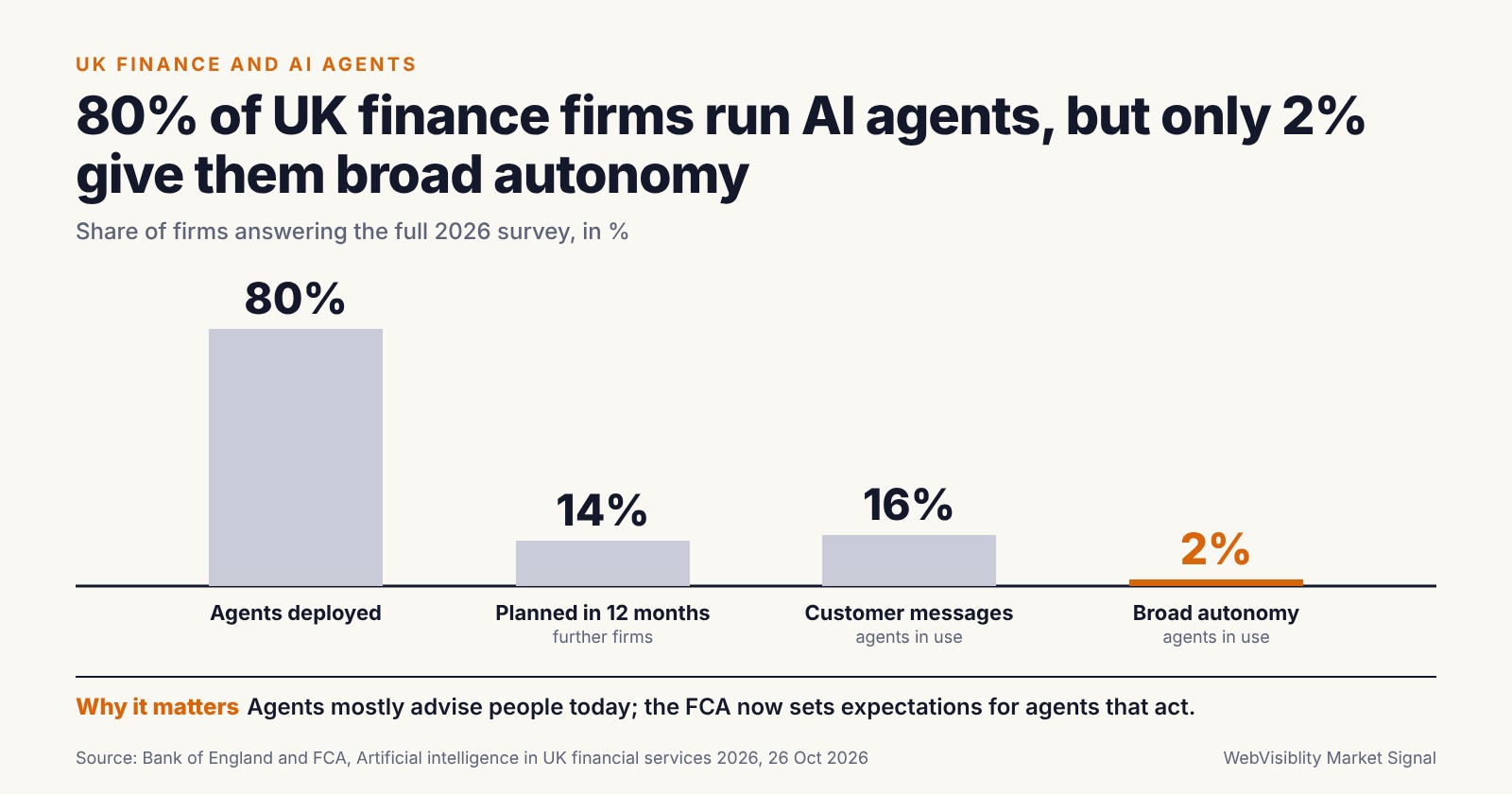
| UK finance firms with agents deployed | 80% of respondents in the 2026 survey |
| Agents with broad autonomy | Only 2% of respondents |
| New AI-specific rules | None planned; existing rules apply |
Do this today
Tick each step as you do it. Your ticks stay on this device. See the full list.
For marketers
For software buyers and IT teams
The signal
- Describing a business as a technology provider does not mean that they do not need FCA authorisation; Parliament sets that boundary.
- Regulated firms that buy agents from outside remain responsible, and so do their senior managers.
- Firms should work out how to tell when they are dealing with an agent, what consents exist and what the agent may do.
- The FCA asks firms to consider whether to accept payments instructed by an AI agent or by a wallet an agent controls.
- AI providers are expected to use clear, proportionate and consistent disclaimers on financial information their models give.
- The FCA plans an Agentic Policy Sprint with firms, policymakers and tech providers; no date is set.
Which of these are you?
Tap the one that fits you best. We show what this story changes for you.
What happened
On 24 November the FCA published a page titled Our approach to Agentic AI. It says firms in financial services are moving from experimenting with AI agents to deploying them, and that the regulator is already talking to companies planning personal AI agent products for UK consumers. The page promises regular updates as products roll out.
The central message is about the line between regulated and unregulated work. An agent that only gives information sits on one side. An agent that pays bills, moves money, arranges a loan or makes an investment call may sit on the other. TNW summed it up as Parliament sets the boundary, not branding. The FCA lists activities a tech firm should check, including payment services, financial promotions, credit broking and financial advice.
For firms the FCA already regulates, the page repeats that the Consumer Duty and senior manager rules apply to AI. Insurance Business noted that the regulator has confirmed it will not write AI-specific rules. Firms must show they understand the degree of autonomy their systems have, and must plan for customers who send agents to deal with them on their behalf.
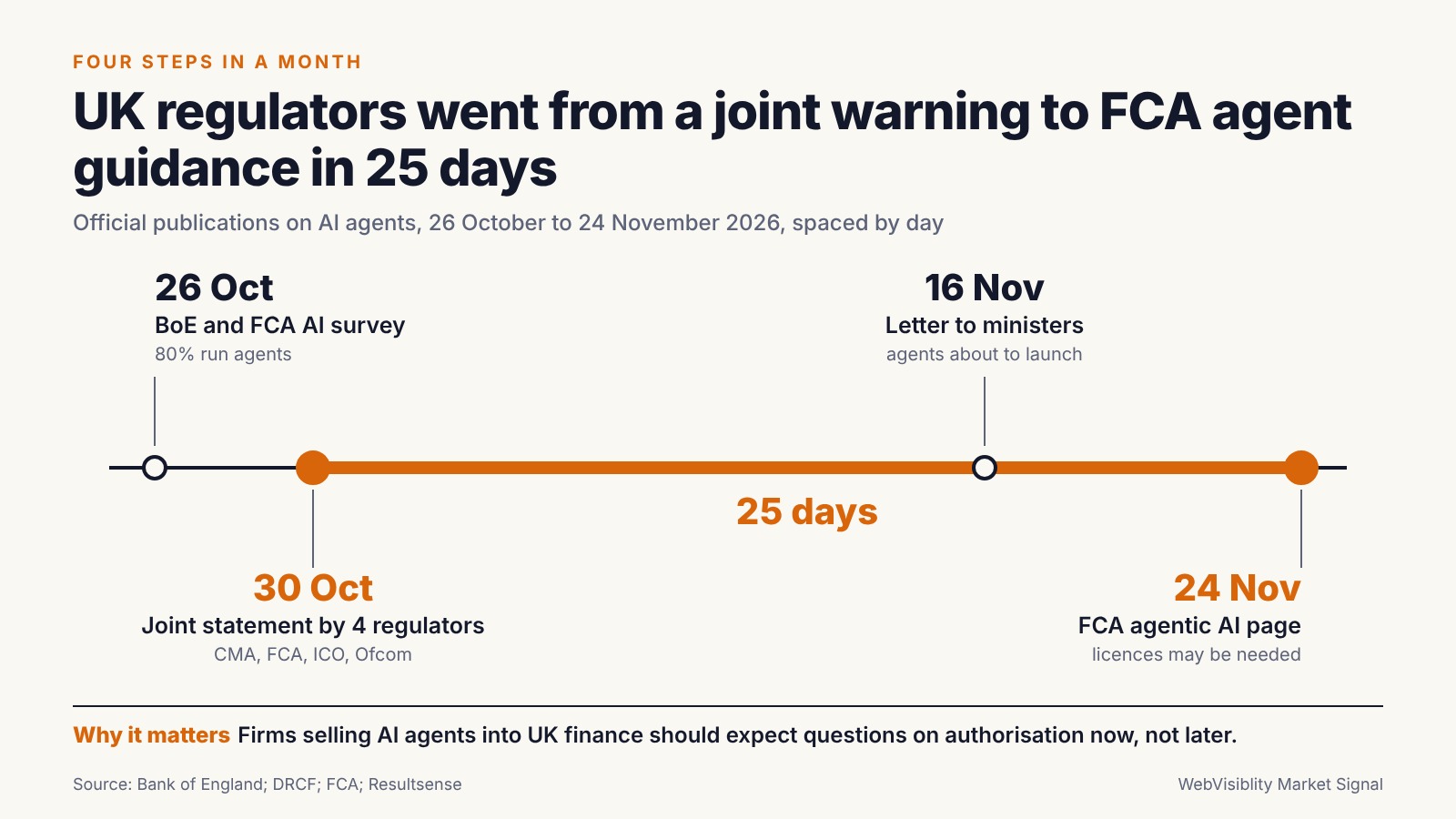
The page is the latest of several moves. On 30 October the CMA, FCA, ICO and Ofcom said in a joint statement that existing legal and regulatory frameworks apply to personal AI agents. On 16 November the heads of the four regulators wrote to ministers that several personal agents are due to launch and that engagement has not been consistently early or open. CX Today reported the FCA wants clear controls over permissions, consent and escalation.
How the FCA wants a firm to think about an agent product
- 1Map
List the activities your agents undertake, not how the product is branded.
- 2Check
Test them against payments, credit broking, promotions and advice.
- 3Engage
Use the FCA's pre-application support service or AI Lab before launch.
- 4Control
Show you understand the degree of autonomy and keep real-time controls.
Timeline
Bank of England and FCA survey finds 80% of respondents have AI agents deployed.
CMA, FCA, ICO and Ofcom issue a joint statement on personal agents.
The four regulator heads write to ministers about coming agent launches.
The FCA publishes its agentic AI expectations.
“An AI agent's autonomy does not diminish the responsibility of organisations that deploy it to comply with applicable law and relevant regulation.”
Who is affected
Buyers remain responsible for your agent, so expect detailed questions on autonomy and controls.
Agents that move money may need FCA authorisation at launch.
Promotions and AI-made product descriptions sit inside issuing financial promotions checks.
Must decide whether to accept payments instructed by an AI agent.
Why it matters
The survey numbers show where finance stands. 80% of respondents already have AI agents deployed, yet most keep them in an advisory role, and only 2% report agents with broad autonomy. Even counting plans for the next year, no more than 9% expect agents to initiate payments or execute trades. The FCA page is aimed at exactly that next step, so vendors whose agents act rather than advise face a licensing question before launch, not after.
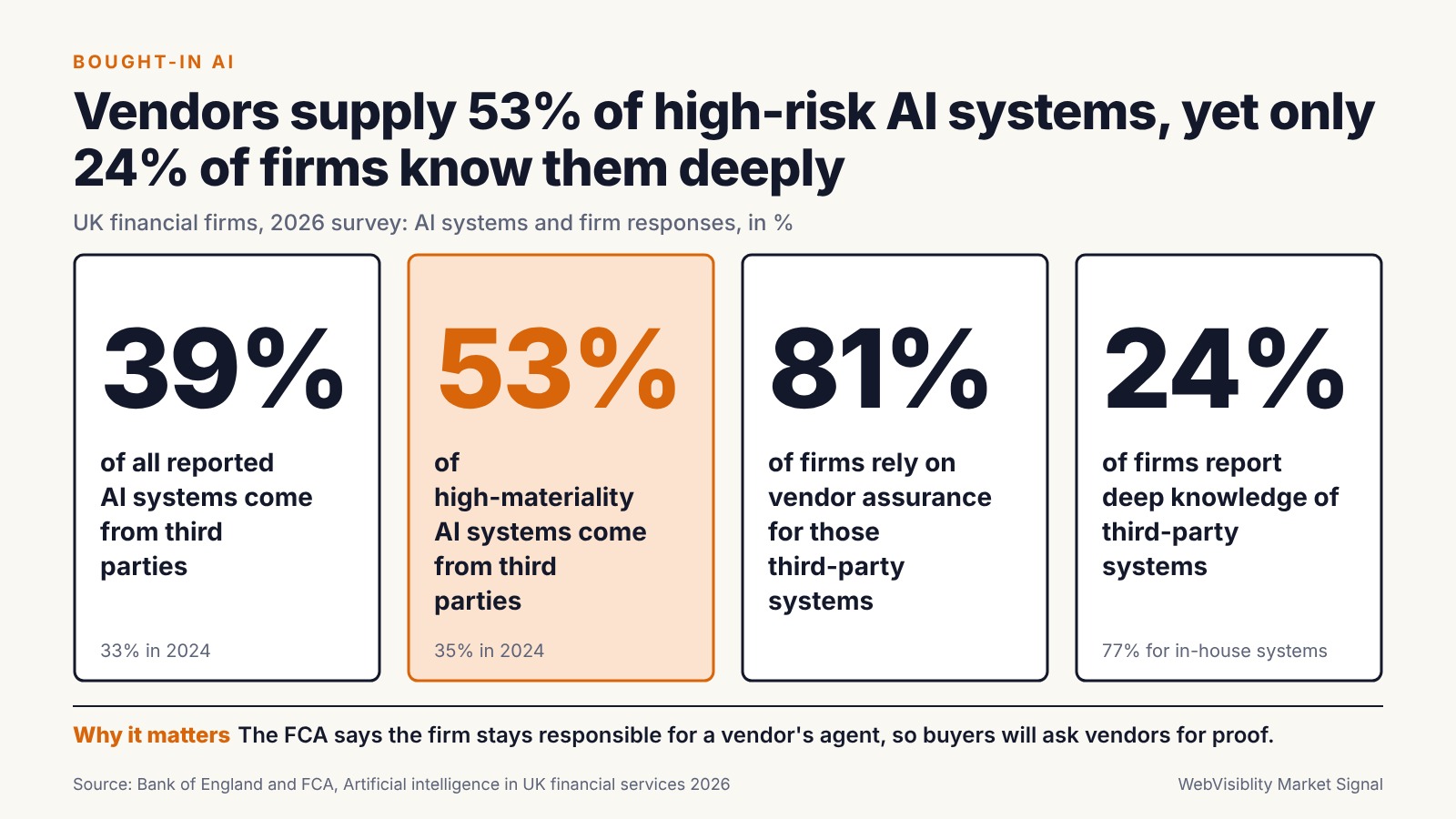
The vendor story matters just as much to anyone selling AI into banks, insurers or brokers. Third parties now supply 53% of high-materiality AI systems, up from 35% in 2024, and 81% of firms rely on vendor assurance to understand those systems. Because the buying firm remains responsible for a bought-in agent, procurement teams will want written answers on autonomy, controls and regulatory status. Vendors who publish those answers clearly, on pages that AI search tools can read and quote, give buyers less work and fewer doubts. That is an AI visibility task as much as a compliance one.
Marketing teams in financial services have a narrower point to note. The FCA lists issuing financial promotions among the activities a tech provider should check, and expects AI providers to explain the limits of model-generated financial information. Brands that let assistants describe their products should check that the wording those assistants pick up from their own pages is accurate and compliant.
By the numbers
What to do now
For marketers
- Publish one plain page per AI agent feature stating what it does on its own and where a person approves.
- Add a regulatory status section for UK finance buyers, naming any FCA permissions you hold or need.
- Ask ChatGPT, Gemini and Perplexity how they describe your agent product, and correct pages that overstate what it can do.
- Brief sales on the FCA page so they can answer authorisation questions in the first call.
For software buyers and IT teams
- Ask each AI vendor to list every action its agent can take without human approval.
- Request written evidence of the controls and monitoring behind any agent you deploy.
- Agree with payments and compliance teams whether you will accept agent-instructed payments, and how.
Printable, one page, 11 checks. Enter your email and it opens right away.
We email you a copy. We never share your email and never send you sales emails.
Pick one. It takes 5 seconds and helps more people find these briefings. Your checklist opens straight after.
Have a work email? Use it instead and the checklist opens straight away.
Open it, then save it as a PDF or print it.
Know someone who would find this useful?
These steps are our recommendations based on this news, not statements from the companies involved.
What to watch
- The Agentic Policy Sprint. The FCA is taking expressions of interest; dates and members will show which firms help shape the approach.
- First enforcement. Whether the FCA uses its powers to intervene against an unauthorised agent product.
- Launches the regulators flagged. The letter said several personal agents are due to launch in the UK; watch whether they arrive with authorisation.
- Payments acceptance. Whether banks publish policies on payments instructed by an AI agent.
Questions readers ask
Do AI agents need FCA authorisation in the UK?
Some may. The FCA says agent products that move money, arrange borrowing or make investment decisions may require FCA regulation at launch, depending on the activities they actually carry out.
Can a tech company avoid FCA rules by calling itself a technology provider?
No. The FCA says describing a business as a technology provider does not mean that they do not need authorisation. The boundary is set by Parliament, not by how a firm labels itself.
Who is responsible if a bank uses a third-party AI agent?
The bank. Responsibility for regulatory compliance remains with you and senior managers when a regulated firm relies on a third-party agent provider.
How many UK financial firms use AI agents?
80% of respondents to the 2026 Bank of England and FCA survey reported having AI agents deployed, and a further 14% planned to deploy them within 12 months.
Is the FCA writing new rules for AI?
No new AI-specific rules are planned. The FCA applies its existing framework, including the Consumer Duty, and Insurance Business reports it has confirmed it will not write AI-specific rules.
Should banks accept payments made by AI agents?
The FCA has not banned them. It asks firms to consider whether it is appropriate to accept payments instructed by an AI agent or from a wallet an agent controls, and to check their controls.
What is the FCA Agentic Policy Sprint?
It is a planned FCA forum where firms, policymakers and tech providers collaborate on agentic AI. Interest can be registered now by email; TNW reports no date has been set.
Companies in this story
Sources
- Financial Conduct AuthorityOriginal
- Bank of England
- TNW
- Insurance Business UK
- Resultsense
- Digital Regulation Cooperation Forum
- CX Today
Researched, fact-checked and edited by the Market Signal desk. Read our editorial standards. Spotted an error? Email hello@webvisiblity.com and we will correct it.
Update history
- Nov 27, 2026, 3:30 PM ET: Three days after this page, TrueLayer said a Papa John's AI agent paid from a customer's bank account in the FCA's Supercharged Sandbox, with spending limits enforced by the bank and approval in the banking app. See papa-johns-ai-agent-pay-by-bank-truelayer-fca.
- Nov 27, 2026, 11:30 PM ET: On 24 November Meta's Muse became the first Big Tech personal agent to launch in the UK; the CMA said Meta changed its terms first, and the UK version has no liability cap. See meta-muse-uk-terms-no-liability-cap-cma.