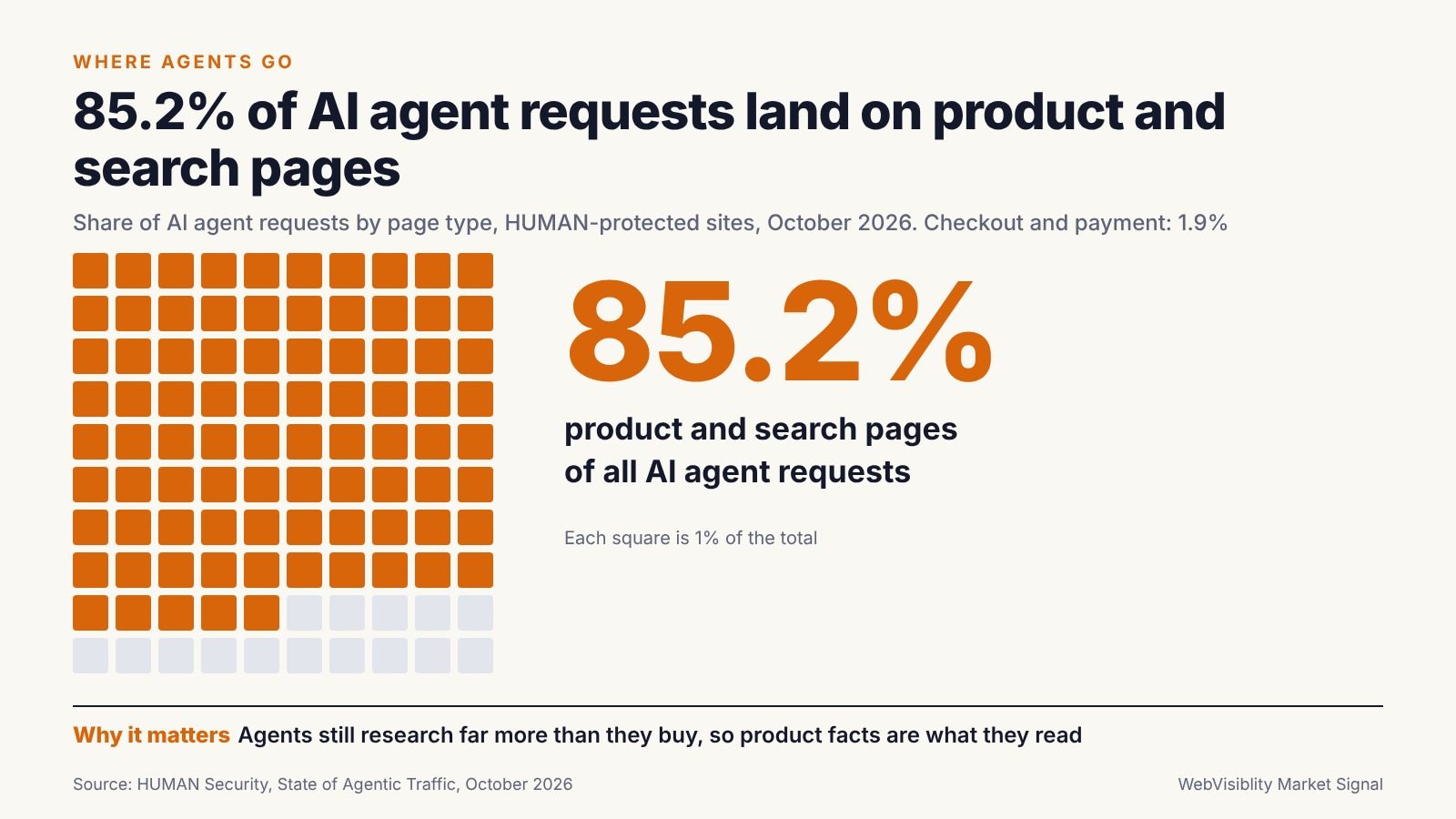
The busiest shopping week of the year is the first one in which AI agents arrive in bulk. HUMAN Security, which screens traffic for retailers and other sites, expects agent traffic from 26 to 30 November to reach 150 times last year's Cyber Week, and says Meta's Muse produces nearly 70% of it. Its October data shows where those agents go: 85% of agent requests land on product and search pages, while only a small slice reaches checkout.
At a glance
| Cyber Week forecast | About 150x last year's agent traffic |
|---|---|
| Muse's share, latest | Nearly 70% of agent traffic |
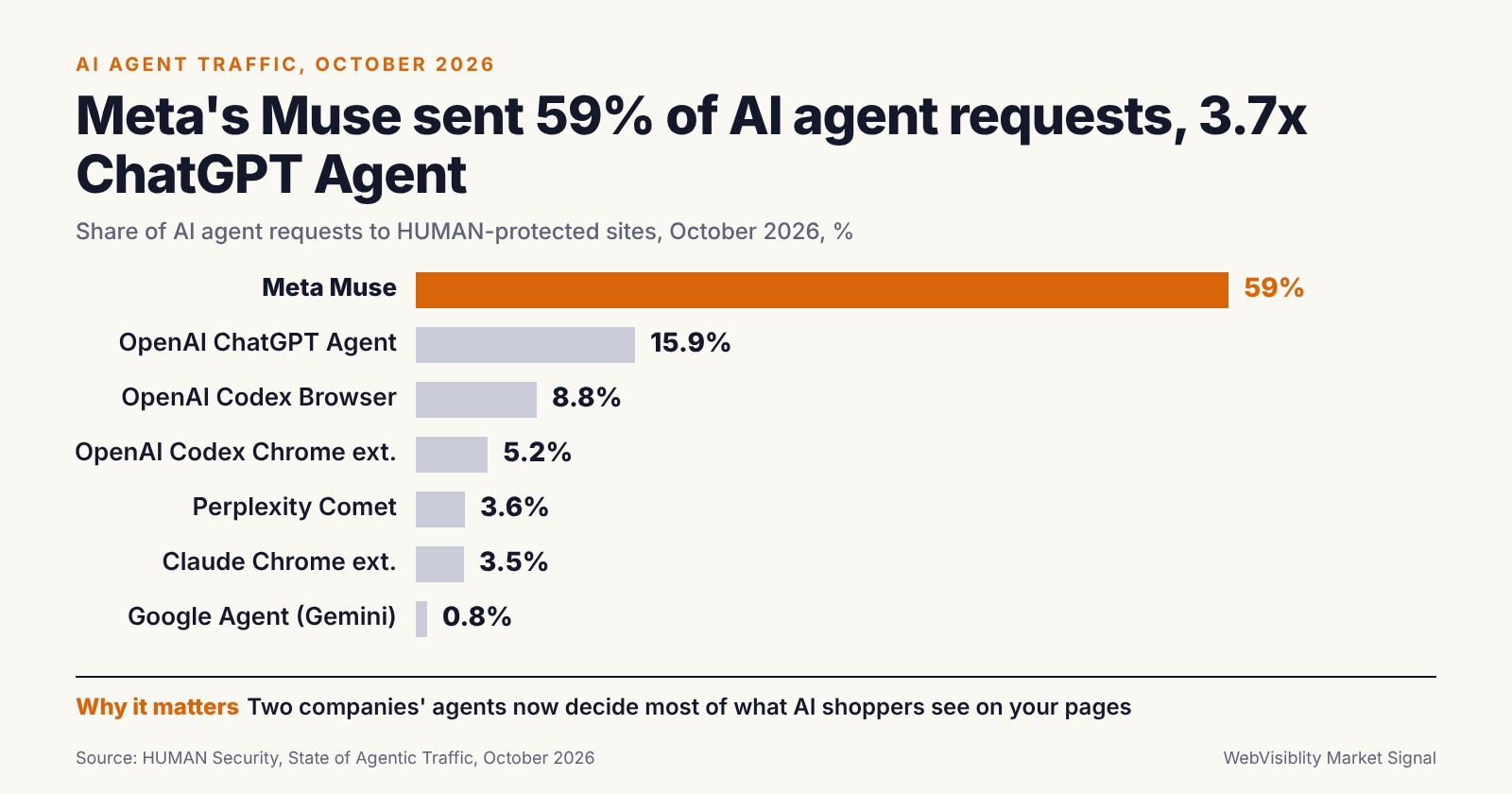
| Muse's share, October | 59% of agent requests |
| Growth in October | 2.6x September, about 8x August |
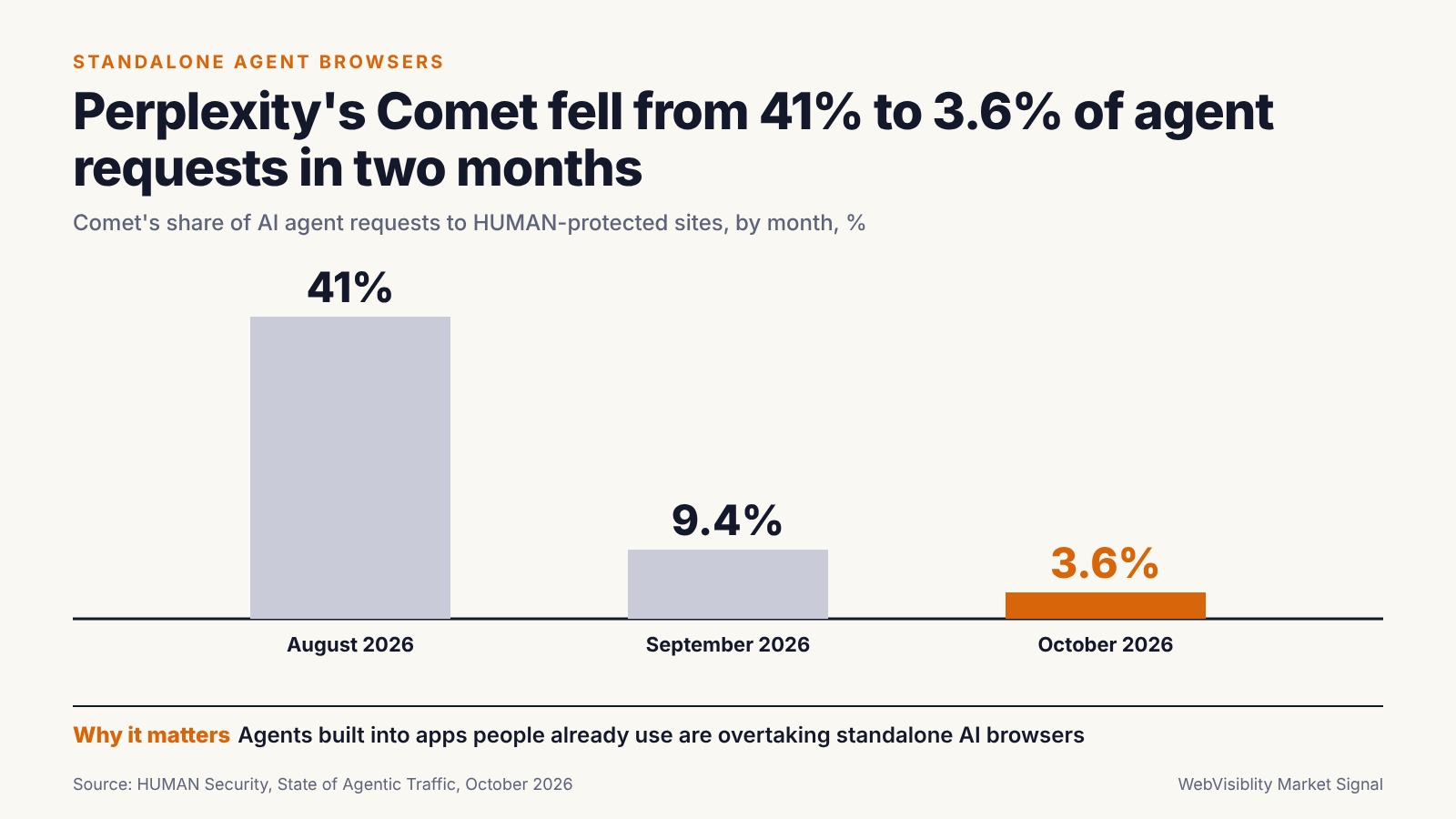
| Perplexity Comet | 41% in August, 3.6% in October |
| Requests to checkout | 1.9% of requests, volume up 117% in a month |
Do this today
Tick each step as you do it. Your ticks stay on this device. See the full list.
For marketers
For software buyers and IT teams
The signal
- HUMAN counts requests, not people: one request is one action an agent takes, such as loading a page or running a search.
- Meta and OpenAI agents made about 90% of agent requests in October, and Muse sent 3.7 times as many as ChatGPT Agent.
- ChatGPT Agent's share fell from 28.5% to 15.9% even though its traffic rose 44%, because Muse grew faster.
- Google's agents make up under 5% of agent traffic but nearly 20% of agent requests to checkout pages, as reported by Adweek.
- SaaS sites drew only 1.2% of agent traffic in October, but it was the fastest-growing sector, at about 15 times its August level.
- HUMAN says analytics tools on most sites can't distinguish AI agents from human visitors.
Which of these are you?
Tap the one that fits you best. We show what this story changes for you.
What happened
HUMAN Security publishes a monthly benchmark of AI agent activity across the sites and apps it protects. Its October 2026 edition, published on 9 November, found agent requests 2.6 times September's level and about eight times August's. It counts only agents that load a browser and act on a page, not crawlers that collect data for AI training or search indexes, and it covers HUMAN's customers rather than the whole web.
The mix changed fast. Meta's Muse, which launched on 8 September, went from a newcomer to 59% of agent requests in two months. OpenAI's ChatGPT Agent, Codex Browser and Codex Chrome extension together held about 30%. Perplexity's Comet browser, the leader in August with 41%, slid to 3.6% and was the only top-10 agent whose traffic shrank. Google's Gemini agent, launched on 8 October, reached 0.8% within weeks. HUMAN concludes that people are moving to agents built into platforms they already use.
On 25 November, ahead of the holiday rush, HUMAN told Adweek it expects Cyber Week agent traffic to reach about 150x last year's figures, and the New York Stock Exchange repeated the forecast in its 27 November pre-market update. HUMAN had already warned in its Black Friday outlook that agent traffic would be far higher in absolute terms this year, after jumping 209.7% in September alone.
By the numbers
How HUMAN measures agent traffic
- 1Detect
Behaviour signals, user-agent attribution and publisher integration identify agents.
- 2Filter
Crawlers are left out; only browser-based agents are counted.
- 3Count
Each request is one action, not a user or a session.
- 4Sort
Requests are grouped by destination page and sector.
Timeline
Perplexity's Comet leads with 41% of agent requests.
Meta launches Muse; agent traffic jumps 209.7% that month.
Muse reaches 59% of agent requests; Comet falls to 3.6%.
HUMAN publishes its October agentic traffic report.
HUMAN forecasts 150x agent traffic for Cyber Week.
NYSE pre-market update repeats the forecast on Black Friday.
“Agents still browse far more than they buy, yet the number of agent requests reaching checkout is rising fast.”
Why it matters
Two platforms now carry most agent visits. In HUMAN's October count, Meta and OpenAI sent roughly nine in ten agent requests, and Comet's slide from first place shows how quickly the list can change. A marketer who checked which agents read the site in the summer is working from an old map. AI visibility now includes agents that browse a page on a person's behalf, not only the chatbots that quote it, and Perplexity's own agent browser is no longer the one doing most of that browsing in HUMAN's data.
Agents read before they buy. With 85% of requests on product and search pages, the facts an agent finds there, such as specs, prices, stock and plain descriptions, shape what it reports back. Pages that state those facts in text, with schema markup that matches, give an agent less to guess. Checkout traffic is small but its volume grew 117% in a month, so a broken or blocked checkout is starting to cost real orders.
B2B teams should watch the SaaS line. SaaS drew a small share of agent traffic in October, yet HUMAN says it was the fastest-growing sector, at about 15 times its August level. That points to agents beginning to research software, the kind of work a buyer once did across vendor sites by hand. Because most analytics tools count agents as ordinary visitors, AI monitoring that separates agent sessions from human ones is the only way to see whether those visits turn into demos or trials.
Who is affected
| Who | What changes | Impact |
|---|---|---|
| Ecommerce and travel sites | Most agent requests already land here: ecommerce about 60%, travel 19.3%. | High |
| SaaS and B2B software vendors | Small share, but the fastest-growing sector for agent visits. | Medium |
| Analytics and growth teams | Agents are counted as people on most sites, skewing conversion data. | Medium |
What to do now
For marketers
- Ask whoever runs bot protection which AI agents reached your site this month, and whether Muse is allowed or blocked.
- Check that pricing, specs and plan details on product pages are written in plain text an agent can read, with schema markup that matches.
- Split agent sessions from human sessions in reporting before judging conversion rates for Cyber Week.
For software buyers and IT teams
- If you use an AI agent to research vendors, check its summary against the vendor's own product page.
- Ask software vendors whether their trial or demo forms accept requests from AI agents.
- Treat agent-made shortlists as a starting point and confirm prices directly.
Printable, one page, 11 checks. Enter your email and it opens right away.
We email you a copy. We never share your email and never send you sales emails.
Pick one. It takes 5 seconds and helps more people find these briefings. Your checklist opens straight after.
Have a work email? Use it instead and the checklist opens straight away.
Open it, then save it as a PDF or print it.
Know someone who would find this useful?
These steps are our recommendations based on this news, not statements from the companies involved.
What to watch
- November report. HUMAN says its next report will show how agents behaved over Black Friday and Cyber Monday.
- Block rates. Last year the agent block rate fell to 4.7% in Black Friday week; HUMAN expects blocking to ease again, per Adweek.
- Signed requests. SEJ, citing DataDome, reports that about half of Muse's requests carried no signature on 10 November.
- Google at checkout. Whether Google's small agent share keeps its outsized share of checkout requests.
- SaaS growth. Whether software sites keep their place as the fastest-growing sector for agent visits.
Questions readers ask
How much AI agent traffic is expected during Cyber Week 2026?
HUMAN Security expects agent traffic from 26 to 30 November to reach about 150 times last year's Cyber Week level, measured across the sites it protects.
Which AI agent sends the most traffic to websites?
Meta's Muse. It sent 59% of agent requests in HUMAN's October data, 3.7 times ChatGPT Agent, and nearly 70% in the latest figures.
What happened to Perplexity Comet's agent traffic?
Its share fell from 41% in August to 3.6% in October, and its request volume dropped about 30% since August while total agent traffic grew about eight times.
Are AI shopping agents actually buying things?
Some are, but most only browse. In October, 1.9% of agent requests reached checkout and payment pages, though that volume grew 117% from September.
What pages do AI agents visit most?
Product and search pages. They drew 85% of agent requests in October, followed by content pages at 4.3%.
Can Google Analytics tell AI agents from human visitors?
Usually not. HUMAN says analytics tools on most sites can't distinguish AI agents from human visitors, let alone name the agent or what it is trying to do.
Do AI agents visit B2B software websites?
Yes, though still rarely. SaaS sites drew 1.2% of agent traffic in October, but that traffic nearly quadrupled in a month, the fastest rise of any sector.
Companies in this story
Sources
- HUMAN SecurityOriginal
- Adweek
- New York Stock Exchange via PR Newswire
- HUMAN Security
- Search Engine Journal
- Z Media
Researched, fact-checked and edited by the Market Signal desk. Read our editorial standards. Spotted an error? Email hello@webvisiblity.com and we will correct it.