On this page
Key takeaways
- More than 100 million people in India use ChatGPT every week, and LinkedIn has 167 million members in India. Indian buyers can now get a supplier shortlist from AI before they call anyone.
- LinkedIn's 2026 guide says LinkedIn is the most-cited website when AI answers work questions (Profound, 2026).
- About 75% of those LinkedIn citations come from personal profiles and 25% from company pages (Meltwater, 2026). Your engineers, sales and delivery people matter more than your page.
- Articles of 800 to 1,200 words and posts of 200 to 300 words, written answer first with lists and real numbers, are what AI tends to quote.
- Give it at least 30 days before you judge, and measure whether AI names you, how it describes you, and whether enquiries follow.
The short answer. Indian buyers now ask ChatGPT, Gemini and Perplexity for a shortlist before they call a supplier. LinkedIn's 2026 guide says LinkedIn is the most-cited website when AI answers work questions, and most of those citations come from individual people, not company pages. For an Indian brand, that means your experts posting clear, useful answers on LinkedIn every week now help decide whether AI names you.
This guide decodes LinkedIn's Unlocking AI Search Visibility: The B2B Marketer's Guide to LinkedIn (2026) for Indian companies. It adds India figures from OpenAI and LinkedIn, and a 30-day plan you can start this week. A free LinkedIn checklist for AI visibility holds the whole plan on two printable pages.
How LinkedIn shapes what AI says about Indian brands
Your first 30 days on LinkedIn
- 1Week 1: pick one theme and set a baseline
- 2Week 2: publish one strong article
- 3Week 3: three people post three times each
- 4Week 4: reply, link up and recheck
How has B2B buying changed?#
Buyers used to search Google, open ten websites and call three suppliers. Now many ask an AI tool for the shortlist first, and only visit the names it gives them. We cover the wider research in how B2B buyers use AI to shortlist vendors.
The numbers LinkedIn's guide quotes:
- 94% of B2B buyers use generative AI for research (6sense, 2025).
- Gartner predicts traditional search volume will fall 50% by 2028.
- LinkedIn's own marketing sites saw non-branded search traffic fall by up to 60% (LinkedIn internal data, 2026).
- The average buying group has 13 people and 9 outside influencers (Forrester, State of Business Buying 2026). Every one of them can ask AI about you.
India is not behind this shift. It is one of its biggest markets:
- More than 100 million people in India use ChatGPT every week, making India its second-largest market after the United States, OpenAI's CEO Sam Altman said in February 2026.
- LinkedIn has 167 million members in India, up 20% in a year (February 2026).
When a purchase manager in Pune or a plant head in Coimbatore asks AI "Which CNC machine makers in India supply automotive component makers?", the answer is a short list of names. If your company is not on it, the buyer may never reach your website.
Why does LinkedIn matter so much in AI answers?#
AI tools trust sources where a real, named expert stands behind the words. LinkedIn ties every post to a person, their employer and their work history, so AI treats it as a high-trust source.
What the guide reports:
- LinkedIn is the most-cited website for professional questions in AI search (Profound, 2026).
- 75% of LinkedIn citations come from personal profiles, 25% from company pages (Meltwater, 2026). People with fewer than 10,000 followers who post regularly earn 35% of them.
- Long articles get about 60% of LinkedIn citations, short posts about 40% (LinkedIn internal data).
- 95% of cited LinkedIn content is original posts, not reshares (Semrush, 2026).
- When AI quotes LinkedIn, it stays close to your words (Semrush, 2026). Your framing survives into the answer.
One caution: this is LinkedIn's own guide, so it naturally argues that LinkedIn matters most. The figures it quotes come from named outside sources, but your website, trade directories, press coverage and reviews still feed AI answers too. Treat LinkedIn as the strongest single lever, not the only one.
What does this mean for Indian buyers and brands?#
Indian marketers already sense the change. In LinkedIn research run by Censuswide among B2B marketers in 12 markets (July to August 2026), Indian respondents said:
- 84% believe brands need a presence on trusted professional networks to support AI-driven discovery.
- 82% say brand credibility is becoming more important than visibility.
- 95% say younger buyers are more likely to consider a brand when someone in their professional community vouches for it.
- 69% expect their company to spend more on AI search optimisation in the next 12 months.
What it means in practice, by type of company:
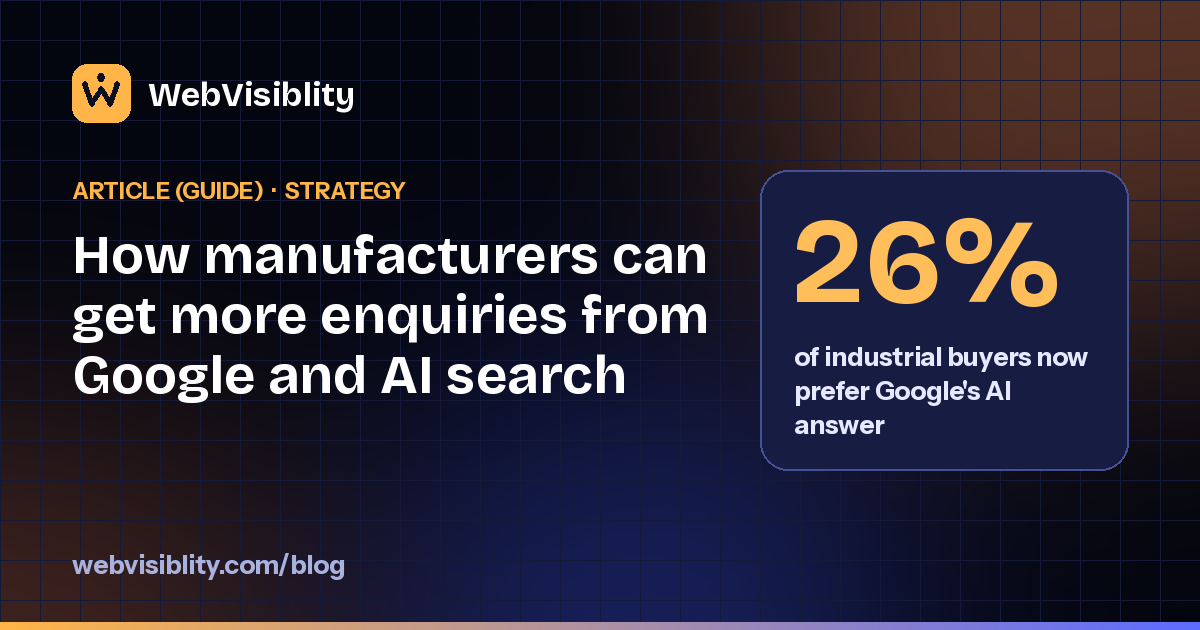
- Manufacturers and industrial suppliers. Your buyers ask specific, technical questions: tolerances, certifications, lead times, which industries you serve. An engineer on your team answering those on LinkedIn gives AI exact facts it can repeat. A catalogue PDF does not. Our guide for manufacturers covers the website side.
- Exporters. An overseas buyer can now ask AI for reliable suppliers from India without opening a trade portal. Clear posts about export markets, compliance and delivery records, from named people at your company, help AI connect your name to those questions.
- IT services and SaaS companies. Your category is crowded and AI shortlists only a few names. Original points of view from your delivery heads and architects stand out more than another company page post.
- Buyers. AI shortlists are a starting point, not a verdict. A good supplier with a quiet online presence can be missing. Ask the AI where its answer came from, and check the suppliers you already trust.
The habit of letting only the founder or the brand page speak works against you here. AI rewards many credible voices saying consistent things, which means your sales, engineering and delivery people.
How do you write LinkedIn content that AI will quote?#
Write each piece as a clear answer to one real buyer question, with the answer first and facts after. Meltwater's study of the 24 most-cited LinkedIn articles found that all of them used lists, 92% used clear section headings, 75% named specific companies or tools, and 67% included hard numbers.
For articles (800 to 1,200 words):
- Make the title a question your buyer would type, such as "How to choose an industrial valve supplier in India in 2026". The title also becomes the web address.
- Open with a short summary, then a 30 to 80 word answer under each heading.
- Use headings that are questions, with lists, plain definitions and real numbers.
- Name things: standards, materials, industries, cities, tools.
- End with a short checklist. The guide says AI often lifts these closing lists straight into its answers.
For posts (200 to 300 words):
- Put your main keywords in the first line, with no hashtags or emojis. The first line becomes the post's web address and cannot be changed later.
- Give the main takeaway first and stick to one idea.
- Use posts to point back to your longer articles.
For credibility:
- Stay on 3 to 4 themes your company wants to be known for.
- Share what only you know: a customer story, a failure, a test result, a number from your own plant.
- Reply to comments. The guide says highly cited content usually earns 10 or more thoughtful comments.
- Keep profiles public and comments switched on. AI cannot cite what it cannot read.
The guide adds one point above all the rest: structure helps, but it does not get you cited on its own. A point of view only your company could write is what gets cited.
How long does it take, and what should you measure?#
Give it at least 30 days before you judge anything. Profound tracked about 900 new pages cited by ChatGPT or Claude between March and May 2026: half were first cited within about 7 days, three quarters within about 19 days, and 90% within about 37 days.
The guide warns against the most common mistake: calling a programme a failure in week three. AI tools refresh on their own schedules and need several sources saying the same thing before they repeat it.
What to track, from fastest to slowest:
- Early signals: LinkedIn impressions, comments and shares. They move first, but they are not the result.
- Results: how often AI names you, how often it links to you, where you appear in its list, and your share of mentions against your rivals.
- How AI describes you: positive, neutral or negative, and whether the facts are right.
- Business impact: visits, enquiries and orders that began with an AI answer. The guide's final advice: if the other numbers rise but business does not, investigate.
Check these monthly, not weekly. Weekly numbers jump around and cause needless panic. Our guide to measuring AI visibility explains why one check is not enough.
A 30-day plan for an Indian brand#
Start small: one theme, one article, a few voices, one baseline. This follows the guide's own "your next move".
- Week 1: pick one theme and check where you stand. Choose the one topic buyers should link to your name, for example "precision castings for EV makers". Ask ChatGPT, Gemini and Perplexity 7 to 10 questions a buyer would ask on it, and note who they name. That is your baseline.
- Week 2: publish one strong article. 800 to 1,200 words, written by a named expert, built on the question you most want to win. Use the checklist above.
- Week 3: three people, three posts each. Ask two or three colleagues (sales, engineering, delivery) to post one idea each from the article, in their own words, two or three times a week.
- Week 4: reply, connect and recheck. Reply to every comment. Make sure your website links to your company page and your company page links back. Then ask the same 7 to 10 questions again and compare.
Keep the cycle going for at least a quarter. The guide is clear that AI visibility comes from steady work over time, not one big launch.
The free LinkedIn checklist for AI visibility puts this plan, the writing checklists and a baseline sheet for your 7 to 10 questions on two printable pages. To get your baseline in about 2 minutes, run the free check: it asks AI the questions your buyers ask and shows every answer word for word.
Sources: LinkedIn, Unlocking AI Search Visibility: The B2B Marketer's Guide to LinkedIn (2026; figures from Profound, Meltwater, Semrush, 6sense, Gartner and Forrester as quoted in the guide) · India TV News, India becomes second-largest ChatGPT market with 100 million weekly users (February 2026) · NewsBytes, LinkedIn's user base in India grows 20% in a year (February 2026) · Manifest Media, LinkedIn research on Indian B2B marketers (September 2026)
Questions and answers
Does LinkedIn really affect what ChatGPT says about my company?
It can. LinkedIn's 2026 guide reports that LinkedIn is the most-cited website when AI tools answer professional questions (Profound, 2026), and that AI tends to quote LinkedIn content closely. It is one source among many: your website, directories, press and reviews also shape answers.
Should we post from the company page or from people's profiles?
Both, but put most effort into people. About 75% of LinkedIn citations in AI answers come from personal profiles and 25% from company pages (Meltwater, 2026). A well-kept company page plus experts who post regularly works best.
Do we need thousands of followers to be cited?
No. People with fewer than 10,000 followers who post regularly earn about 35% of LinkedIn citations, according to the guide. It notes that authors with 2,000 or more followers tend to be surfaced more often, but consistent, expert posting on one topic matters more than reach.
How often should we post?
The guide suggests articles weekly and posts at least two to three times a week. For a smaller Indian company, one article and two or three posts from different people each month is a realistic start. Stay on the same 3 to 4 themes.
How do we know if it is working?
Set a baseline first: ask ChatGPT, Gemini and Perplexity the same 7 to 10 buyer questions and note who they name. Recheck after 30 days and then monthly. Track whether AI names you, how it describes you, and whether enquiries mention AI.
B2B marketers who build tools to measure how ChatGPT, Gemini, Claude and Perplexity talk about companies. About us