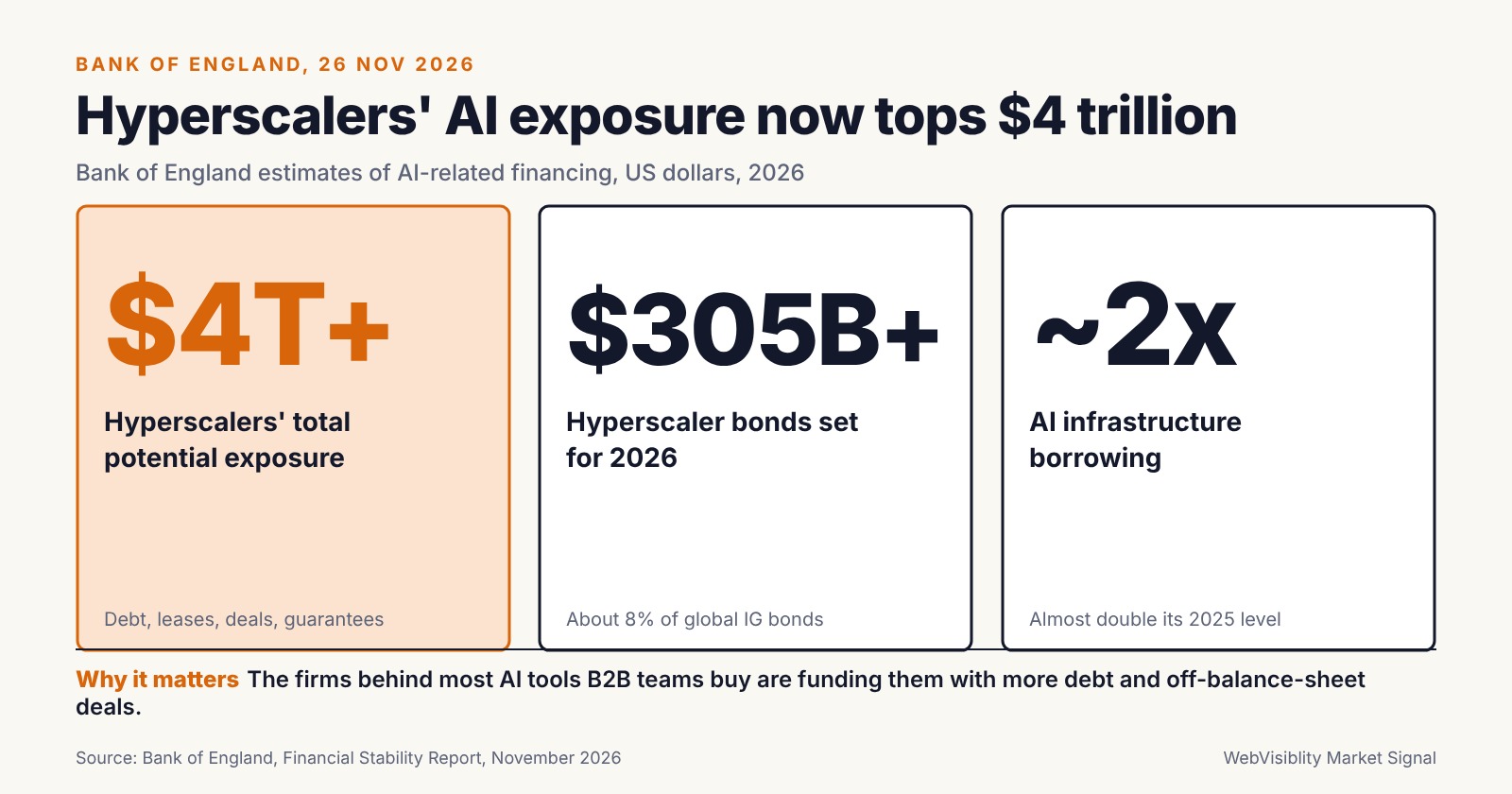
The companies building AI data centres now carry just over $4 trillion in debt and contractual commitments, by the Bank of England's own estimate. Its half-yearly Financial Stability Report, published on 26 November, says the money behind AI is arriving in a form that is complex, circular and opaque, which makes it easier for trouble in one corner of finance to spread to another.
At a glance
| Hyperscaler exposure | Just over $4 trillion |
|---|---|
| Hyperscaler bonds in 2026 | More than $305 billion |
| Share of global investment-grade bonds | Around 8% |
| AI infrastructure borrowing | Almost double its 2025 level |
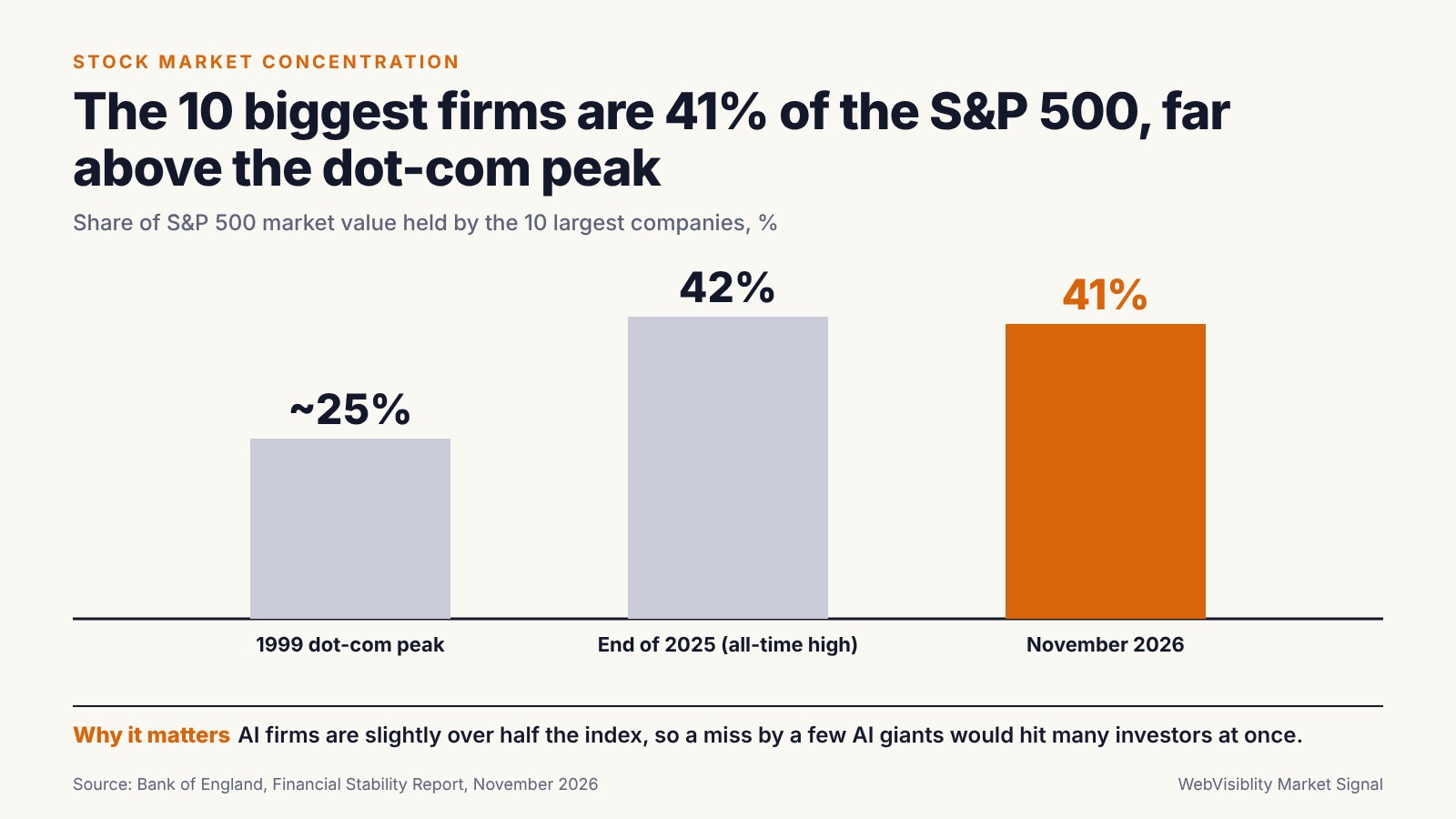
| AI firms in the S&P 500 | Slightly over half of its market value |
Do this today
Tick each step as you do it. Your ticks stay on this device. See the full list.
For marketers
For software buyers and IT teams
The signal
- The $4 trillion counts debt, leases, purchase commitments and guarantees, not only bonds.
- The Bank's list of hyperscalers names Alphabet, Amazon, Microsoft, Meta, Oracle and SpaceX.
- Some large firms are at once investors, customers and suppliers of the AI companies they fund.
- Credit spreads widened particularly sharply for some lower-quality AI-related borrowers since July.
- Deputy Governor Katharine Braddick called the AI risk a very live part of the Bank's supervision.
Which of these are you?
Tap the one that fits you best. We show what this story changes for you.
What happened
The Bank of England's Financial Policy Committee publishes a Financial Stability Report twice a year. The November edition gives AI more room than any other single industry. It says borrowing by hyperscalers, data-centre operators and other AI-infrastructure firms is almost double its 2025 level, and that hyperscaler bond sales are set to exceed $305 billion this year. Counting chipmakers and data-centre operators too, the sector's 2026 borrowing exceeds that of many individual governments, including the UK.
The headline number is a Bank staff estimate. Adding existing debt to leases, purchase commitments, guarantees and backstops, it puts hyperscalers' total potential exposure at just over $4 trillion. The report warns these commitments could come under strain if expectations of future AI revenue were cut, especially where the path to making money from AI is still uncertain.
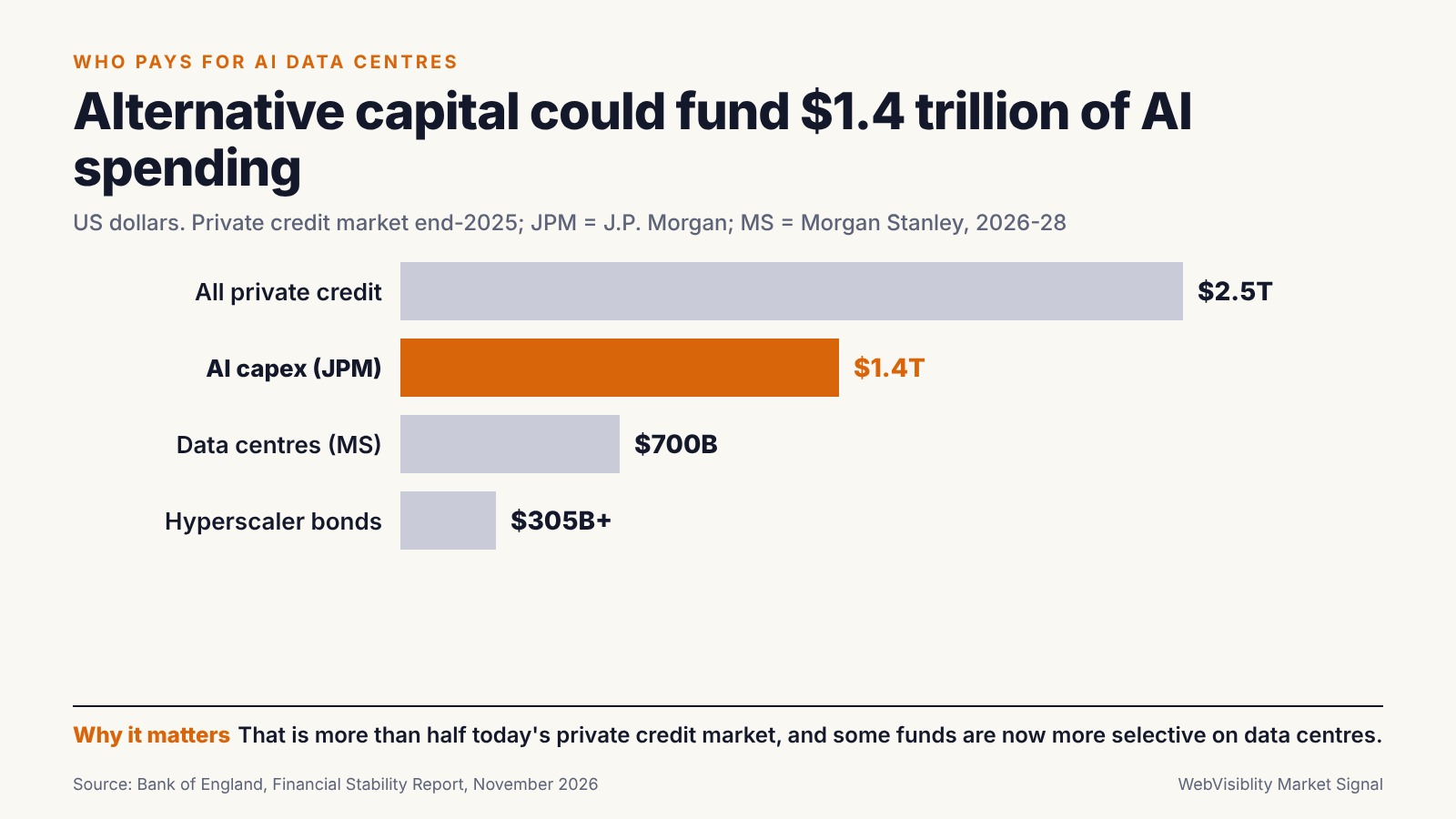
Private lenders are now a big part of the picture. The Bank cites Morgan Stanley analysts who expect private credit to fund $700 billion of data-centre spending from 2026 to 2028, and J.P. Morgan analysts who see $1.4 trillion of AI capex financed by alternative capital. The whole private credit market is around $2.5 trillion. Market intelligence suggests some of those funds are becoming more selective and want to offload AI and data-centre exposure.
Reuters reports the Bank still judged share prices "stretched" and dependent on AI companies delivering the profits expected of them. Governor Andrew Bailey called for international cooperation, including with China, to test new AI models before and after release.
By the numbers
How AI financing becomes circular
- 1Commit
A hyperscaler signs long-term contracts with a data-centre vehicle.
- 2Borrow
The vehicle uses those expected revenues to raise debt.
- 3Invest back
Large firms also act as investors, customers and suppliers to the same companies.
- 4Spread
Exposure ends up with private credit funds and insurers, hard to trace.
Timeline
The 10 largest firms reach an all-time high of 42% of the S&P 500's market value.
The Bank publishes its November Financial Stability Report.
Braddick tells a press conference AI risk is a very live part of supervision.
New UK reporting on firms' dependence on material third parties begins.
“It's a very live part of our supervision.”
Why it matters
Most of the AI tools a B2B team uses or competes inside, from AI search answers to the assistants built into office software, sit on hyperscaler infrastructure. The Bank's point is that this infrastructure is now paid for with layers of debt, leases and promises between a small number of very large firms. If the expected revenue from AI slips, those firms may cut back, and prices, free tiers and product roadmaps are where customers usually feel it first. That is a reason to plan AI search and AI visibility work around what a platform does today, not on promises of what it will add next year.
Vendor risk is the second angle. The Bank says lower-quality AI borrowers already pay sharply wider spreads, and that stress at one firm can tighten money for similar projects. Smaller AI vendors that depend on outside funding are the most exposed. Buyers signing multi-year contracts with AI start-ups should ask who funds them and what happens to their data if the vendor is sold or shuts down.
The report also returns to a point B2B teams felt this month: the Bank says outages at Microsoft and Google cloud services show why critical systems should not depend on a single provider. The same logic applies to AI monitoring. Tracking how a brand appears across several assistants, not just one, protects against both outages and a platform changing course.
Who is affected
| Who | What changes | Impact |
|---|---|---|
| Buyers of AI tools from start-ups | Weaker AI borrowers face sharply wider spreads, raising vendor risk. | High |
| Teams relying on one cloud or AI platform | The Bank warns against depending on a single provider. | Medium |
| Marketers planning AI search work | Platform plans rest on future AI revenues that could be revised. | Medium |
What to do now
For marketers
- List the AI platforms your traffic and leads depend on, and rank them by how much you would lose if one changed course.
- Track how your brand appears across several AI assistants, not just the largest one.
- Base next year's AI search plan on features platforms ship today, not on announced roadmaps.
For software buyers and IT teams
- Ask each AI vendor who funds it and how long its current funding lasts.
- Add data export and exit terms to any multi-year AI contract.
- Check which hyperscaler each critical AI tool runs on and whether a fallback exists.
Printable, one page, 10 checks. Enter your email and it opens right away.
We email you a copy. We never share your email and never send you sales emails.
Pick one. It takes 5 seconds and helps more people find these briefings. Your checklist opens straight after.
Have a work email? Use it instead and the checklist opens straight away.
Open it, then save it as a PDF or print it.
Know someone who would find this useful?
These steps are our recommendations based on this news, not statements from the companies involved.
What to watch
- AI bond sales in 2027. J.P. Morgan strategists expect $450bn of investment-grade AI debt next year, up from $368bn in 2026, The Next Web reports.
- Private credit pullback. Whether more funds try to offload AI exposures.
- Revenue proof. Earnings that confirm or cut the AI revenue expectations behind the commitments.
- Third-party rules. UK reporting on firms' reliance on big tech providers starts on 18 March 2027.
- Rate path. Markets price an 80% chance of another UK rate rise next month, Reuters reports.
Questions readers ask
What did the Bank of England say about AI financing?
It said AI financing is growing fast in a form that is complex, circular and opaque, making it more likely that stress in one part of the financial system spreads to another.
How much AI debt do hyperscalers have?
Bank of England staff put hyperscalers' total potential exposure, including debt and off-balance-sheet commitments, at just over $4 trillion. Their 2026 bond issuance is set to exceed $305 billion.
Which companies count as hyperscalers in the Bank of England report?
The report names Alphabet, Amazon, Microsoft, Meta, Oracle and SpaceX as examples of firms that build, lease and run data-centre networks for computing, storage and AI.
What is circular financing in AI?
It is when the same large firms act as investors, customers and suppliers to AI companies at once, so money and commitments flow in a loop that makes risk harder to trace.
Is the AI boom a bubble according to the Bank of England?
The Bank does not call it a bubble. It says valuations look stretched and that the 10 largest firms hold 41% of the S&P 500, above the dot-com peak of about 25%.
How much of AI spending will private credit fund?
Estimates the Bank cites range from $700 billion of data-centre spending in 2026 to 2028 (Morgan Stanley) to $1.4 trillion of AI capex from alternative capital (J.P. Morgan).
What does AI debt risk mean for companies buying AI tools?
Mainly vendor risk. Weaker AI borrowers already face wider credit spreads, so buyers should check how AI suppliers are funded and avoid relying on a single provider.
Companies in this story
Sources
Researched, fact-checked and edited by the Market Signal desk. Read our editorial standards. Spotted an error? Email hello@webvisiblity.com and we will correct it.