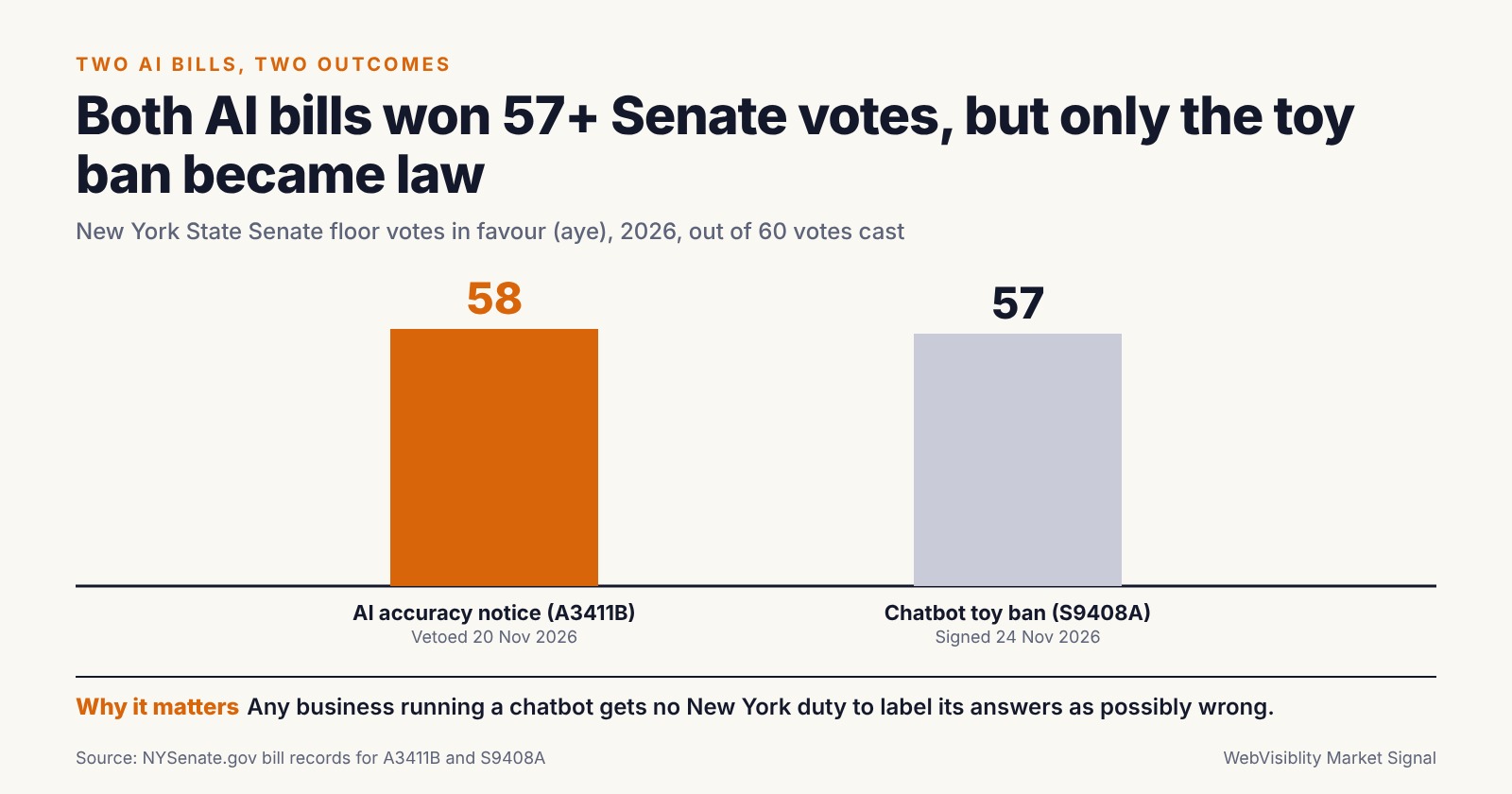
New York will stop the sale of toys with built-in AI chatbots for five years, under a law Governor Kathy Hochul signed on 24 November. Four days earlier she vetoed a bill that would have made the owner or operator of any generative AI system show users a notice that its outputs may be inaccurate. One law targets a narrow product. The other would have reached every business running a chatbot, and it did not survive.
At a glance
| Toy ban length | Five years |
|---|---|
| Toy ban fine | Up to $15,000 per day per violation |
| Toy ban starts | 90 days after signing |
| Vetoed notice bill fine | Up to $1,000 per violation |
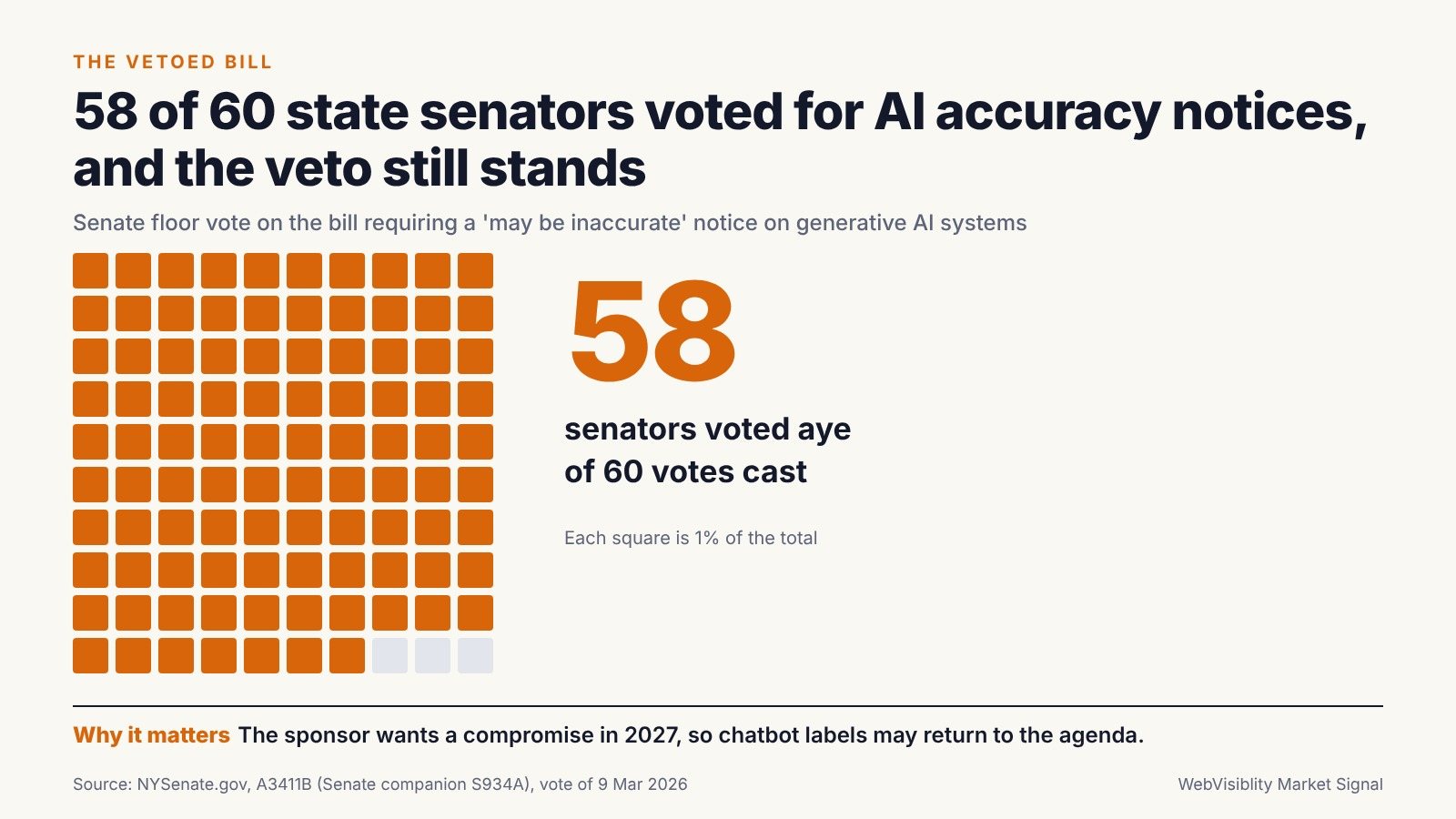
| Senate votes | 58-2 (notice), 57-3 (toys) |
Do this today
Tick each step as you do it. Your ticks stay on this device. See the full list.
For marketers
For software buyers and IT teams
The signal
- The toy law, chapter 416, bars anyone from making, holding for sale, distributing or selling any chatbot toy in this state.
- The vetoed bill would have counted each user not shown the notice as a separate violation.
- Hochul said the notice bill took an inflexible one-size-fits-all approach and could raise free-speech problems.
- Trade groups for firms including OpenAI and Meta lobbied against the notice bill, Gothamist reports.
- Amazon told TechCrunch it will restrict the sale of AI-enabled toys in places where they are banned, without giving details.
Which of these are you?
Tap the one that fits you best. We show what this story changes for you.
What happened
On 24 November Hochul signed S9408A, which adds a new article to New York's general business law titled Prohibition on chatbot toys. A chatbot toy is any children's toy with an AI companion embedded or integrated, such as talking stuffed animals, dolls and robots that use the internet to hold conversations. The Attorney General enforces it and can seek up to $15,000 per day for each violation. The governor's office cited a consumer watchdog whose tests found some toys talked about sexually explicit topics and told children where to find matches at home. NBC News reports New York is the second state to ban the toys, after California.
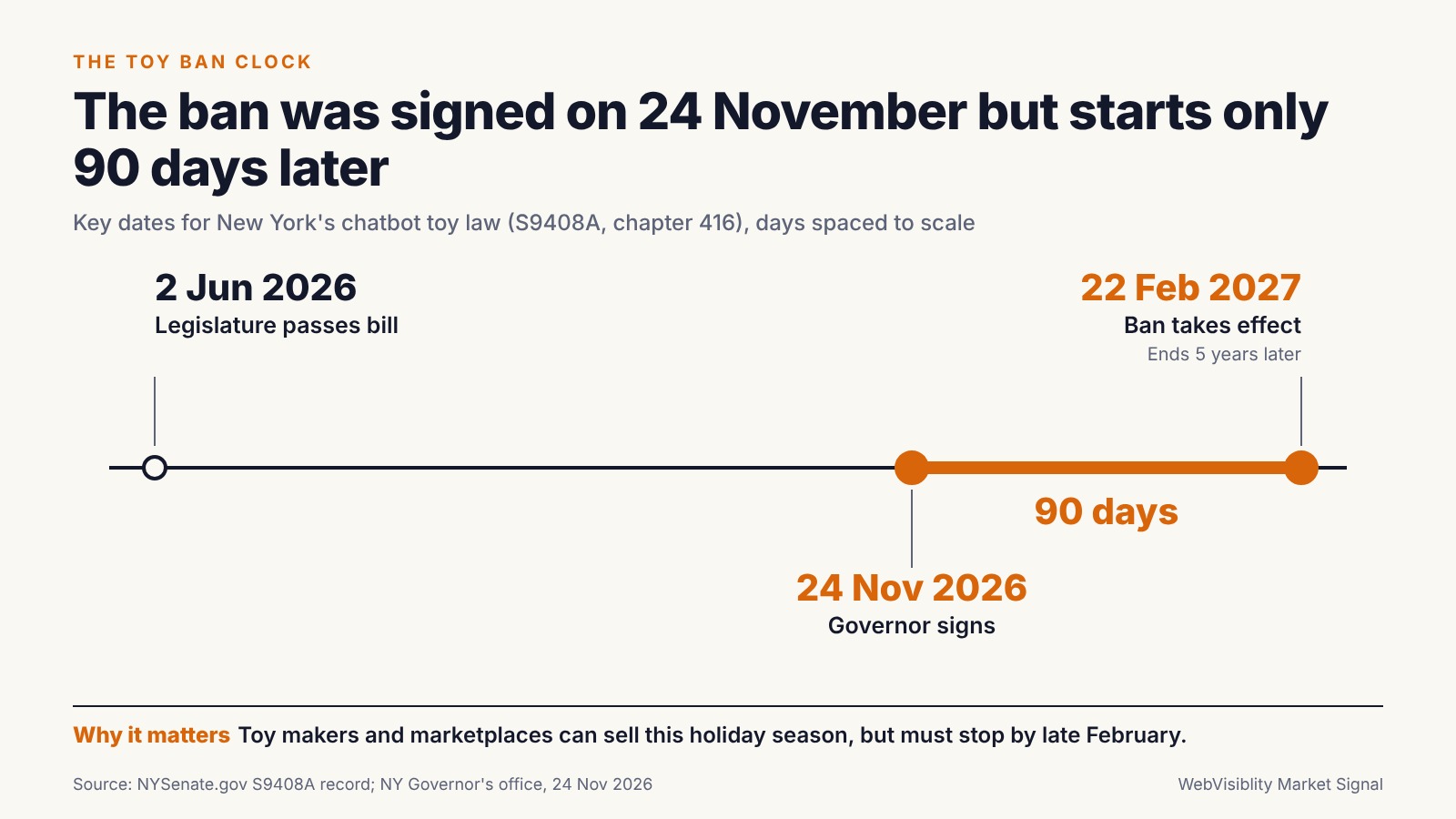
The ban does not touch this holiday season. It takes effect on the ninetieth day after it became law, which falls on 22 February 2027 by WebVisiblity's count, and it expires five years after that date. Hochul urged parents to consider the potential risks before buying such toys as gifts in the meantime.
The second decision came first. On 20 November the bill record for A3411B shows "tabled; vetoed memo.10". That bill would have required the owner, licensee or operator of a generative AI system to clearly and conspicuously display a notice on its user interface that outputs may be inaccurate, with civil penalties of up to one thousand dollars per violation. It had been delivered to the governor on 13 November. Sponsors Assemblymember Clyde Vanel and Senator Kirsten Gonzalez wrote it after Meta's AI tool hallucinated sexual harassment allegations against several state lawmakers in 2024, including both of them, according to Gothamist.
By the numbers
| What | Figure | Source |
|---|---|---|
| Length of the chatbot toy ban | 5 years | New York State Senate |
| Maximum toy ban penalty per violation | $15,000 a day | Office of the Governor of New York |
| Maximum penalty in the vetoed notice bill | $1,000 | New York State Senate |
| Senate votes for the AI notice bill | 58 of 60 | New York State Senate |
Figures exactly as published.
How the toy ban reaches a seller
- 1Signed
Chapter 416 became law on 24 November 2026.
- 2Grace period
Sales stay legal for 90 days.
- 3Ban starts
No one may make, hold for sale or sell any chatbot toy in the state.
- 4Enforcement
The Attorney General can sue for up to $15,000 a day per violation.
Timeline
The AI notice bill passes the Senate 58 to 2 and returns to the Assembly.
The chatbot toy bill passes the Assembly after a 57-3 Senate vote on 1 June.
The notice bill is delivered to the governor.
Hochul vetoes the notice bill (veto memo 10).
Hochul signs the toy ban as chapter 416.
The toy ban starts, 90 days after signing (WebVisiblity's count).
“[This] bill takes an inflexible one-size-fits-all approach to require notifications on all generative AI systems regardless of context and in doing so, the bill may present constitutional and pragmatic challenges.”
Why it matters
The veto matters more to most B2B teams than the toy ban. The notice bill applied to the owner, licensee or operator of any generative AI system, which would have covered a support chatbot on a software vendor's site as much as ChatGPT. Penalties were counted per user, so a busy site without the label could have run up exposure fast. That duty is now off the table in New York, at least until the Legislature returns. Sponsor Clyde Vanel told Gothamist he hopes to reach a compromise next year, so the rule may come back in a different form.
The story behind the bill is a warning for anyone who cares about AI visibility. The sponsors wrote it after an AI assistant made up harassment allegations about real lawmakers. The same thing can happen to a company: an AI search answer can state wrong prices, features or history about a vendor, and no New York law will now require the tool to flag that its answer may be wrong. Brand monitoring of what ChatGPT, Perplexity and other assistants say about your company is the practical defence, along with clear, current facts on your own pages that AI tools can cite.
For firms that make or sell connected products, the toy ban shows how state lawmakers now write AI rules: by product category, with daily fines and the Attorney General as enforcer. Marketplaces are already reacting, with Amazon saying it will restrict AI-enabled toy sales where they are banned.
Who is affected
No New York duty to show a may be inaccurate notice, for now.
Must stop selling chatbot toys in New York from late February.
Wrong AI answers stay unlabelled, as the bill's origin story shows.
What to do now
For marketers
- Ask ChatGPT, Perplexity and Gemini what they say about your company and record any wrong facts.
- If your site runs a chatbot, decide your own accuracy notice now instead of waiting for a law.
- Put prices, product names and company facts on one clear page that AI tools can cite.
For software buyers and IT teams
- Ask AI vendors whether their tools show users an accuracy notice and where.
- Check any connected products you resell or bundle against New York's chatbot toy ban before February.
- Confirm vendor facts found through AI answers against the vendor's own pages.
Printable, one page, 9 checks. Enter your email and it opens right away.
We email you a copy. We never share your email and never send you sales emails.
Pick one. It takes 5 seconds and helps more people find these briefings. Your checklist opens straight after.
Have a work email? Use it instead and the checklist opens straight away.
Open it, then save it as a PDF or print it.
Know someone who would find this useful?
These steps are our recommendations based on this news, not statements from the companies involved.
What to watch
- A new notice bill. Vanel wants to work with the governor's office on a compromise next year.
- Data center moratorium. Hochul has until the end of the year to act on a stricter moratorium bill.
- Enforcement detail. How the Attorney General applies the toy ban to third-party sellers on large marketplaces.
- Other states. New York is the second state after California to ban AI chatbot toys.
- Platform labels. Whether AI tools add on-screen accuracy notices on their own, as some platforms such as ChatGPT already do.
Questions readers ask
What did New York ban on AI toys?
New York banned the manufacture, distribution and sale of toys with embedded AI chatbots, such as talking stuffed animals, dolls and robots, for five years.
When does the New York AI toy ban take effect?
It takes effect 90 days after signing on 24 November 2026, which is 22 February 2027 by WebVisiblity's count, and lasts five years. It does not apply this holiday season.
What are the penalties under the New York AI toy ban?
The Attorney General can seek civil penalties of up to $15,000 per day for each violation and can ask a court to stop the sales.
Why did Hochul veto the AI accuracy warning bill?
She said it took a one-size-fits-all approach to every generative AI system regardless of context and could face constitutional challenges, including on free speech.
Do businesses in New York have to label chatbot answers as possibly inaccurate?
No. The bill that would have required a may be inaccurate notice on generative AI systems was vetoed on 20 November 2026, so there is no such state duty now.
Which other state bans AI chatbot toys?
California. NBC News reports New York is the second state to ban the toys.
Could AI chatbots say false things about my company?
Yes. The vetoed bill was written after an AI tool invented harassment allegations about New York lawmakers. Check regularly what AI assistants say about your brand and keep your own facts clear and current.
Companies in this story
Sources
- Office of the Governor of New YorkOriginal
- New York State Senate
- New York State Senate
- Gothamist
- TechCrunch
- The Center Square
- NBC News
Researched, fact-checked and edited by the Market Signal desk. Read our editorial standards. Spotted an error? Email hello@webvisiblity.com and we will correct it.