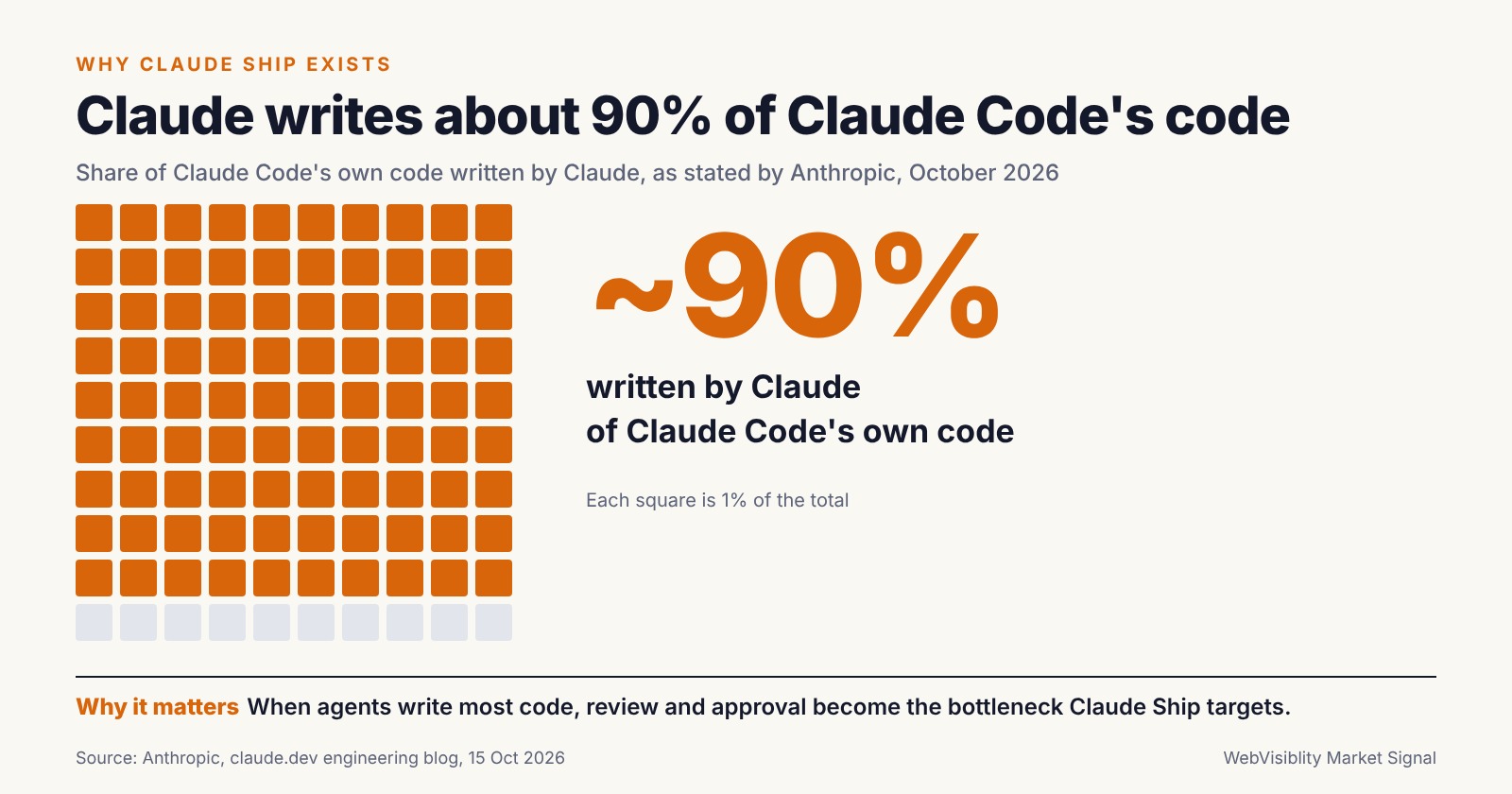
Anthropic has launched Claude Ship, available today in beta, a set of three agents that take a GitHub pull request from review to an approval decision. The new part is Claude Approvals, which can approve routine changes on its own when a policy file in the repository allows it. Anthropic says the aim is to ship code as fast as teams write it.
At a glance
| Launched | Monday 23 November 2026 |
|---|---|
| Agents | Code Review (generally available), plus PR Steward and Claude Approvals in beta |
| Who can use it | Claude Team and Enterprise plans, GitHub repositories only |
| Pricing | Billed on tokens, separately from the plan's included usage |
| Launch offer | At least $10,000 in credits for eligible Enterprise organizations, claim by 15 January 2027 |
| Not available with | Zero Data Retention, HIPAA or customer keys |
Do this today
Tick each step as you do it. Your ticks stay on this device. See the full list.
For marketers
For software buyers and IT teams
The signal
- Code Review posts findings on a pull request, with Quick, Standard or Deep review levels set per repository.
- PR Steward fixes failing checks, merge conflicts and reviewer comments, and is designed not to approve or merge anything.
- Claude Approvals reads a policy the team writes, which can set how many people must approve changes to a path.
- Anthropic recommends running approvals in observe-only mode first, and observe mode is still billed.
- Developers can also type /ship in Claude Code to push a change, open the pull request and work through feedback.
- Early customers TELUS Digital and Carvana are quoted, but neither describes letting Claude approve a change on its own.
Which of these are you?
Tap the one that fits you best. We show what this story changes for you.
What happened
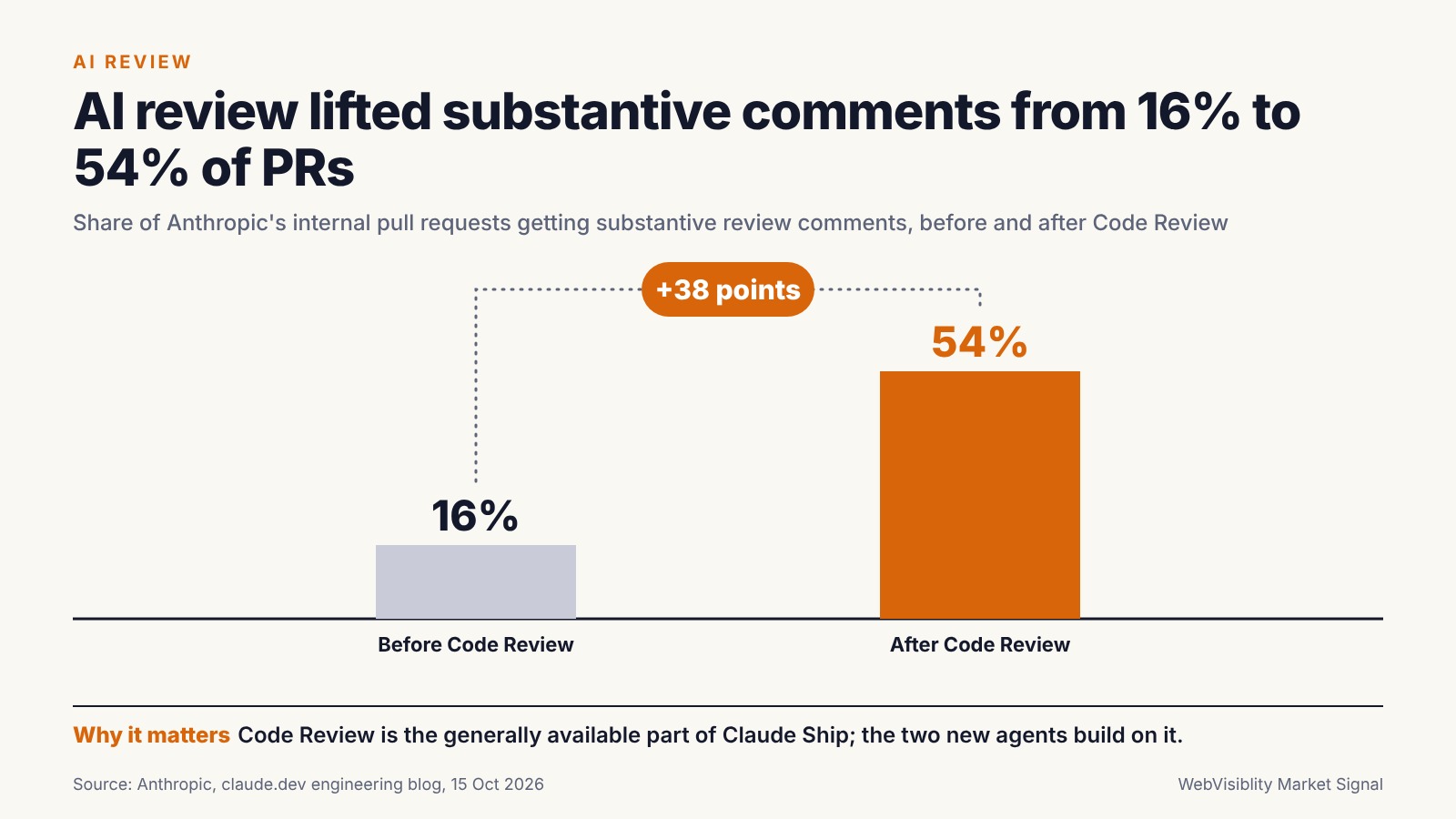
Anthropic announced Claude Ship on its website on 23 November, and Reuters, TechCrunch and The Verge reported it the same day. It bundles three agents. Code Review, first announced in March and generally available since October, reads a change against the surrounding code and posts ranked findings. PR Steward then works on failing checks, merge conflicts and review comments, and after every push it explains what it changed and how to undo it. Claude Approvals is the third step. It applies a policy file kept in the repository, works like a smarter CODEOWNERS file, and can send riskier changes to a human.
Admins switch the agents on one repository at a time, choose the review level and set spend limits. The documentation warns that PR Steward has no spend limit of its own until one is set, and that switching off usage credits does not stop an agent that is already running. It also says a policy that does not require a person, combined with GitHub auto-merge or a merge queue, means a change can merge without anyone acting.
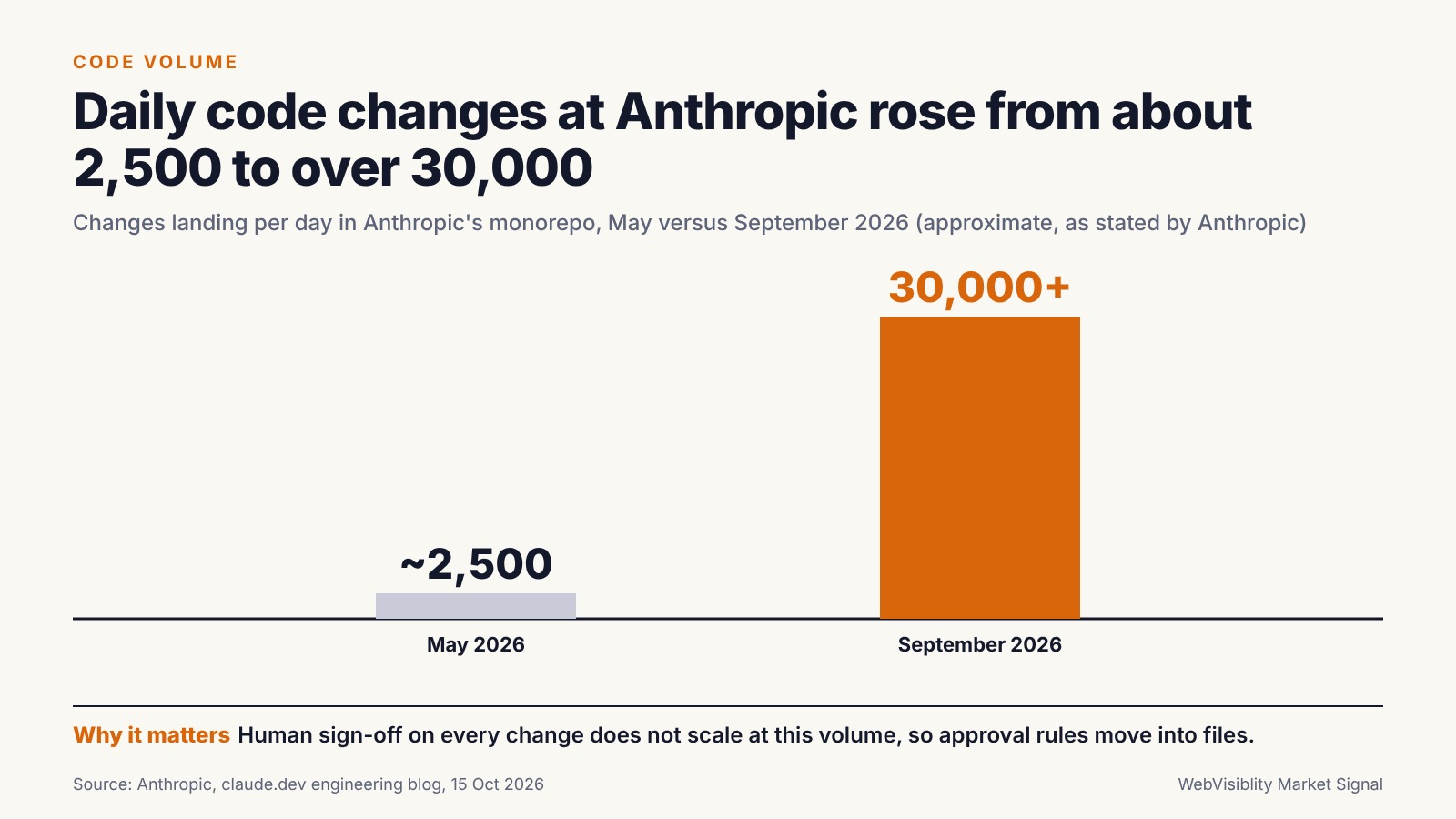
Anthropic points to its own team as proof. A product manager on the Claude Code team saw that the Analytics API documentation confused a customer, asked an agent to open a fix, and the change passed Code Review, a docs reviewer and Claude Approvals and merged that same evening. In an October engineering post, the team said that between June and September its merged pull requests more than doubled while the share that had to be reverted fell by more than 40 percent.
How a pull request moves through Claude Ship
- 1Review
Code Review posts findings ranked by severity on the changed lines.
- 2Fix
PR Steward pushes fixes and says how to undo them.
- 3Decide
Claude Approvals checks the team's policy file and approves or asks for people.
- 4Merge
GitHub branch rules decide what merges.
Timeline
Anthropic announces Code Review for Claude Code.
Code Review becomes generally available.
Engineering post sets out the team's risk-based approval tiers.
Claude Ship launches with PR Steward and Claude Approvals in beta.
Last day for eligible Enterprise organizations to claim Claude Ship credits.
“We keep a human in the loop, and the human's time now goes to the changes that need it.”
Who is affected
| Who | What changes | Impact |
|---|---|---|
| Web and docs teams | Copy and docs fixes can pass with no human approval under low-risk rules like Anthropic's own. | High |
| Engineering leaders | Approval rules move into a file the team writes, tested in observe mode first. | High |
| Finance and procurement | Token billing with no built-in PR Steward cap until an admin sets one. | Medium |
| Vendors selling to IT buyers | An agent can now approve routine changes on its own; buyers will ask the same of yours. | Medium |
Why it matters
Website and documentation fixes stop waiting in a queue. Anthropic's own example of Claude Ship at work is not a product feature but a documentation correction: a confusing line in API docs, found through customer feedback, fixed and live the same evening. In the approval tiers Anthropic described in October, docs and copy changes from trusted authors need no human approval once automated review and security checks pass. For B2B teams whose website, help centre or docs sit in a code repository, the gap between spotting a wrong claim and correcting it can shrink to the same day, as it did in Anthropic's example. That matters for AI visibility, because AI search engines quote these pages. Google's new guidance on AI Overviews and AI Mode tells site owners to check pages for factual errors and update them when information changes.
AI agent rules are becoming a buying question. Claude Ship turns approval into a written policy file that a team controls, with an observe mode to test it first. That is the same pattern buyers will ask every vendor about as agents take on real work: what the agent may do alone, what needs a person, and who can switch it off. Vendors that sell to engineering or IT buyers should expect these questions in security reviews and be ready with plain answers about their own agent features.
The cost is open-ended by design. Each agent is billed on tokens separately from the plan's included usage, and the bill depends on how many pull requests run, how large they are and how much fixing PR Steward does. The $10,000 Enterprise credit softens the first month, but procurement teams will want spend limits set before any repository is switched on.
By the numbers
What to do now
For marketers
- Find out whether your website, help centre and docs live in a code repository, and who approves changes to them.
- Keep a list of claims on your site that AI assistants repeat, and fix wrong ones fast.
- Ask engineering which content paths could use a low-risk approval rule with automated checks.
- Prepare plain answers on what your own product's AI agents can do without a person.
For software buyers and IT teams
- Set spend limits for Code Review and PR Steward before switching on any repository.
- Run Claude Approvals in observe mode and compare its decisions with your reviewers'.
- Check whether GitHub auto-merge could let a change merge with no person involved.
Printable, one page, 10 checks. Enter your email and it opens right away.
We email you a copy. We never share your email and never send you sales emails.
Pick one. It takes 5 seconds and helps more people find these briefings. Your checklist opens straight after.
Have a work email? Use it instead and the checklist opens straight away.
Open it, then save it as a PDF or print it.
Know someone who would find this useful?
These steps are our recommendations based on this news, not statements from the companies involved.
What to watch
- Who trusts the approve button. Whether any named customer says publicly that Claude approves changes on its own, beyond observe mode.
- Beta to general release. When PR Steward and Claude Approvals leave beta, and whether pricing changes then.
- Other code hosts. Claude Ship works only with repositories on GitHub today.
- Real bills. Early reports of token costs once the January credit window closes.
Questions readers ask
What is Claude Ship?
Claude Ship is a set of three Anthropic agents for GitHub pull requests: Code Review finds problems, PR Steward pushes fixes, and Claude Approvals checks the change against a team's approval policy.
Can Claude approve and merge pull requests on its own?
Claude Approvals can approve routine changes if the team's policy file allows it. Merging follows GitHub branch rules, and with auto-merge a change can merge without anyone acting.
How much does Claude Ship cost?
There is no flat price. Each agent is billed on token usage through usage credits, so cost depends on pull request volume, size, review level and how much fixing is done.
Who can use Claude Ship?
Organizations on Claude Team and Enterprise plans with repositories on GitHub. It is not offered to organizations using Zero Data Retention, the HIPAA configuration or customer-managed keys.
What is PR Steward in Claude Code?
PR Steward is the agent that works on failing CI checks, merge conflicts and review feedback. It explains each change and how to undo it, and it does not approve or merge.
Is there a free trial of Claude Ship?
Eligible Claude Enterprise organizations can claim at least $10,000 in Claude Ship credits, to use within 30 days of claiming, if they claim by 15 January 2027.
What is observe mode in Claude Approvals?
Observe mode runs the approval policy and reports what it would decide without blocking merges. Anthropic recommends starting there, but observe mode is still billed.
Companies in this story
Sources
- AnthropicOriginal
- Anthropic Claude Code Docs
- Anthropic claude.dev blog
- Reuters
- TechCrunch
- The Verge
- The New Stack
- Google Search Central
Researched, fact-checked and edited by the Market Signal desk. Read our editorial standards. Spotted an error? Email hello@webvisiblity.com and we will correct it.