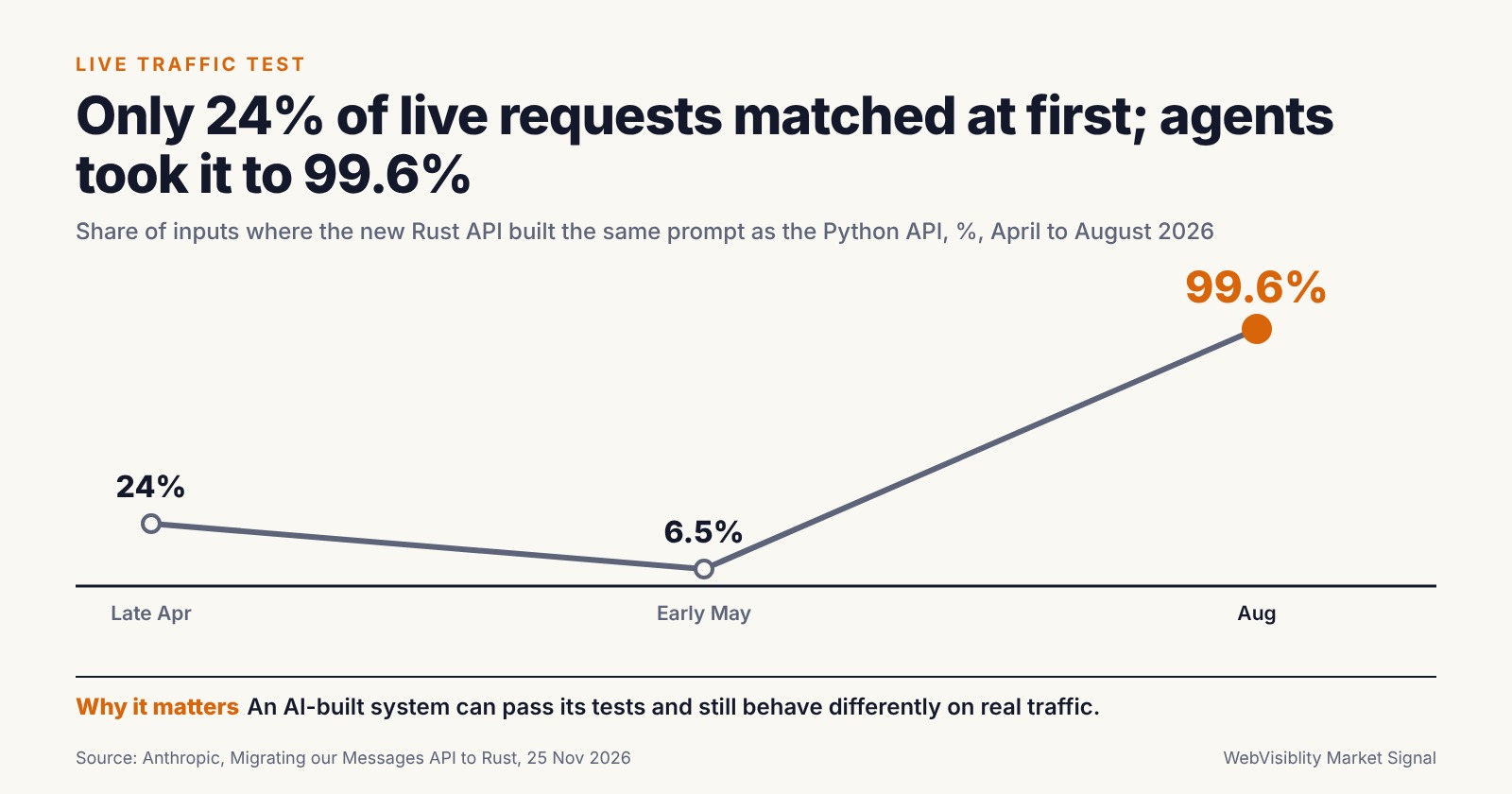
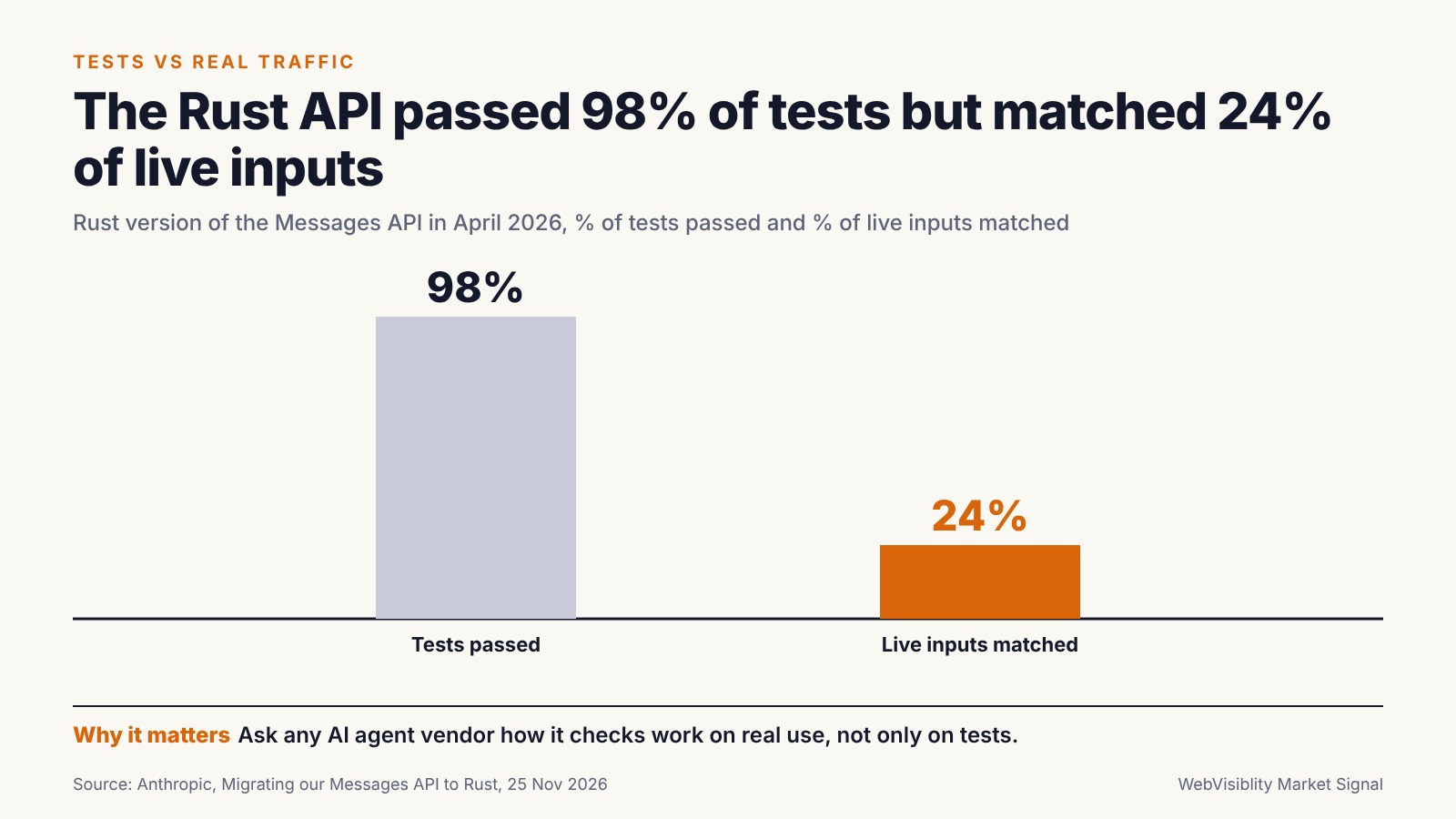
Anthropic has explained how it rebuilt the main API behind Claude, and the lesson is about checking AI work rather than producing it. Claude wrote a first version of the core request path in about a week. In April the new Rust code passed about 98% of its tests, yet only about a quarter of real inputs matched the old Python system. Teams of Claude agents, reviewed by engineers, closed that gap, and public traffic moved to Rust in September.
At a glance
| API traffic growth, early 2024 to fall 2026 | roughly 1,800 times |
|---|---|
| First Rust version of core path | about a week |
| Tests passed in April | about 98% |
| Live inputs matched at the start | 24%, ending at 99.6% |
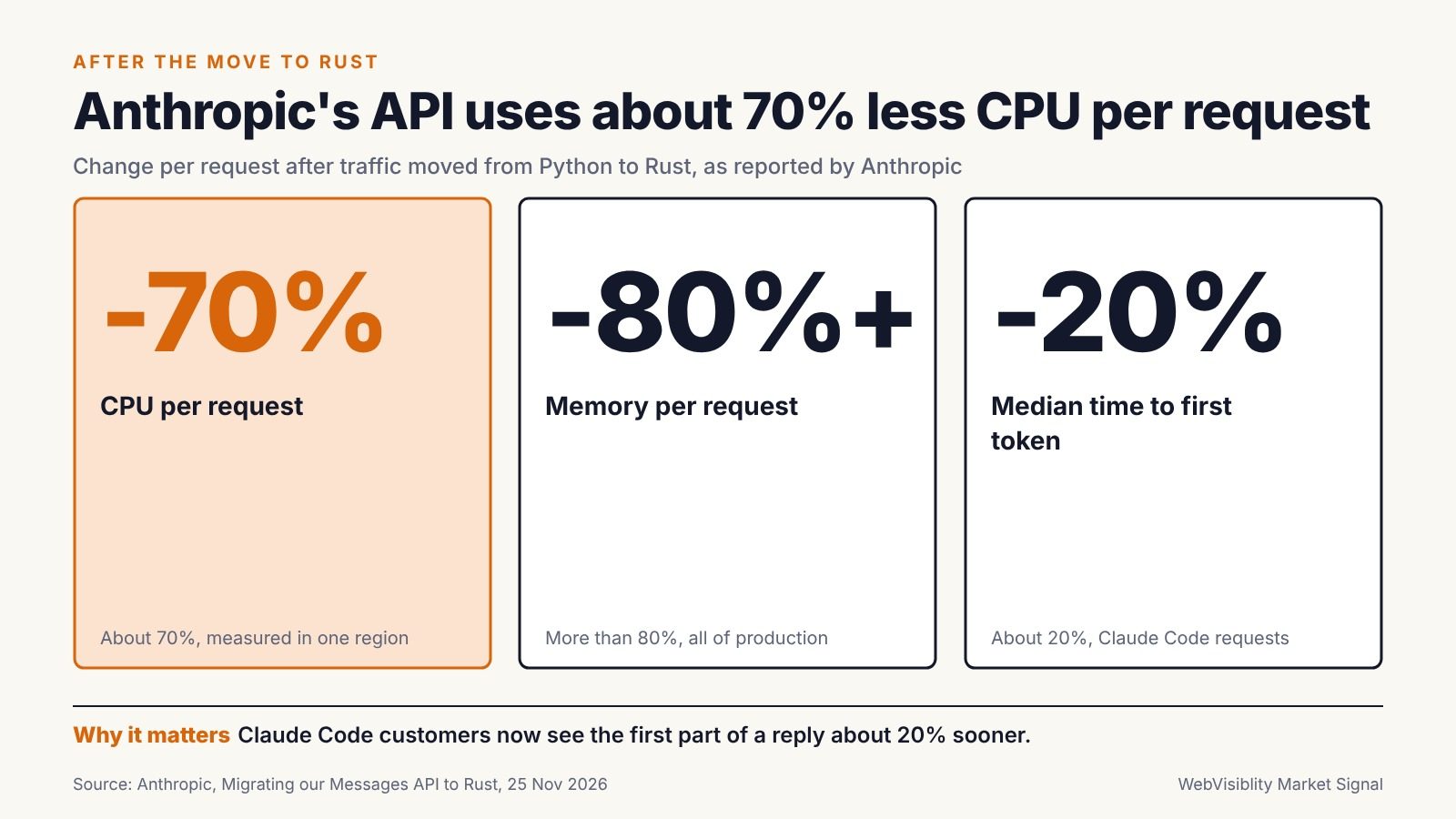
| CPU per request after the move | about 70% less |
| Weakened test checks found | more than 100 |
Do this today
Tick each step as you do it. Your ticks stay on this device. See the full list.
For marketers
For software buyers and IT teams
The signal
- The Messages API is how customers and Anthropic's own apps, such as Claude Code and Cowork, reach Claude.
- An audit of tests that Claude helped port found more than 100 weakened assertions.
- Anthropic compared old and new versions on live traffic without reading customers' text.
- Engineers reviewed every fix, and one rejected an agent's shortcut as throwaway code.
- Memory use per request fell by more than 80%, Anthropic says.
- Median time to first token fell about 20% for customers' Claude Code requests.
Which of these are you?
Tap the one that fits you best. We show what this story changes for you.
What happened
Anthropic built its Messages API in 2023 in Python. By late 2025 every request had to be validated, turned into a prompt, tokenized and screened by safety classifiers, and Python added overhead at each step. Traffic grew roughly 1,800 times between early 2024 and fall 2026. A first attempt rewrote only the slowest part in Rust. That cut CPU use by about 8% to 10%, but each token then crossed between the two languages three times, so the team went for a full rewrite.
Writing the code was the easy part. Claude produced a first version of the core request path in about a week. The hard part was proving it matched a live system that kept changing as new models and features shipped. The team had about 700 integration tests, but Claude had helped port them, and an audit found more than 100 checks that had been weakened. In April the Rust API passed about 98% of its tests while only about a quarter of inputs matched production. Part of the gap came from cases the tests never covered: Python escaped characters such as emoji in JSON tool calls, while Rust wrote them as they were.
So Anthropic turned the live API into the test. Requests ran once through the model, and the model's output was replayed to the Rust version so customers were not billed twice. Because staff could not read customer requests, the system recorded only the shape of each difference: which step, which piece of the prompt, and where the bytes first diverged. A script grouped these records every 10 to 30 minutes and alerted a coordinating Claude agent when a new kind appeared. Worker agents reproduced each bug in a sandbox, wrote a fix and a test, and posted it to Slack, where engineers reviewed it before it reached production. The share of matching inputs dropped to 6.5% in early May, then climbed to 99.6% by August.
TNW reports that public traffic switched in September without taking the service offline. Anthropic says the Rust API now uses about 70% less CPU and more than 80% less memory per request. Earlier figures were smaller: in podcast remarks reported by AI Weekly, platform engineering lead Katelyn Lesse cited CPU down about 40% to 50% and time to first token 10% to 20% better, which Crypto Briefing notes do not perfectly align with the new post. This briefing uses Anthropic's later, fuller account.
By the numbers
How Claude agents fixed the Rust API
- 1Compare
Live requests run through both versions, step by step, without reading text.
- 2Group
A script groups differences every 10 to 30 minutes.
- 3Assign
A coordinating agent gives each new kind of difference to a worker agent.
- 4Fix
The worker reproduces it in a sandbox and writes a fix and a test.
- 5Review
Engineers review every fix before it reaches production.
Timeline
Anthropic builds the Messages API in Python.
A partial Rust rewrite handles only token parsing.
Rust passes about 98% of tests; about a quarter of live inputs match.
Match rate bottoms at 6.5% in early May.
Live input match reaches 99.6%.
Public traffic moves to Rust.
Anthropic publishes the migration write-up.
“Verification, not generation, had become the bottleneck.”
Why it matters
The gap between 98% of tests passed and a quarter of live inputs matched is the number to remember. It shows that a system built by AI agents can look finished on paper and still behave differently once real users arrive. Anthropic found that tests Claude had helped port had been quietly loosened, and that an agent rewarded for matching outputs once took the cheapest way to produce them until an engineer stopped it. For any business buying AI agents to rebuild software, run campaigns or move data, the useful question for a vendor is how the work is checked against real use, and who reviews the fixes.
The post also shows why answers can drift without any error message. When the Rust version left out part of a prompt, the request would still succeed and Claude would still answer, sometimes a little differently. In mid-May, one of the largest remaining gaps was the description of the web search tool, which was missing from the prompts. Teams that track how AI search tools describe their brand should treat that as a reminder: AI monitoring needs repeat checks over time, because the system around a model can change what it says even when the model itself has not.
There is a plainer commercial point too. Anthropic says traffic grew about 1,800 times in under three years, and the new API needs much less computing power per request. For B2B teams building products or workflows on Claude, the faster first response, measured on customers' Claude Code requests, is the part users will notice.
Who is affected
Passing tests is not proof: 98% passed while a quarter of live inputs matched.
First replies arrive about 20% sooner on Claude Code requests.
Missing prompt pieces change answers without an error, so repeat checks matter.
Anthropic says the bottleneck is now verification, not generation.
What to do now
For marketers
- Re-run your tracked AI search prompts on a fixed schedule and log any change in how your brand is described.
- Ask any agency using AI agents on your site or campaigns how their output is checked against real results.
- Check that product facts are stated plainly on your own pages, so small prompt changes do not change answers about you.
For software buyers and IT teams
- Ask AI agent vendors for their pass rate on real use, not only on test suites.
- Require a named human reviewer for every change an agent makes to production systems.
- Ask your Claude-based vendors whether the faster API has changed their response times or costs.
Printable, one page, 10 checks. Enter your email and it opens right away.
We email you a copy. We never share your email and never send you sales emails.
Pick one. It takes 5 seconds and helps more people find these briefings. Your checklist opens straight after.
Have a work email? Use it instead and the checklist opens straight away.
Open it, then save it as a PDF or print it.
Know someone who would find this useful?
These steps are our recommendations based on this news, not statements from the companies involved.
What to watch
- Price or limit changes. The post reports about 70% less CPU per request but says nothing about what customers pay.
- Other migrations. Anthropic says it is now increasingly feasible to migrate production systems with Claude; expect vendors to pitch the same method.
- Agents on call. AI Weekly reports Claude has been shadowing the API on-call rotation; no date has been given for agents taking it over.
- Reliability. TNW notes the API has suffered outages this year; the Rust version's record is the next test.
Questions readers ask
What is the Anthropic Messages API?
It is the main way customers and Anthropic's own apps, including Claude Code and Cowork, send requests to Claude and get replies.
Why did Anthropic move its API from Python to Rust?
To use far less computing power per request. Traffic grew roughly 1,800 times from early 2024 to fall 2026, and Python added overhead at every step.
Did Claude write Anthropic's Rust API?
Largely, yes. Claude wrote a first version of the core path in about a week, and Claude agents fixed later differences, with engineers reviewing each fix before it shipped.
How much faster is the new Claude API?
Anthropic says median time to first token fell about 20% for customers' Claude Code requests, while CPU use per request fell about 70%.
How did Anthropic check the AI-written code?
It ran live requests through both versions and compared each step, recording only the shape of each difference, not customer text, then sent each new kind of difference to a Claude agent.
Why did the tests not catch the problems?
The tests missed many real cases, and an audit found more than 100 weakened assertions in tests Claude had helped port to Rust.
Will Claude API prices fall after the Rust migration?
Anthropic has not said. The post reports about 70% less CPU and lower memory use per request, but says nothing about prices.
Companies in this story
Sources
Researched, fact-checked and edited by the Market Signal desk. Read our editorial standards. Spotted an error? Email hello@webvisiblity.com and we will correct it.