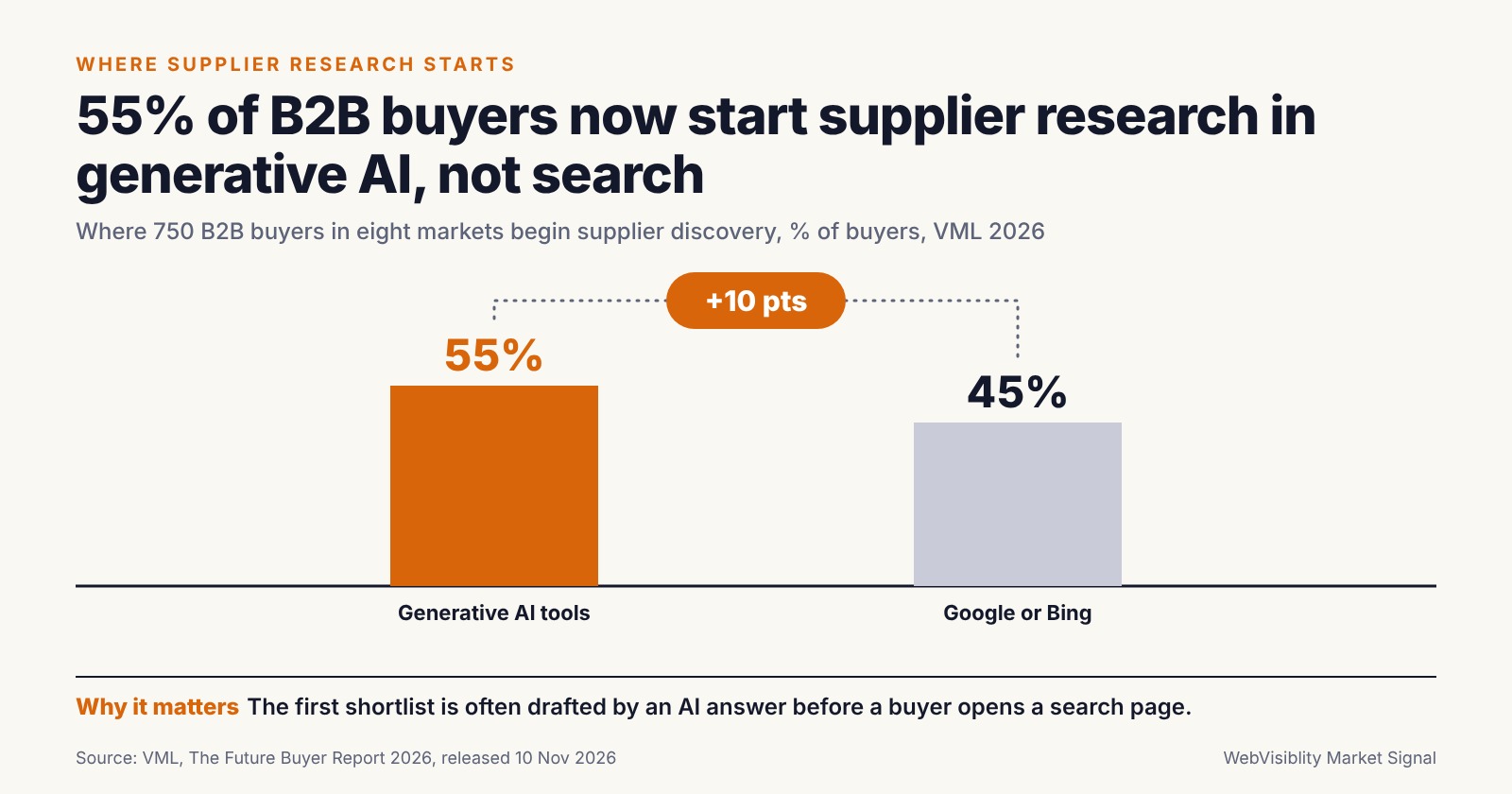
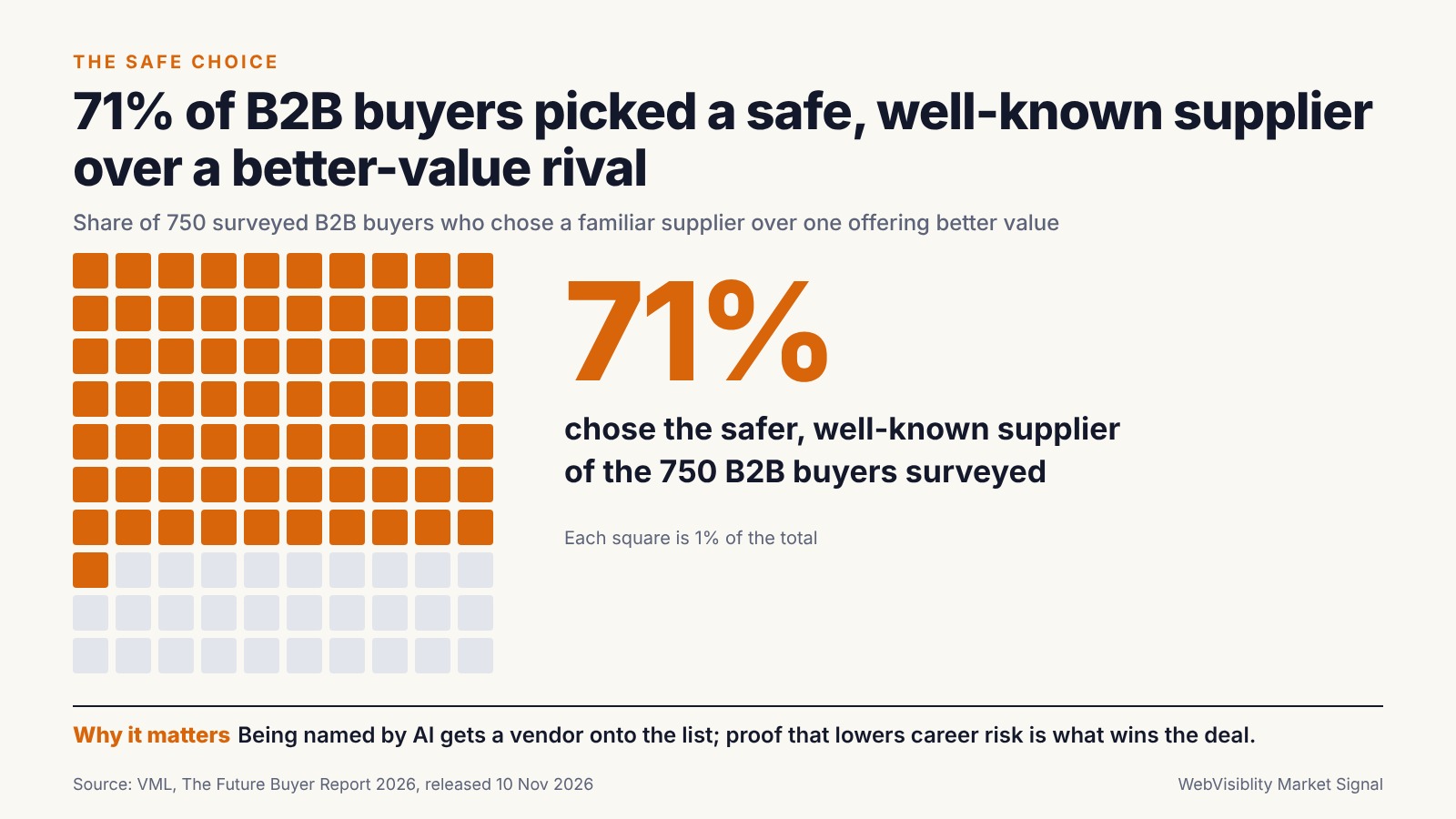
More business buyers now open a chatbot than a search engine when they look for suppliers. VML's Future Buyer Report 2026 found 55% begin supplier discovery on GenAI platforms, against 45% using Google or Bing. The same buyers are cautious at the finish line: 71% have chosen a safer supplier over one they believed offered better value. The survey covered 750 enterprise buyers across eight markets and was fielded in late July and early August 2026.
At a glance
| Start supplier research in generative AI | 55% of buyers |
|---|---|
| Start with Google or Bing | 45% of buyers |
| Chose a safe supplier over better value | 71% |
| Big purchases ending with no decision | 38% |
| Stakeholders per significant purchase | 6.8 on average |
| Survey base | 750 buyers, eight markets, seven industries |
Do this today
Tick each step as you do it. Your ticks stay on this device. See the full list.
For marketers
For software buyers and IT teams
The signal
- AI use goes past the first search: 74% frequently or always use AI to research suppliers, and the same share say they are likely to act on AI recommendations.
- Nearly a third, 31%, expect an AI agent to be the main way they evaluate their next major purchase.
- Preferences form early: 36% form supplier preferences on their own before they speak to sales.
- Career risk shapes choices: 80% weigh the impact on their reputation, and 73% say a poor purchase would meaningfully damage their career.
- Brand reputation is the #1 shortlist tiebreaker at 30%, and 65% call third-party analyst recognition essential or important.
- When two suppliers are comparable, responsiveness is the top tiebreaker at 22%, ahead of brand reputation at 18% and price at 14%.
Which of these are you?
Tap the one that fits you best. We show what this story changes for you.
What happened
On 10 November the agency VML released The Future Buyer Report 2026, which MarketScale describes as an extension of VML's Future Shopper consumer research. It is based on a 750-person international B2B buyer survey across the United States, United Kingdom, France, Germany, Brazil, Australia, New Zealand and Singapore. VML's report page lists seven sectors, from manufacturing and energy to finance, telecommunications and healthcare and beauty.
The headline result is where research begins. VML says generative AI has overtaken traditional search as the starting point, with 55% beginning on GenAI platforms. AI then stays in the process: 74% say they are likely to act on AI-generated recommendations.
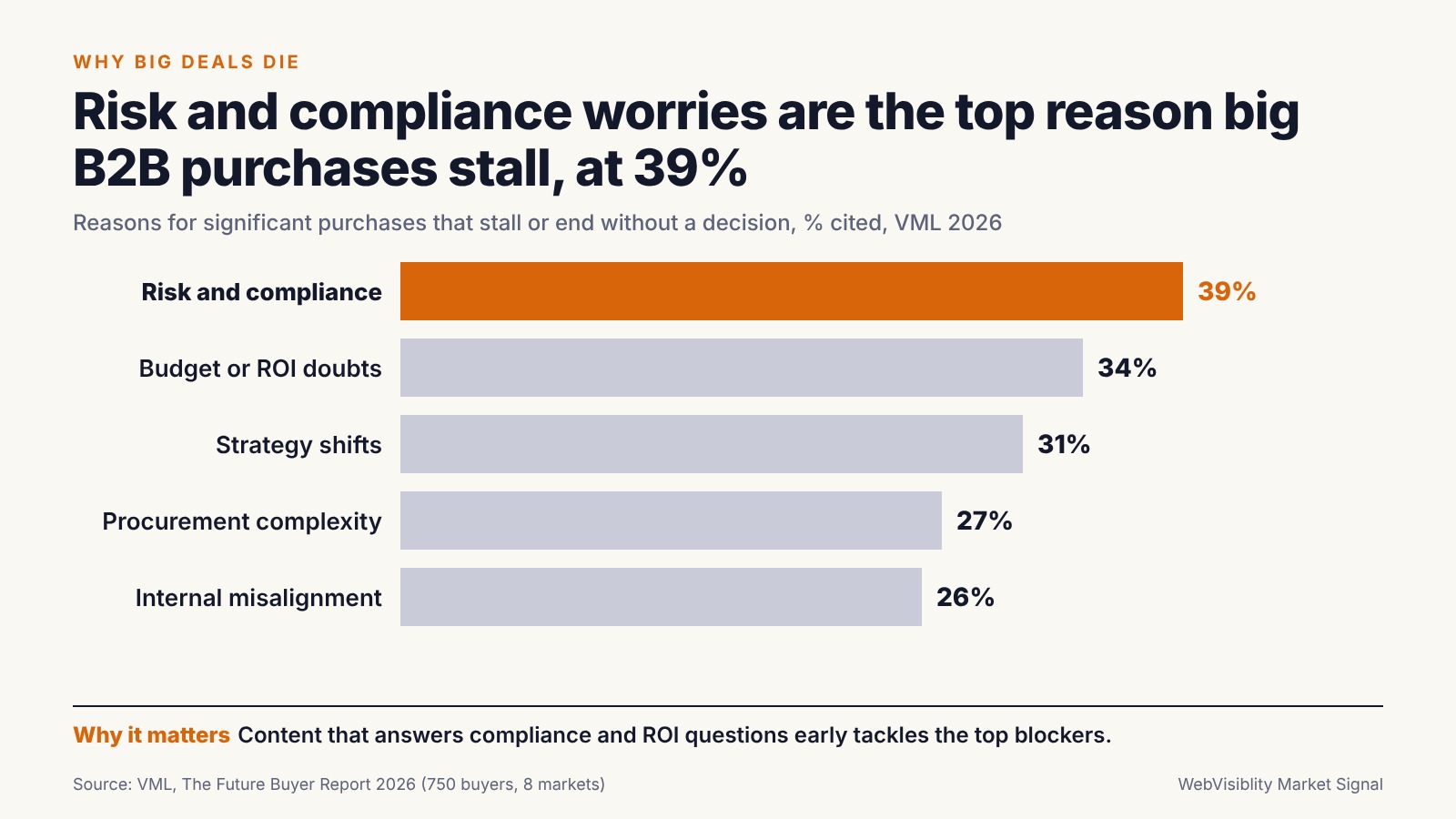
The rest of the report is about what happens after the shortlist, and it is less about technology than about fear. VML calls it "Defensibility Bias": buyers protect their careers first. Significant purchases involve an average of 6.8 stakeholders and take an extra 5.35 weeks of internal alignment after a preferred supplier is found. 38% of significant enterprise purchasing initiatives stall or collapse with no decision, led by risk and compliance concerns at 39% and budget or ROI uncertainty at 34%. Abandonment is highest in Telecommunications at 44.1% and Finance at 40.8%.
Power over the final call sits with central teams. VML says Finance (63%), the C-suite (57%), and IT (56%) hold the greatest influence over final supplier approvals, while front-line sales and marketing rank near the bottom. The report page does not publish question wording or a margin of error, so these shares are best read as VML's own summary.
Trade outlets picked up different parts of the study. MediaNews4U led on brand trust and risk aversion; MarketScale led on the 38% no-decision rate; and The Inclined set the 55% figure beside the finding that 73% fear the career consequences of a poor purchase.
By the numbers
| What | Figure | Source |
|---|---|---|
| Buyers who begin supplier research with generative AI | 55% | VML |
| Buyers who begin with Google or Bing | 45% | VML |
| Buyers who chose a safer supplier over better value | 71% | VML via Business Wire |
| Significant purchases ending with no decision | 38% | VML |
Figures exactly as published.
Timeline
VML surveys buyers between late July and early August.
VML releases The Future Buyer Report 2026 in New York.
MediaNews4U reports the brand trust and risk aversion findings.
The Inclined pairs the 55% figure with career fear among buyers.
MarketScale leads on 38% of initiatives ending undecided.
“Modern B2B marketing has to work for humans and machines at the same time.”
Who is affected
| Who | What changes | Impact |
|---|---|---|
| B2B marketing teams | First lists form in AI answers for 55% of buyers, so AI visibility feeds pipeline. | High |
| Challenger brands | 71% chose a safer supplier; proof of low risk matters as much as features. | High |
| Sales teams | 36% form preferences before the first sales call. | Medium |
| Search-only programs | 45% still start in Google or Bing, so search remains a large share. | Medium |
Why it matters
The shortlist is now built inside an AI answer for most buyers. If 55% begin on GenAI platforms, a vendor that the assistants do not name is missing from the first list more often than not. That makes AI visibility a pipeline question, not a branding side project. It also raises the stakes of what the models say: with 74% likely to act on AI-generated recommendations, a wrong or outdated description of a product can quietly cost a place on the list.
Getting named is only half the job. The same buyers pick the familiar option 71% of the time and spend more than five weeks aligning a group of 6.8 people. The most common blockers are risk and compliance concerns (39%) and budget or ROI doubts (34%). Content that wins the final round looks different from content that wins discovery: security answers, compliance proof, clear pricing and case studies that a nervous approver in finance or IT can forward without editing. VML found transparent pricing is the #1 factor that makes a supplier easy to buy from, at 39%.
Marketing's own seat at the table is small. VML places marketing (18%) near the bottom of the functions that sway final approval. Marketers reach finance, IT and the C-suite mostly through the material those people read and the answers their AI tools return, so the job is to equip those readers, not just the champion.
What to do now
For marketers
- Ask ChatGPT, Gemini, Claude and Perplexity the questions your buyers ask, and log whether your brand is named.
- Publish plain answers on security, compliance and ROI, the top two stall reasons in VML's data.
- Put pricing ranges or a pricing model on the website, since transparent pricing ranks first for ease of buying.
- Build material a finance or IT approver can forward without edits.
For software buyers and IT teams
- Check AI-generated vendor lists against independent sources before shortlisting.
- Agree risk and ROI criteria with finance and IT before the search starts.
- Give challenger suppliers a fair test against clear criteria rather than defaulting to the familiar name.
Printable, one page, 11 checks. Enter your email and it opens right away.
We email you a copy. We never share your email and never send you sales emails.
Pick one. It takes 5 seconds and helps more people find these briefings. Your checklist opens straight after.
Have a work email? Use it instead and the checklist opens straight away.
Open it, then save it as a PDF or print it.
Know someone who would find this useful?
These steps are our recommendations based on this news, not statements from the companies involved.
What to watch
- Agent-led evaluation. Whether the 31% who expect an AI agent to run their next evaluation turns into real procurement practice in 2027.
- Sector reports. VML has published separate industry cuts; whether they show the AI-first share rising or falling by sector.
- Method detail. Whether VML publishes question wording and per-market splits behind the 55% and 45% figures.
- Search share. Whether other buyer studies confirm generative AI has passed Google or Bing as the first stop, or find the opposite.
From AI answer to signed deal: where buyers drop off
- 1Discover
55% start in generative AI, 45% in Google or Bing.
- 2Prefer
36% form a preference before talking to sales.
- 3Align
6.8 stakeholders spend about 5.35 more weeks agreeing.
- 4Approve
Finance, the C-suite and IT hold the most sway.
- 5Decide or stall
38% end with no decision.
Questions readers ask
Do B2B buyers use AI to find suppliers?
Yes. In VML's 2026 survey of 750 buyers, 55% begin supplier research on generative AI platforms, and 74% frequently or always use AI to research suppliers.
Is AI replacing Google for B2B research?
For the first step, more buyers now start in AI. VML found 55% begin with GenAI tools against 45% using Google or Bing, though most still use several sources later.
Why do B2B buyers choose well-known suppliers?
Fear of a bad call. VML says 71% have chosen a safer supplier over one offering better value, and 73% think an underperforming purchase could hurt their career.
Why do B2B deals end with no decision?
VML found 38% of significant purchases stall, mostly over risk and compliance concerns (39%) and budget or ROI uncertainty (34%), followed by strategy shifts and procurement complexity.
How many people are in a B2B buying group?
VML puts it at an average of 6.8 stakeholders for significant purchases, with about 5.35 more weeks of internal alignment after a preferred supplier is picked.
Who has the most say in B2B purchase approvals?
Central teams. VML says Finance (63%), the C-suite (57%), and IT (56%) hold the most influence over final supplier approvals, with sales and marketing near the bottom.
What is the VML Future Buyer Report 2026?
It is VML's B2B buyer study, released on 10 November 2026, based on a survey of 750 buyers in eight countries and seven industries.
Companies in this story
Sources
- VMLOriginal
- VML via Business WireOriginal
- MediaNews4U
- MarketScale
- The Inclined
Researched, fact-checked and edited by the Market Signal desk. Read our editorial standards. Spotted an error? Email hello@webvisiblity.com and we will correct it.