Liam Byrne, who chairs the House of Commons Business, Innovation, Science and Trade Committee, has asked Anthropic for a full and unredacted version of an outside safety report on the company. The report, by the evaluation group METR, found that Anthropic is likely improving its models at around twice the rate of 2024 and 2025. Byrne wants the missing material, and the reasons it was removed, by Friday 4 December.
At a glance
| Request sent | 27 November 2026, to Anthropic's UK and Ireland head |
|---|---|
| Reply due | Friday 4 December |
| Report published | 5 November 2026 by METR |
| METR's central estimate | About 2x the earlier pace |
| Evidence shown in full | 1 of 7 evidence types |
Do this today
Tick each step as you do it. Your ticks stay on this device. See the full list.
For marketers
For software buyers and IT teams
The signal
- The committee asked Anthropic to share the unredacted report or the material omitted, and to explain the basis for each redaction.
- METR wrote that Anthropic redacted a majority of the evidence it found most informative for its conclusions.
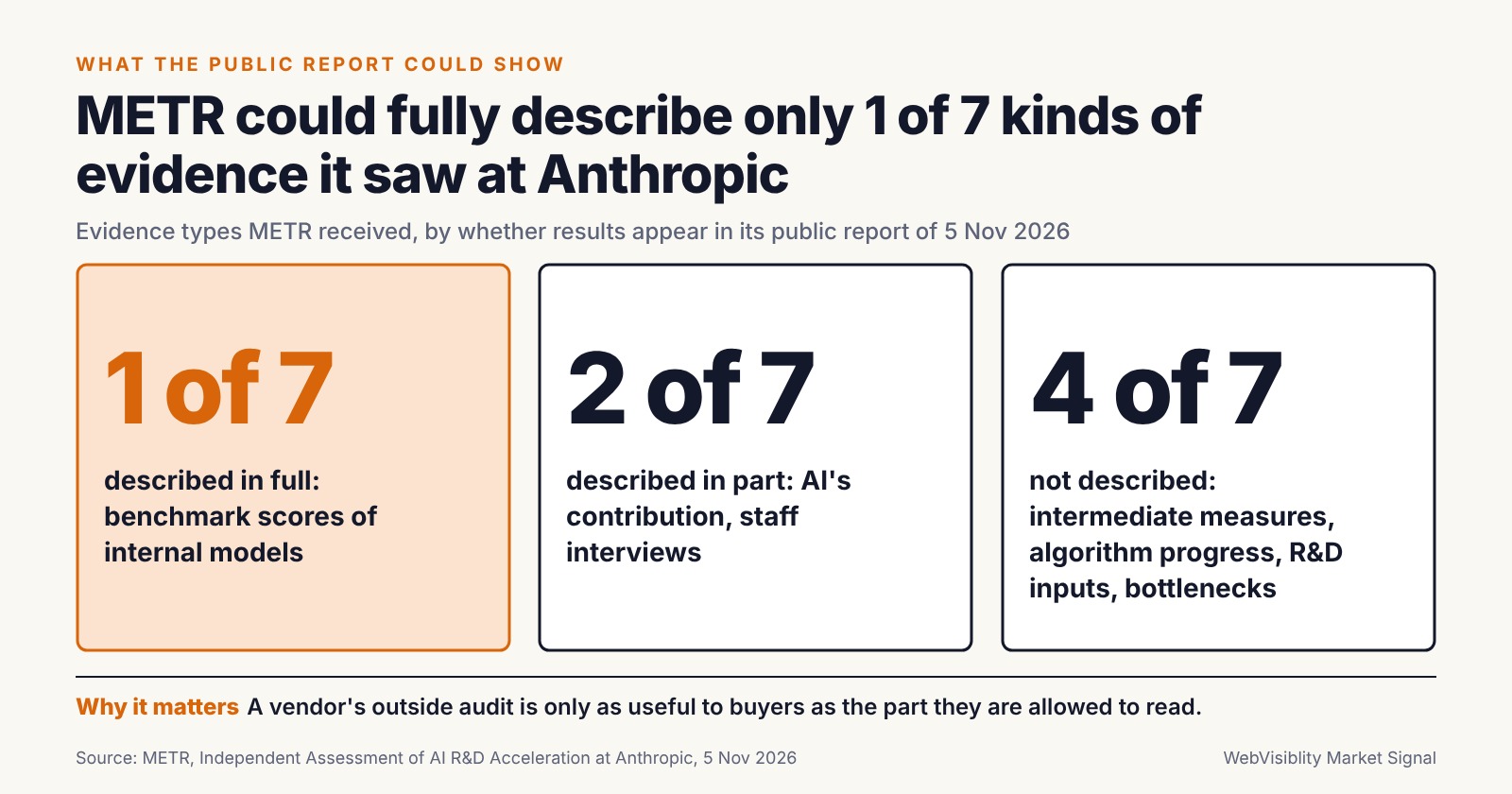
- Of seven kinds of evidence METR received, results for only one, benchmark scores of internal models, appear in full in the public report.
- Anthropic said the cuts were aimed at removing confidential information that could speed up other AI developers.
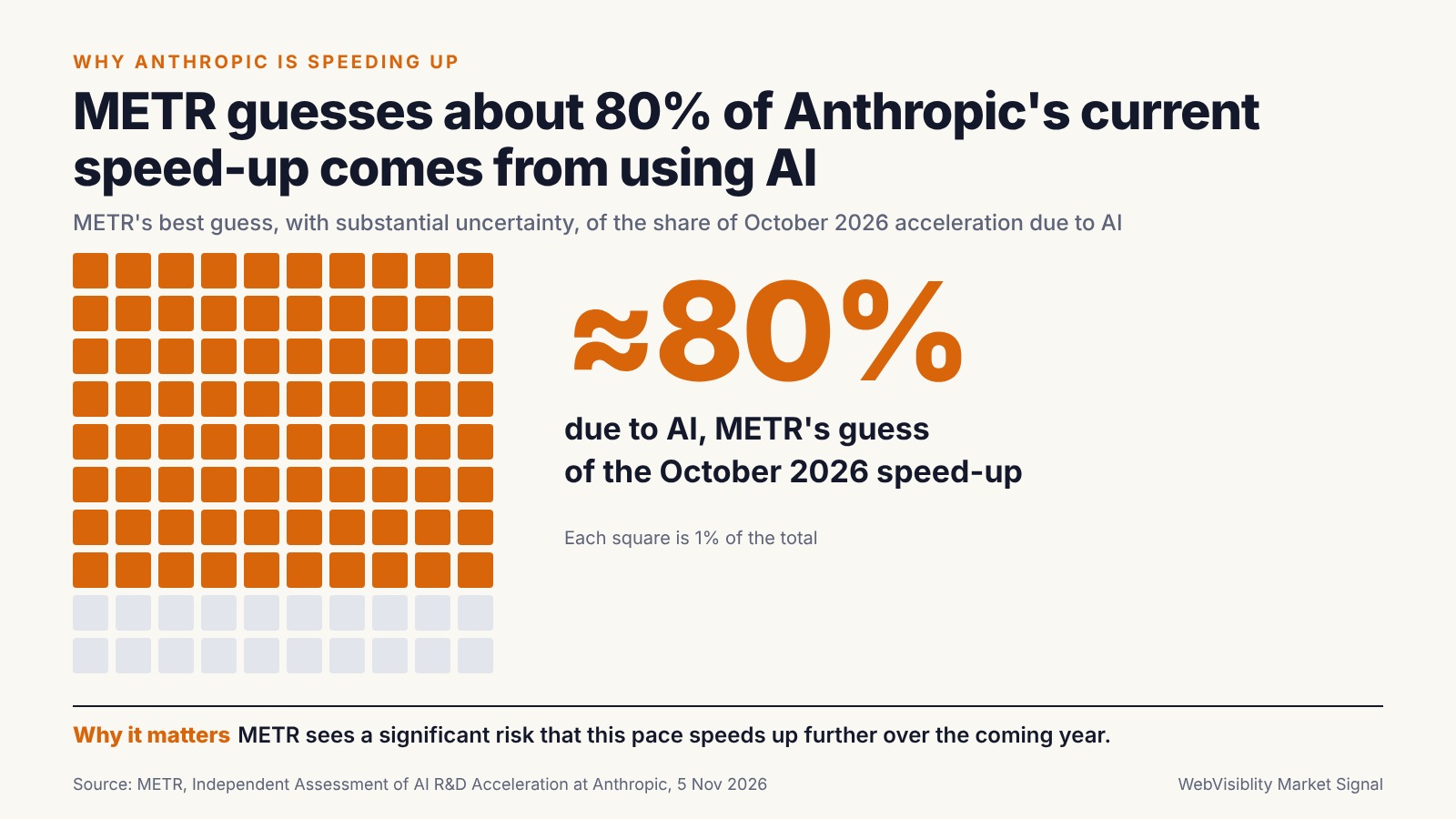
- METR's best guess is that perhaps about 80% of Anthropic's current speed-up comes from its own use of AI.
- Anthropic also dropped a planned check of how it splits computing power between capabilities and safety, saying it would revisit it later.
Which of these are you?
Tap the one that fits you best. We show what this story changes for you.
What happened
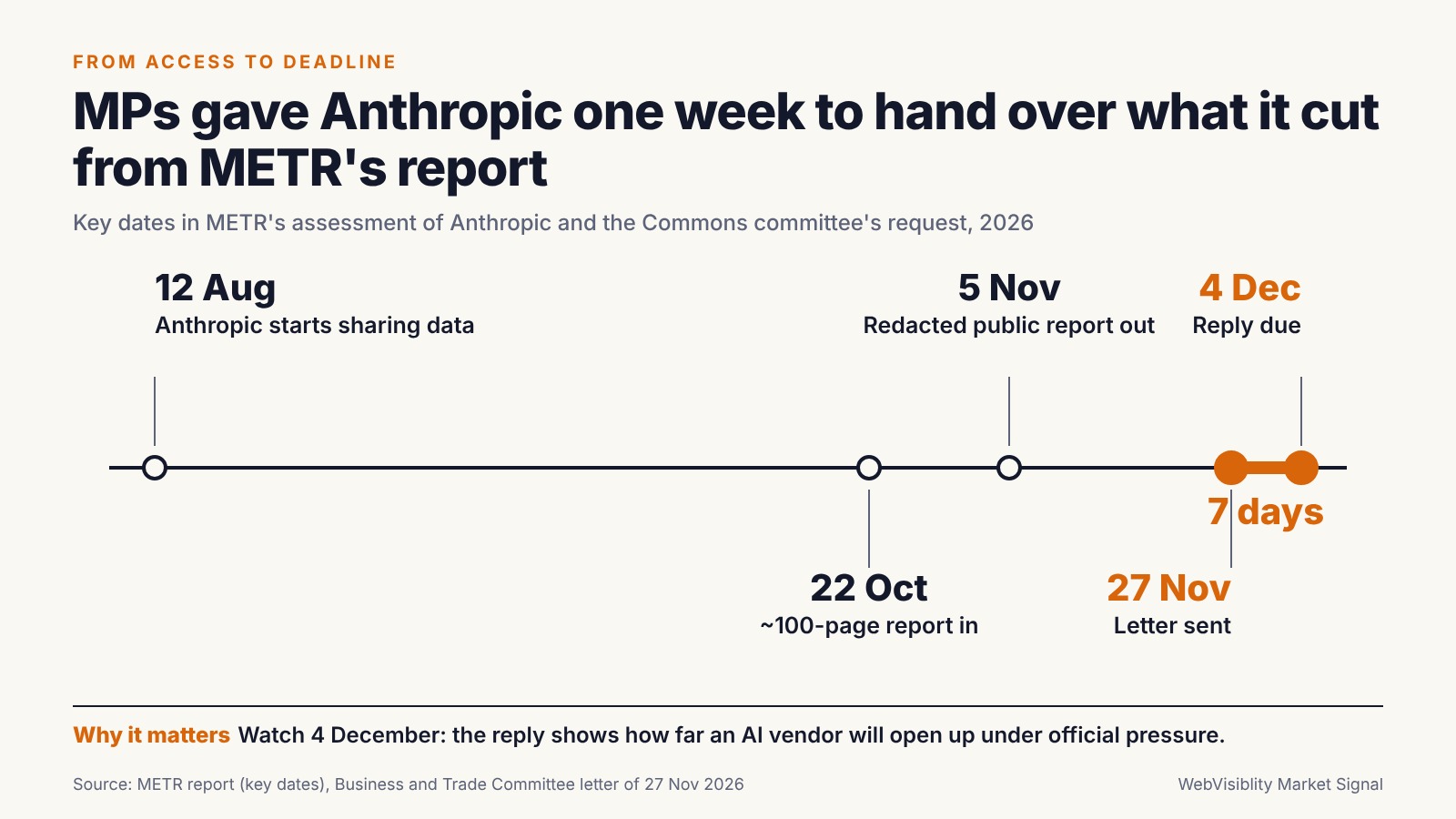
The letter, dated 27 November and addressed to Pip White, Anthropic's head of UK and Ireland, is short. It asks for METR's report on AI research and development at Anthropic as it stood before the cuts, or for the omitted material in another form, plus an explanation of the basis on which the redactions were made. Byrne links the request to the committee's ongoing work on AI safety. The letter was reported by The Decoder and RuntimeWire.
METR, a nonprofit that tests frontier AI systems, spent August 12 to October 29 inside Anthropic with what it called unprecedented access to internal data, from benchmark scores of unreleased models to staff surveys and about 15 interviews. It handed Anthropic a ~100-page Full Report on 22 October. Anthropic held the right to redact any non-public information, issued redaction guidance on 25 October and tightened that guidance between 27 and 29 October. The public version went out on 5 November.
That version carries a note at the top. METR says it could share its highest-level conclusions freely, but Anthropic redacted most of the evidence behind them, so the public has to rely on METR's judgment much more than would be ideal. Anthropic co-founder Sam McCandlish wrote on X, as reported by Cybernews, that the company redacted a lot because sharing what drives the speed-up is commercially sensitive and could hand others a roadmap. No reply from Anthropic to the committee had been published at the time of writing.
By the numbers
| What | Figure | Source |
|---|---|---|
| METR's central estimate of Anthropic's speed-up | ~2x | METR |
| Benchmark (AECI) acceleration since Oct 2025 | 1.9x | METR |
| Share of speed-up METR guesses is due to AI | ≈80% | METR |
| Evidence types described in full | 1 of 7 | METR |
Figures exactly as published.
How to read a vendor's outside AI audit
- 1Scope
Check what the reviewer was asked to cover and what was dropped, as with the compute check here.
- 2Access
Note what data the reviewer saw and on whose devices, as METR set out in detail.
- 3Redactions
Look for a statement of what was cut and whether the findings depend on it.
- 4Follow-up
Ask the vendor for the fuller version under NDA, as MPs have asked Anthropic.
Timeline
Anthropic begins sharing confidential data with METR.
City AM reports Byrne has invited Anthropic, OpenAI, Google DeepMind and Meta to a committee hearing on AI safety.
METR delivers its ~100-page Full Report to Anthropic.
METR publishes the redacted public report.
Byrne writes to Anthropic asking for the unredacted version.
Deadline for Anthropic's response to the committee.
“Anthropic redacted a majority of the evidence we found most informative for these conclusions.”
Why it matters
Outside audits are becoming part of how AI vendors earn trust. Anthropic chose to let METR in, with access METR calls unprecedented. But a buyer, regulator or journalist reading it sees the conclusions, not most of the proof: METR's own table shows four of seven evidence types not described at all. That is a pattern procurement teams know from security reviews, where a vendor shares a summary and keeps the detail under NDA. The committee is now testing whether an elected body can get further than the public did.
The substance of the report also matters for anyone who builds on Claude. METR found Anthropic's benchmark progress 1.9 times its earlier rate since October 2025, and sees a significant risk of further acceleration over the next year. Anthropic's own filing to investors says it has met its own threshold for AI dramatically speeding up its research. For B2B teams, that points to faster model changes: features, prices and the answers Claude gives about companies and products may shift more often than annual vendor reviews assume.
That last point touches AI search. Claude is one of the assistants buyers now use to research suppliers, alongside ChatGPT, Google's AI Mode and Perplexity. When the models behind those answers change quickly, a brand's AI visibility can change with them, which is a practical reason to run AI monitoring on a regular schedule rather than as a one-off audit.
What to do now
For marketers
- Re-run your AI visibility prompts in Claude, ChatGPT and Perplexity after each major model release, not once a year.
- Keep a dated log of how AI assistants describe your company, so changes after model updates are easy to spot.
- If you publish your own audits or certifications, say plainly what they covered and what they did not.
For software buyers and IT teams
- Ask AI vendors which outside reviews they allow and whether you can see the unredacted findings under NDA.
- Build model change clauses into contracts, including notice periods before a default model is replaced.
- Follow Anthropic's reply to the committee after 4 December for what it is willing to disclose.
Printable, one page, 10 checks. Enter your email and it opens right away.
We email you a copy. We never share your email and never send you sales emails.
Pick one. It takes 5 seconds and helps more people find these briefings. Your checklist opens straight after.
Have a work email? Use it instead and the checklist opens straight away.
Open it, then save it as a PDF or print it.
Know someone who would find this useful?
These steps are our recommendations based on this news, not statements from the companies involved.
What to watch
- Anthropic's reply by 4 December. Whether it hands over the unredacted report, sends the cut material privately, or explains why it will not.
- What the committee does with it. Byrne has asked whether pre-release safety testing should be legally mandatory, and the reply could feed that inquiry.
- METR's next review. Anthropic told METR it would revisit the compute allocation check it dropped from this assessment.
- Other labs. Whether OpenAI, Google DeepMind or Meta allow similar outside reviews, and on what redaction terms.
Who is affected
Model progress running at about twice the earlier pace means more frequent changes to plan for.
Outside audits may arrive with most evidence redacted, so summaries need follow-up questions.
Faster model updates can shift how AI assistants describe brands between checks.
Questions readers ask
What is the METR report on Anthropic?
It is an independent assessment, published on 5 November 2026, of how much AI is speeding up Anthropic's own AI research. METR worked inside Anthropic from August to October.
Why did Anthropic redact the METR report?
Anthropic said the cuts were aimed at removing confidential information that could help other AI developers go faster. METR says most of its most informative evidence was removed.
What did the UK Parliament ask Anthropic for?
Committee chair Liam Byrne asked for the full unredacted report, or the omitted material, and an explanation of the redactions, by Friday 4 December 2026.
How fast is Anthropic's AI improving, according to METR?
METR's best estimate is around twice the rate of March 2024 to October 2025, though it would not be surprised by anything from 1.3 to 3 times.
Is AI building AI at Anthropic?
Partly. METR guesses perhaps about 80% of the current speed-up is due to AI, mostly as assistance to researchers rather than fully autonomous work.
Does Anthropic have to give MPs the unredacted report?
That is not clear from the letter, which is phrased as a request. The committee asked for a response by Friday 4 December.
What does this mean for companies that buy AI tools?
Expect faster model changes and treat vendor audit summaries with care. Ask what an outside review covered and what was left out, as METR's table shows.
Companies in this story
Sources
- ParliamentOriginal
- METROriginal
- The Decoder
- RuntimeWire
- Cybernews
- TNW
- City AM
Researched, fact-checked and edited by the Market Signal desk. Read our editorial standards. Spotted an error? Email hello@webvisiblity.com and we will correct it.