OpenAI wants to answer the question procurement teams ask first: can the AI company see our data? Sam Altman said on 25 November that OpenAI is now testing Private Inference with a small group of customers. The feature uses confidential computing with strict controls to protect prompts and responses while the model is working on them, not only after.
At a glance
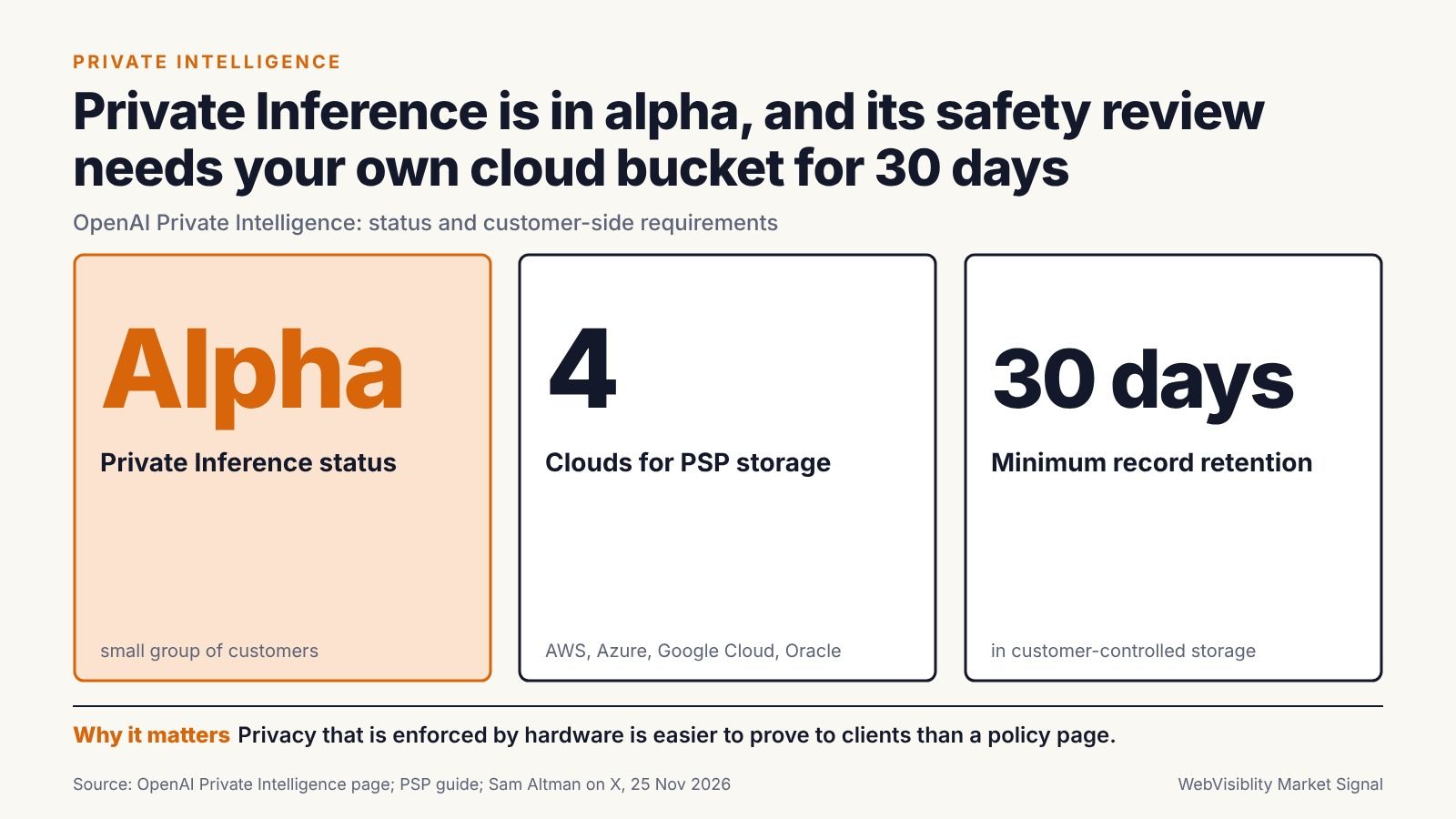
| Private Inference status | Alpha, small customer group |
|---|---|
| Announced | 25 November 2026 |
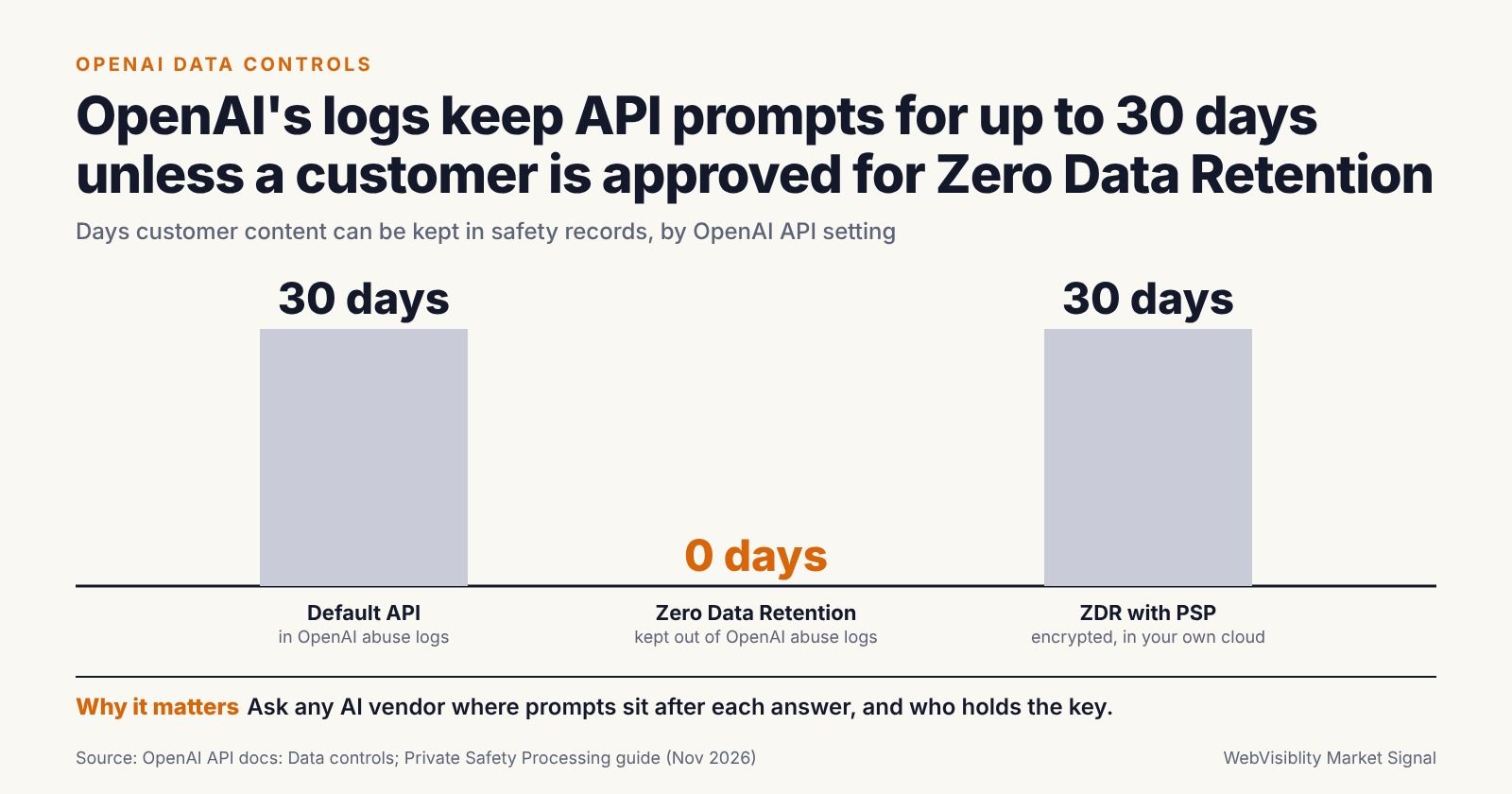
| Default API abuse log retention | up to 30 days |
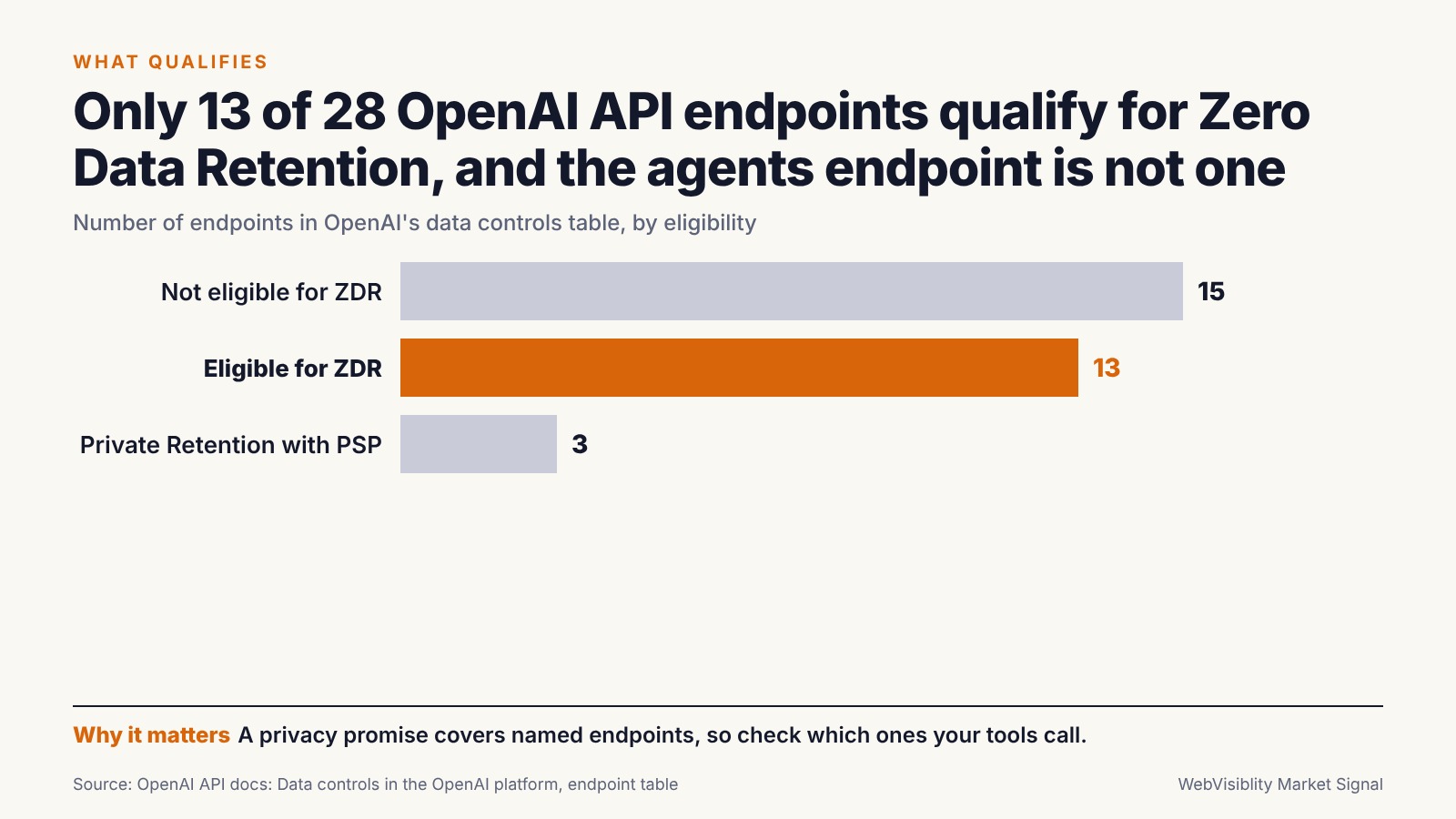
| Endpoints eligible for Zero Data Retention | 13 of 28 |
| Clouds that can hold PSP records | AWS, Azure, Google Cloud, Oracle |
| Minimum PSP record retention | 30 days, in your storage |
Do this today
Tick each step as you do it. Your ticks stay on this device. See the full list.
For marketers
For software buyers and IT teams
The signal
- Private Inference protects data during model processing; Zero Data Retention covers what is kept afterwards.
- Safety review under PSP runs in a protected runtime with human access disabled.
- Only predefined safety signals and approved metadata may leave that review in plain text.
- The /v1/agents endpoint is not eligible for Zero Data Retention.
- OpenAI says it is getting more confidential compute capacity to scale the test.
- Pricing, covered models and a release date are not stated.
Which of these are you?
Tap the one that fits you best. We show what this story changes for you.
What happened
On 25 November Sam Altman posted that OpenAI is testing Private Inference, the newest part of a privacy package it calls OpenAI Private Intelligence, with a small group of customers. He wrote that stronger privacy would make frontier AI useful for more work and asked interested companies to contact Shekar, who leads the effort. Shekar called the test a first step and said OpenAI is getting the confidential compute capacity to scale it up.
OpenAI's product page lists the feature as Private Inference (Alpha) and describes it as confidential computing combined with strict controls that protect prompts and responses while the model processes them. That closes a gap left by older promises. Zero Data Retention, available for eligible API work, means OpenAI does not keep prompts or responses after processing, but it says nothing about who could see the data during processing. OpenAI first showed Private Intelligence at DevDay 2026 in September and said Private Inference would arrive in the autumn.
The second half of the package, Zero Data Retention with Private Safety Processing, is already documented. Records picked by a safety classifier or a sampling policy are encrypted and written to the customer's own storage with a time-to-live of 30 days. Customers can connect AWS, Azure, Google Cloud or Oracle storage and must keep the records for at least 30 days. An automated review reads them inside a hardware-attested runtime, and Unite.AI notes that runtime has human access disabled.
What OpenAI has not said matters as much. Let's Data Science found no published pricing, general availability date, list of covered models or customer count. OpenAI's own data controls table also shows that only 13 of 28 API endpoints are eligible for Zero Data Retention, so privacy terms still depend on which features a product uses.
By the numbers
How a prompt moves under OpenAI Private Intelligence
- 1Set limits
The customer decides what agents can access and do.
- 2Send
The prompt is encrypted in transit and passes real-time safeguards.
- 3Process
Private Inference runs the model under confidential computing.
- 4Review
Selected records go encrypted to your own cloud for automated checks.
- 5Expire
Records carry a 30-day time-to-live.
Timeline
OpenAI stops using API data for training by default.
OpenAI unveils Private Intelligence at DevDay 2026.
Altman says Private Inference is being tested with customers.
OpenAI's Shekar says more confidential compute capacity is coming.
“Stronger privacy protections will make frontier AI useful for a lot more work, and business privacy is important for a healthy ecosystem.”
Why it matters
Security reviews are now one of the slowest steps in buying AI software. Until now the strongest answer an AI provider could give was a contract clause: we do not train on your data, and we delete it after a set time. Private Inference tries to replace part of that promise with hardware that limits what OpenAI can see while the model runs. If it works at scale, buyers in legal, finance and health work will start asking every AI vendor the same question, and a policy page alone will look weak next to it.
For B2B marketers the effect is close to home. Campaign plans, customer lists, pricing and call notes go into AI tools every day. The fine print shows how much depends on the setting: by default OpenAI's abuse logs keep API content for up to 30 days, and the agents endpoint is not covered by Zero Data Retention. Before pasting client data into any assistant, check which plan and which features it runs on, not just the brand name.
Software companies that build on OpenAI face a second task. Their own customers will ask whether a feature uses Zero Data Retention, Private Safety Processing or neither. Clear, specific trust pages help here, and they also shape AI visibility: when a buyer asks ChatGPT or Perplexity whether a vendor is safe for sensitive data, the answer can only be as precise as what the vendor publishes. Note that Private Inference is still an alpha test with no public price, so plans should not depend on it yet.
Who is affected
Can ask for proof of privacy during processing, not only a retention policy.
Must say which endpoints a feature uses, since only 13 of 28 qualify for ZDR.
Client data sent through default API settings may sit in logs up to 30 days.
PSP needs a bucket kept for at least 30 days in your cloud.
What to do now
For marketers
- List the AI tools that receive client names, pricing or campaign plans, and note the plan each runs on.
- Ask each tool's vendor whether your data goes through Zero Data Retention or default 30-day logs.
- Rewrite your own trust page so it names the AI provider, the retention setting and who can see data.
For software buyers and IT teams
- Add a question on privacy during processing, not just after, to your AI vendor security review.
- Ask vendors which OpenAI endpoints their features call, since agents and files are not ZDR eligible.
- Register interest with OpenAI only if a sensitive use case is blocked today, and plan without it until pricing is public.
Printable, one page, 10 checks. Enter your email and it opens right away.
We email you a copy. We never share your email and never send you sales emails.
Pick one. It takes 5 seconds and helps more people find these briefings. Your checklist opens straight after.
Have a work email? Use it instead and the checklist opens straight away.
Open it, then save it as a PDF or print it.
Know someone who would find this useful?
These steps are our recommendations based on this news, not statements from the companies involved.
What to watch
- Wider access. OpenAI says it is lining up confidential compute capacity; watch for a waitlist moving to general release.
- Scope. Which models and endpoints Private Inference will cover is not yet published.
- Proof. Whether OpenAI publishes attestation evidence that outside auditors can check, as its page promises verifiable controls.
- Price. Any premium over standard API rates, still unstated.
- Rivals. Let's Data Science reports Google is pursuing a similar approach; expect other AI providers to answer.
Questions readers ask
What is OpenAI Private Inference?
It is an alpha feature that uses confidential computing with strict controls to protect business prompts and responses while an OpenAI model is processing them, not just after.
Is OpenAI Private Inference available now?
Only to a small test group. Sam Altman said on 25 November 2026 that OpenAI is testing it with a small group of customers; companies can register interest on OpenAI's site.
How long does OpenAI keep API prompts?
By default, abuse monitoring logs keep API content for up to 30 days. Customers approved for Zero Data Retention have their content excluded from those logs.
What is Zero Data Retention with Private Safety Processing?
It lets OpenAI run automated safety checks without keeping your content itself. Selected records are encrypted and stored in your own cloud for 30 days, and reviewed without human access.
Which OpenAI API endpoints support Zero Data Retention?
13 of the 28 endpoints in OpenAI's data controls table, including Responses and Chat Completions. Agents, Assistants, Files and Batches are not eligible.
How much does OpenAI Private Inference cost?
OpenAI has not published a price. Reports note that pricing, covered models and a release date are all still unstated.
Does OpenAI train on business data?
Not by default. OpenAI says API data has not been used for training since 1 March 2023 unless a customer opts in.
Companies in this story
Sources
- OpenAIOriginal
- Sam Altman on X
- OpenAI Developers
- OpenAI Developers
- Unite.AI
- Let's Data Science
- VentureBeat
- Shekar (OpenAI) on X
Researched, fact-checked and edited by the Market Signal desk. Read our editorial standards. Spotted an error? Email hello@webvisiblity.com and we will correct it.