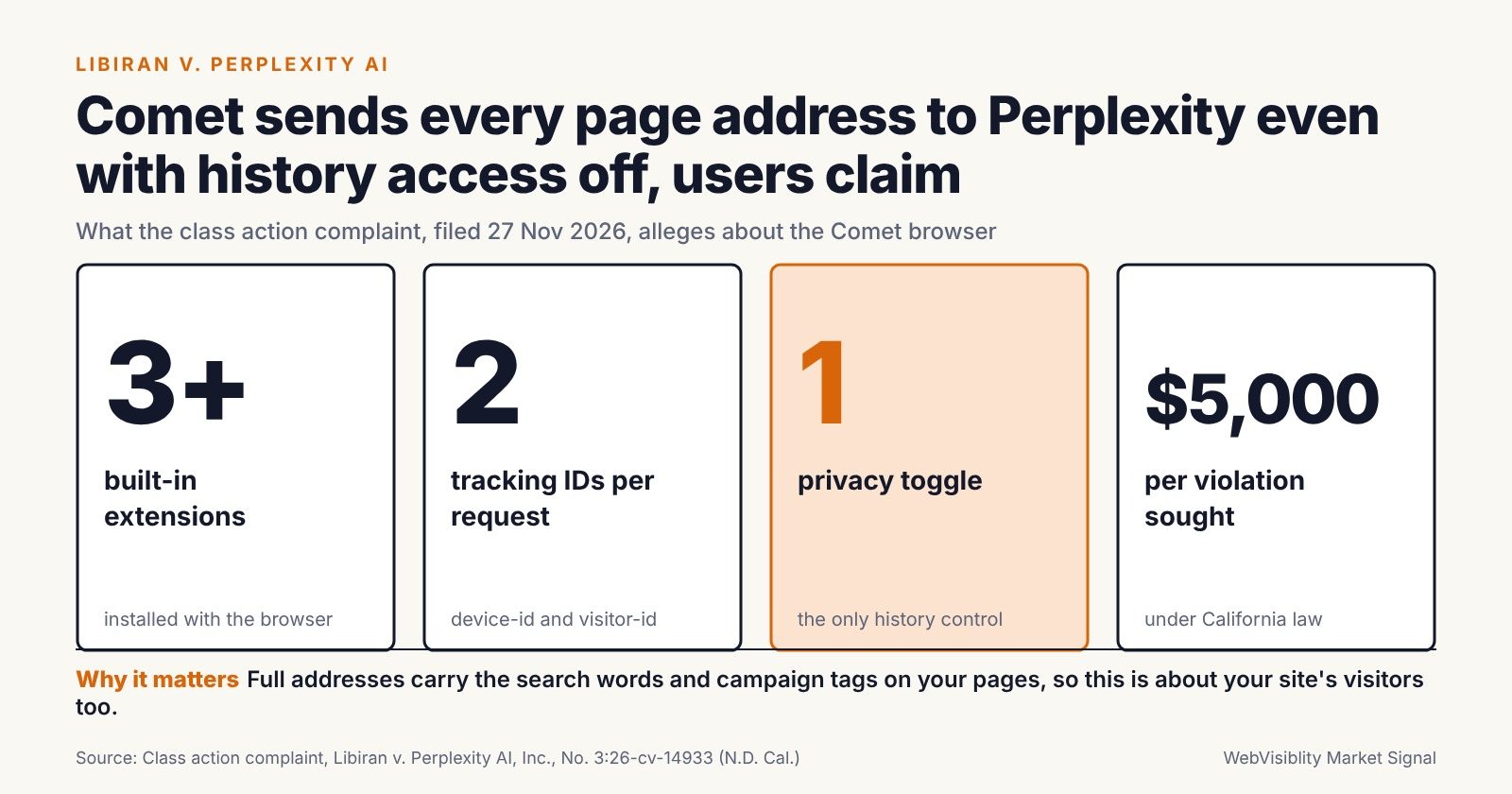
Two California users of Comet, Perplexity's AI browser, sued the company on 27 November, alleging that the browser sends the full address of every page they open to Perplexity's servers even after they switched off the setting Perplexity presents as controlling access to their browsing history. The proposed class action asks a federal court in San Francisco to stop the transfers, order the data deleted and award damages, including $5,000 per violation under California's privacy law.
At a glance
| Case | Libiran v. Perplexity AI, Inc., No. 3:26-cv-14933 |
|---|---|
| Filed | 27 November 2026, N.D. California |
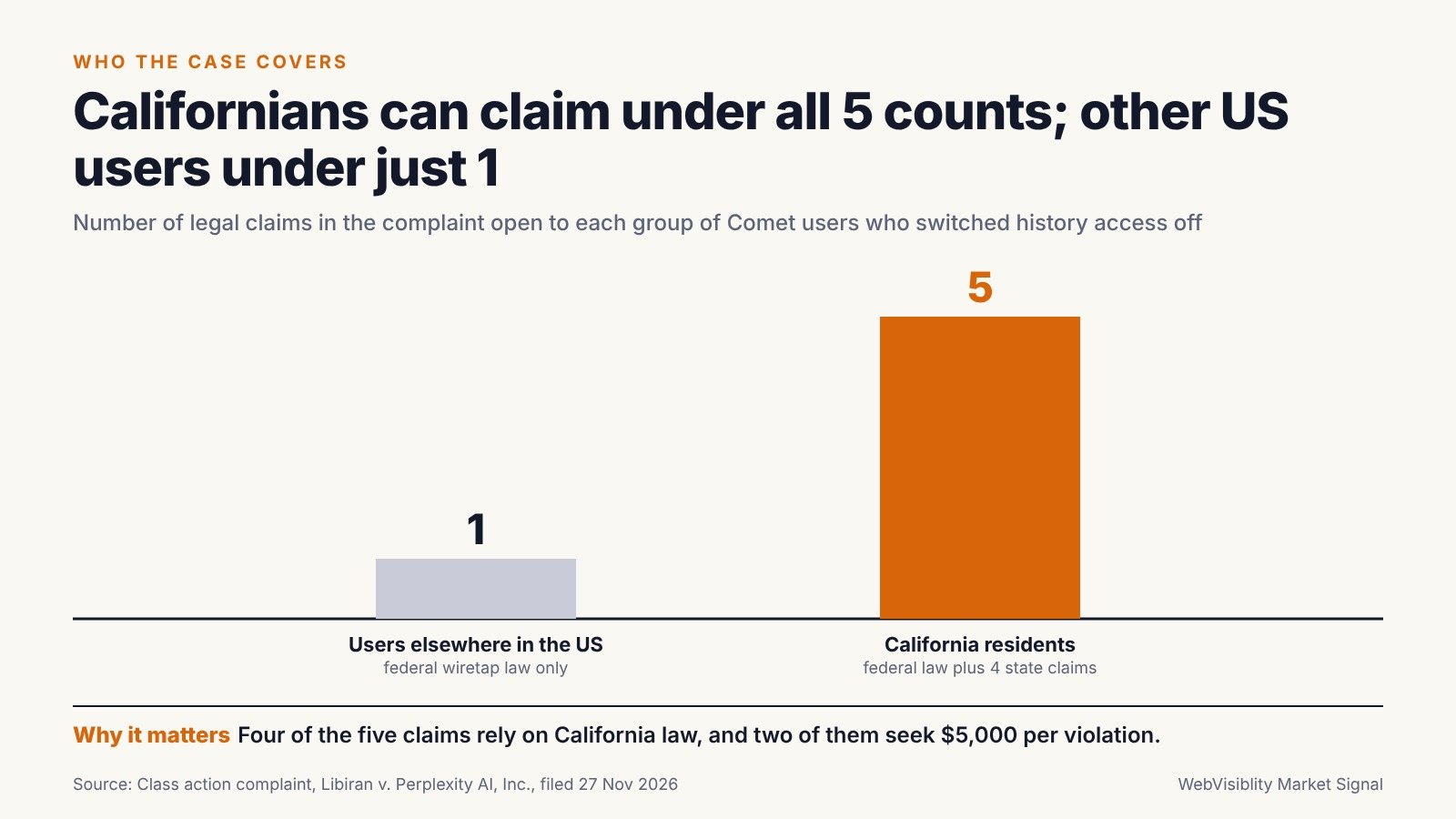
| Claims | 5 counts, 1 federal and 4 under California law |
| Damages sought | $5,000 per violation on each California wiretap count |
| Identifiers sent | a device-id and a visitor-id, per the complaint |
| Status | Allegations only, no class certified |
Do this today
Tick each step as you do it. Your ticks stay on this device. See the full list.
For marketers
For software buyers and IT teams
The signal
- The complaint says Comet installs at least three extensions that run from the moment the browser opens and watch the active tab.
- It alleges one extension posts each new page address to a Perplexity autosuggest endpoint before the user opens the AI Assistant.
- The 'Comet Assistant' toggle is on by default and is the only control over the browser's access to history, the filing says.
- Users who switch it off see the promise that browsing data is stored only on your device by default.
- The suit is the second big legal fight over Comet, after an appeals court vacated an injunction Amazon won against it.
- Perplexity had not responded in court, and no class has been certified.
Which of these are you?
Tap the one that fits you best. We show what this story changes for you.
What happened
Sean Libiran of San Diego and Megan Martin of Ivanhoe, California, filed a 27-page class action complaint against Perplexity AI in the US District Court for the Northern District of California on Friday, 27 November 2026. The law firm Edelson PC represents them, and the court docket lists the case as Libiran v. Perplexity AI, Inc..
The complaint describes Comet as a browser built on Chromium, the engine behind Google Chrome and Microsoft Edge, with a layer of Perplexity's own software on top. That layer is a bundle of at least three extensions that install automatically with Comet and that Perplexity updates without any action by the user. According to the filing, one extension monitors the active tab at all times, even when the AI Assistant side panel is closed. When the user moves to a new page in a tab with no Assistant conversation, a second extension sends the full address to perplexity.ai/rest/autosuggest/list-autosuggest, together with a device-id and a visitor-id. The complaint calls this the Autosuggest Transmission and says its apparent purpose is to prepare suggested prompts, such as 'Summarize this article', in case the user opens the Assistant.
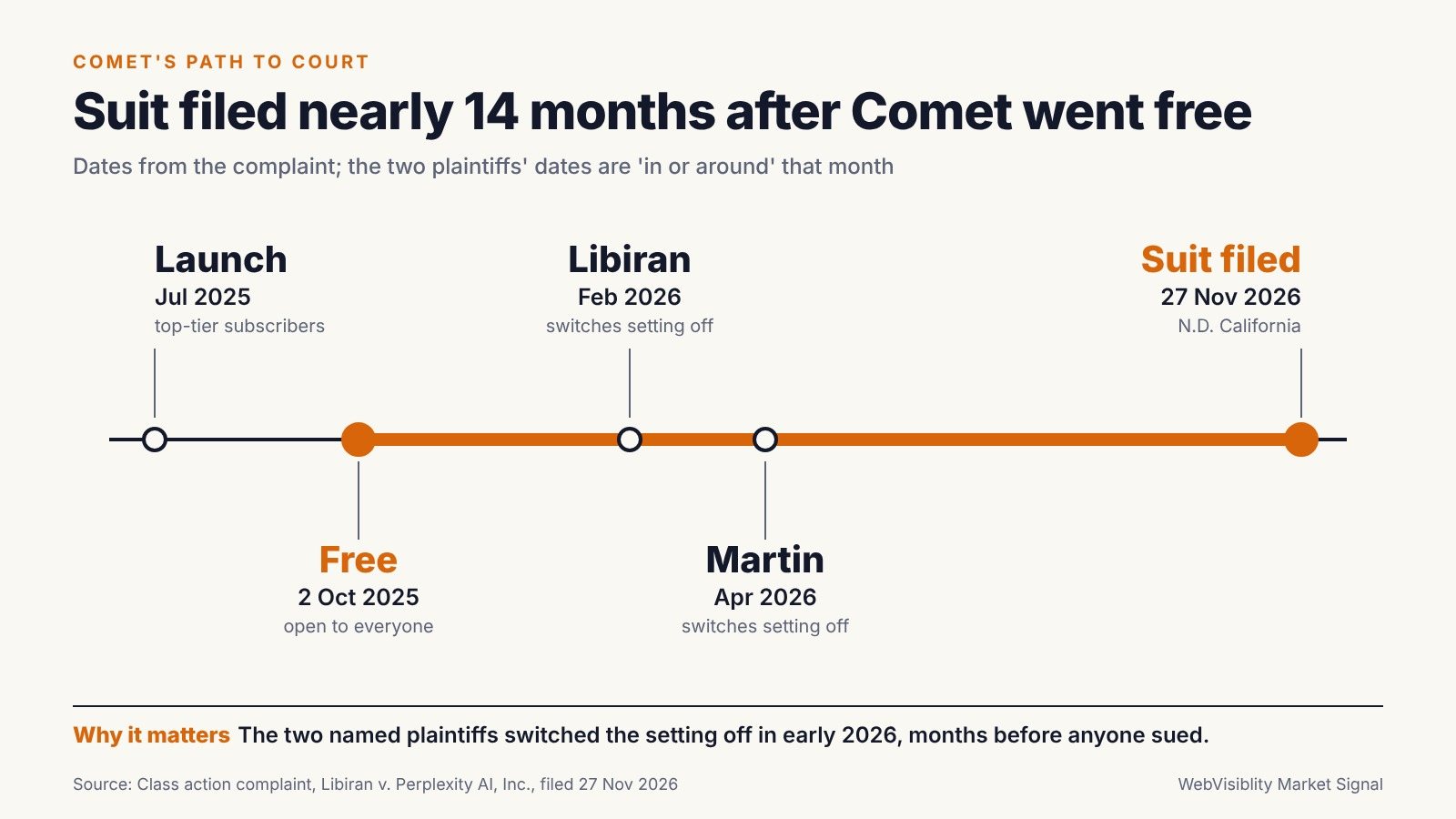
The plaintiffs' objection is that it happens on every page load, before anyone asks for a suggestion, and that it continues after the user switches off the 'Comet Assistant' toggle. That toggle is described on screen as allowing Comet to access your browser history, navigate the web and interact with sites. Beneath it, Perplexity tells users that 'Comet sends data to Perplexity only when necessary to complete your request.' Libiran says he switched it off in or around February 2026 and Martin in or around April 2026; both then browsed without opening the Assistant.
The suit brings five claims: the federal Electronic Communications Privacy Act for a nationwide class, and intrusion upon seclusion, the California Constitution and two sections of the California Invasion of Privacy Act for California residents. It proposes to cover every US user who disabled the setting and then browsed without opening the Assistant, and says only that Perplexity has many thousands of Comet users in that group. Open Class Actions notes that the account of how the extensions work is the complaint's own, and that it has not tested the network behaviour independently. None of the allegations has been proven.
By the numbers
| What | Figure | Source |
|---|---|---|
| Statutory damages sought per violation, each California wiretap count | $5,000 | Courtlistener |
| Legal claims in the complaint | 5 | Courtlistener |
| Built-in Comet extensions named in the complaint (at least) | 3+ | Courtlistener |
| Tracking identifiers sent with each page address | 2 | Courtlistener |
Figures exactly as published.
How to check what an AI browser sends before your team uses it
- Step 1List the tools
Record which AI browsers and assistant extensions staff already use for research and sales work.
- Step 2Read the setting
Note what each privacy toggle promises, as the plaintiffs did with Comet's Comet Assistant setting.
- Step 3Test with AI off
Ask IT to watch network traffic with the AI switched off, checking whether complete URLs still leave the device.
- Step 4Separate accounts
Run AI search tests on machines and logins that carry no client or CRM data.
- Step 5Clean your links
Keep personal data and internal IDs out of the page addresses and campaign tags you publish.
Timeline
Perplexity releases Comet to subscribers of its highest-priced tier.
Comet becomes free to the public.
Libiran switches off the Comet Assistant setting, he says.
Martin switches the same setting off, according to the complaint.
The Ninth Circuit vacates Amazon's injunction against Comet's shopping agent.
Edelson PC files the class action in San Francisco.
“A privacy switch is not a suggestion.”
Who is affected
| Who | What changes | Impact |
|---|---|---|
| B2B marketing teams | Campaign tags and on-site search terms in your URLs travel with any browser that copies full addresses. | Medium |
| IT and procurement | AI browsers need the same data-flow review as any vendor, starting with what is sent when AI is off. | High |
| Perplexity and other AI browser makers | Privacy settings may be judged on what they stop, not what they say, if the wiretap claims survive. | High |
Why it matters
Your page addresses are marketing data. The complaint says a full address includes query parameters, search terms and referral strings. On a B2B site that is often the search a visitor ran, the pricing tier they opened and the campaign tags your team added to the link. PPC Land points out that any browser copying the complete address also copies whatever marketing data sits in it. If the allegations are right, a browser maker received that trail without either the visitor or the website agreeing. The plaintiffs argue website operators had no knowledge of, role in, or means of detecting the transfers.
AI browsers are now a procurement question. Captain Compliance lists the checks a company should run before staff use an AI browser, including whether it sends complete URLs and whether switching the AI off stops the data flow. Employees who research vendors, log into a CRM or read contracts in the same browser can leak more than a cookie banner on your own site would ever capture. Marketing and sales teams that test Comet or similar tools to see how AI search describes their brand should set that up on machines and accounts that carry no client data.
Perplexity is also a channel. The case does not change how Perplexity's answer engine ranks or cites sources, and nothing in it concerns AI visibility directly. It does put Perplexity's handling of user data in front of a judge while marketers are deciding how much effort to put into being cited by Perplexity and its rivals, and it gives buyers a reason to ask every AI search vendor the same question: what leaves the device when the AI is switched off?
What to do now
For marketers
- Search your site's URLs for email addresses, names or account IDs in query strings, and remove them.
- Keep UTM tags to campaign, source and medium only, with nothing a visitor would mind a third party reading.
- Run Perplexity and Comet tests from a separate browser profile with no logged-in client tools.
For software buyers and IT teams
- Ask every AI browser or assistant vendor in writing what data leaves the device when the AI feature is off.
- Ask IT to block unapproved AI browsers on machines that open CRM, contract or HR systems.
- Add AI browsers and extensions to your software inventory and annual vendor review.
Printable, one page, 10 checks. Enter your email and it opens right away.
We email you a copy. We never share your email and never send you sales emails.
Pick one. It takes 5 seconds and helps more people find these briefings. Your checklist opens straight after.
Have a work email? Use it instead and the checklist opens straight away.
Open it, then save it as a PDF or print it.
Know someone who would find this useful?
These steps are our recommendations based on this news, not statements from the companies involved.
What to watch
- Perplexity's answer. The company's first response, and whether it disputes that a page address counts as the contents of a communication under wiretap law.
- Judge assignment. The case is assigned to Magistrate Judge Joseph C. Spero; the parties' consent or declination is due in December, Open Class Actions says.
- A product change. Whether Comet stops sending addresses while the Assistant is closed, which the complaint names as a less intrusive alternative.
- Copycat suits. Captain Compliance says the case could make AI browsers a new target for privacy litigation.
Questions readers ask
What is the Perplexity Comet lawsuit about?
Two users allege Comet sends the full address of every page they visit to Perplexity, with two tracking identifiers, even after they switched off its browsing history setting. Perplexity has not answered yet.
Does Perplexity Comet track your browsing history?
That is the claim, not a finding. The complaint says a built-in extension posts each new page address to a Perplexity server on every page load, even with the Assistant closed.
Who can join the Comet class action?
Proposed only: US users who switched off the setting and then browsed without opening the AI Assistant. No class has been certified and there is nothing to claim yet.
How much money does the Comet lawsuit seek?
It seeks $5,000 per violation on two California counts, plus other damages and an injunction. It gives no total and no estimate of how many violations occurred.
Is it safe to use Perplexity Comet for work?
Until the facts are tested, treat it like any tool that may send data off the device: check what complete URLs it sends, and keep client systems out of trial accounts.
Does the lawsuit affect visibility in Perplexity search?
No. It concerns how the Comet browser handles page addresses, not how Perplexity's answers cite or rank sources.
Companies in this story
Sources
Researched, fact-checked and edited by the Market Signal desk. Read our editorial standards. Spotted an error? Email hello@webvisiblity.com and we will correct it.