The US has licensed its first data centers in space. On 25 November the FCC's Space Bureau authorised SpaceX to launch and run up to 1,000,000 Starmind satellites that process data in orbit, calling it the first authorization in U.S. history for such a network. The fine print sets the pace: SpaceX must have one satellite working by 25 November 2033, so no buyer of AI services will rent this capacity soon.
At a glance
| Satellites authorised | 1,000,000 |
|---|---|
| Orbit | 500 to 1,002 km |
| First satellite due | by 25 November 2033 |
| Full network due | by 25 November 2040 |
| Petitions denied | Amazon's Kuiper, Viasat, AAS |
Do this today
Tick each step as you do it. Your ticks stay on this device. See the full list.
For marketers
For software buyers and IT teams
The signal
- The grant was issued by the Chief of the Space Bureau, marked granted in part and deferred in part, with conditions.
- SpaceX must report every 1 January and 1 July on close approaches, removed satellites and the number deployed.
- Its request to skip the rule that low satellites must re-enter the atmosphere at end of life was deferred, not granted.
- SpaceX's own pre-IPO filing called orbital data centers unproven and said they may not be commercially viable.
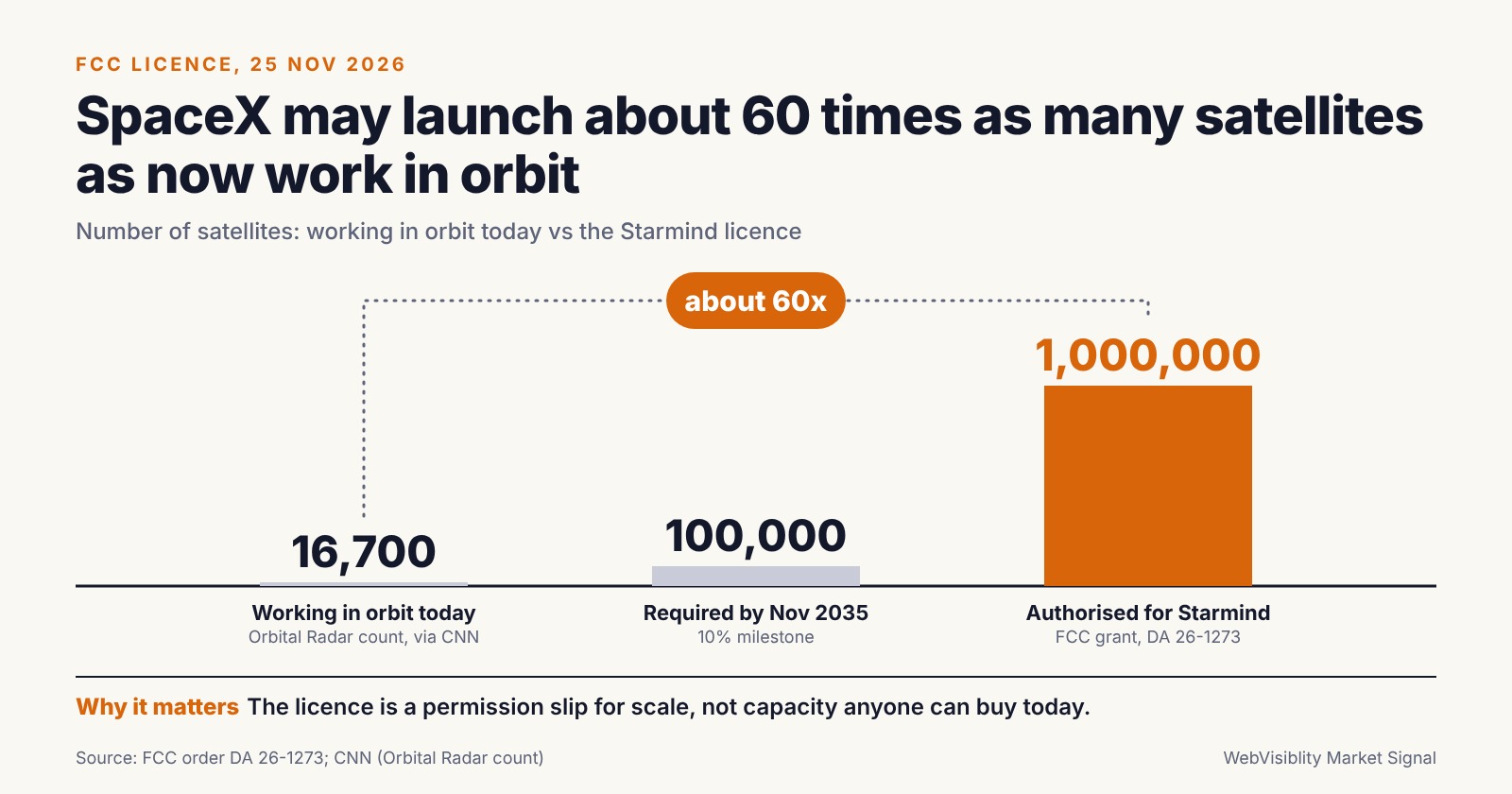
- About 16,700 satellites work in orbit today, by one tracker's count, against the 1,000,000 now licensed.
Which of these are you?
Tap the one that fits you best. We show what this story changes for you.
What happened
SpaceX applied in January for authority to run an orbital data center system, and the FCC accepted it for filing on 4 February. On 6 March, Amazon's satellite unit Kuiper Systems, Viasat and the American Astronomical Society filed petitions to deny. Amazon's petition called the plan a lofty ambition rather than a real plan and said it would take SpaceX centuries to build.
The Space Bureau rejected all three petitions on 25 November. Its order lets SpaceX place 1,000,000 satellites in 50 km shells between 500 and 1,002 km, using optical links between satellites and the Ka band only as a backup for command and control. On orbital crowding, the order says the FCC's rules do not place limits on how many satellites can be authorised. Environmental and night-sky objections were dismissed as outside the Commission's authority.
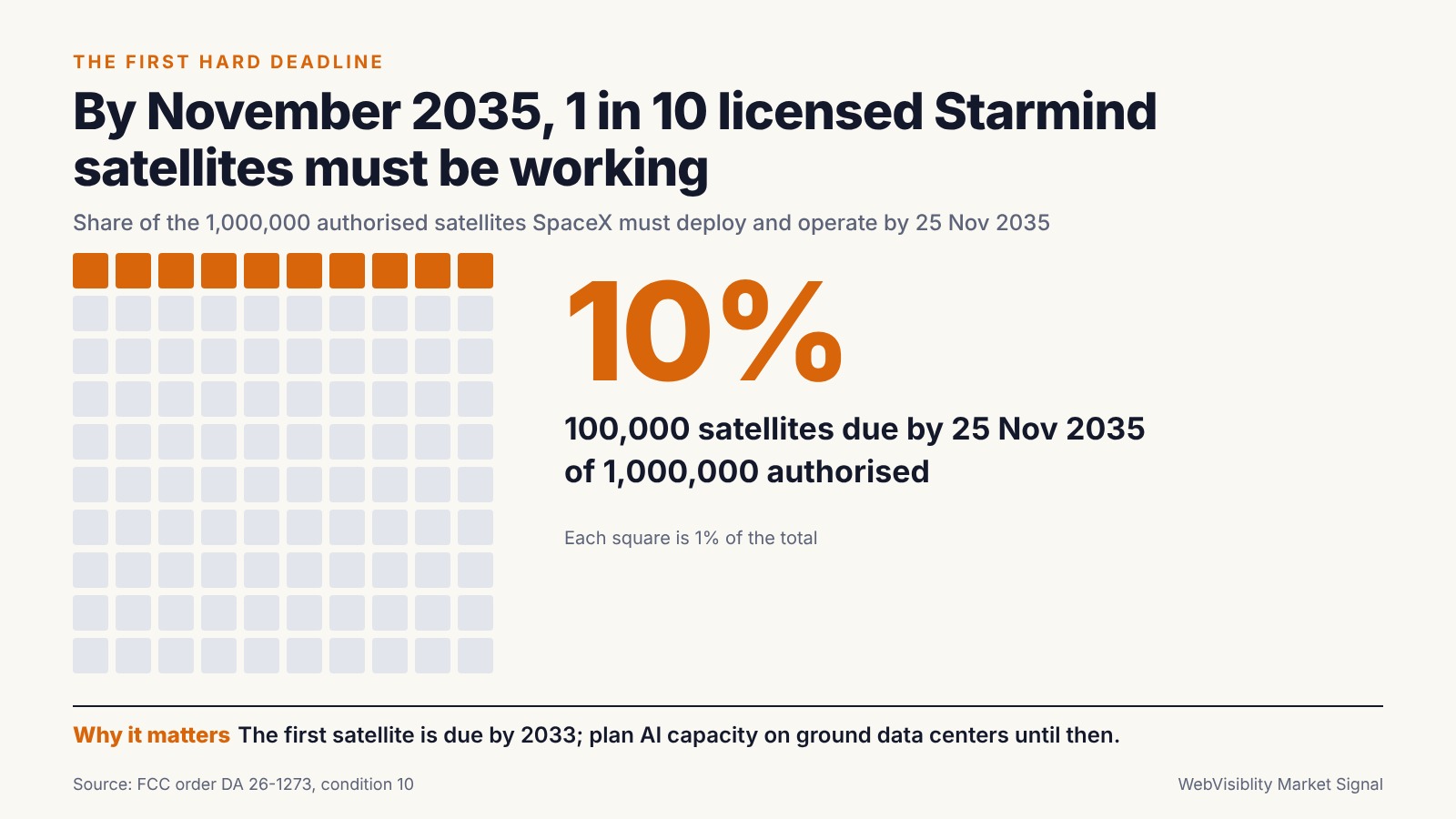
The licence carries deadlines. SpaceX must operate one satellite by 25 November 2033, 10% of the network by 2035, half by 2038 and all of it by 2040, and the 15-year licence term starts only when the first satellite is certified in orbit. It must file semi-annual safety reports, and its request to dispose of some satellites in higher orbits instead of burning them up was deferred.
FCC Chairman Brendan Carr said the decision opens a bold new frontier for computing infrastructure. Elon Musk replied on X that it will be a great asset. The American Astronomical Society said it was disheartened and dismayed, and Earthjustice said the approval skipped an environmental review that it argues the law requires. SpaceX said in August that each satellite will carry Nvidia Rubin GPUs and Vera CPUs. The FCC says it is still reviewing other orbital data center proposals.
By the numbers
What SpaceX must do under the licence
- 1Fly one
Operate the first satellite by 25 November 2033.
- 2Certify
The 15-year licence term starts when the first satellite is certified.
- 3Report
File safety reports each 1 January and 1 July.
- 4Settle disposal
Win approval for its deferred re-entry waiver before using other disposal orbits.
- 5Scale
Reach 10% by 2035, 50% by 2038 and the full network by 2040.
Timeline
FCC accepts SpaceX's application for filing.
Amazon's Kuiper, Viasat and the AAS file petitions to deny.
Space Bureau grants the licence with conditions.
Deadline for the first working satellite.
Deadline for 10% of the network.
Deadline for the full constellation.
“By moving compute capacity beyond Earth, SpaceX and the many competitors working on their own orbital data centers are meeting the moment.”
Why it matters
For anyone buying AI capacity, the dates matter more than the headline number. The licence allows a million satellites, but the first is due by November 2033 and only a tenth by 2035. Every AI search answer, chatbot reply and model call a B2B team pays for in the next several years will still run in ground data centers, so pricing, rate limits and regional hosting decisions should be planned on that basis. A vendor that cites space compute as a reason its prices will fall is talking about the next decade.
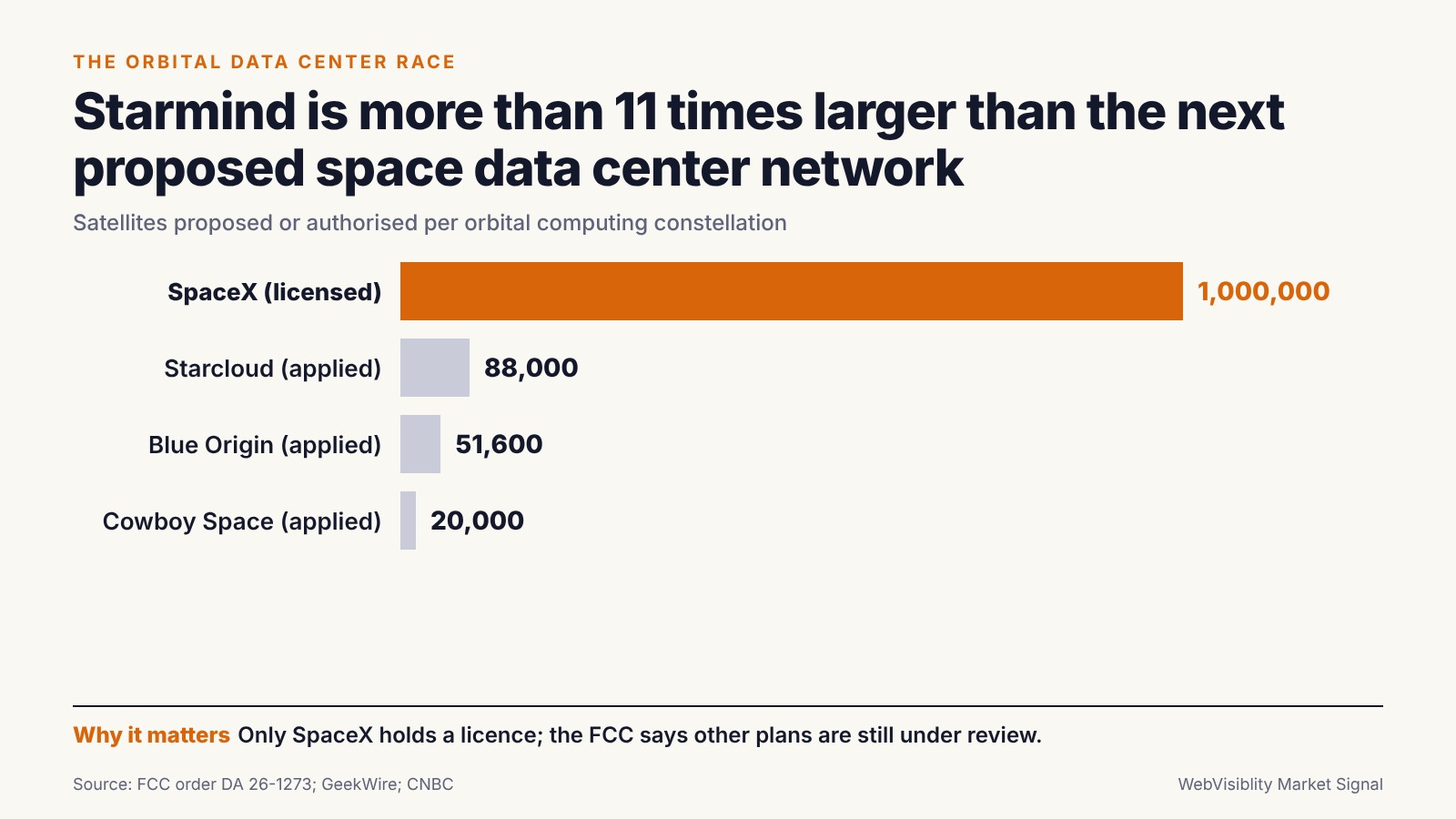
The ruling also shows how US regulators now treat AI infrastructure. The order frames the grant as advancing American leadership in space and artificial intelligence, dismisses environmental objections as outside its remit, and says the rules do not place limits on satellite numbers. The decision came about ten months after SpaceX applied, and it gives SpaceX a head start: Blue Origin, Starcloud and Cowboy Space have filed their own plans, and Google plans to launch Suncatcher satellites on Blue Origin's New Glenn no earlier than 2029.
There is a messaging lesson too. The FCC release talks of a Kardashev II civilization, while SpaceX's own investor filing called the same technology unproven. Marketers writing about AI infrastructure, sustainability or capacity should quote the licence conditions, not the slogans, because buyers and AI assistants can check both.
Who is affected
No orbital capacity is due before 2033; plan on ground data centers.
Blue Origin, Starcloud and Cowboy Space still await decisions.
Claims about space compute will be checked against the licence dates.
What to do now
For marketers
- If you sell AI infrastructure, put real service dates next to any mention of orbital or space compute.
- Check that your sustainability claims about AI hosting cite measured data, not future technology.
- Brief sales teams on the 2033 first-satellite deadline so they can answer buyer questions plainly.
For software buyers and IT teams
- Ask vendors that mention space-based compute when, in writing, it would serve your workloads.
- Base AI cost and capacity plans for the next three years on ground data centers.
- Note the first FCC safety report on 1 January as a check on progress.
Printable, one page, 10 checks. Enter your email and it opens right away.
We email you a copy. We never share your email and never send you sales emails.
Pick one. It takes 5 seconds and helps more people find these briefings. Your checklist opens straight after.
Have a work email? Use it instead and the checklist opens straight away.
Open it, then save it as a PDF or print it.
Know someone who would find this useful?
These steps are our recommendations based on this news, not statements from the companies involved.
What to watch
- Other licences. The FCC says it will decide the other orbital data center proposals under its regular procedures.
- Debris rules. SpaceX's deferred request on end-of-life disposal must be settled before it flies satellites that will not re-enter.
- Legal challenges. Earthjustice argues the approval needed an environmental review.
- First safety report. The first semi-annual report is due 1 January.
- Hardware. Progress on the compute payload SpaceX is designing with Nvidia for the first Starmind satellite.
Questions readers ask
What did the FCC approve for SpaceX Starmind?
It approved, with conditions, SpaceX's plan to launch and operate up to 1,000,000 satellites that work as data centers in orbit between 500 and 1,002 km.
When will SpaceX's space data centers be working?
The licence requires the first satellite in operation by 25 November 2033, 10% by 2035, half by 2038 and the full network by 2040. No earlier service date has been confirmed.
Who opposed SpaceX's orbital data center plan?
Amazon's Kuiper Systems, Viasat and the American Astronomical Society filed petitions to deny. The FCC denied all three on 25 November 2026.
Does the FCC approval include an environmental review?
No. The order dismissed environmental and night-sky concerns as outside FCC authority. Earthjustice says an environmental review was legally required.
How many satellites are in orbit now compared with Starmind?
About 16,700 working satellites, according to Orbital Radar via CNN. The Starmind licence covers about 60 times that number.
Will orbital data centers make AI cheaper for businesses?
Not soon. SpaceX itself called the technology unproven in its IPO filing, and the first satellite is not due until 2033, so AI prices will depend on ground data centers for years.
Companies in this story
Sources
Researched, fact-checked and edited by the Market Signal desk. Read our editorial standards. Spotted an error? Email hello@webvisiblity.com and we will correct it.