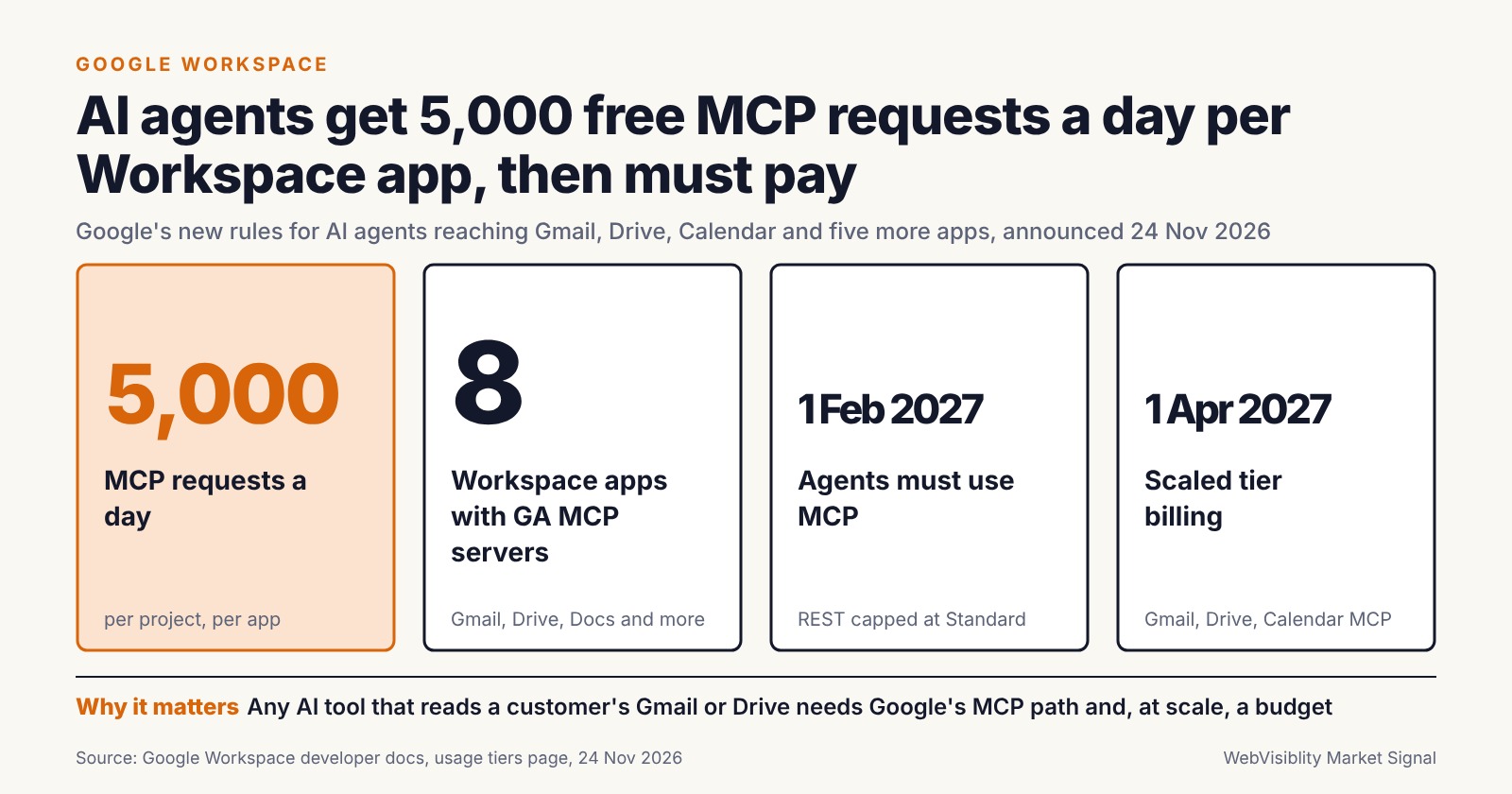
Google on 24 November told every company building AI agents on top of Gmail, Drive and Calendar to change how they connect. From 1 February 2027, agents must use Google's Workspace MCP servers instead of calling REST APIs directly. The free Standard tier allows 5,000 requests per day, per project, per product; above that, a project needs the paid Scaled tier, which starts billing on 1 April 2027.
At a glance
| Announced | 24 November 2026 |
|---|---|
| Now generally available | Workspace MCP servers and CLI |
| Apps covered | Gmail, Drive, Docs, Sheets, Slides, Calendar, Chat, Tasks |
| Free Standard cap | 5,000 MCP requests a day per project, per product |
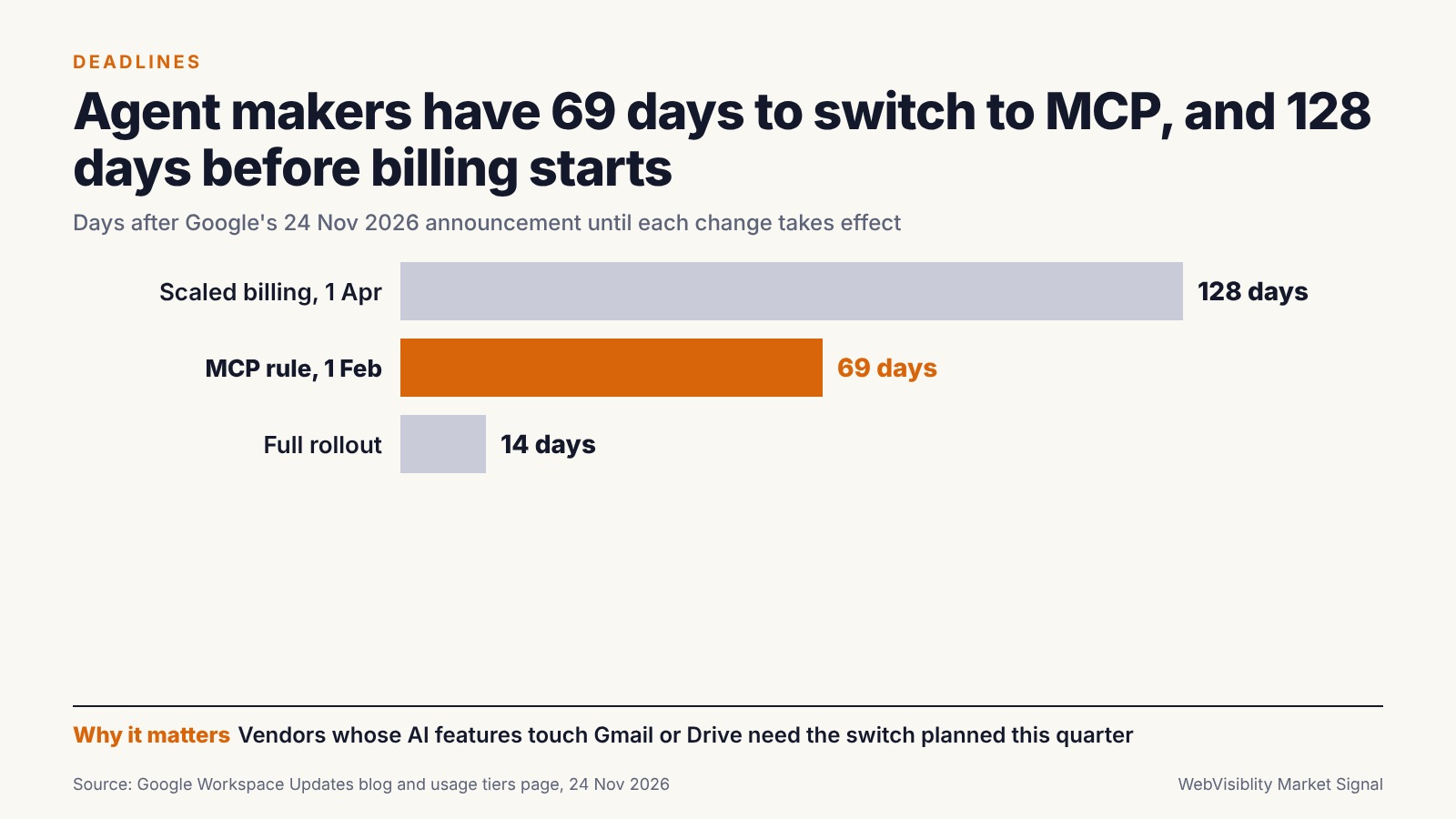
| MCP required for agents | 1 February 2027 |
| Scaled tier billing | 1 April 2027 |
Do this today
Tick each step as you do it. Your ticks stay on this device. See the full list.
For marketers
For software buyers and IT teams
The signal
- Agents that keep calling REST APIs after 1 February are limited to Standard tier quotas, even on a paid tier.
- On the Scaled tier, Gmail, Calendar and Drive MCP usage is billed from the first request, with no daily free allowance.
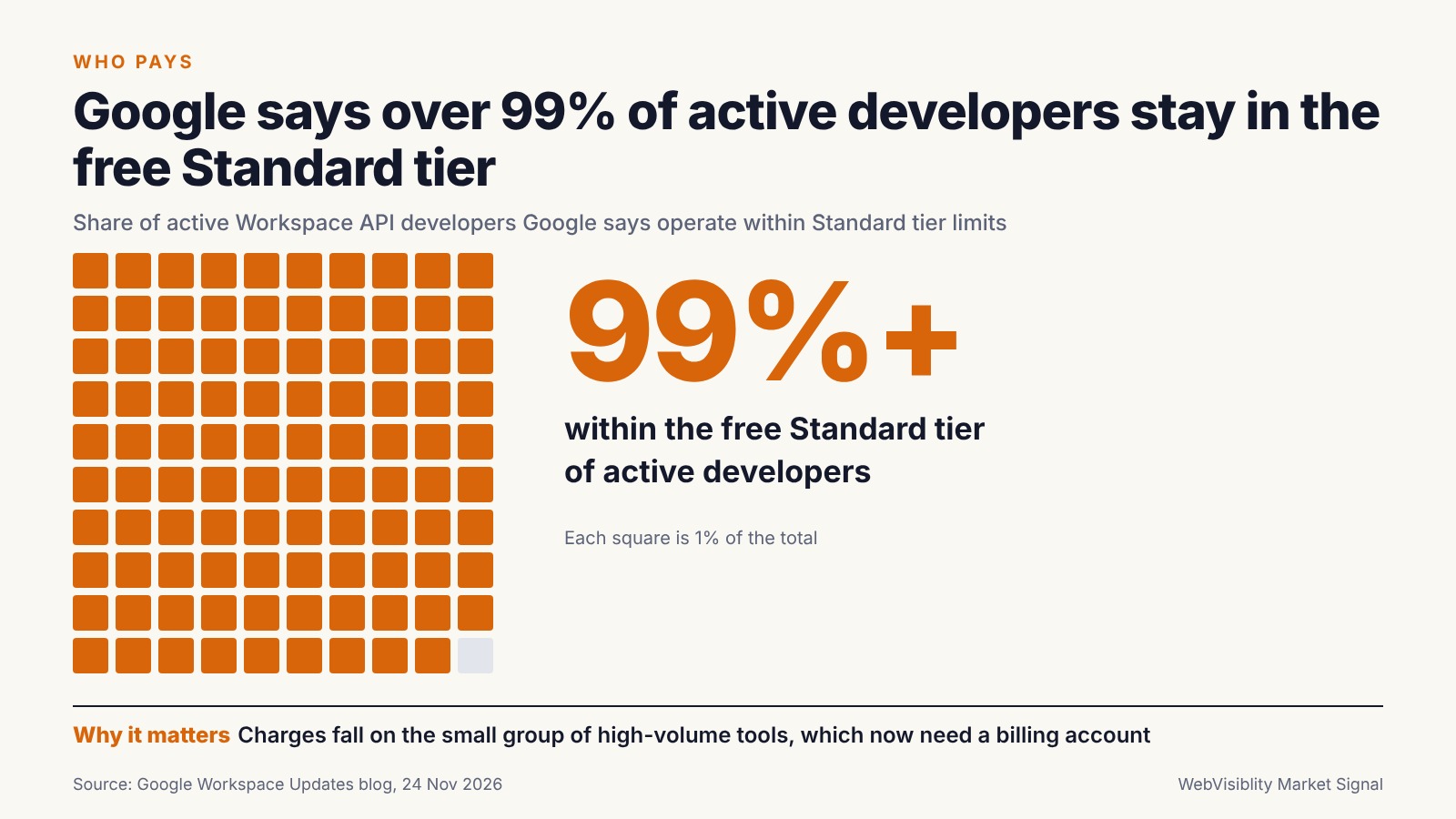
- Google says over 99% of active developers already work within the free Standard tier.
- External agents must use dedicated OAuth client IDs marked as AI agents, separate from normal app clients.
- Admins can view, audit and revoke AI agents in the Admin console, like ordinary apps.
- A new addendum bars agents from scraping Workspace APIs or storing certain derived data for long periods.
Which of these are you?
Tap the one that fits you best. We show what this story changes for you.
What happened
Google has offered Workspace APIs for years to apps that sync mail, files and calendars. On 24 November it split that world in two. Ordinary apps can keep using the REST APIs. AI agents, which Google says act at machine speed, must go through two Google-run front doors: the Workspace MCP servers for cloud and web agents, and the Workspace CLI for local and terminal agents. Both are now generally available.
MCP, the Model Context Protocol, is an open standard for connecting AI tools to apps. Google says its servers return synthesized summaries within Workspace's boundary instead of raw data line by line, which cuts token cost and keeps company data rules in force. Every agent request is checked against the customer's permissions, DLP rules and classification labels. Agents can draft and summarise on their own, but sending external email, changing Drive sharing or making bulk edits needs a person's confirmation under rules the IT team sets.
The second change is money. Usage now sits in two tiers, starting with Gmail, Drive and Calendar. Standard is free with published limits. Scaled offers higher quotas to a project with a linked billing account, and Google will not bill Scaled usage before 1 April 2027. A new Workspace AI Tools Addendum takes effect on 1 February and, according to Google's own blog, requires deletion of your data when you disconnect. The Next Web reported the addendum also bars using Workspace data to train models or build rival services. Coverage by explainx.ai and The D*AI*LY Brief stressed that this is a required path, not a ban on agents.
By the numbers
How an AI agent will reach Workspace data from 2027
- 1Register
Agent uses an OAuth client marked as an AI agent.
- 2Connect
It calls the Workspace MCP servers or CLI, not REST.
- 3Check
Each request meets permissions and DLP rules.
- 4Confirm
Sensitive actions need a user's confirmation.
- 5Log
Admins see actions in agent audit logs.
Timeline
Google documents baseline quotas for new Gmail, Calendar and Drive API projects.
Workspace MCP servers and CLI become generally available; Standard and Scaled tiers launch.
MCP requirement enforcement begins and the AI Tools Addendum takes effect.
Scaled tier billing starts; projects above Standard limits without Scaled revert to Standard.
“Because traditional APIs and access models were built for human-paced predictable software, they cannot effectively secure this frontier.”
Why it matters
Many B2B tools now sell AI features that read a customer's inbox or files: sales assistants that draft follow-ups from Gmail threads, meeting tools that read Calendar, content tools that pull briefs from Drive. Each of those vendors now has a deadline. If their agent still calls REST directly on 1 February, it drops to Standard tier quotas, and heavy users of the product will feel it as throttling.
The Standard cap is per product, so an agent that touches mail, calendar and files counts against three separate 5,000-request daily limits. Google also warns that some MCP tools count as multiple requests because they make several API calls. Vendors that need more than that pay on the Scaled tier from April, and that cost will show up somewhere, most likely in their own pricing. Buyers comparing AI sales and marketing tools should ask who pays.
There is also a trust angle that matters for AI visibility. Google is making agents visible: admins see them in a console, users confirm sensitive actions, and agents get their own identity. For a vendor, being an approved, well-behaved agent in a customer's Workspace becomes a selling point, and security reviews will start asking for it. Expect procurement questionnaires to add one line: does your AI use Workspace MCP, and can we revoke it?
Who is affected
Must move agent access to MCP by 1 February 2027.
Pay on the Scaled tier from 1 April 2027.
Gain an agent view and revoke control in the Admin console.
Little change; most stay within the free Standard tier.
What to do now
For marketers
- List every AI tool your team uses that reads Gmail, Calendar or Drive.
- Ask each vendor in writing when it will move to Workspace MCP.
- If you sell an AI product on Workspace data, publish a plain-English page on how it connects and how admins revoke it.
For software buyers and IT teams
- Add 'Does your AI use Workspace MCP?' to security questionnaires.
- Ask AI tool vendors whether Scaled tier costs will change your price after April 2027.
- Have your Workspace admin review agent access under Security, API Controls.
Printable, one page, 11 checks. Enter your email and it opens right away.
We email you a copy. We never share your email and never send you sales emails.
Pick one. It takes 5 seconds and helps more people find these briefings. Your checklist opens straight after.
Have a work email? Use it instead and the checklist opens straight away.
Open it, then save it as a PDF or print it.
Know someone who would find this useful?
These steps are our recommendations based on this news, not statements from the companies involved.
What to watch
- Vendor notices. Which sales, meeting and email tools announce their move to MCP before 1 February.
- Price changes. Whether AI tools that sync Gmail, Calendar or Drive at volume pass on Scaled tier charges after April.
- More apps. Google says Keep is coming soon and other data access mechanisms will follow.
- User controls. The promised ability for users to view agent activity and revoke access themselves.
Questions readers ask
Is Google blocking AI agents from Gmail and Drive?
No. Agents must connect through Workspace MCP servers or the CLI from 1 February 2027. Agents that keep calling REST APIs directly are limited to Standard tier quotas.
What is the Google Workspace MCP server limit?
The free Standard tier allows 5,000 requests per day, per project, per product, plus per-minute limits. Higher quotas need the Scaled tier with a linked billing account.
When does Google Workspace start charging for AI agent API use?
Scaled tier billing starts on 1 April 2027. Gmail, Calendar and Drive MCP usage on Scaled is billed from the first request, with no daily free allowance.
Which Google Workspace apps have MCP servers?
Gmail, Drive, Docs, Sheets, Slides, Calendar, Chat and Tasks, with Keep coming soon. Billing on the Scaled tier currently covers the Gmail, Calendar and Drive MCP servers.
What is the Workspace AI Tools Addendum?
New Google terms, effective 1 February 2027, that require MCP for AI agents and ban scraping Workspace APIs or storing certain derived data for long periods.
How can a Workspace admin see which AI agents access company data?
In the Admin console under Security, API Controls, admins can manage agent access, set confirmation rules and view agent audit logs.
Do internal company AI agents have to pay for the Scaled tier?
Not always. Admins can mark internal projects for higher REST limits without Scaled, but Google says MCP quotas are not eligible for increases under that exception.
Companies in this story
Sources
- Google Workspace UpdatesOriginal
- Google for DevelopersOriginal
- Google Workspace BlogOriginal
- The Next Web
- explainx.ai
- The D*AI*LY Brief
Researched, fact-checked and edited by the Market Signal desk. Read our editorial standards. Spotted an error? Email hello@webvisiblity.com and we will correct it.