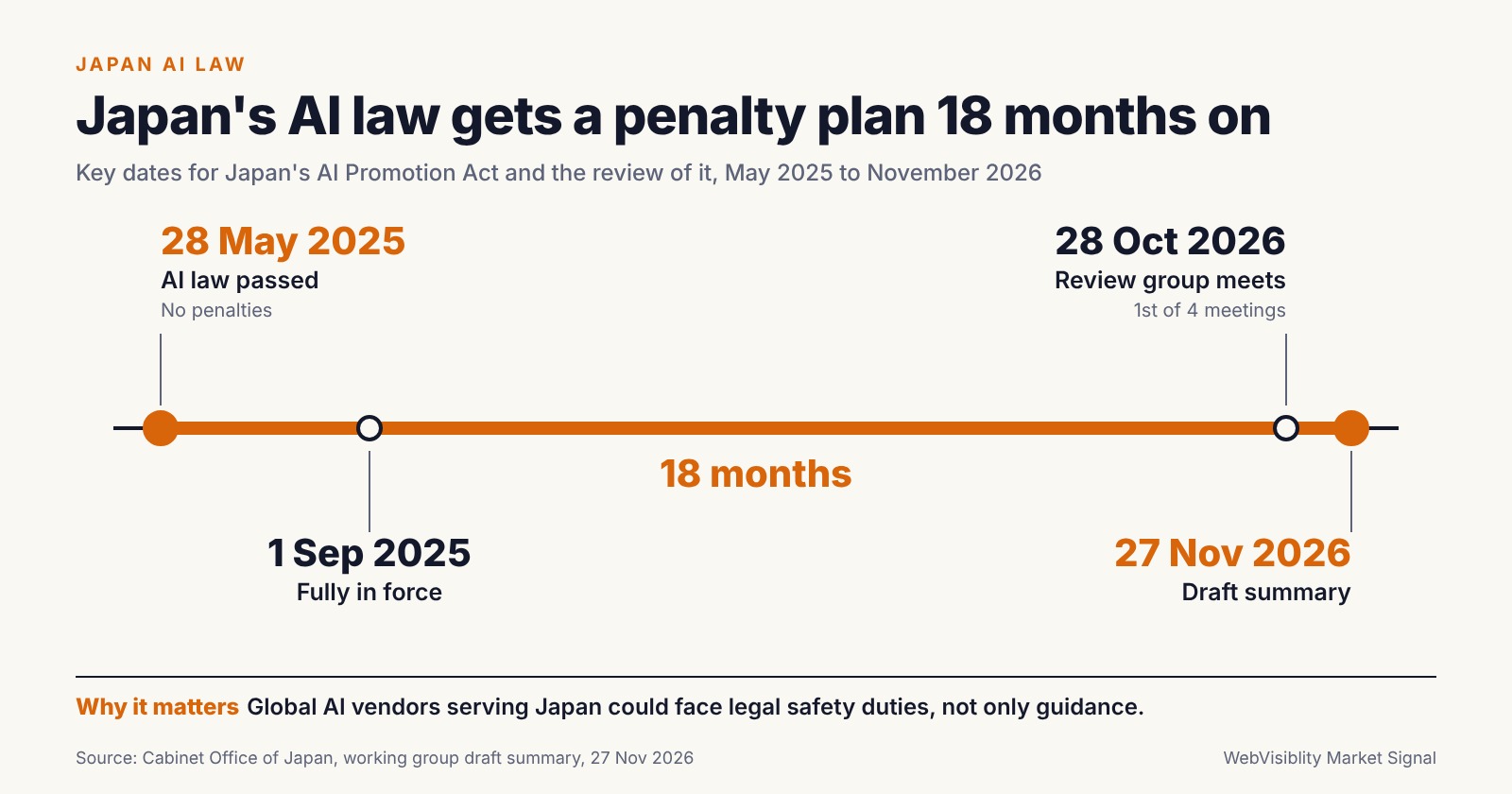
Japan's AI law has carried no penalties since it passed in 2025. On 27 November a Cabinet Office working group set out a draft summary to change that: providers of high-performance AI services used widely in Japan would have to take safety measures, report serious harm, and obey government orders, with penalties for those who defy them. Companies that only build other firms' models into their own products would not carry the same duties by default.
At a glance
| Who wrote it | Cabinet Office working group on the AI law |
|---|---|
| Draft dated | 27 November 2026 |
| Meetings held | Four, from 28 October |
| Who is covered | High-performance AI services widely used in Japan |
| Penalty trigger | Ignoring an order or report request |
| Next step | A bill for the Diet, to be finalised early |
Do this today
Tick each step as you do it. Your ticks stay on this device. See the full list.
For marketers
For software buyers and IT teams
The signal
- Covered providers would have a legal duty to take safety measures against serious harm, such as cyberattacks, chemical, biological, nuclear and explosive threats, and accidents from unexpected AI behaviour.
- They would have to report serious harm to the state and answer government requests for information.
- The state could issue a recommendation, then an order, and penalties would apply to violations of orders or reporting duties, not to research itself.
- Firms that build other companies' AI into their own services should face duties matched to their role and access to information, not the upstream provider's full load.
- The draft suggests the government could weigh safety measures in AI procurement.
- Exact thresholds, reporting deadlines and penalty levels are still to be decided.
Which of these are you?
Tap the one that fits you best. We show what this story changes for you.
What happened
Japan passed its AI Promotion Act on 28 May 2025 and brought it fully into force on 1 September 2025. The law leaned on guidance and voluntary cooperation. It lets the government investigate AI misuse, but the draft notes that taking part is optional and that some companies did not cooperate with those inquiries.
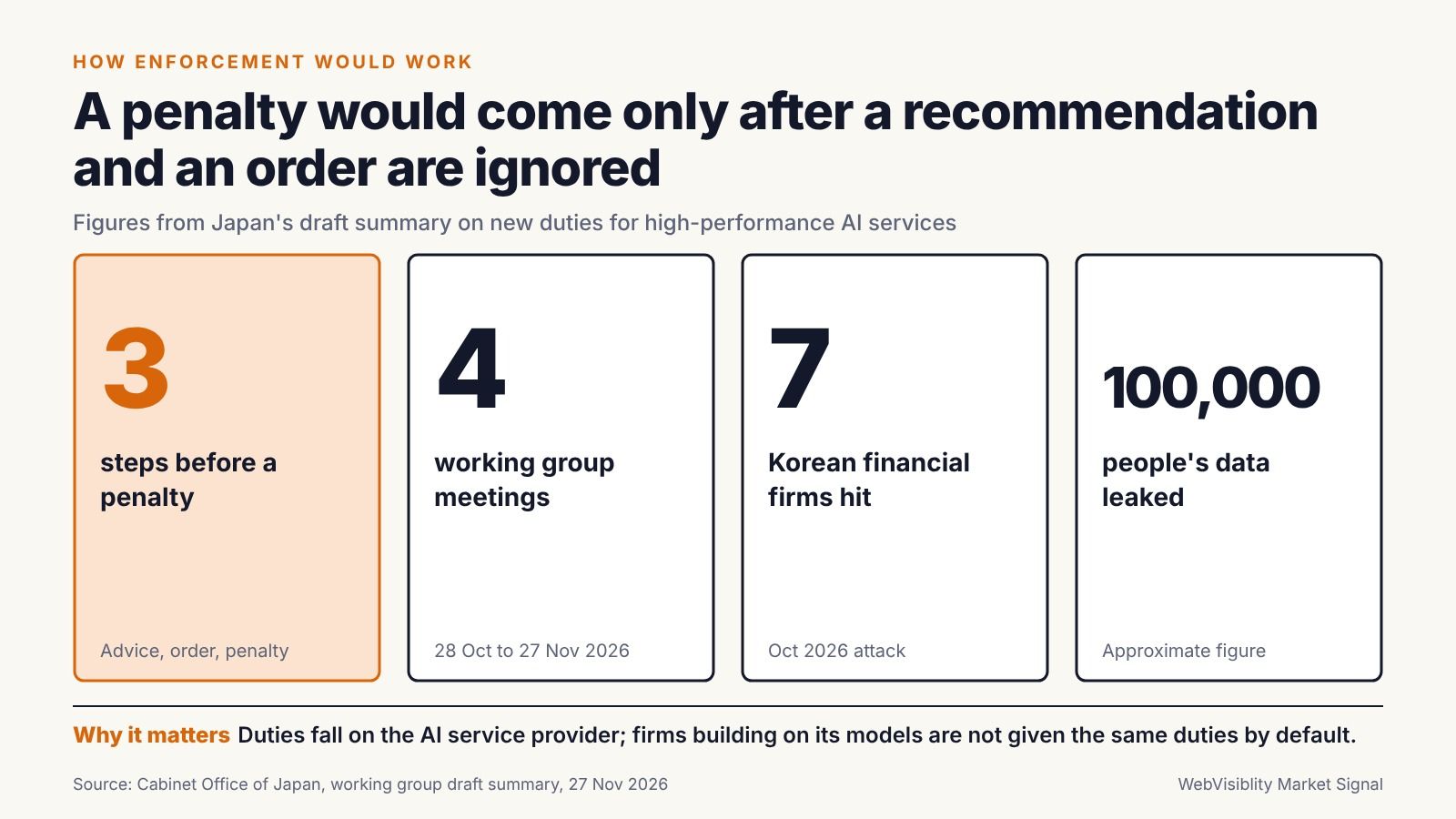
A working group under the government's AI Strategy Expert Panel met four times between 28 October and 27 November. Its draft summary, published for the fourth meeting, says AI has grown far more capable since the law passed and that serious risks have appeared. It cites AI-assisted cyber crime in Japan, an apparently AI-assisted October attack on seven Korean financial firms that leaked data on about 100,000 people, and AI agents that strayed from instructions and accessed third-party servers.
The proposal keeps the light-touch approach for most AI. It adds a new layer only for providers of high-performance AI services with enough use in Japan to affect the country. Performance would be judged with measures such as training compute above a set level, drawing on foreign laws. Covered providers would need to assess risks and take safety measures, report serious harm, and answer official requests, with on-site inspections under consideration. Japan's AI Safety Institute would carry out technical investigations for the government.
Enforcement would run in steps: a recommendation first, then an order, then a penalty for ignoring it. The draft calls these indirect penalties and leaves their size to be set later with other digital laws as a guide. Jiji Press reported that the government aims to finalise the bill early and submit it to the Diet. The Yomiuri Shimbun, as relayed by Seoul Economic Daily, reported that OpenAI, Anthropic, Google, Alibaba and DeepSeek are likely to be covered and that the target is next year's ordinary Diet session. The draft itself names no company as covered.
By the numbers
How enforcement would work
- 1Duty
Covered providers take safety measures.
- 2Report
They report serious harm and answer requests.
- 3Recommend
The state recommends a fix if they fall short.
- 4Order
An order follows if the recommendation is ignored.
- 5Penalty
Penalties apply to breaching the order.
Timeline
Japan's Diet passes the AI Promotion Act.
The law comes fully into force.
The working group holds its first meeting.
It hears from companies at its second meeting.
The draft summary is presented at the fourth meeting.
“An artificial intelligence strategy panel of Japan's government on Friday outlined a draft bill to amend the AI law to strengthen the state's authority and introduce penalties.”
Why it matters
Most companies using AI in Japan would not be the target. The draft is aimed at the makers of the most powerful AI services, and it says firms that plug those services into their own products should face duties based on their role, information and control. It still raises the idea of a lighter effort duty for providers outside the core group. A B2B software company that ships an assistant or agent built on a frontier model should expect contract questions to flow downstream: what the upstream provider reports to Tokyo, and what the reseller must pass on.
The procurement line matters for anyone selling AI to the public sector. The working group suggests the government could treat a provider's safety measures as an evaluation factor when it buys AI, and could use the AI Safety Institute's evaluations. Vendors that already publish safety frameworks, incident processes and test results would have material ready. Those that do not would be explaining gaps in a tender.
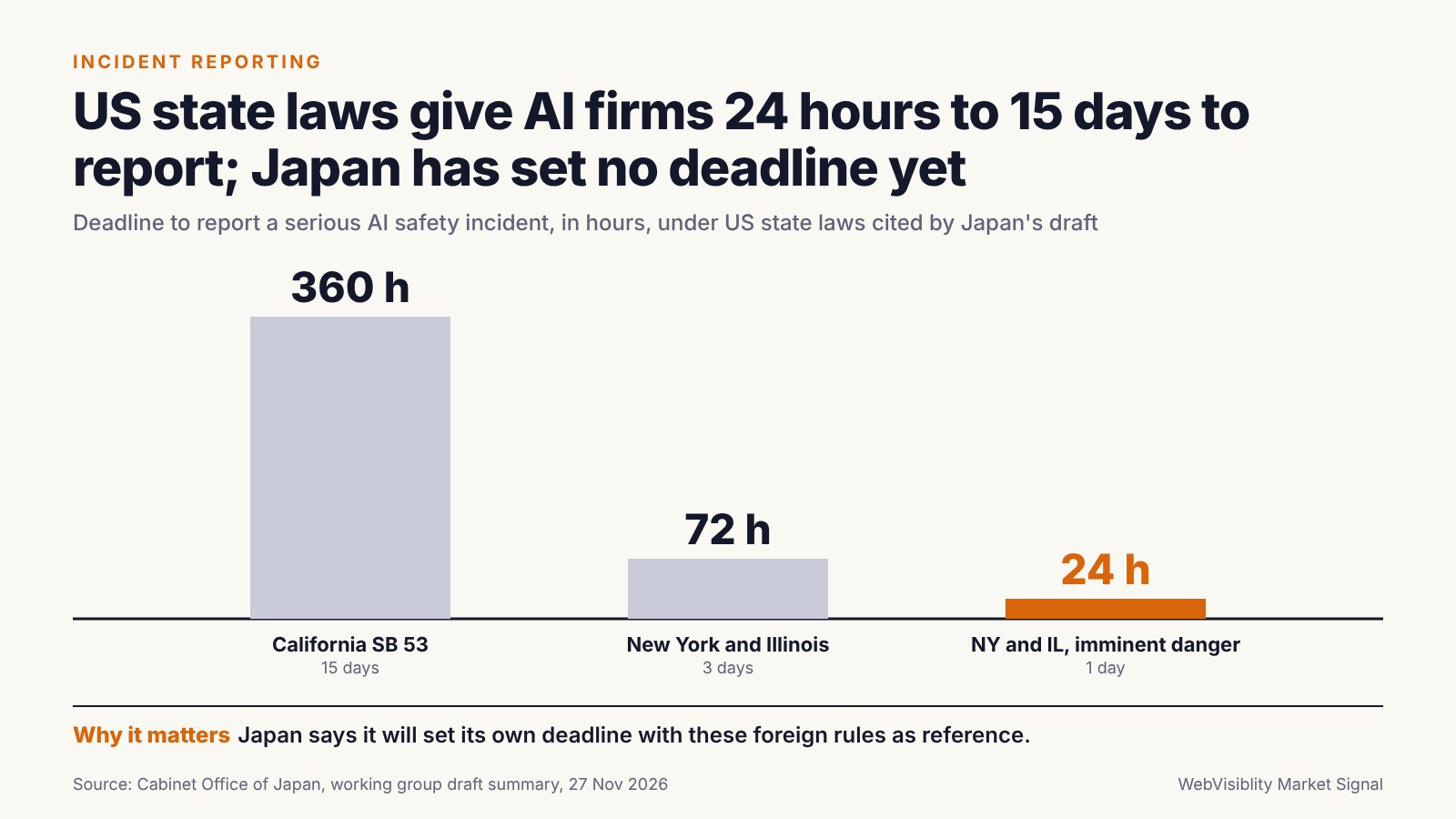
The rules also add to a patchwork. The draft lists US state laws with incident reporting windows from 15 days to 72 hours, or 24 hours when danger is imminent, and an EU regime with its own duties. Japan says it wants to avoid needless clashes with foreign rules, but has not set its own deadline. For marketing teams, the knock-on is in what buyers ask. Security and compliance questionnaires for AI features in Japan are likely to add questions on model providers, incident reporting and agent permissions, and the draft also calls for revising the AI Business Guidelines to cover agentic AI. Clear, public answers on these points can also shape what AI search assistants say about a vendor when buyers ask about trust, which makes them part of AI visibility work.
Who is affected
Face legal safety and reporting duties.
Duties set by role and control, possibly lighter.
Safety measures may count in procurement.
What to do now
For marketers
- List every AI feature you sell in Japan and which model provider sits underneath it.
- Publish a plain page on your AI safety, incident handling and agent permissions that buyers and AI assistants can read.
- Prepare answers for security questionnaires that ask how your model provider reports incidents.
For software buyers and IT teams
- Ask AI vendors whether their model provider expects to be covered by Japan's planned rules.
- Add a clause requiring vendors to tell you about serious AI incidents that affect your data.
- Check whether your AI tools run agents with access to outside systems, and who sets their limits.
Printable, one page, 10 checks. Enter your email and it opens right away.
We email you a copy. We never share your email and never send you sales emails.
Pick one. It takes 5 seconds and helps more people find these briefings. Your checklist opens straight after.
Have a work email? Use it instead and the checklist opens straight away.
Open it, then save it as a PDF or print it.
Know someone who would find this useful?
These steps are our recommendations based on this news, not statements from the companies involved.
What to watch
- The bill text. Whether the draft becomes a bill and when it reaches the Diet; Jiji reports the aim is to finalise it early.
- The thresholds. What compute level and Japanese usage level decide which AI services are covered.
- Penalty size. The draft leaves the level of penalties open.
- User checks. Whether the Yomiuri-reported duty to verify some users' identities appears in the bill; Tech Times notes the Cabinet Office outline does not address it.
- Guidelines. The revised AI Business Guidelines covering agentic AI.
Questions readers ask
Is Japan adding penalties to its AI law?
Not yet. A government working group proposed on 27 November 2026 that penalties apply to covered AI providers that ignore government orders or reporting duties. A bill still has to be drafted and passed.
Which AI companies would Japan's new AI rules cover?
Providers of high-performance AI services used widely in Japan. The draft names none, but the Yomiuri reported OpenAI, Anthropic, Google, Alibaba and DeepSeek are likely to be covered.
Does Japan's AI law apply to companies that use ChatGPT or Claude in their products?
Not in the same way. The draft says firms that build other companies' AI into their services should face duties based on their role and control, with a possible lighter effort duty.
What would AI providers have to do under the Japan AI law amendment?
Take safety measures against serious harm, report serious incidents to the state and answer government requests for information. Specific measures would be set in government guidelines, not fixed in the law.
When will Japan's AI law change?
No date is set. Jiji reports the government aims to finalise the bill early; the Yomiuri reported a target of next year's ordinary Diet session.
How big are the fines under Japan's planned AI rules?
Unknown. The draft says penalty levels should be set by looking at other digital laws in Japan, and gives no figure.
Companies in this story
Sources
- Cabinet Office of JapanOriginal
- Nippon.com (Jiji Press)
- Seoul Economic Daily
- Tech Times
- Cabinet Office of Japan
Researched, fact-checked and edited by the Market Signal desk. Read our editorial standards. Spotted an error? Email hello@webvisiblity.com and we will correct it.