Google DeepMind has published a benchmark that grades AI models on consistency rather than peak skill. Humanity's First Exam holds 544 elementary text and image prompts that human testers solved in a median of about one minute. A model only passes a set of four related prompts if it answers all 16 runs correctly. The five best models scored 96% to 98% on a single try, but averaged 85.8% once every run had to be right.
At a glance
| Prompts in the test | 544, in 136 sets of four |
|---|---|
| Models scored | 18 frontier and fast-tier models |
| Best strict score | 92.4% for GPT-6.2 Astra |
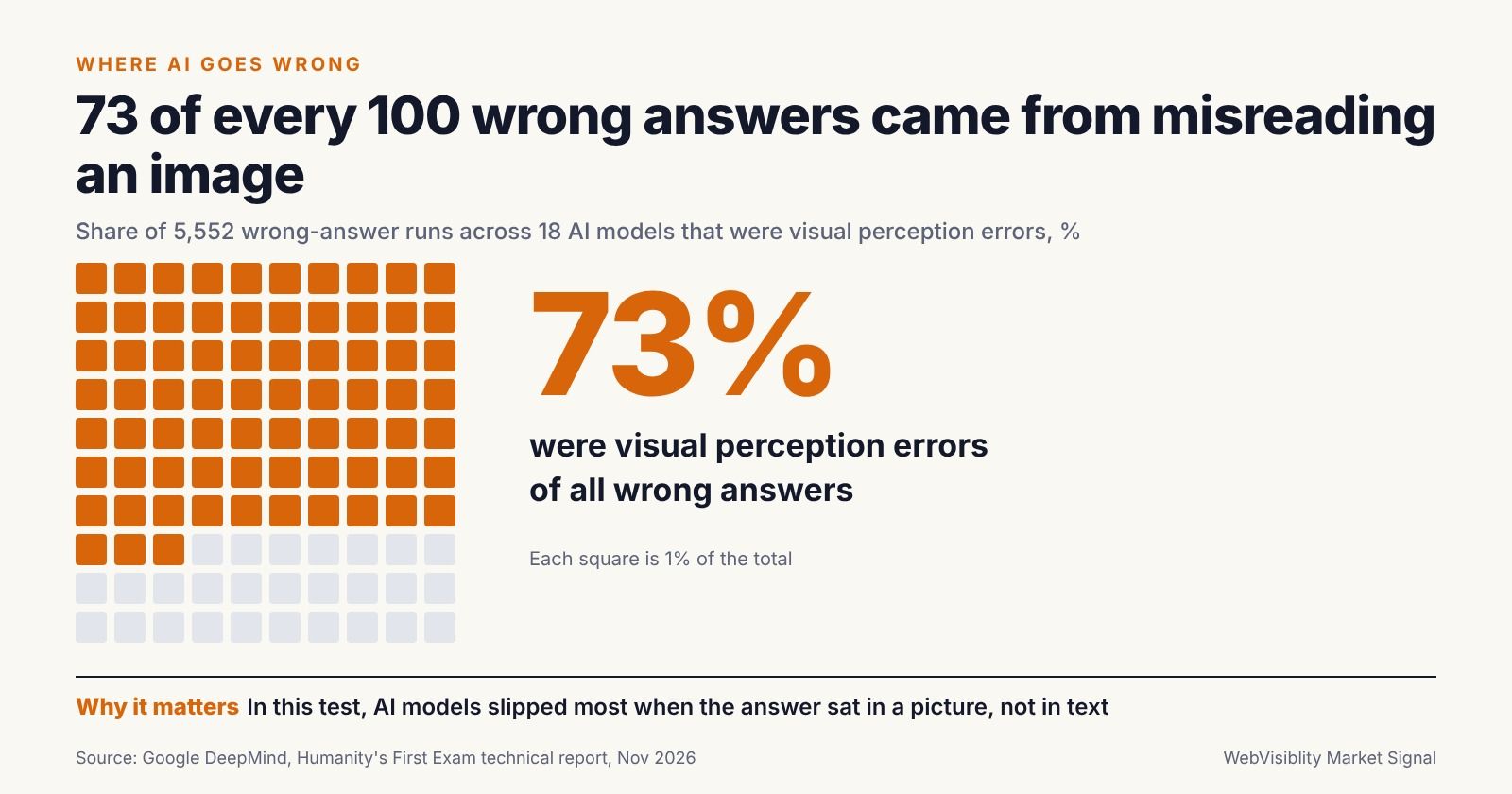
| Wrong answers from images | 73% of wrong answers |
| Question contest closes | 15 December on Kaggle |
Do this today
Tick each step as you do it. Your ticks stay on this device. See the full list.
For marketers
For software buyers and IT teams
The signal
- Every model in the top 12 solved 99.3% to 100% of sets at least once, so the gap is about consistency, not ability.
- Roughly half of the shortfall comes from questions a model always gets wrong and half from answers that change between runs.
- Misjudging a position or direction in an image caused 31% of wrong answers, and miscounting objects caused 23%.
- In 40% of failed cases the answer was a near miss, such as a count off by one.
- Extra thinking time helped text tasks far more than image tasks: Gemini 4 Carbon lost 42.4 points on maths at low effort but only 3.1 on vision.
- Refusals hit only Anthropic models; Claude Opus 5.5 refused on 1.6% of runs, which cut its strict score by 4.4 points.
Which of these are you?
Tap the one that fits you best. We show what this story changes for you.
What happened
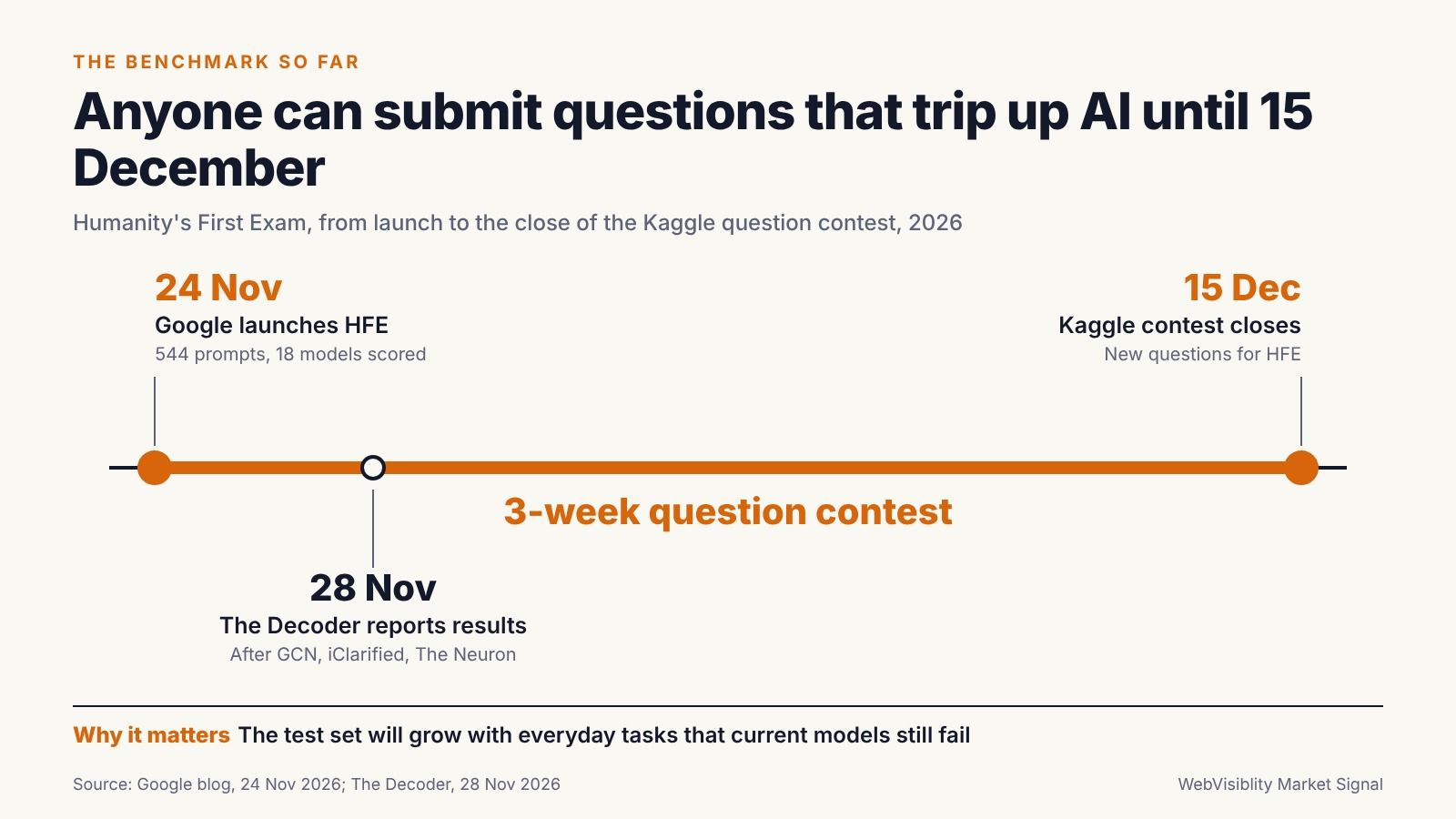
Google DeepMind launched the benchmark on 24 November with a live Kaggle leaderboard and a technical report. The test is a deliberate counterpoint to Humanity's Last Exam, which chases expert-level problems; this one checks whether models can do simple, everyday questions correctly every single time. Its prompts cover counting objects, naming colours, reading text in pictures, tracking positions, simple arithmetic and following exact formats.
Each prompt was run six times per model with no tools, no search and no system prompt, and the main score asks for all 16 sampled runs across a set to be correct. On that measure OpenAI's GPT-6.2 Astra led at 92.4%, followed by GPT-6.2 Sol at 86.9% and Google's Gemini 4 Neon at 85.8%. The strict score fell as low as 18.6% for Gemini 3.5 Flash-Lite. The live leaderboard at launch showed slightly different figures, with GPT-6.2 Astra at 90.7%.
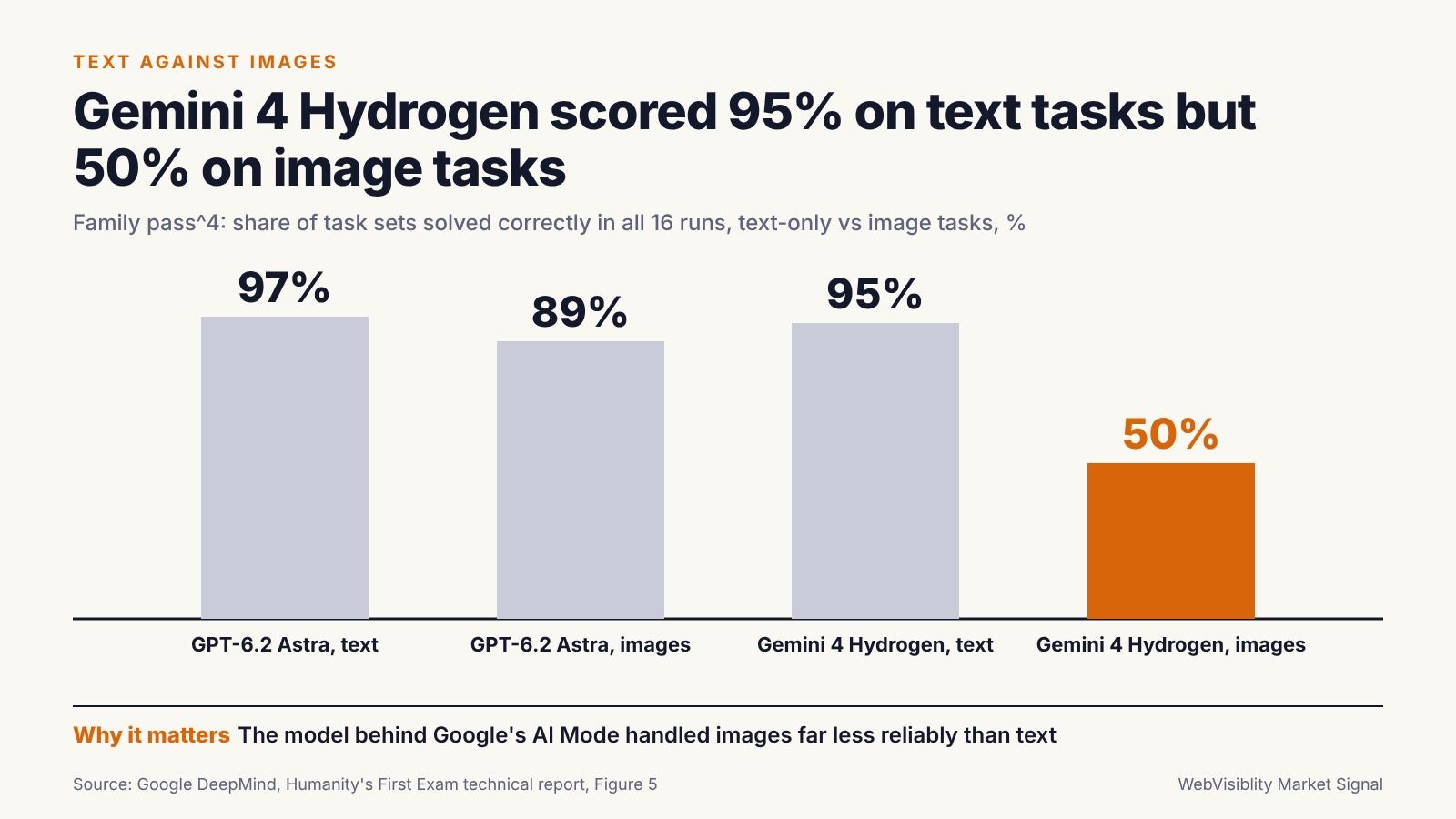
The report shows small single-try gaps turning into large reliability gaps. Claude Opus 5.5 trailed GPT-6.2 Astra by 6.6 points on one try but by 29.4 points on the strict score. Images drove most failures: the top nine models scored 83% to 97% on text-only sets but 64% to 89% on image sets.
The Decoder's 28 November report brought the results to a wider audience, after GCN, iClarified and The Neuron covered the launch. DeepMind released 112 public prompts and keeps the other 432 private to stop models training on the answers.
By the numbers
How to test what AI says about your brand
- 1Phrase
Write three or four versions of each buyer question, since models handle slight variations differently.
- 2Repeat
Run each version several times; answers that change between runs are about half the problem.
- 3Spot images
List facts that live only in screenshots, charts or product images.
- 4Move to text
Put those facts in page text and structured data, then check again.
Timeline
Google makes Gemini 4 Hydrogen the default model in AI Mode.
Google DeepMind launches Humanity's First Exam on Kaggle with a technical report.
iClarified and The Neuron report the launch leaderboard.
GCN details the $50,000 Kaggle prize pool, paid in Kaggle merchandise.
The Decoder reports that visual perception drives most errors.
The Kaggle contest for new everyday questions closes.
“Instead of focusing on whether a model is capable of solving a task once, HFE measures whether models can consistently solve tasks (and slight variations) every single time.”
Why it matters
B2B buyers increasingly read a vendor through an AI answer, and this report puts numbers on how often those answers wobble. A model that gets a simple task right on one try can still miss it on the next run or on a slightly reworded question. DeepMind found that failing one version of a prompt only weakly predicts failure on a close variant, so one spot check of what an assistant says about a brand proves little. AI visibility checks need several phrasings of each buyer question, repeated over time, before a result counts as a pattern; answers vary from run to run even when the facts behind them do not change.
The image finding is the practical one for content teams. Reading text or values in a picture caused 7% of wrong answers, and chart reading had its own category in the test. Pricing tables saved as screenshots, specs inside product images and key figures shown only in infographics ask an AI model to do the task this benchmark shows it does least reliably. Keeping those facts in page text, with schema markup where it fits, gives AI search systems a version that does not depend on reading a picture.
The Google result deserves a note. Gemini 4 Hydrogen, which Google made the default AI Mode model, scored 68.9% on the strict measure and fell 45.5 points from text to image tasks, one of the widest drops in the test. The benchmark ran models without search or tools, so it does not grade AI Mode itself, but it shows where the model underneath is weakest.
What to do now
For marketers
- Find every pricing table, spec sheet or key figure on your site that exists only as an image and add it as page text.
- Ask your top buyer questions in three or four wordings, three times each, before drawing conclusions about AI answers.
- Log which answers change between runs and recheck those monthly rather than treating one result as fixed.
For software buyers and IT teams
- Ask the same vendor question more than once, in different words, before trusting an AI shortlist.
- Check any figure an assistant reads from a chart or screenshot against the vendor's own page.
- Ask AI tool vendors how they test consistency, not only peak accuracy.
Printable, one page, 11 checks. Enter your email and it opens right away.
We email you a copy. We never share your email and never send you sales emails.
Pick one. It takes 5 seconds and helps more people find these briefings. Your checklist opens straight after.
Have a work email? Use it instead and the checklist opens straight away.
Open it, then save it as a PDF or print it.
Know someone who would find this useful?
These steps are our recommendations based on this news, not statements from the companies involved.
What to watch
- New questions. The Kaggle contest runs to 15 December; winning tasks are meant to feed later versions of the test.
- Leaderboard moves. Watch whether Google's own models close the gap to GPT-6.2 Astra on the live Kaggle leaderboard.
- Agent reliability. The report scopes the test to single-turn answers and says reliability is equally critical in agentic workflows, which it does not yet measure.
- Refusals. Anthropic's strict scores would rise if refusals on benign, basic tasks fall in later model versions.
Who is affected
| Who | What changes | Impact |
|---|---|---|
| Content and web teams | Facts kept only in images face the task where 73% of errors occurred. | High |
| AI visibility and SEO teams | Single checks miss run-to-run changes in AI answers. | High |
| Buyers using AI to compare vendors | Counts and figures read from pictures were often off by one. | Medium |
Questions readers ask
What is Humanity's First Exam?
It is a Google DeepMind benchmark of 544 simple text and image prompts that tests whether AI models answer everyday questions correctly every time, not just once.
Which AI model is most reliable on Humanity's First Exam?
OpenAI's GPT-6.2 Astra. In DeepMind's technical report it scored 92.4% on the strict measure, ahead of GPT-6.2 Sol at 86.9% and Gemini 4 Neon at 85.8%.
Why do AI models get simple questions wrong?
Mostly because of images. DeepMind found 73% of wrong answers were visual perception errors, led by misjudging positions or directions and miscounting objects.
Does AI give the same answer every time?
Not reliably. In DeepMind's test, about half of the shortfall came from answers that changed between runs of the same prompt, even for top models.
Does more reasoning make AI more reliable?
For text, yes; for images, much less. Gemini 4 Carbon lost 42.4 points on maths tasks at low effort but only 3.1 points on vision tasks.
How did Gemini 4 Hydrogen do on Humanity's First Exam?
It scored 68.9% on the strict measure. Its score fell 45.5 points from text to image tasks, one of the largest drops among the 18 models.
How can I submit a question to Humanity's First Exam?
Through Google's Kaggle competition, which takes everyday questions that models still get wrong until 15 December.
Companies in this story
Sources
Researched, fact-checked and edited by the Market Signal desk. Read our editorial standards. Spotted an error? Email hello@webvisiblity.com and we will correct it.