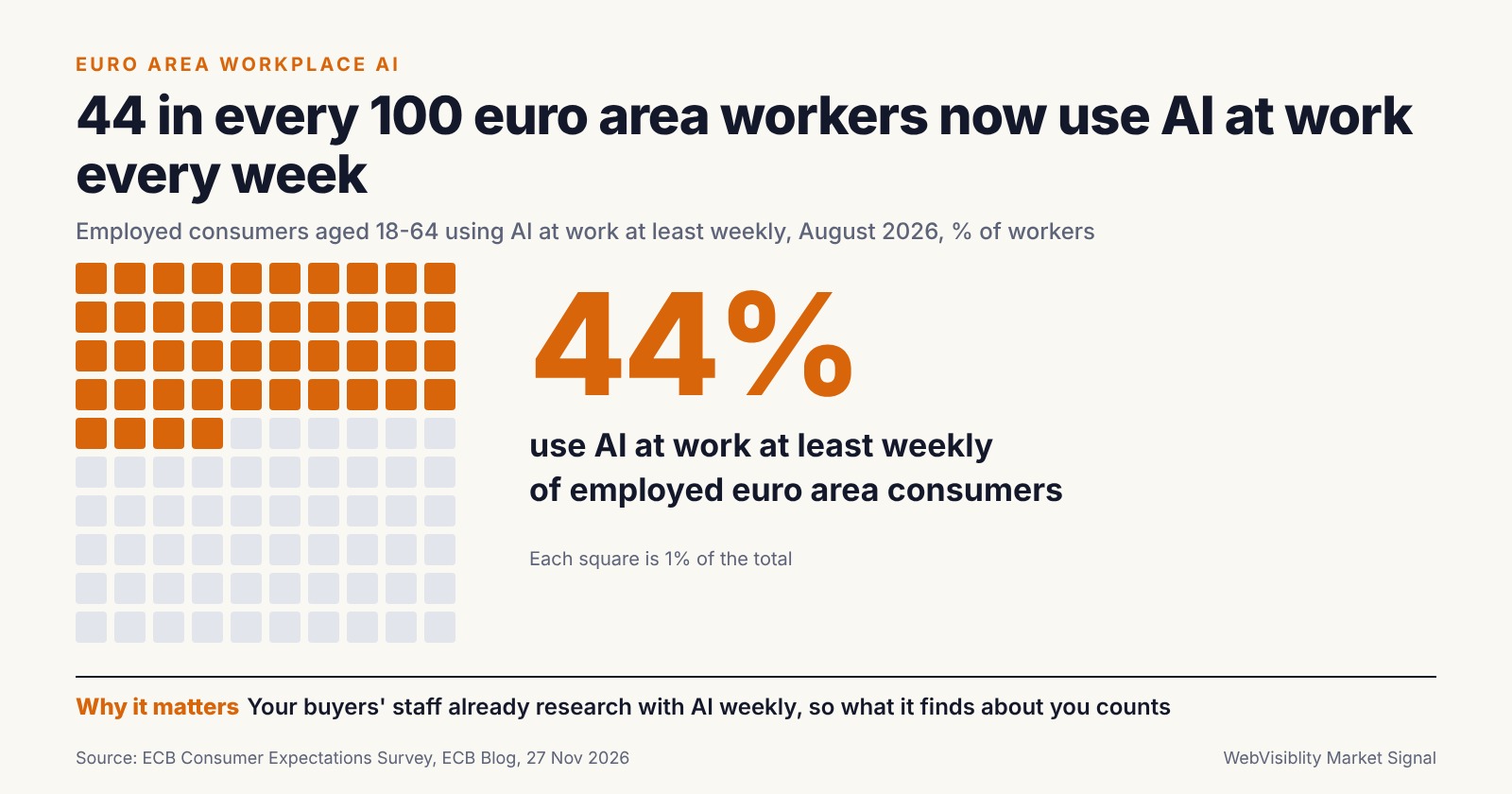
AI is now a weekly work tool for 44% of employed euro area consumers, according to the European Central Bank's Consumer Expectations Survey, published on its blog on 27 November. Around 18% use it daily, a larger daily share than in the US, Bloomberg reported. The same survey shows where the payoff stalls: among users who get no extra output, the most common reason is the time needed to check or correct what AI produces.
At a glance
| Weekly AI use at work | 44% in August 2026 |
|---|---|
| Daily AI use at work | Around 18% |
| Say AI raises their output | Around 56% of users |
| Say AI improves quality | 47% of users |
| Expected sector AI use in 5 years | 46%, up from 34% |
| Who was asked | Employed consumers aged 18-64 |
Do this today
Tick each step as you do it. Your ticks stay on this device. See the full list.
For marketers
For software buyers and IT teams
The signal
- In August 2026, 44% used AI at least weekly at work and around 18% used it daily.
- Overall adoption in the euro area is similar to the United States, and a larger share in Europe reports daily use, though that gap is narrowing.
- Of users who say AI lifts their output, 62% credit finding or processing information and 51% say it cuts the effort needed.
- Users with no output gain most often cite the time spent checking AI results.
- Skills gaps and privacy and security concerns are among the most reported barriers for non-users.
- Around half of respondents expect AI to make it easier to find the best prices over the next 12 months.
Which of these are you?
Tap the one that fits you best. We show what this story changes for you.
What happened
The European Central Bank published a blog post on 27 November by economists Dimitris Georgarakos, Geoff Kenny and Justus Meyer. It draws on the ECB Consumer Expectations Survey, which Ipsos carries out for the bank, and previews a forthcoming working paper on AI diffusion in the euro area. The figures cover employed people aged 18 to 64.
The headline number is adoption. 44% of employed euro area consumers used AI at work at least weekly in August 2026, and around 18% used it daily. The post says more than 50% of workers reported using AI at work in May 2026. It compares the euro area with Gallup data for the United States and finds overall use similar, while warning that the two surveys use different questions and samples. Bloomberg's report summed it up as euro area use comparable to numbers across the Atlantic.
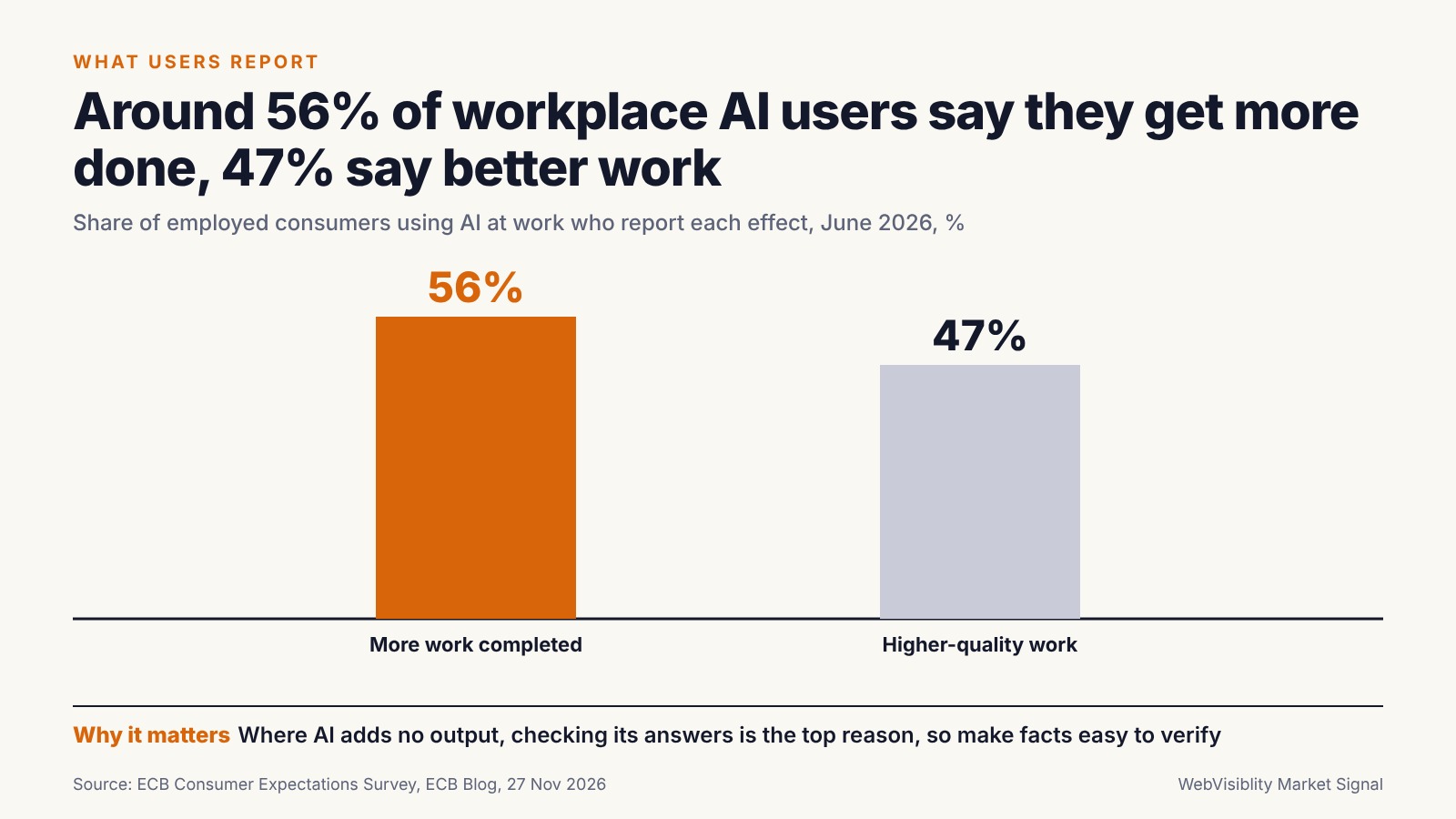
The survey then asks what AI actually does for people at work. Around 56% of users say it raises the amount of work they complete and 47% report higher-quality output. Among those who complete more, 62% point to help finding or processing information. For users who see no increase, the most common reason is the time needed to check or correct AI output. Other reasons include AI not suiting the task and worries about keeping control.
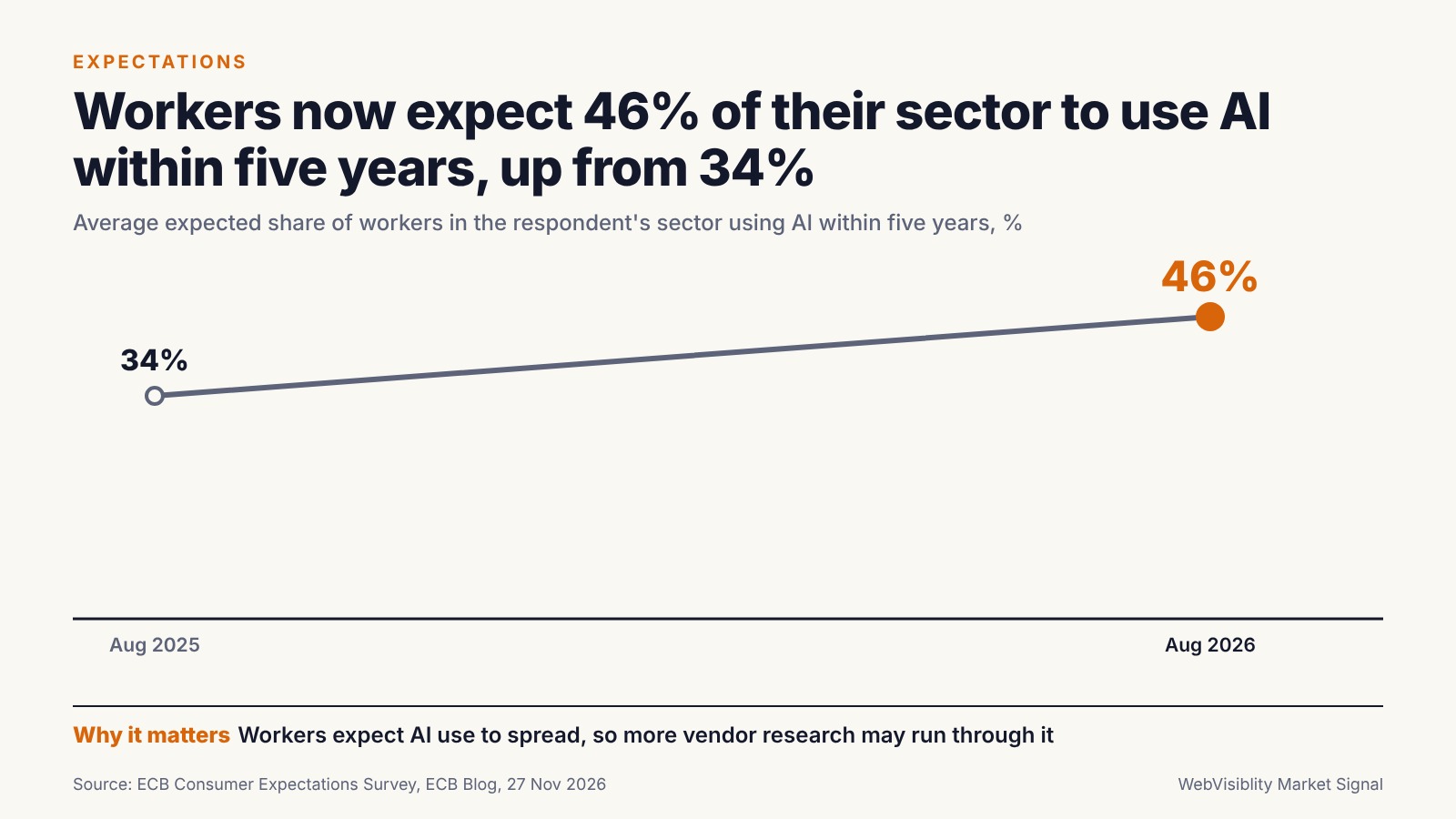
Expectations are moving fast. In August 2026, workers expected 46% of people in their sector to use AI within five years, up from 34% a year earlier. Around half expect AI to save time on everyday tasks or make it easier to find the best prices. Respondents also want rules: demand for AI regulation is strong among both regular users and non-users. The authors add that weak business investment could raise Europe's dependence on foreign AI technology, citing an estimate of about 12% investment growth in the euro area from 2021 to the end of 2027 against around 40% in the US.
By the numbers
See the figures as a table
| Employed euro area consumers using AI at work at least weekly, August 2026 | 44% |
| Using AI at work daily, August 2026 (approximate) | around 18% |
| AI users who say it increases the work they complete (approximate) | around 56% |
| AI users who report higher-quality output | 47% |
| Expected share of sector workers using AI within five years, August 2026 | 46% |
| Same expectation one year earlier | 34% |
Figures exactly as published. Source: European Central Bank (The ECB Blog)
Where workplace AI gains are won and lost
- 1Adopt
44% use AI weekly at work.
- 2Research
Gainers credit finding and processing information.
- 3Check
Verifying AI output eats the gain for some.
- 4Expand
Workers expect 46% sector use in five years.
Timeline
Workers expect 34% of their sector to use AI within five years.
More than 50% of workers report using AI at work.
AI users report gains in output and quality.
44% use AI weekly at work; expected sector use reaches 46%.
The ECB publishes the findings on its blog.
“Consumers see clear benefits from AI, but they also worry about jobs, privacy, security and the reliability of AI-generated information.”
Why it matters
This is a survey of workers, not buyers, but in B2B the two are the same people. When 62% of users who gain output credit AI with finding or processing information, a large part of that work is research: comparing tools, reading reviews, checking prices. Around half also expect AI to make it easier to find the best prices. For a vendor selling into Europe, the first description of your product that a prospect reads may now come from an AI assistant, which is why AI visibility belongs in the European marketing plan rather than as a US-only experiment.
The friction point is just as useful. Users who get nothing extra from AI most often blame the time needed to check or correct its output, and the authors name the reliability of AI-generated information as a worry. That favours vendors whose facts are easy to confirm: current pricing pages, dated product specs, named customers and clear policies, ideally marked up with schema markup so AI search tools read them accurately. A buyer who can confirm an AI answer in one click is more likely to keep that vendor on the list.
Privacy and security concerns are among the most reported barriers to using AI at all, and support for AI rules is strong across the board. B2B companies that publish plain answers on data handling and model providers give buyers, and the assistants that summarise vendors for them, less room to guess.
Who is affected
| Who | What changes | Impact |
|---|---|---|
| B2B vendors selling into Europe | Buyers' staff research with AI weekly. | High |
| Content and product marketing teams | Facts must be quick to verify. | Medium |
| Security and trust teams | Privacy concerns still hold some users back. | Medium |
What to do now
For marketers
- Ask ChatGPT, Perplexity and Google's AI in English and one EU language how they describe your product, and log the errors.
- Put current prices, specs and a last-updated date on pages that AI tools are likely to quote.
- Publish a short, plain page on how your product handles customer data and which AI providers it uses.
For software buyers and IT teams
- Check any AI-generated vendor summary against the vendor's own dated pages before shortlisting.
- Agree an internal rule on which AI tools staff may use for supplier research.
- Note where AI answers about vendors were wrong, and tell the vendor so it can fix the source.
Printable, one page, 10 checks. Enter your email and it opens right away.
We email you a copy. We never share your email and never send you sales emails.
Pick one. It takes 5 seconds and helps more people find these briefings. Your checklist opens straight after.
Have a work email? Use it instead and the checklist opens straight away.
Open it, then save it as a PDF or print it.
Know someone who would find this useful?
These steps are our recommendations based on this news, not statements from the companies involved.
What to watch
- The working paper. The ECB says the figures come from a forthcoming paper on AI diffusion in the euro area, which should add country and sector detail.
- Daily use. Whether the euro area's lead in daily use over the US keeps narrowing.
- Price effects. The authors say a sizeable share of consumers expect AI to push up prices over the next year.
- Regulation. How strong demand for rules among users and non-users shapes the EU's AI policy debate.
Questions readers ask
How many workers in Europe use AI at work?
In the euro area, 44% of employed consumers aged 18-64 used AI at work at least weekly in August 2026, and around 18% used it daily, according to the ECB.
Do Europeans use AI at work as much as Americans?
Roughly yes. The ECB finds overall adoption similar to the United States, with a larger daily share in Europe, but warns the two surveys use different questions.
Does AI make workers more productive?
Many users think so. Around 56% say AI raises the amount of work they complete and 47% report higher quality, but gains depend on the task and on checking time.
Why do some workers get no benefit from AI?
The most common reason given is the time needed to check or correct AI output. Other reasons include AI not suiting the task and concerns about keeping control.
What stops people using AI at work in Europe?
Skills and knowledge gaps, together with privacy and security concerns, are among the barriers non-users report most often. Social norms and regulation are cited less.
What is the ECB Consumer Expectations Survey?
A regular ECB survey of households in 11 euro area countries, carried out by Ipsos, that asks about expectations and behaviour, including AI use at work.
How should B2B marketers respond to rising AI use at work?
Make product facts easy for AI tools to find and for buyers to verify, because the most common reason users see no gain is checking AI output.
Companies in this story
Sources
Researched, fact-checked and edited by the Market Signal desk. Read our editorial standards. Spotted an error? Email hello@webvisiblity.com and we will correct it.