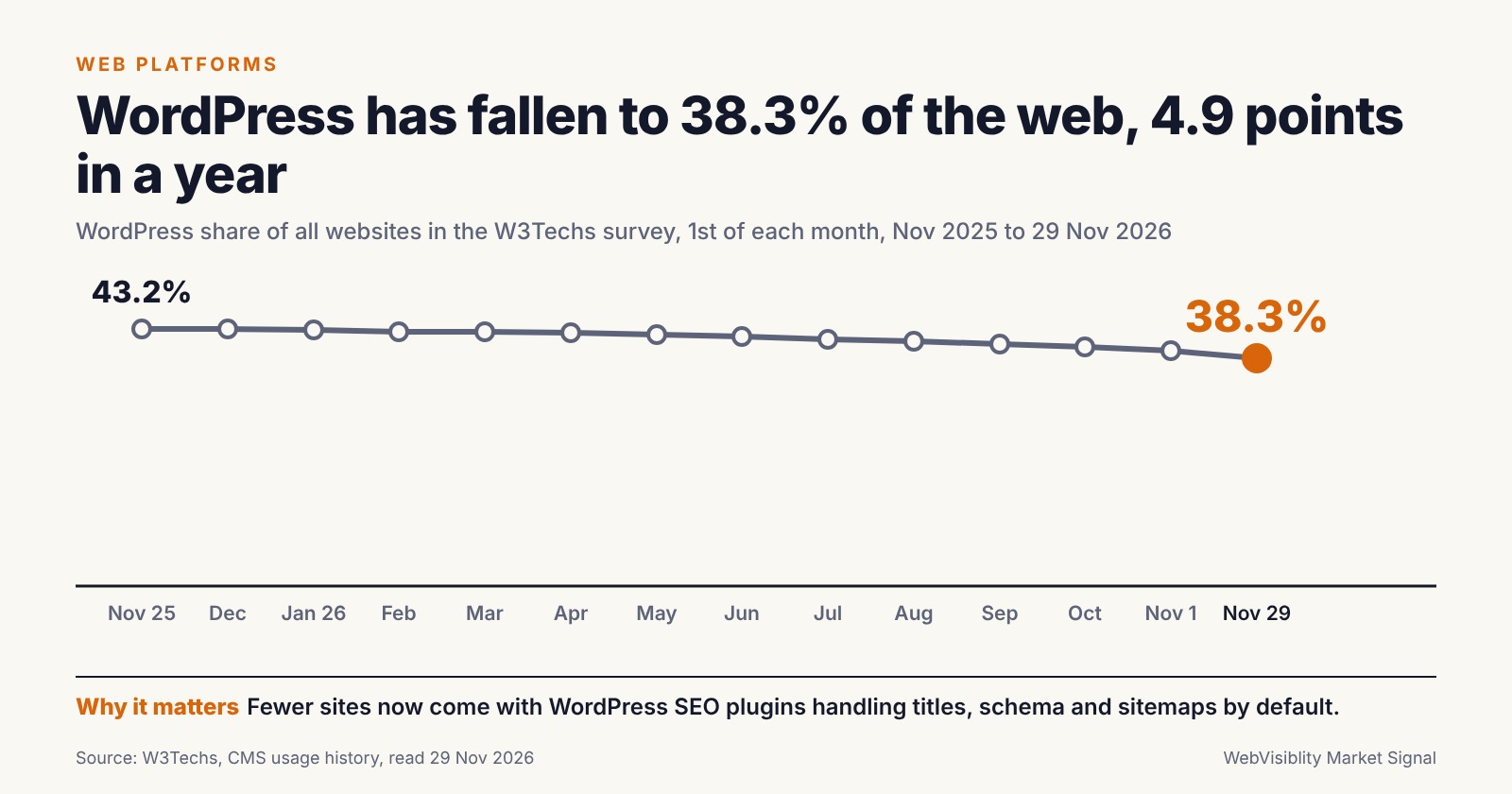
WordPress runs 38.3% of all websites in W3Techs' survey as of 29 November, down from 43.2% a year earlier. The share it lost did not go to Wix or Squarespace. Sites using none of the systems W3Techs tracks climbed to 33.1%, and Lovable, an AI website builder, entered the table at 0.6% of all websites, the same rounded share as Drupal.
At a glance
| WordPress, all websites | 38.3% on 29 Nov 2026 |
|---|---|
| A year earlier | 43.2% on 1 Nov 2025 |
| No tracked CMS | 28.6% to 33.1% |
| WordPress, sites with a known CMS | 57.2% |
| Lovable | 0.6% of all websites |
| Lovable sites recently on another tracked CMS | 2.24% |
Do this today
Tick each step as you do it. Your ticks stay on this device. See the full list.
For marketers
For software buyers and IT teams
The signal
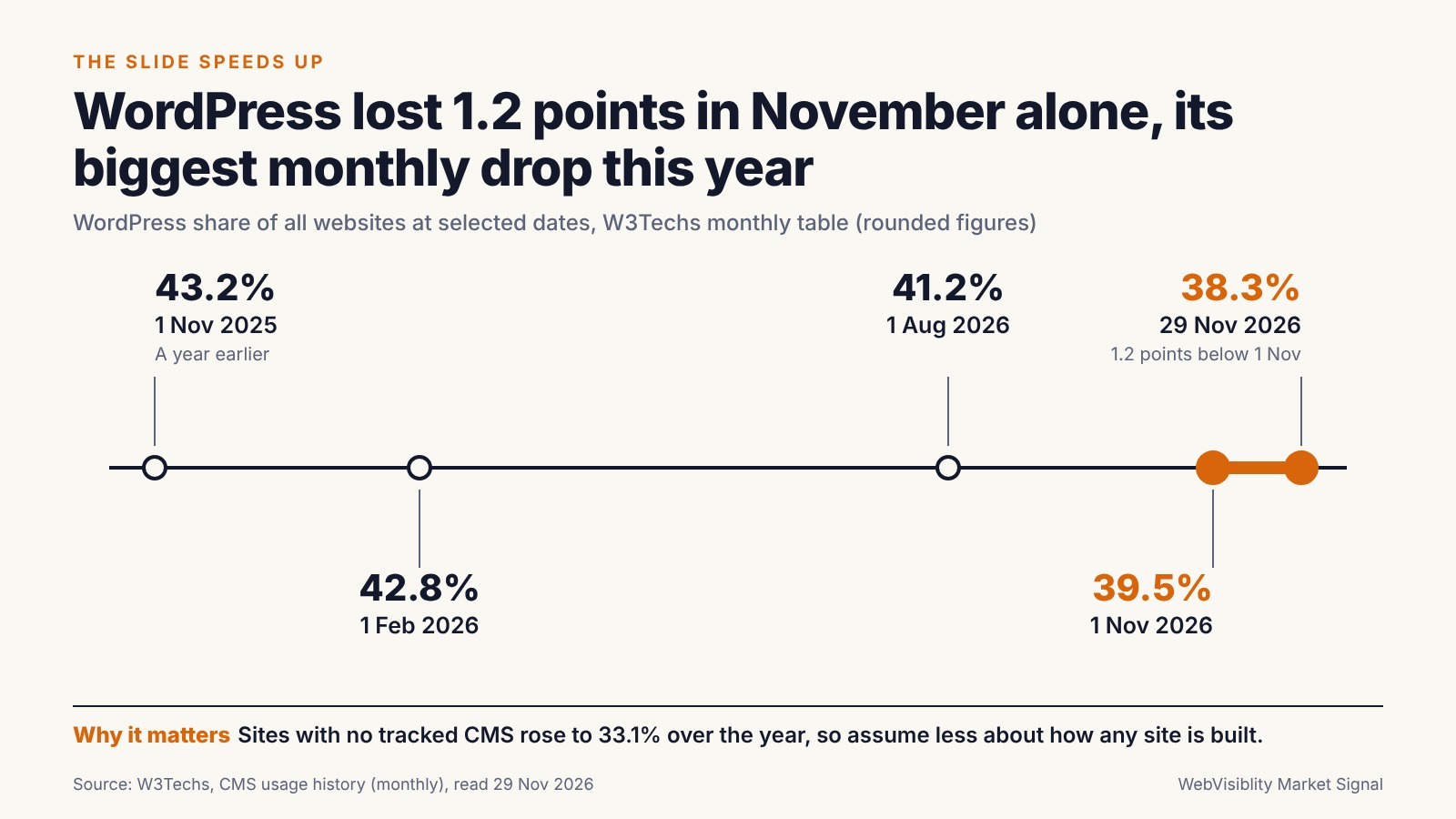
- WordPress fell from 39.5% to 38.3% between 1 and 29 November, a bigger drop than in any full month of 2026.
- Shopify was the only large hosted platform to gain, rising from 4.9% to 5.5% over the year.
- Wix and Squarespace ended the year where they started, at 4.1% and 2.4%.
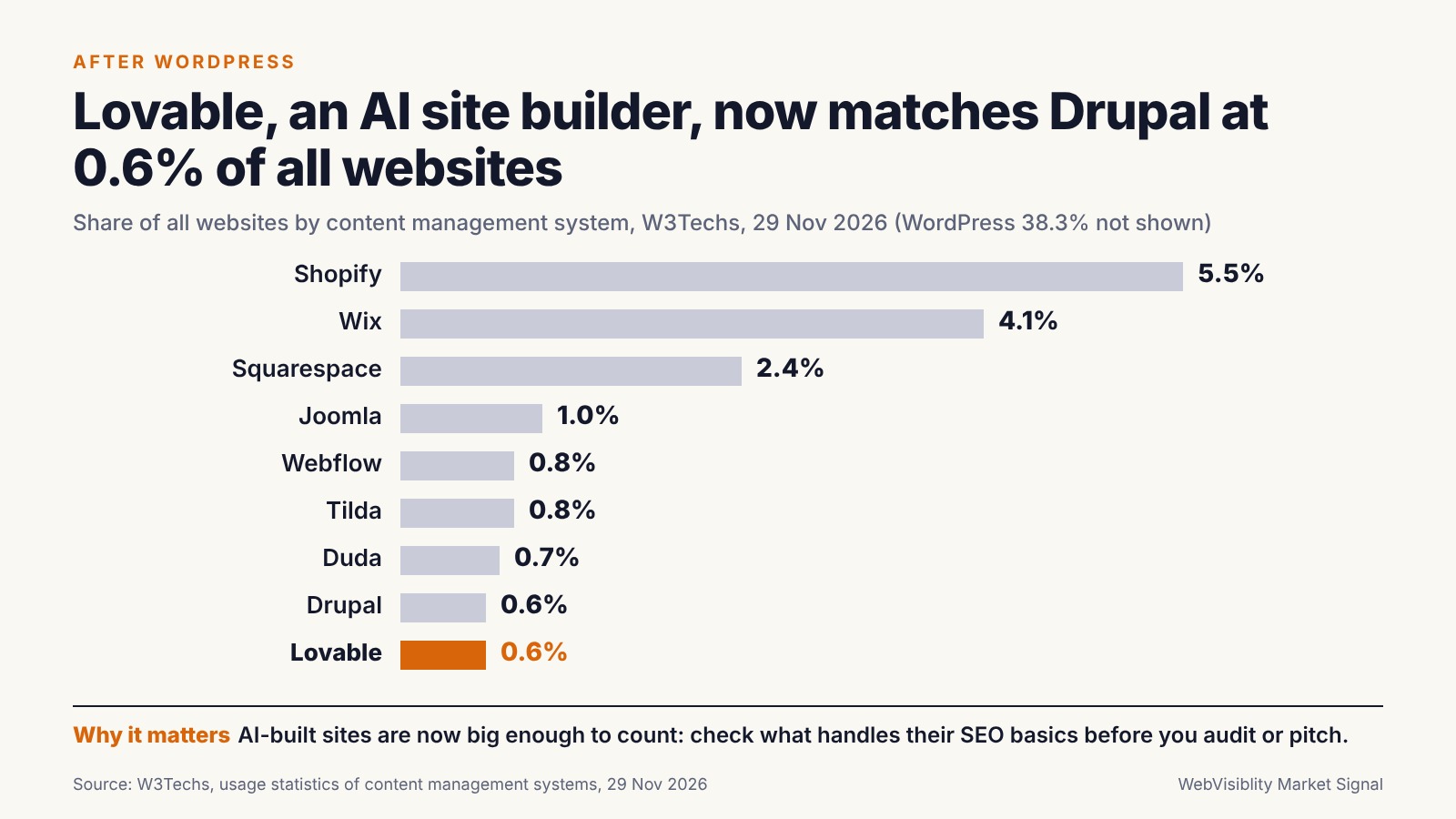
- Lovable appears in the monthly table for the first time, level with Drupal, Adobe's systems and GoDaddy's builder at 0.6%.
- HubSpot CMS, a common choice for B2B sites, sits at 0.2% of all websites.
- Only 1.29% of Lovable sites were recently on WordPress, so few got there by recently switching from a tracked CMS.
Which of these are you?
Tap the one that fits you best. We show what this story changes for you.
What happened
W3Techs, which publishes daily usage statistics on web technologies, shows WordPress on 38.3% of all websites in its monthly trend table for 29 November 2026. On 1 November 2025 the figure was 43.2%, so WordPress has lost 4.9 percentage points in a year. Measured only among sites whose content management system W3Techs can identify, WordPress holds 57.2%. NTx Ventures, a WordPress services firm, notes that the survey covers what W3Techs calls the relevant web, well over 20 million sites, and that it is updated every day.
The decline has sped up. On W3Techs' rounded monthly figures, WordPress lost less than half a point a month until August, then 0.5 points in each of the next two months and 0.7 points in October. Between 1 and 29 November it fell from 39.5% to 38.3%, a drop of 1.2 points in four weeks. Search Engine Journal reported the acceleration on 24 November, when the share stood at 38.4%, and MA-NO Web Design & Development and NTx Ventures reported the same figures over the following days.
Rival platforms did not absorb the loss. Over the same year Shopify rose from 4.9% to 5.5%, Wix went from 4.1% back to 4.1%, Squarespace stayed at 2.4%, and Joomla and Drupal slipped. The category that grew is the one W3Techs labels none: sites running none of the content management systems it monitors. That group rose from 28.6% to 33.1% of all websites, so the gap between WordPress and unrecognised sites narrowed from 14.6 points to 5.2 points. As MA-NO points out, none does not prove a site has no CMS or was built a particular way; NTx adds that a headless WordPress site may not show WordPress signs to a scanner.
The new name is Lovable, which W3Techs describes as an AI-powered platform for building websites. It is used by 0.6% of all websites and 0.8% of sites with a known CMS. The 29 November column is the first in the monthly table to list it, at the same rounded share as Drupal, Adobe's systems and GoDaddy Website Builder, against 0.2% for HubSpot CMS. W3Techs' change report for Lovable shows that 2.24% of its sites were using another tracked CMS until recently, including 1.29% that came from WordPress, 0.27% from Wix and 0.11% from Squarespace. The data does not say what the rest used before, or whether they are new sites.
By the numbers
How to check a site's SEO basics when you cannot assume WordPress
- 1Identify the stack
Find out what builds and serves the site before auditing it; a third of sites run no tracked CMS.
- 2Check the head
Confirm titles, meta descriptions, canonical tags and robots settings on key pages.
- 3Check structured data
Test Organization and Product schema markup, since no plugin adds it by default.
- 4Read as a crawler
Load pages without JavaScript to see what AI crawlers and search engines can read.
- 5Recheck after edits
AI builders can rewrite pages when prompted again, so retest after each change.
Timeline
WordPress runs 43.2% of all websites; sites with no tracked CMS are 28.6%.
The share of sites with no tracked CMS starts rising every month.
WordPress is at 41.2%; monthly falls then grow to 0.5 points.
WordPress opens November at 39.5% of all websites.
Search Engine Journal reports WordPress at 38.4% and Lovable listed by W3Techs.
WordPress reaches 38.3%; Lovable appears in the monthly table at 0.6%.
“Lovable is an AI-powered platform for building websites.”
Who is affected
Sites built outside WordPress need their own checks for titles, sitemaps and schema markup.
Audits and pitches can no longer start from a WordPress plugin assumption.
WordPress plugins now reach under four in ten sites, and that share is shrinking.
Why it matters
For years an SEO or AI visibility review could start from a safe guess: the site probably runs WordPress, and a plugin probably writes the titles, canonical tags, sitemaps and schema markup. On W3Techs' numbers that guess now fits fewer than four in ten sites, and a third of sites run nothing the survey recognises. Search Engine Journal draws the practical conclusion: for those sites, an audit or pitch has to find out what handles the basics, if anything does. The same applies to the structured data that AI search engines read when they describe a company.
Lovable's entry puts a first number on AI-built websites. At 0.6% of the web it is small, but it already matches Drupal and Adobe's systems in the same survey. Pages produced by prompting a builder are not automatically set up with clean headings, crawlable text or schema markup, so marketing teams that launch campaign pages, microsites or whole sites this way should check them the way an AI crawler or Perplexity would see them before counting on them for AI visibility.
There is also a vendor-research angle. Agencies and SaaS tools that sell into the website market often size their audience by CMS share. With Shopify the only big gainer and the unrecognised group growing fastest, plugin-based distribution reaches a shrinking share of sites, and tools that work from the outside, by reading the live page, cover more of it.
What to do now
For marketers
- List every site, microsite and landing page you run and note which system or builder produced each one.
- For any page built with an AI builder, check its title, canonical tag, sitemap entry and Organization schema before launch.
- Ask whether your AI visibility reporting covers pages outside your main CMS.
For software buyers and IT teams
- When choosing a website builder, ask how it outputs structured data and whether you can edit it without re-prompting.
- Ask whether you can export the code and content, and host them elsewhere.
- Treat CMS market share as a trend signal, not proof that a platform suits your site.
Printable, one page, 10 checks. Enter your email and it opens right away.
We email you a copy. We never share your email and never send you sales emails.
Pick one. It takes 5 seconds and helps more people find these briefings. Your checklist opens straight after.
Have a work email? Use it instead and the checklist opens straight away.
Open it, then save it as a PDF or print it.
Know someone who would find this useful?
These steps are our recommendations based on this news, not statements from the companies involved.
What to watch
- 1 December figures. Whether the November drop of 1.2 points was a one-off or the new pace; Search Engine Journal named the share with no tracked CMS as the figure to watch.
- More AI builders. W3Techs already lists v0, another AI builder, at 0.1% of websites; watch whether more AI builders get their own rows.
- Lovable's sources. Whether the share of Lovable sites that came from another CMS grows as businesses move existing sites rather than launch new ones.
- Known-CMS share. WordPress holds 57.2% of sites with a known CMS; a smaller known-CMS pool can lift rivals' shares without new sites.
Questions readers ask
What percentage of websites use WordPress in 2026?
38.3% of all websites, according to W3Techs on 29 November 2026. Among sites whose CMS W3Techs can identify, WordPress holds 57.2%.
How much has WordPress market share fallen?
About 4.9 percentage points in a year, from 43.2% on 1 November 2025 to 38.3% on 29 November 2026, with 1.2 points of that lost in November.
Where are websites going instead of WordPress?
Mostly into sites using no CMS that W3Techs tracks, which grew to 33.1% of all websites. Shopify gained 0.6 points; Wix and Squarespace were flat.
How many websites are built with Lovable?
W3Techs counts Lovable on 0.6% of all websites and 0.8% of sites with a known CMS, as of 29 November 2026.
Is Lovable bigger than Drupal?
They are level on rounded figures, both at 0.6% of all websites. Among sites with a known CMS, Drupal has 0.9% and Lovable 0.8%.
Did Lovable sites switch from WordPress?
Very few. W3Techs says 1.29% of Lovable sites were using WordPress until recently, and 2.24% came from any tracked CMS.
Do AI-built websites hurt SEO or AI visibility?
Not by default, but nothing can be assumed. Sites without a known CMS need a check of titles, canonicals, sitemaps and schema markup, since no plugin handles them.
Companies in this story
Sources
- W3TechsOriginal
- W3Techs
- W3Techs
- W3Techs
- Search Engine Journal
- NTx Ventures (a WordPress services firm)
- MA-NO Web Design & Development
- Search Engine Journal
Researched, fact-checked and edited by the Market Signal desk. Read our editorial standards. Spotted an error? Email hello@webvisiblity.com and we will correct it.