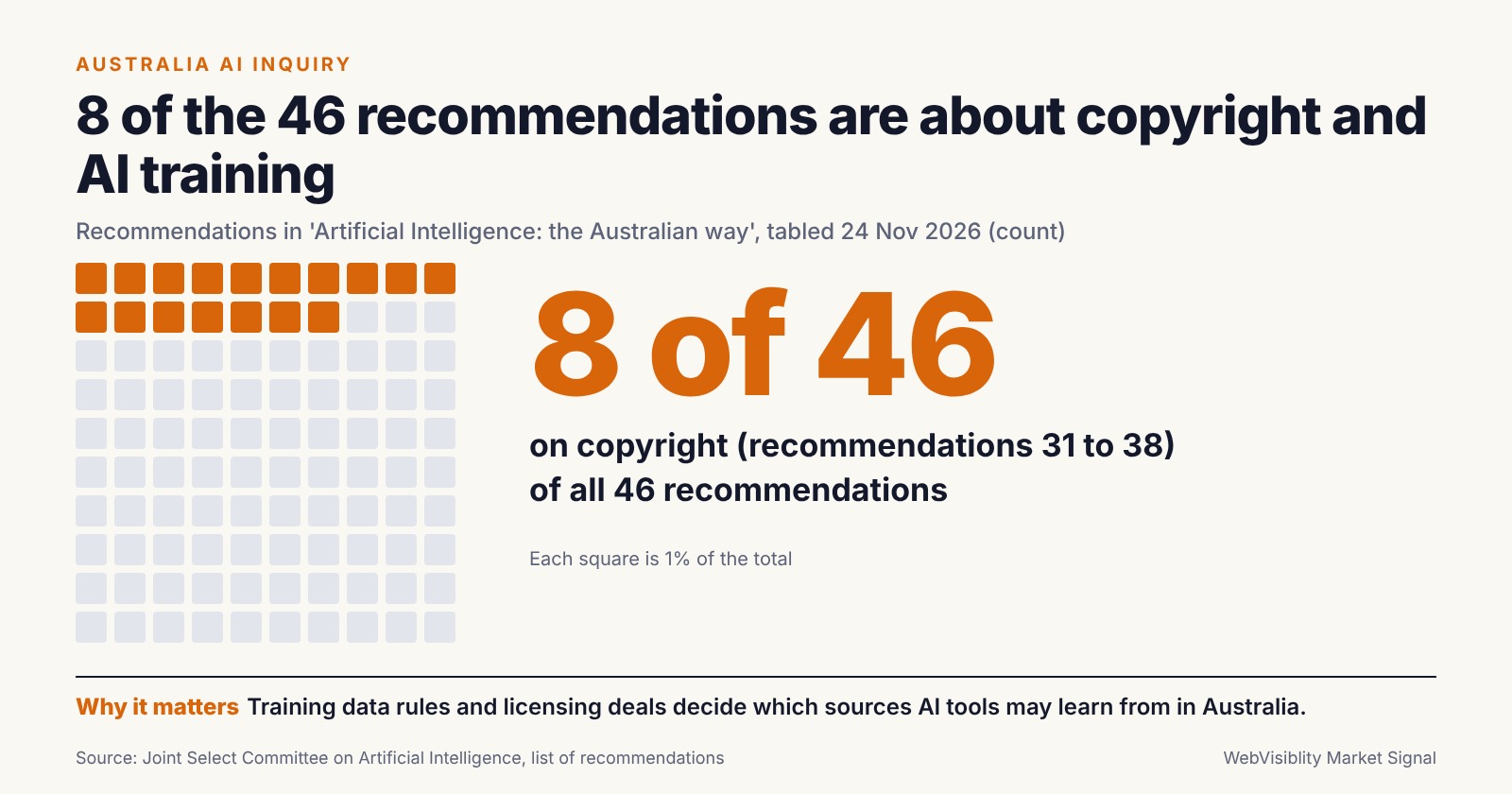
Australia's Joint Select Committee on Artificial Intelligence tabled its final report on 24 November with 46 recommendations. Most of the coverage has been about copyright, where the creative industries are split on the result. Two quieter recommendations reach any business that markets in Australia: machine-readable labelling of AI-generated photos, videos and voice recordings, and legal frameworks that hold companies accountable for their AI agents.
At a glance
| Recommendations | 46 |
|---|---|
| On copyright | 8, numbers 31 to 38 |
| Public submissions | 592 |
| Report tabled | 24 November 2026 |
| Binding? | No, the government must respond |
Do this today
Tick each step as you do it. Your ticks stay on this device. See the full list.
For marketers
For software buyers and IT teams
The signal
- Recommendation 18 asks the government to consider mandating machine-readable labelling of AI-generated and materially AI-altered photos, videos or voice recordings.
- Recommendation 22 asks for legal frameworks that hold humans or companies accountable when AI agents do tasks they would otherwise be responsible for.
- Recommendation 37 would require AI companies training models in Australia to be transparent about their training data.
- Recommendation 30 asks for whole-of-government buying policies that stimulate investment in Australian AI.
- The music industry is divided: ARIA called parts of the copyright approach 'gaslighting', while APRA AMCOS welcomed the finding that unpaid training is wrong.
- Senator David Pocock issued a dissenting report and wants existing copyright law left unchanged.
Which of these are you?
Tap the one that fits you best. We show what this story changes for you.
What happened
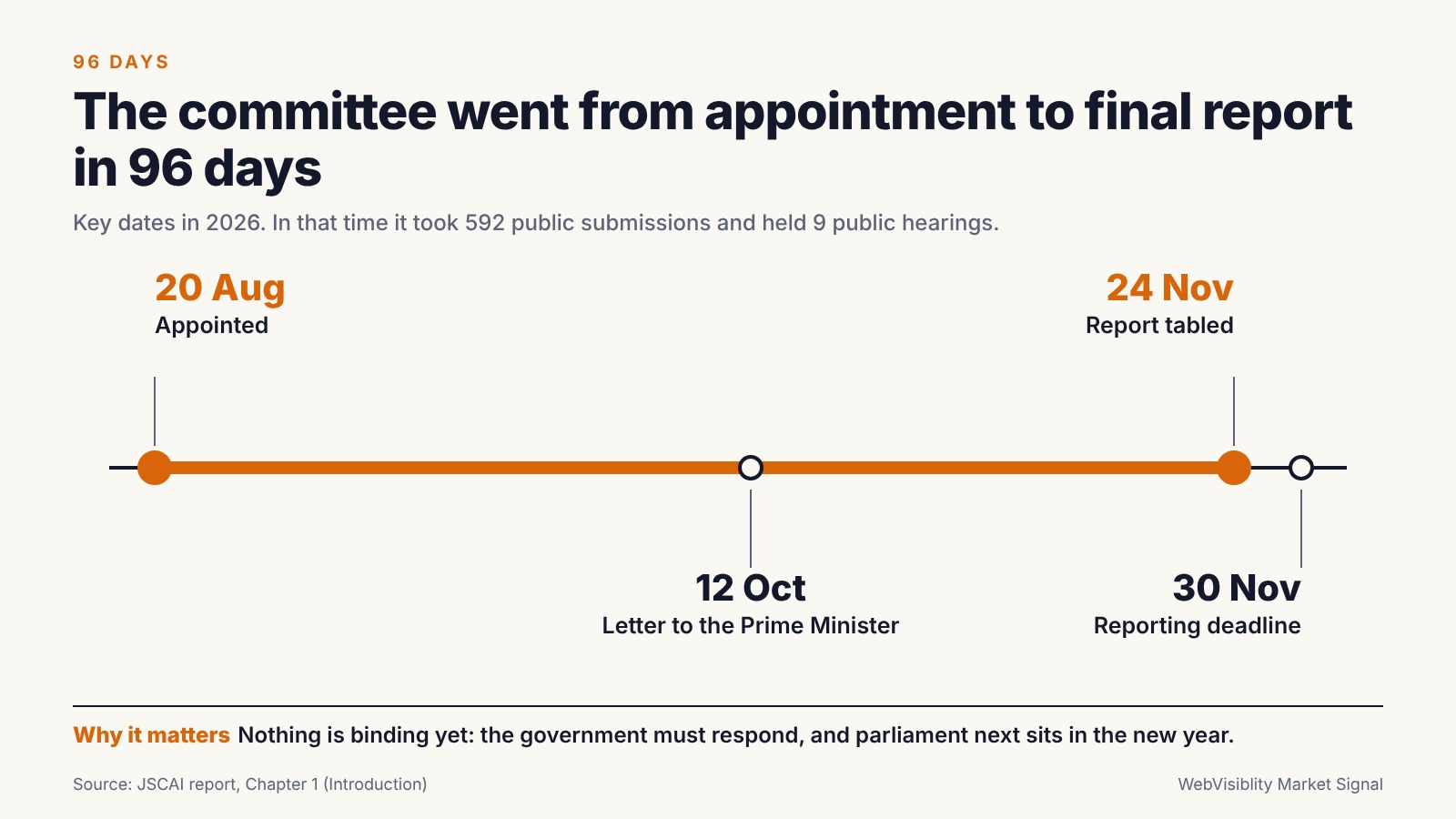
The joint committee was appointed on 20 August 2026 to look at the opportunities and risks of AI for Australian businesses, governments and people, with a deadline of 30 November. It wrote to the Prime Minister with early findings on 12 October, received 592 public submissions and held nine public hearings in Canberra, Sydney and Melbourne between 18 September and 30 October. The final report, titled Artificial Intelligence: the Australian way, was tabled on Tuesday 24 November.
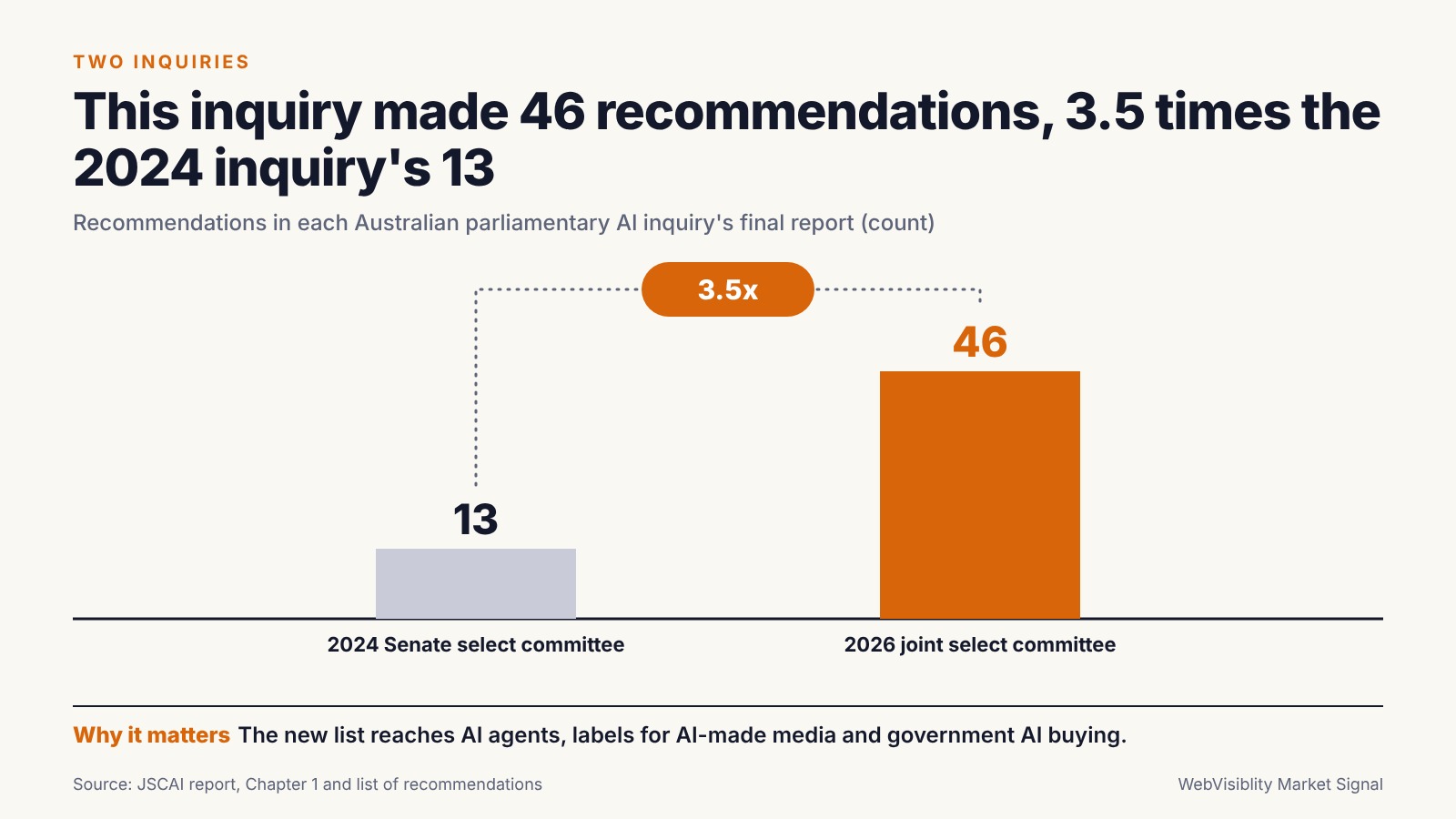
It carries 46 recommendations, against 13 in the 2024 report of the Senate's earlier AI inquiry. The first asks for an ongoing joint standing committee on AI. Others cover frontier lab incident reporting, AI safety funding, data centres, national security and the workforce. Eight of them, recommendations 31 to 38, deal with copyright: a mechanism for AI companies training models in Australia to pay rights holders and creators, strong penalties for breaking the law, incentives for licensing deals, and certainty for frontier AI companies that want to train locally.
The new fact this week is the reaction. On 27 November ArtsHub reported that screen and writing bodies gave a cautious welcome while the music industry is markedly mixed. APRA AMCOS said opt-out in any form remains a red line. ARIA rejected the basis of the copyright recommendations outright. The recommendations are not binding, and with parliament's last sitting day of the year on 27 November, a government response must wait until the new year.
By the numbers
Timeline
The Senate's earlier AI inquiry makes 13 recommendations.
The joint select committee is appointed.
It sends early findings to the Prime Minister.
The Prime Minister announces a new AI safety regulator.
The final report is tabled with 46 recommendations.
Creative bodies split on the copyright advice.
“Opt-outs are inadequate for protecting the rights of those who genuinely do not want their creative works to be used for AI training.”
How to prepare for AI content labels
- 1List
Find assets that are AI-generated or altered.
- 2Tag
Record the tool used in each asset's file data.
- 3Test
Check what your AI agents tell customers.
- 4Track
Follow the government response in 2027.
Why it matters
For B2B marketers the copyright fight is the headline, but recommendations 18 and 22 are the ones that would change daily work. A labelling rule would cover photos, video and voice that are AI-generated or materially AI-altered, which describes a growing share of product videos, ad creative and synthetic voiceovers. Teams that already keep a record of which assets were made or edited with AI will find any future label easy to apply. Teams that do not will have to rebuild that record across old campaigns.
Recommendation 22 points the same way for AI agents. The committee wants the law to hold the humans or companies behind an agent to account when the agent does work they would otherwise be answerable for. A sales or support agent that quotes a price, a delivery date or a contract term would be treated as speaking for the business that deployed it. That makes the answers an agent gives a brand risk to test before launch, in the same way a company already checks its website copy.
The training data recommendations matter for AI visibility too. If AI companies training in Australia must be transparent about the data they use, brands and publishers would get a clearer view of which sources feed the models behind AI search answers. That would sit alongside the controls that exist today, such as robots.txt rules for AI crawlers, which tell bots what they may read but not what ends up in training.
What to do now
For marketers
- Start a simple register of which images, videos and voiceovers were generated or materially edited with AI.
- Test your website chatbot or AI sales agent with real customer questions about price, refunds and contract terms.
- Review which AI crawlers your robots.txt allows, and note that it controls reading, not what is used for training.
For software buyers and IT teams
- Ask AI agent vendors how their tools record what the agent said and did on your behalf.
- Ask generative AI vendors whether their outputs can carry machine-readable content labels.
- If you sell to the Australian government, watch for buying rules that favour local AI capability.
Printable, one page, 10 checks. Enter your email and it opens right away.
We email you a copy. We never share your email and never send you sales emails.
Pick one. It takes 5 seconds and helps more people find these briefings. Your checklist opens straight after.
Have a work email? Use it instead and the checklist opens straight away.
Open it, then save it as a PDF or print it.
Know someone who would find this useful?
These steps are our recommendations based on this news, not statements from the companies involved.
What to watch
- The government's formal response. The report is a set of recommendations, not law, and parliament does not sit again until the new year.
- Opt-out. Screen Producers Australia says every model it understands the government to be considering involves a technical opt-out.
- Australian Standards for AI. The government's planned standards are expected in early 2027.
- The new AI safety regulator. The Prime Minister said it will require AI companies to allow independent evaluation of their models; how it fits with the report is not yet known.
- A standing committee. The report's first recommendation is an ongoing joint standing committee on AI.
Who is affected
| Who | What changes | Impact |
|---|---|---|
| Content and creative teams | AI photos, video and voice may need machine-readable labels. | Medium |
| Teams running AI sales or support agents | The deploying company would be held accountable. | High |
| AI vendors selling to government | Buying policy may favour Australian AI capabilities. | Medium |
Questions readers ask
What did Australia's AI inquiry recommend?
It made 46 recommendations covering AI safety, national security, data centres, the workforce, government use of AI and copyright. Eight are about copyright and payment for AI training.
Will Australia require labels on AI-generated images and video?
Not yet. Recommendation 18 asks the government to consider mandating machine-readable labelling of AI-generated or materially altered photos, videos and voice recordings. It is not law.
Who is responsible when an AI agent makes a mistake in Australia?
The committee wants the law to hold the humans or companies behind an AI agent accountable for tasks they would otherwise be responsible for. That is a recommendation, not yet a rule.
Did the committee back payment for AI training on Australian content?
Yes. Recommendation 31 calls for a mechanism making it easier and fairer for rights holders and creators to be paid by AI companies training models in Australia, with strong penalties.
Why is the music industry unhappy with the AI report?
ARIA says the copyright recommendations propose wholesale changes to the law and called that 'gaslighting'. APRA AMCOS welcomed parts of the report but says any opt-out is a red line.
Are the AI inquiry recommendations binding?
No. The government must formally respond first, and that will not happen before parliament resumes in the new year.
Companies in this story
Sources
Researched, fact-checked and edited by the Market Signal desk. Read our editorial standards. Spotted an error? Email hello@webvisiblity.com and we will correct it.