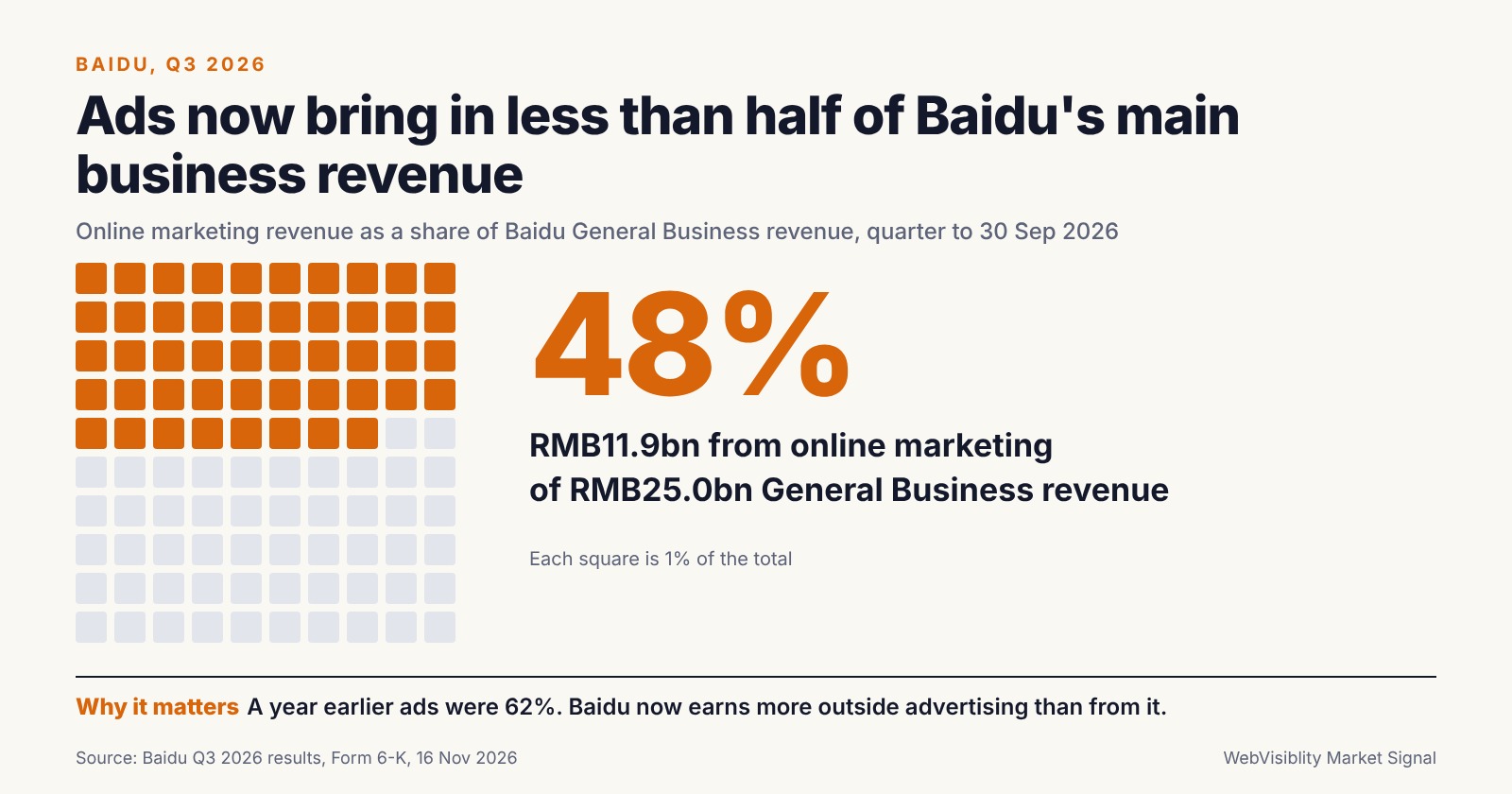
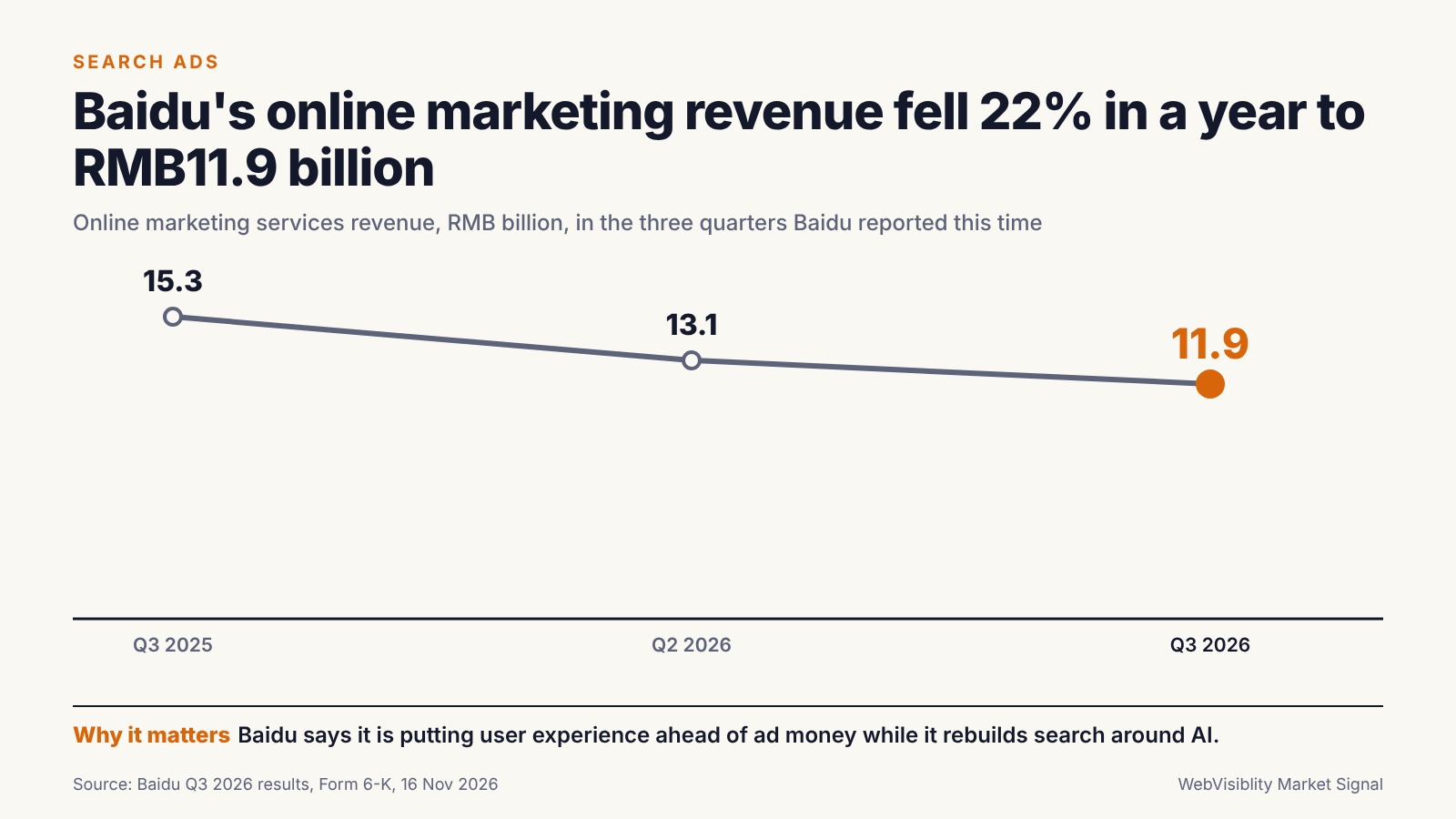
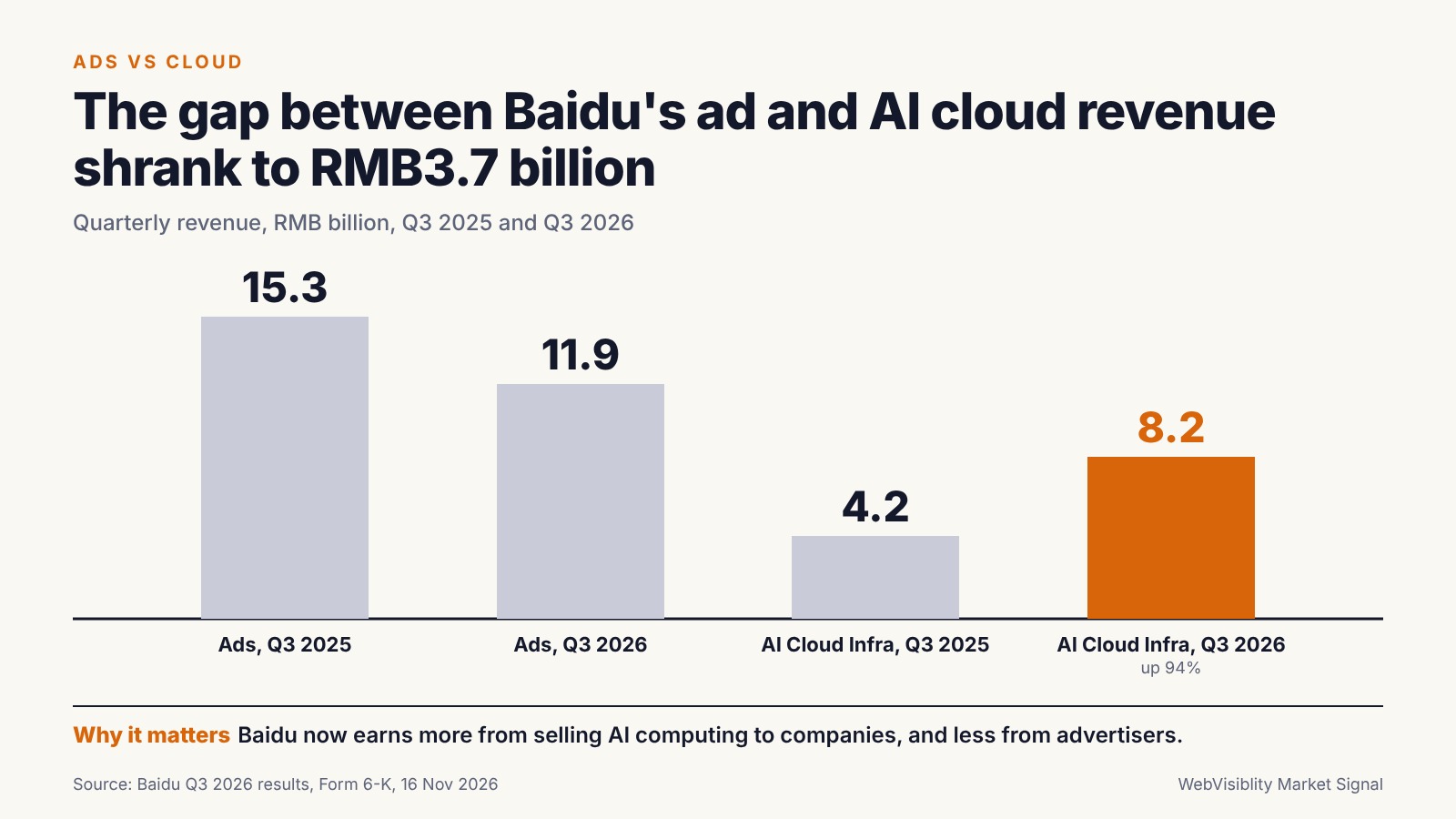
Baidu's online marketing revenue fell 22% to RMB11.9 billion in the three months to 30 September, its results showed on Monday 16 November. Its AI Cloud Infra unit grew 94% to RMB8.2 billion over the same period. Group revenue was RMB30.8 billion ($4.60 billion), down 1% on a year earlier.
At a glance
| Group revenue | RMB30.8 billion, down 1% year on year |
|---|---|
| Online marketing | RMB11.9 billion, down 22%; down 9% on the quarter |
| Ads' share | 48% of General Business revenue, from 62% a year earlier |
| AI Cloud Infra | RMB8.2 billion, up 94% |
| AI-native marketing | RMB2.4 billion, down 15% |
| Baidu App users | 604 million monthly active users in September 2026 |
| Net income | RMB1.4 billion ($208 million) attributable to Baidu |
Do this today
Tick each step as you do it. Your ticks stay on this device. See the full list.
For marketers
For software buyers and IT teams
The signal
- Online marketing slid from RMB15.3 billion a year ago to RMB11.9 billion this quarter.
- Ads made up 48% of Baidu General Business revenue, against 62% in Q3 2025 and 52% in Q2 2026.
- Even AI-native ad products shrank, down 15% to RMB2.4 billion.
- Baidu blames the economy, competition and its decision to prioritize user experience during the AI Search rebuild.
- AI Cloud Infra nearly doubled, and GPU Cloud revenue rose 191% year on year.
- Baidu gives no figure for how many searches now show AI answers; the release does not say.
Which of these are you?
Tap the one that fits you best. We show what this story changes for you.
What happened
Baidu splits its main business, which it calls General Business, two ways. In the first split, Online Marketing Services fell to RMB11.9 billion while everything else rose 40% to RMB13.1 billion. For the first time in the three quarters shown, marketing is the smaller half: 48% of the total, down from 62% a year earlier.
The second split sorts revenue by AI. Baidu's Core AI-powered Business reached RMB13.2 billion, up 37%, or 53% of General Business revenue. Inside it, AI Cloud Infra rose to RMB8.2 billion and AI Applications held flat at RMB2.6 billion. The ad products built for AI search, which Baidu calls AI-native marketing services, fell 15% to RMB2.4 billion. The Legacy Business line dropped 24% to RMB9.4 billion.
Baidu explains the AI-native ad decline in one sentence. It names a hard economy, evolving competitive dynamics, and a strategic decision to prioritize user experience over near-term monetization at this stage of our AI Search transformation. Spending on the shift is rising: capital expenditure was RMB7.3 billion, more than double the year before. Net income attributable to Baidu was RMB1.4 billion, after a loss in the same quarter of 2025. Adjusted earnings per share came in below analyst forecasts, Investing.com reported.
By the numbers
Timeline
Q3 2025 ends with online marketing at RMB15.3 billion, 62% of General Business.
Q2 2026: online marketing RMB13.1 billion, 52% of the total.
Q3 2026: online marketing RMB11.9 billion, 48% of the total.
Baidu World 2026 brings Famou Agent 3.0 and Token Exchange.
Baidu reports third quarter results and holds its earnings call.
“We are pleased to see our AI-first strategy yielding tangible results even as we navigate headwinds in online marketing.”
Where Baidu's revenue moved this quarter
- 1Ads shrink
Online marketing fell 22% to RMB11.9 billion.
- 2AI ads shrink too
AI-native marketing services fell 15% to RMB2.4 billion.
- 3Cloud grows
AI Cloud Infra rose 94% to RMB8.2 billion.
- 4Mix flips
Non-marketing revenue is now 52% of General Business.
Why it matters
Baidu's results put figures beside a trade-off it names itself: a search page built around AI answers, and less ad money from it for now. Its own words tie the fall in AI-native marketing revenue partly to a choice to favour the user while search changes. When a search company gives more of the page to AI answers and less to paid slots, fewer clicks are for sale, and the brands that still get seen are the ones the answer itself names.
That moves the fight from the ad auction to the answer. A B2B vendor that relied on paid search to appear for category queries has fewer slots to buy on an engine that behaves like this. Being cited inside the AI response, by name and with correct facts, becomes the way to show up. Baidu still has 604 million monthly users on its app, so the audience has not gone away; the paid route to it has narrowed.
The second lesson is about money. Baidu is replacing ad revenue by selling computing power to companies, with GPU Cloud revenue up 191%. Search firms that sell AI infrastructure need ads less, and can afford to keep answers cleaner for longer. Marketers outside China should treat this as a signal to watch, not a forecast: Baidu's market, rivals and ad formats differ from Google's and Microsoft's, and the release does not say how much of the drop is the economy and how much is the AI page.
Who is affected
Baidu's AI Search shift came with a 22% ad revenue fall; paid reach may narrow.
Being named inside AI answers matters more as engines favour user experience over monetization.
Baidu's 604 million app users remain, but the paid path to them is narrower.
Search pages with fewer ads may show more neutral answers, though Baidu gives no data on that.
What to do now
For marketers
- List the category queries where paid search brings you the most leads, and check what AI answers show for them.
- Test whether ChatGPT, Gemini, Claude and Perplexity name your brand for those queries, and with correct facts.
- Shift some budget review time from bids to the pages AI answers cite, such as comparisons and pricing.
- If you sell in China, ask your agency how Baidu's AI-native ad formats perform against classic search ads.
For software buyers and IT teams
- When an AI answer recommends a vendor, open the cited source before you shortlist.
- Ask vendors where their claims come from, since fewer ads do not mean the answer is complete.
Printable, one page, 10 checks. Enter your email and it opens right away.
We email you a copy. We never share your email and never send you sales emails.
Pick one. It takes 5 seconds and helps more people find these briefings. Your checklist opens straight after.
Have a work email? Use it instead and the checklist opens straight away.
Open it, then save it as a PDF or print it.
Know someone who would find this useful?
These steps are our recommendations based on this news, not statements from the companies involved.
What to watch
- Q4 results. Whether ads fall below RMB11.9 billion again, or the decline slows.
- AI search data. Baidu gives no share of AI-answered searches; any figure would show how far the page has changed.
- New ad formats. Whether AI-native ads recover once Baidu stops putting user experience over near-term monetization.
- Agents. How companies use Famou Agent 3.0 and the Token Exchange marketplace.
Questions readers ask
How much did Baidu's ad revenue fall in Q3 2026?
Baidu's online marketing revenue fell 22% to RMB11.9 billion in the quarter to 30 September 2026, from RMB15.3 billion a year earlier. It also fell 9% from the second quarter.
Why is Baidu's advertising revenue declining?
Baidu cites a weak economy, competition and a choice to put user experience first while it rebuilds search around AI. It does not say how much each factor contributed.
What share of Baidu's revenue comes from ads now?
Online marketing was 48% of Baidu General Business revenue in Q3 2026, down from 62% a year earlier and 52% in the second quarter of 2026.
How fast is Baidu AI Cloud growing?
Baidu's AI Cloud Infra revenue rose 94% to RMB8.2 billion in Q3 2026. Within it, GPU Cloud revenue rose 191% from a year earlier and 43% from the previous quarter.
What are Baidu's AI-native marketing services?
They are the marketing revenue Baidu counts inside its Core AI-powered Business. That revenue fell 15% to RMB2.4 billion in Q3 2026, which Baidu partly links to its user-first approach.
Did Baidu make a profit in Q3 2026?
Yes. Net income attributable to Baidu was RMB1.4 billion ($208 million), compared with a loss of RMB11.2 billion in Q3 2025, when it booked a large asset impairment.
What does Baidu's AI search shift mean for B2B marketers?
Paid search may reach fewer buyers. As engines give space to answers, being named inside the answer matters more. Baidu's ad revenue fell 22% as it put users first.
Companies in this story
Sources
Researched, fact-checked and edited by the Market Signal desk. Read our editorial standards. Spotted an error? Email hello@webvisiblity.com and we will correct it.