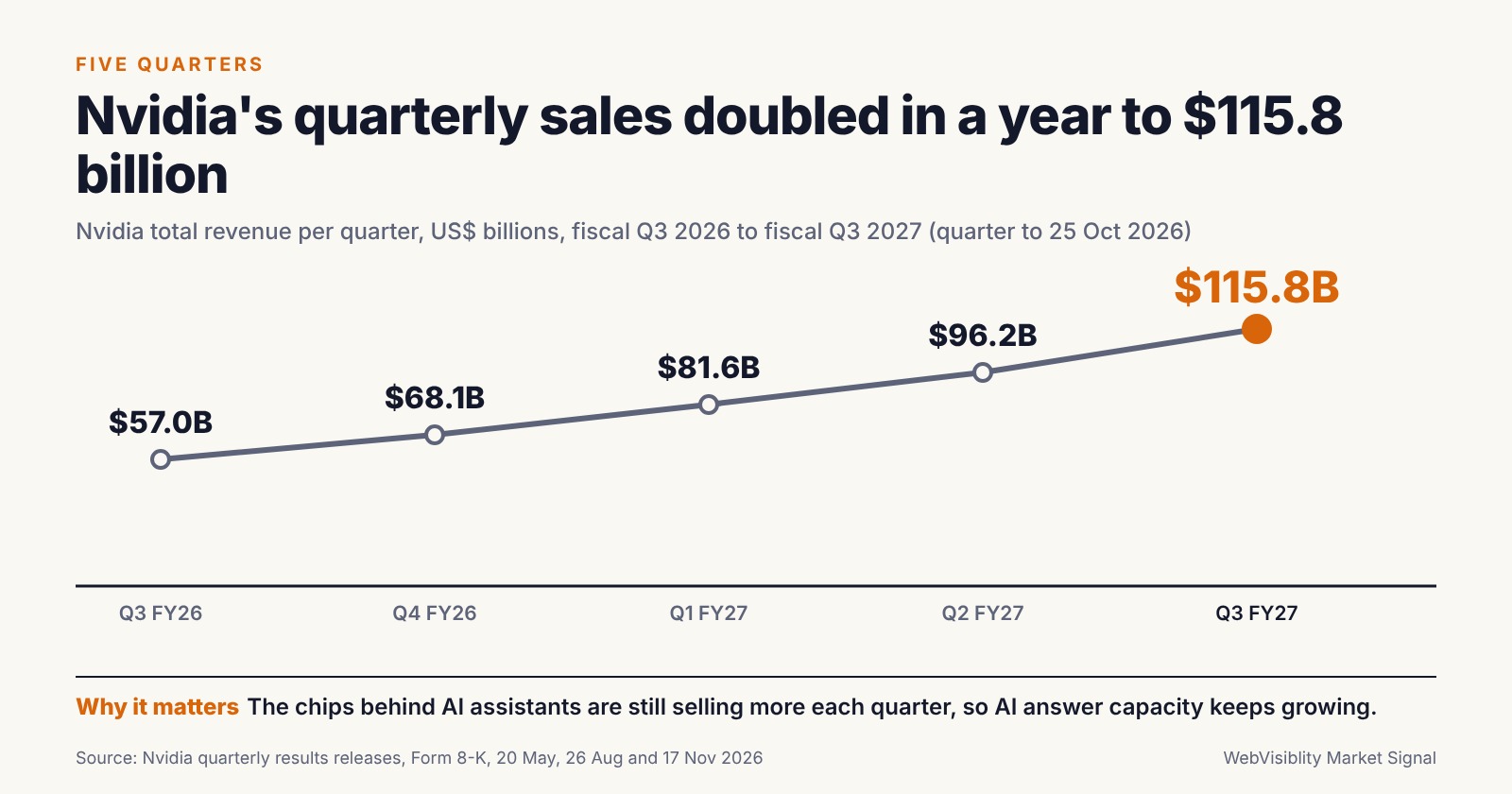
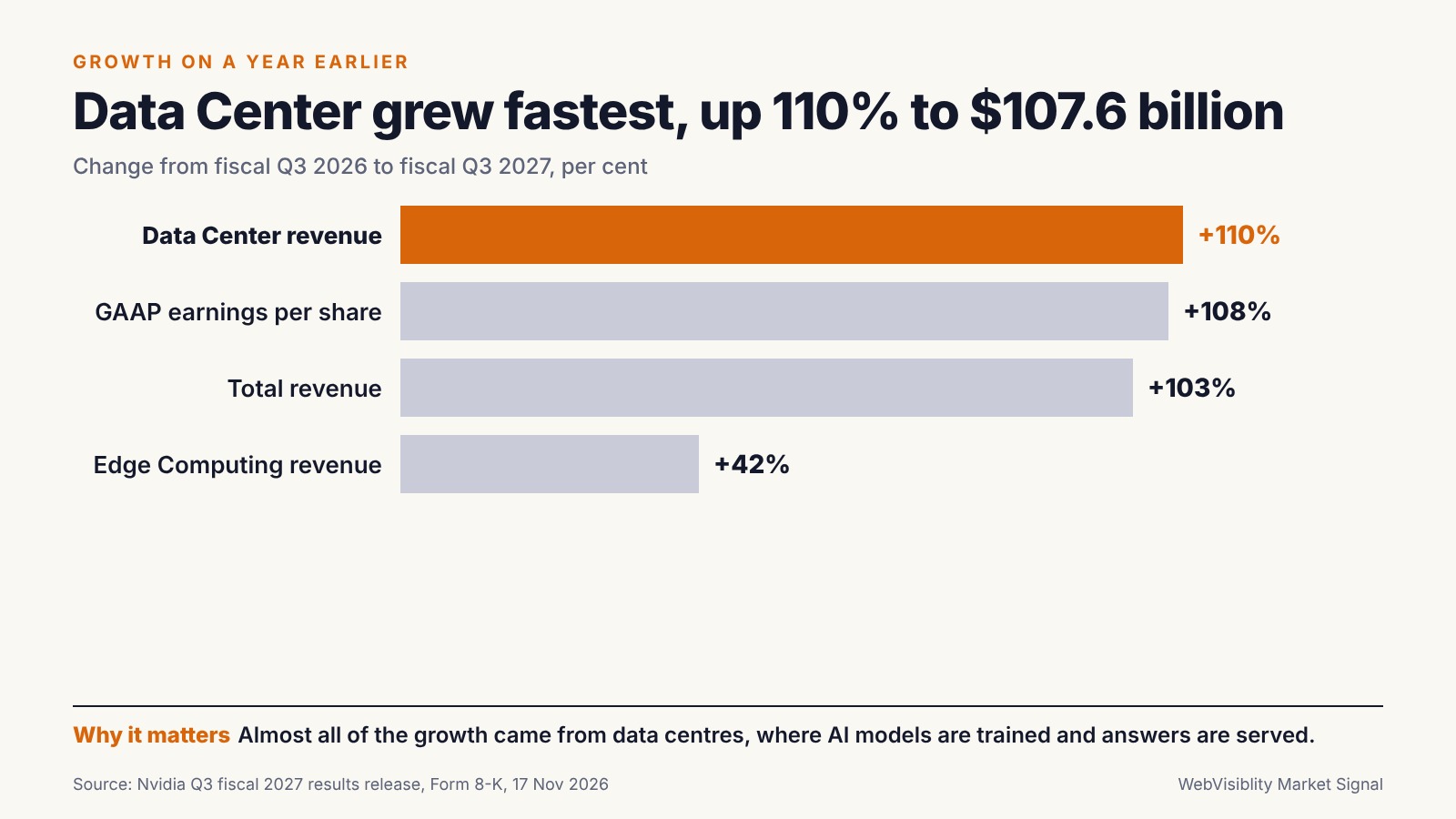
Nvidia reported on Tuesday 17 November that its quarter to 25 October brought in revenue of $115.8 billion, up 103% on a year earlier. Its Data Center business, which sells the systems that train and run AI models, made $107.6 billion, up 110%. The numbers arrived five days after Jensen Huang resigned as CEO, with finance chief Colette Kress presenting them as interim CEO.
At a glance
| Quarter | Fiscal Q3 2027, ended 25 October 2026 |
|---|---|
| Revenue | $115.8 billion, up 103% on a year earlier, up 20% on the quarter |
| Data Center | $107.6 billion, up 110% on a year earlier |
| Edge Computing | $8.2 billion, up 42% on a year earlier |
| Next quarter | $130.0 billion, plus or minus 3%, including an extra week |
| China | No Data Center compute revenue from China assumed in the outlook |
| Leadership | Colette Kress, interim CEO and still CFO, since 12 November |
Do this today
Tick each step as you do it. Your ticks stay on this device. See the full list.
For marketers
For software buyers and IT teams
The signal
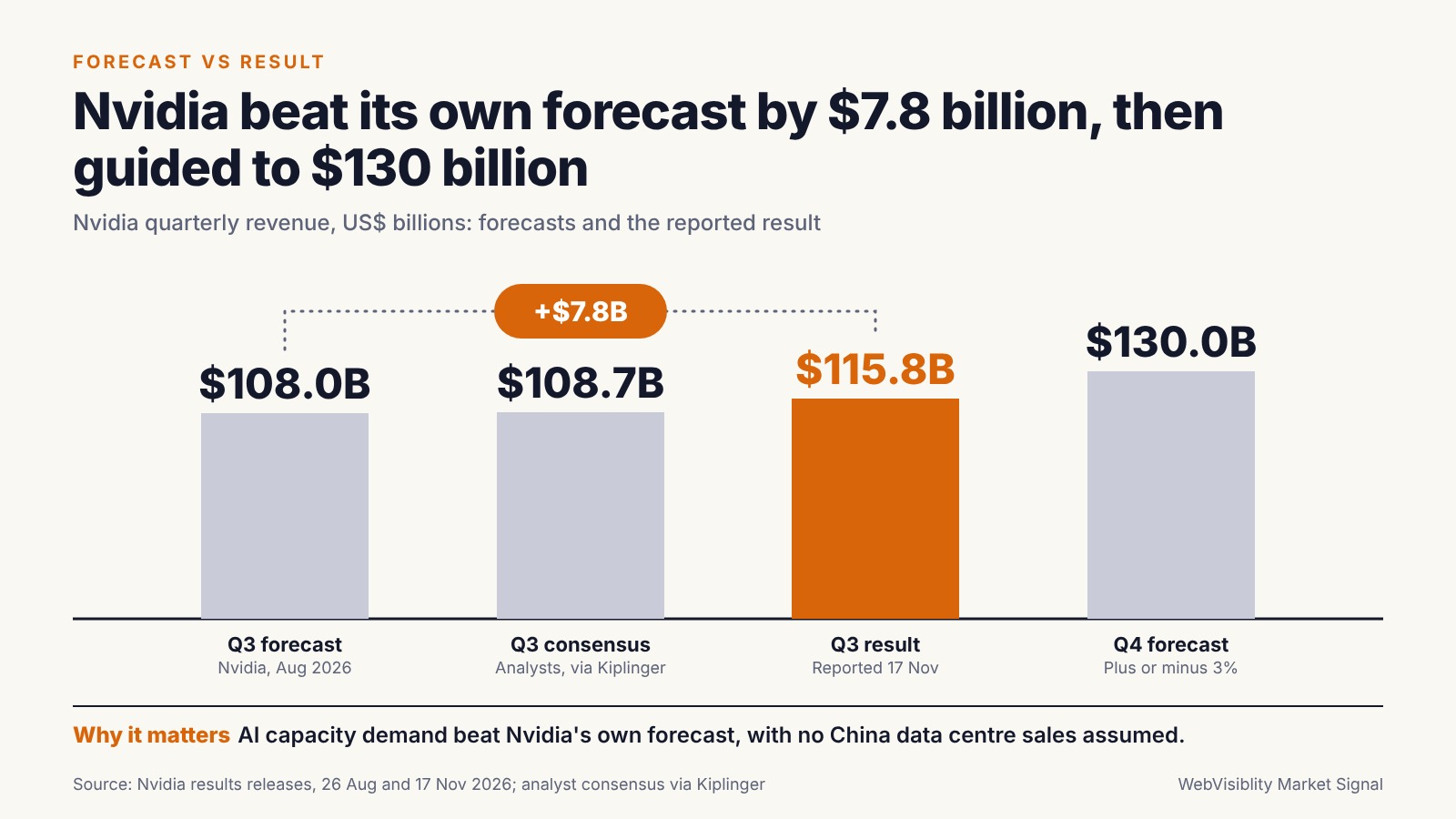
- Revenue beat Nvidia's own August forecast of $108.0 billion, plus or minus 2% by $7.8 billion.
- Analysts had expected revenue of $108.7 billion, according to Kiplinger.
- GAAP earnings per share rose to $2.70 from $1.30 a year earlier.
- The new Vera Rubin NVL72 racks are {running at CoreWeave, Google Cloud, Microsoft Azure, Oracle Cloud Infrastructure and Nebius}.
- The release gives no reason for Huang's resignation; the board is searching for a permanent CEO.
- Shares closed 2.90% lower at $150.96 on 18 November despite the beat, per The Motley Fool.
Which of these are you?
Tap the one that fits you best. We show what this story changes for you.
What happened
Nvidia published its fiscal third-quarter results after the US market closed on 17 November. Total revenue was $115.8 billion, against $96.2 billion in the previous quarter and $57.0 billion a year earlier. Data Center accounted for $107.6 billion of it. The only other segment named in the release, Edge Computing, whose highlights include RTX laptops, gaming and robotics, brought in $8.2 billion.
Gross margin was 74.8% on a GAAP basis, and GAAP net income was $65.3 billion. For the quarter to January, Nvidia expects $130.0 billion, plus or minus 3%, with gross margin between 71.0% and 72.0%. That quarter has an extra week. The company also returned $28.1 billion to shareholders through buybacks and dividends in the quarter.
The report came at an unusual moment. On 12 November Nvidia said Jensen Huang had resigned as President, CEO and director, effective immediately. Colette Kress, CFO since 2013, became interim CEO, and Harvey C. Jones became the company's first chair of the board. The results release refers to an ongoing investigation by an independent committee of the board, without details. PYMNTS wrote that Huang's resignation hung over the call. The Motley Fool pointed out that the next quarter's forecast is spread over 14 weeks instead of 13.
By the numbers
| What | Figure | Source |
|---|---|---|
| Q3 FY27 revenue | $115.8B | NVIDIA (Form 8-K, SEC) |
| Revenue growth, year on year | +103% | NVIDIA (Form 8-K, SEC) |
| Data Center revenue | $107.6B | NVIDIA (Form 8-K, SEC) |
| Data Center growth, year on year | +110% | NVIDIA (Form 8-K, SEC) |
| Q4 FY27 revenue outlook | $130.0B | NVIDIA (Form 8-K, SEC) |
| GAAP gross margin | 74.8% | NVIDIA (Form 8-K, SEC) |
Figures exactly as published.
Timeline
Nvidia reports fiscal Q1 2027 revenue of $81.6 billion.
Fiscal Q2 revenue reaches $96.2 billion; Nvidia forecasts $108.0 billion for Q3.
Jensen Huang resigns; Colette Kress becomes interim CEO.
Nvidia reports Q3 revenue of $115.8 billion and a $130.0 billion outlook.
Nvidia shares close 2.90% lower after the results.
“Vera Rubin is off to an explosive start, our roadmap is on track and our ambition has never been greater.”
How Nvidia's sales reach the AI answers buyers read
- 1Ship
Nvidia ships Vera Rubin NVL72 racks, its newest AI systems.
- 2Host
Clouds such as Google Cloud, Azure and OCI run them.
- 3Rent
AI labs like Anthropic gain access through those clouds.
- 4Answer
Assistants and agents, such as Meta's Muse family, serve users.
Why it matters
The assistants your buyers ask are getting more room to answer. Nvidia's release lists its newest racks in production at Google Cloud, Microsoft Azure and OCI, says Anthropic's access to its capacity has grown through cloud providers, and describes an expanded collaboration with Meta on its Muse agents. Those are the companies behind Gemini, Copilot, Claude and Meta's assistant. A data centre business that doubled in a year means more capacity for those products to handle research questions, including the ones a buyer asks before shortlisting a vendor.
Agents, not chat windows, are where the load is going, if Nvidia's call commentary holds. PYMNTS reported Nvidia saying that agentic workloads make up about 80% of tokens on the OpenRouter platform, and that token prices had fallen nearly 60% since May. Cheaper answers tend to mean more of them: an agent comparing suppliers can read many more pages per task when each step costs less. These figures come from the call as reported by PYMNTS, not from the written release.
The supplier itself is less settled than its numbers. Nvidia has no permanent CEO, an open board investigation, and an outlook that assumes no China data centre compute sales. None of that changed this quarter's demand, but it is the context for every forecast Nvidia now gives.
Who is affected
More AI capacity at Google Cloud, Azure and OCI means AI answers will cover more buyer research.
Agents doing research are about 80% of OpenRouter tokens, as reported by PYMNTS.
Kress expects enterprise revenue to more than double in fiscal 2028, per PYMNTS.
Nvidia assumes no China data centre compute revenue in its outlook.
What to do now
For marketers
- Run your top ten buyer questions through Gemini, Copilot, Claude and Meta AI each month and log which sources they cite.
- Make product pages easy for agents to read: plain specs, prices or pricing logic, and comparison facts in text, not images.
- Budget for AI answer visibility as a standing line, since the capacity behind these assistants is still growing.
- Separate agent and assistant referrals in analytics so changes in AI-driven visits show up early.
For software buyers and IT teams
- When an AI agent shortlists vendors, check the sources it used and their dates.
- If you plan AI projects on Nvidia hardware, ask your cloud provider about Vera Rubin availability and timing.
Printable, one page, 10 checks. Enter your email and it opens right away.
We email you a copy. We never share your email and never send you sales emails.
Pick one. It takes 5 seconds and helps more people find these briefings. Your checklist opens straight after.
Have a work email? Use it instead and the checklist opens straight away.
Open it, then save it as a PDF or print it.
Know someone who would find this useful?
These steps are our recommendations based on this news, not statements from the companies involved.
What to watch
- The CEO search. Whether the board names a permanent chief, and whether internal or external candidates lead.
- The $130 billion quarter. Results for the quarter to January will show if the forecast of $130.0 billion holds with the extra week.
- Enterprise demand. PYMNTS reported Kress expecting enterprise revenue to more than double in fiscal 2028; watch for that line in later releases.
- The investigation. Any update from the independent board committee named in the release.
Questions readers ask
How much revenue did Nvidia make in Q3 fiscal 2027?
Nvidia made $115.8 billion in revenue in the quarter to 25 October 2026, up 103% from a year earlier and up 20% from the previous quarter.
Why did Jensen Huang resign from Nvidia?
Nvidia has not said. Its 12 November release states that Huang resigned effective immediately but gives no reason. The board is searching for a permanent CEO.
Who is Nvidia's CEO now?
Colette Kress is interim CEO. She has been Nvidia's CFO since 2013 and keeps that role until a permanent successor is named.
What is Nvidia's revenue forecast for next quarter?
Nvidia expects $130.0 billion, plus or minus 3%, for the quarter to January 2027, a period that includes an extra week. Gross margin is guided at 71% to 72%.
Is Nvidia selling data centre chips to China?
Its forecast assumes none. The outlook states that Nvidia is not assuming any Data Center compute revenue from China, the same assumption as in its August outlook.
Did Nvidia beat earnings expectations?
Yes. Revenue of $115.8 billion beat Nvidia's own $108.0 billion forecast and the analyst consensus of $108.7 billion reported by Kiplinger.
What do Nvidia's results mean for AI search?
More capacity for AI assistants. The release names its newest systems running at Google Cloud, Microsoft Azure and OCI, the clouds behind major assistants that buyers use for research.
Companies in this story
Sources
- NVIDIA (Form 8-K, SEC)Original
- NVIDIA (Form 8-K, SEC)
- Kiplinger
- PYMNTS
- The Motley Fool
- NVIDIA (via GlobeNewswire)
- NVIDIA (Form 8-K, SEC)
Researched, fact-checked and edited by the Market Signal desk. Read our editorial standards. Spotted an error? Email hello@webvisiblity.com and we will correct it.