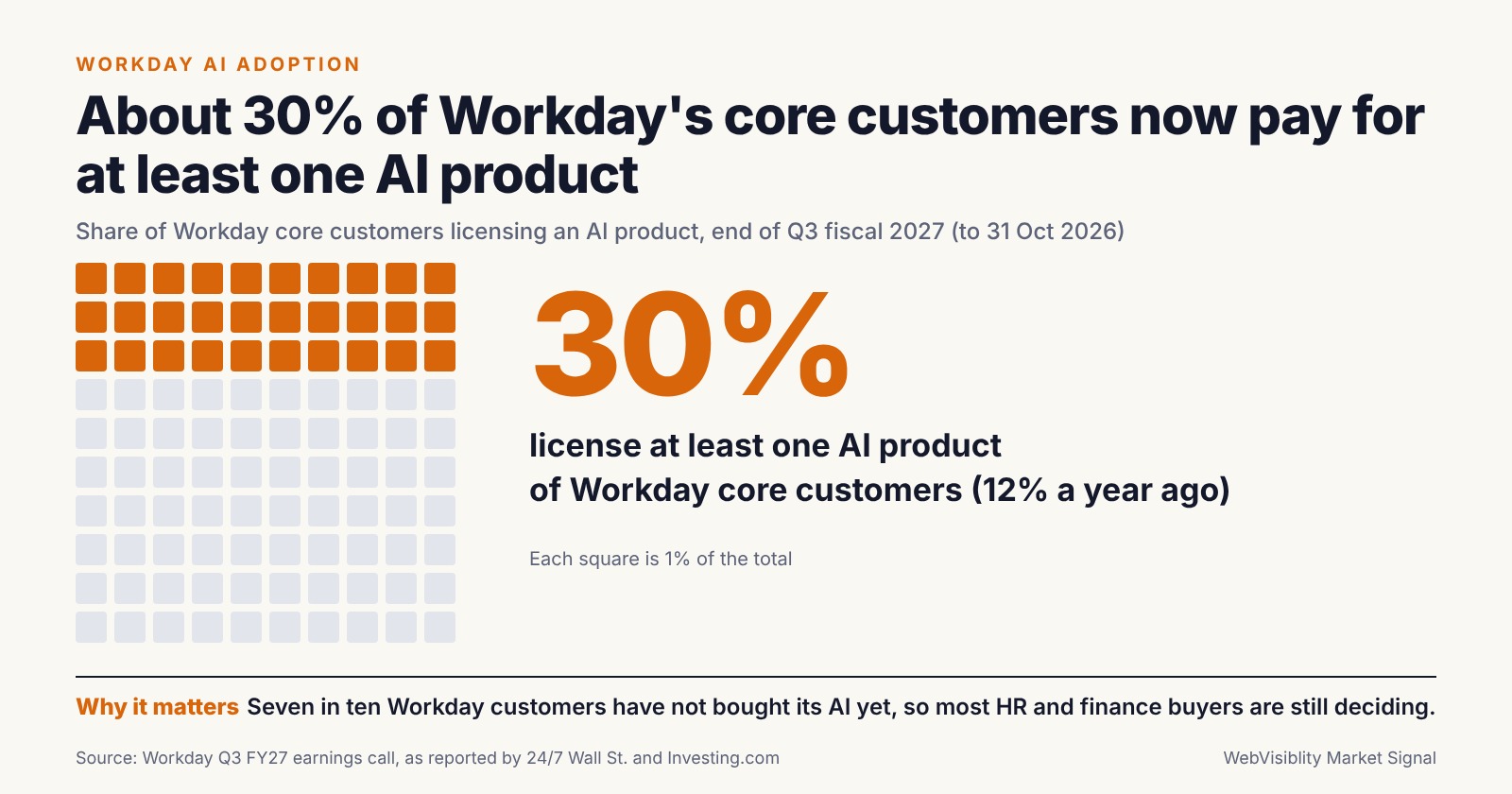
Workday's AI products brought in nearly $150 million in new ACV in the quarter to 31 October, more than three times the figure a year earlier. Yet on the results call, its chief commercial officer said roughly 30% of customers license at least one AI product. The other seven in ten are still deciding, and Workday now plans to reach them through Claude, Gemini, Microsoft Copilot, Teams and Slack as well as its own screens.
At a glance
| Reported | 24 November 2026, quarter to 31 October |
|---|---|
| Total revenue | $2.705 billion, up 11.2% |
| New AI contract value | nearly $150 million, over 3 times a year earlier |
| AI product ARR | more than $750 million, up over 130% |
| Customers with an AI product | more than 2,200 core customers |
| Q4 subscription forecast | $2.600 billion, growth of 10% |
Do this today
Tick each step as you do it. Your ticks stay on this device. See the full list.
For marketers
For software buyers and IT teams
The signal
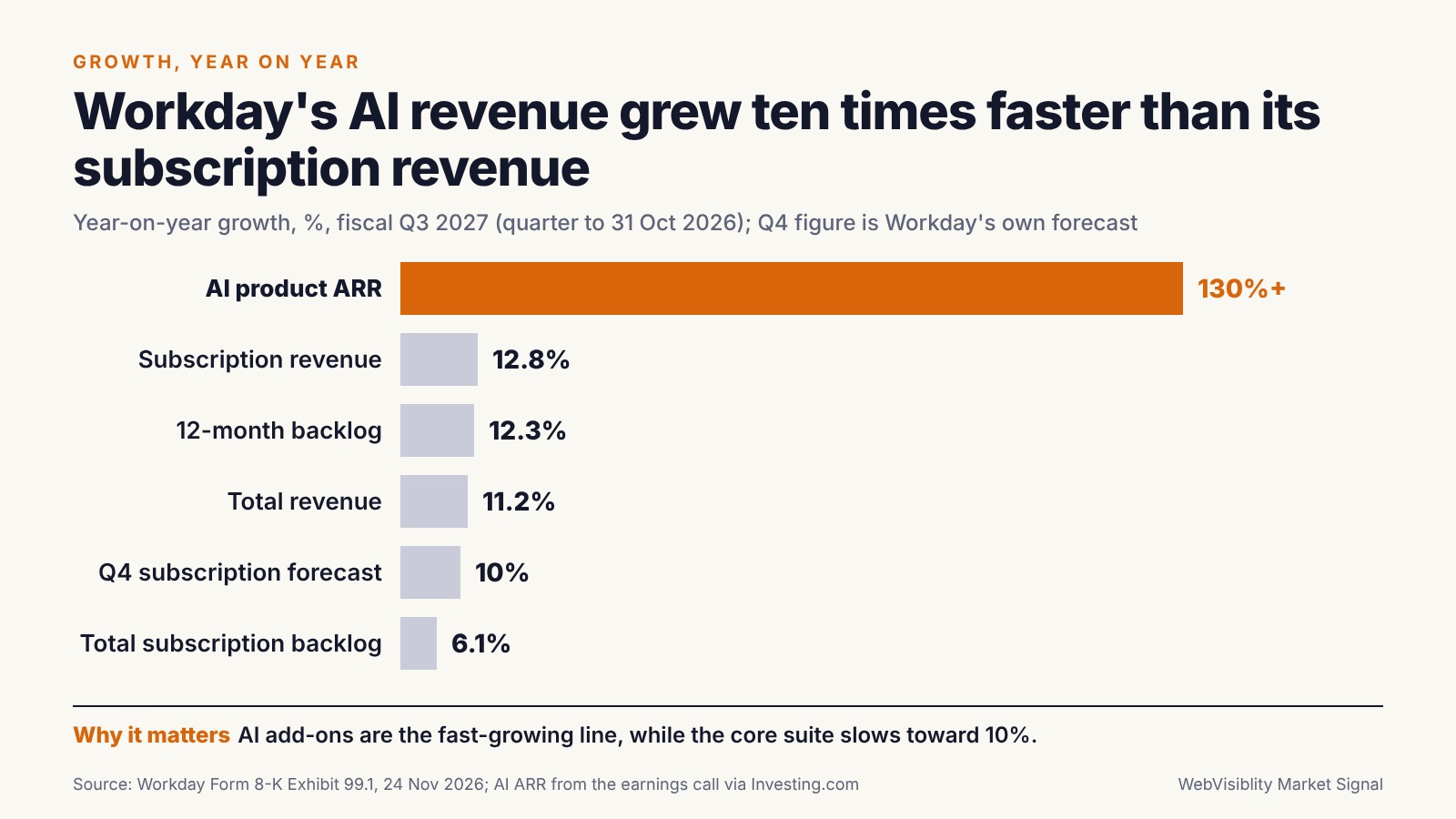
- Subscription revenue rose 12.8% to $2.532 billion, and Workday raised its full-year subscription forecast to $9.958 billion.
- The number of core customers with at least one AI product rose nearly 25% from last quarter.
- About 30% of core customers now license AI, compared with just 12% a year ago, Workday said on its call.
- Shares fell more than 7% in late trading because the fourth-quarter forecast came in below analyst estimates.
- Workday's finance chief said early renewals that lifted the quarter will not repeat.
- Workday says its agent platform is now headless, so customers can build and run agents with the tools and models they choose.
Which of these are you?
Tap the one that fits you best. We show what this story changes for you.
What happened
Workday published results for its fiscal 2027 third quarter after the US market closed on 24 November. Revenue was $2.705 billion, up 11.2%, and non-GAAP earnings per share were $2.82 against $2.32 a year earlier. Analysts had expected $2.75 per share on revenue of $2.69 billion, according to SiliconANGLE. GAAP results carried $51 million of restructuring expenses, which followed a plan to cut about 2.5% of its workforce.
The AI numbers were the headline. Chief executive Aneel Bhusri said AI products drove nearly $150 million in new ACV, more than three times the level a year earlier. On the call, product chief Gerrit Kazmaier said AI products had passed $750 million in ARR, up more than 130% on a year earlier and nearly 25% on the previous quarter. Chief commercial officer Rob Enslin said roughly 30% of customers license at least one AI product, up from 12% a year ago. Workday has more than 11,500 organizations as customers, including more than 65% of the Fortune 500.
The forecast was the problem for investors. Workday guided fourth-quarter subscription revenue to $2.600 billion, growth of 10%, narrowly below the $2.61 billion analysts had expected. It raised its full-year subscription forecast to $9.958 billion, up 13%. Chief financial officer Zane Rowe said on the call that early renewals that lifted the quarter will not repeat, and repeated an outlook of about 11% subscription growth for fiscal 2028. The stock closed at $179.23 and traded at $166.64 after hours, down 7.02%.
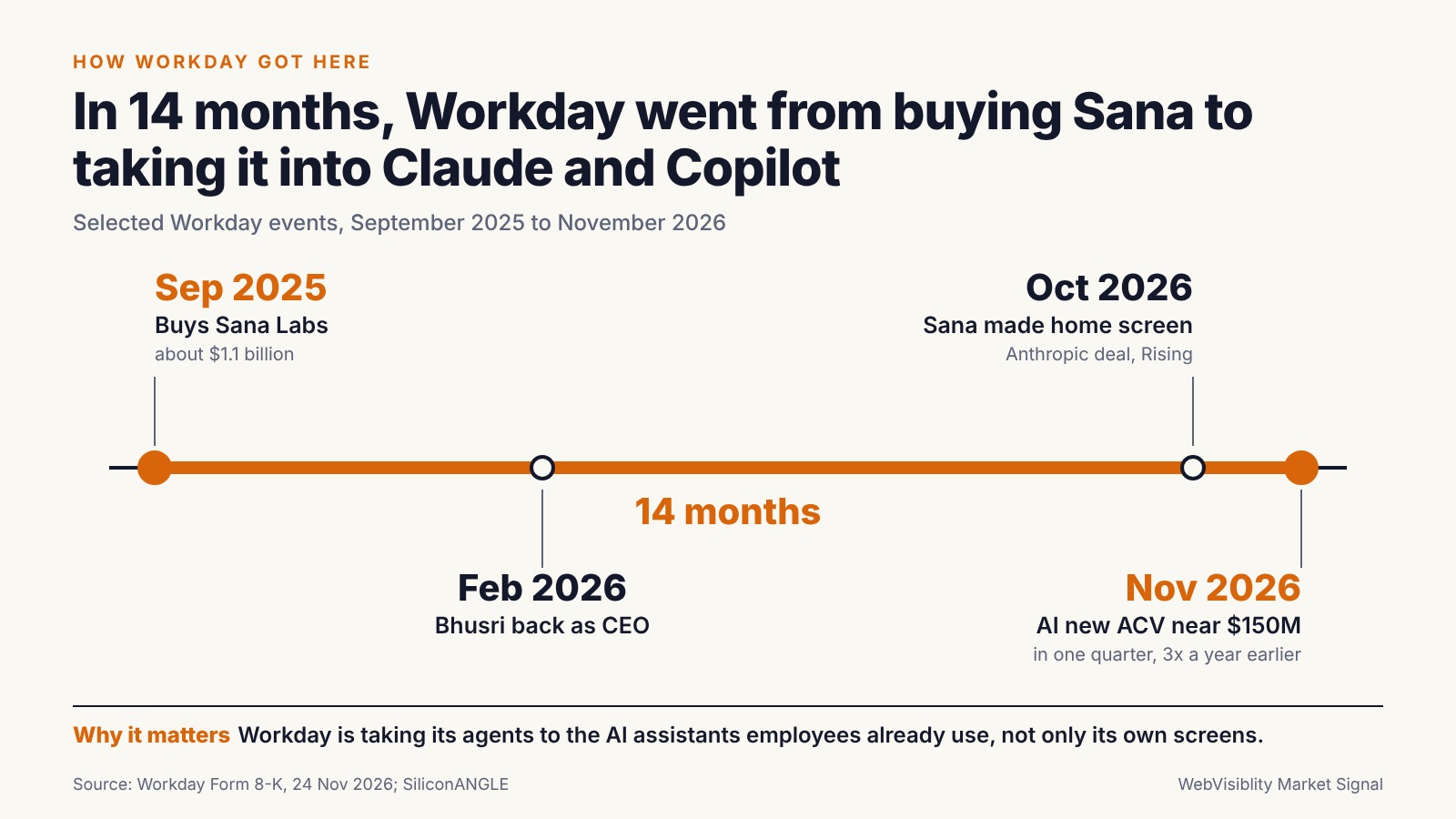
The release also listed what Workday sold and built in the quarter. Sana, the AI interface it bought for about $1.1 billion, is now the home screen for Workday. Workday said Sana will work inside the AI tools employees already use, naming Claude, Google Cloud's Gemini for business, Microsoft Copilot, Microsoft Teams and Slack. It launched Autopilot Agents for routine HR, finance and IT work, announced a partnership with Anthropic, and closed its purchase of C1.ai, an agentic identity platform for people and AI agents.
By the numbers
| What | Figure | Source |
|---|---|---|
| New AI annual contract value, Q3 FY27 | ~$150M | Workday via SEC |
| AI product ARR | $750M+ | Investing.com |
| Core customers with an AI product | 2,200+ | Workday via SEC |
| Total revenue, Q3 FY27 | $2.705B | Workday via SEC |
| Q4 subscription growth forecast | 10% | Workday via SEC |
| Total subscription backlog growth | 6.1% | Workday via SEC |
Figures exactly as published.
Timeline
Workday buys Sana Labs for about $1.1 billion.
Aneel Bhusri returns to the top job after Carl Eschenbach steps down.
At Rising, Sana becomes the new home experience and the Anthropic partnership is announced.
The C1.ai deal closes.
Q3 results: nearly $150 million of new AI contract value and a 10% Q4 forecast.
“We don't want to ask customers to have to switch their front doors or log into Workday when they're happy to use Gemini systems.”
Who is affected
| Who | What changes | Impact |
|---|---|---|
| B2B marketers in enterprise software | Users may meet your product inside the AI tools they already use; check how those tools describe it. | High |
| HR and finance software buyers | About 70% of Workday customers have not bought its AI yet, so there is room to ask for proof first. | High |
| Vendors on per-seat pricing | Workday's product chief said it does not necessarily need more heads; buyers may apply that to seat counts. | Medium |
| Microsoft, Google and Anthropic partners | Their assistants are becoming front doors for business software like Workday. | Medium |
Why it matters
Workday is moving its product to where people already type. Sana is set to work inside Claude, Gemini, Copilot, Teams and Slack, and its agent platform is now headless. For a B2B marketer, that is a clear sign of where software use, and software research, is heading. If an HR director can run a Workday task from inside Copilot, the same director is likely to ask that assistant which vendors to shortlist. How AI search tools describe a product, and which pages they quote, now shapes the first impression a buyer gets. That makes AI visibility a pipeline question, not only a brand one.
The adoption numbers also show a long middle stage. About 70% of customers have not yet licensed a single Workday AI product, and Bhusri named his own priority as moving more agents into production. Buyers in that stage want proof: what an agent does, what it costs, and what changed for a named customer. Vendors in any AI category can expect a similar gap between buyers who are curious and buyers who have signed, and should publish the evidence that closes it.
Pricing is the third thread. Workday's contracts are largely sized by headcount, and 24/7 Wall St. argued that AI add-ons let it charge more on top of seat-based deals if agents shrink the workforce those deals are built on. Kazmaier said on the call that Workday does not necessarily need more heads. Buyers can use that line in their own renewal talks, and sellers on per-seat models should be ready for the question.
How Workday is taking its AI to customers
- 1Interface
Sana becomes the new home experience for Workday.
- 2Agents
Autopilot Agents handle routine HR, finance, and IT work in the background.
- 3Headless
Customers can build agents with the tools and models they choose.
- 4Assistants
Sana is set to work inside Claude and Copilot, Teams and Slack.
What to do now
For marketers
- Ask Copilot, Claude and Gemini to describe your product and list where each answer is wrong or out of date.
- Publish one page per AI feature with what it does, who uses it, how it is priced and a named result.
- Add pricing logic for AI add-ons in plain words, so buyers and AI tools do not have to guess.
- Track how often Perplexity and ChatGPT name you when buyers ask for vendors in your category.
For software buyers and IT teams
- Ask each HR or finance vendor which of its AI products are live in production at customers like you.
- Before renewal, ask how seat-based prices change if AI agents reduce your headcount.
- Check whether a vendor's agents can run inside the assistant your teams already use, and on what terms.
Printable, one page, 10 checks. Enter your email and it opens right away.
We email you a copy. We never share your email and never send you sales emails.
Pick one. It takes 5 seconds and helps more people find these briefings. Your checklist opens straight after.
Have a work email? Use it instead and the checklist opens straight away.
Open it, then save it as a PDF or print it.
Know someone who would find this useful?
These steps are our recommendations based on this news, not statements from the companies involved.
What to watch
- Q4 bookings. Rowe expects 12-month backlog growth of about 10% to 11% in the fourth quarter, after early renewals lifted Q3.
- AI share of customers. Whether the roughly 30% licensing at least one AI product keeps climbing as fast next quarter.
- Fiscal 2028 guidance. Formal guidance arrives with the Q4 report; Workday has pointed to about 11% subscription growth.
- Assistant integrations. When Sana's links into Claude, Copilot, Teams and Slack reach customers, and how they are priced.
Questions readers ask
How much did Workday make from AI in Q3 fiscal 2027?
Workday said AI products drove nearly $150 million in new ACV in the quarter to 31 October 2026, more than three times a year earlier. On the call it put AI product ARR above $750 million.
Why did Workday stock fall after earnings?
Workday guided fourth-quarter subscription revenue to $2.600 billion, growth of 10%, slightly below analyst estimates, and said early renewals that helped Q3 will not repeat. Shares fell more than 7% after hours.
How many Workday customers use its AI products?
More than 2,200 core customers have bought at least one AI product. On the call Workday said that is roughly 30% of core customers, up from 12% a year earlier.
What is Workday Sana?
Sana is Workday's AI interface and the new home experience for its platform. It brings tasks, decisions, meetings and agent activity together and came from Sana Labs, bought for about $1.1 billion.
Does Workday work inside Microsoft Copilot or Claude?
Workday has announced that Sana will work inside the AI tools employees already use, including Claude, Gemini for business, Microsoft Copilot, Microsoft Teams and Slack. It has not given a date or price in the release.
What are Workday Autopilot Agents?
Autopilot Agents are Workday agents that continuously handle routine HR, finance and IT processes in the background, launched in the third quarter of fiscal 2027.
What is Workday's revenue forecast for fiscal 2027?
Workday raised its fiscal 2027 subscription revenue forecast to $9.958 billion, growth of 13%, with a non-GAAP operating margin of 31.5%. Its fiscal year ends on 31 January 2027.
Companies in this story
Sources
Researched, fact-checked and edited by the Market Signal desk. Read our editorial standards. Spotted an error? Email hello@webvisiblity.com and we will correct it.