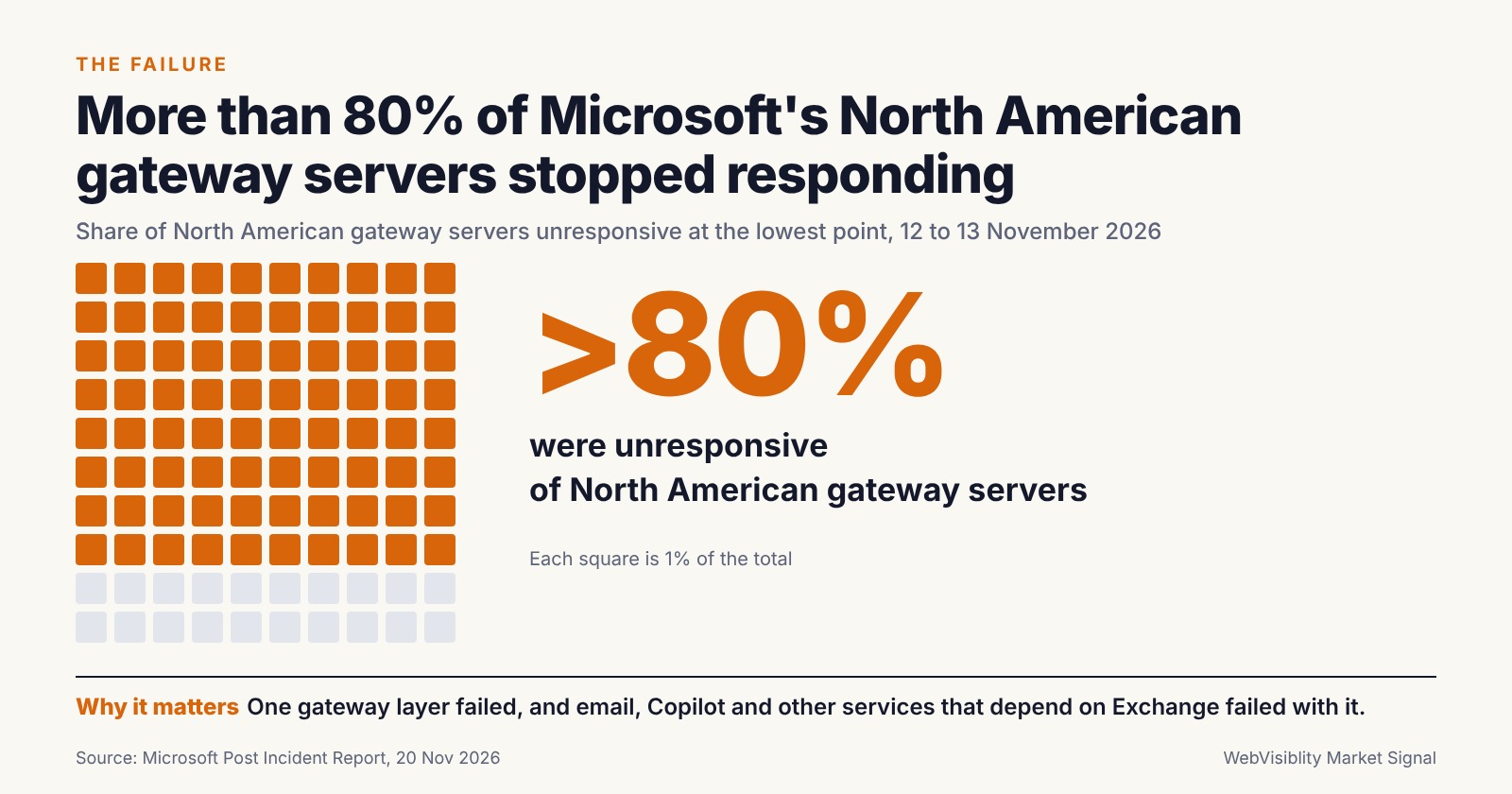
Microsoft has declared a Code Red to overhaul how it prevents and responds to major service failures, according to internal memos Reuters reviewed on 24 November. The trigger was an outage that ran from 16:20 UTC on 12 November to 16:10 UTC on 13 November and cut off Exchange Online, Outlook, Teams and Copilot features. Microsoft says it wants future worldwide incidents resolved within an hour, and says the outage was not caused by a cyberattack or AI agents.
At a glance
| Customer impact window | 23 h 50 min, from 4:20 PM UTC on 12 Nov to 4:10 PM UTC on 13 Nov |
|---|---|
| North American gateway servers unresponsive at the lowest point | More than 80% |
| Gateway capacity already out of service | Nearly 14% |
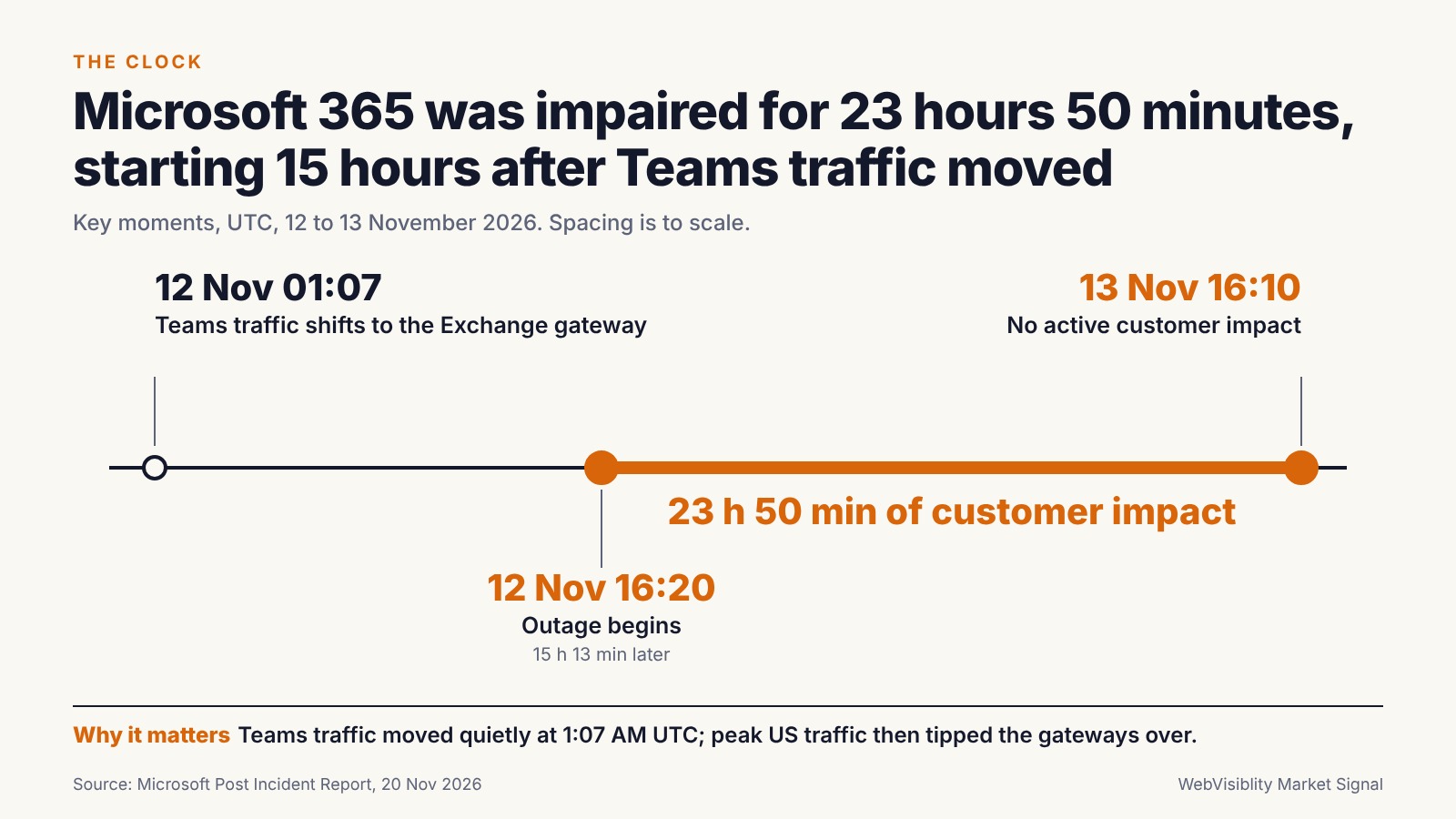
| Gap between Teams traffic shift and outage start | 15 h 13 min, from 1:07 AM UTC to 4:20 PM UTC |
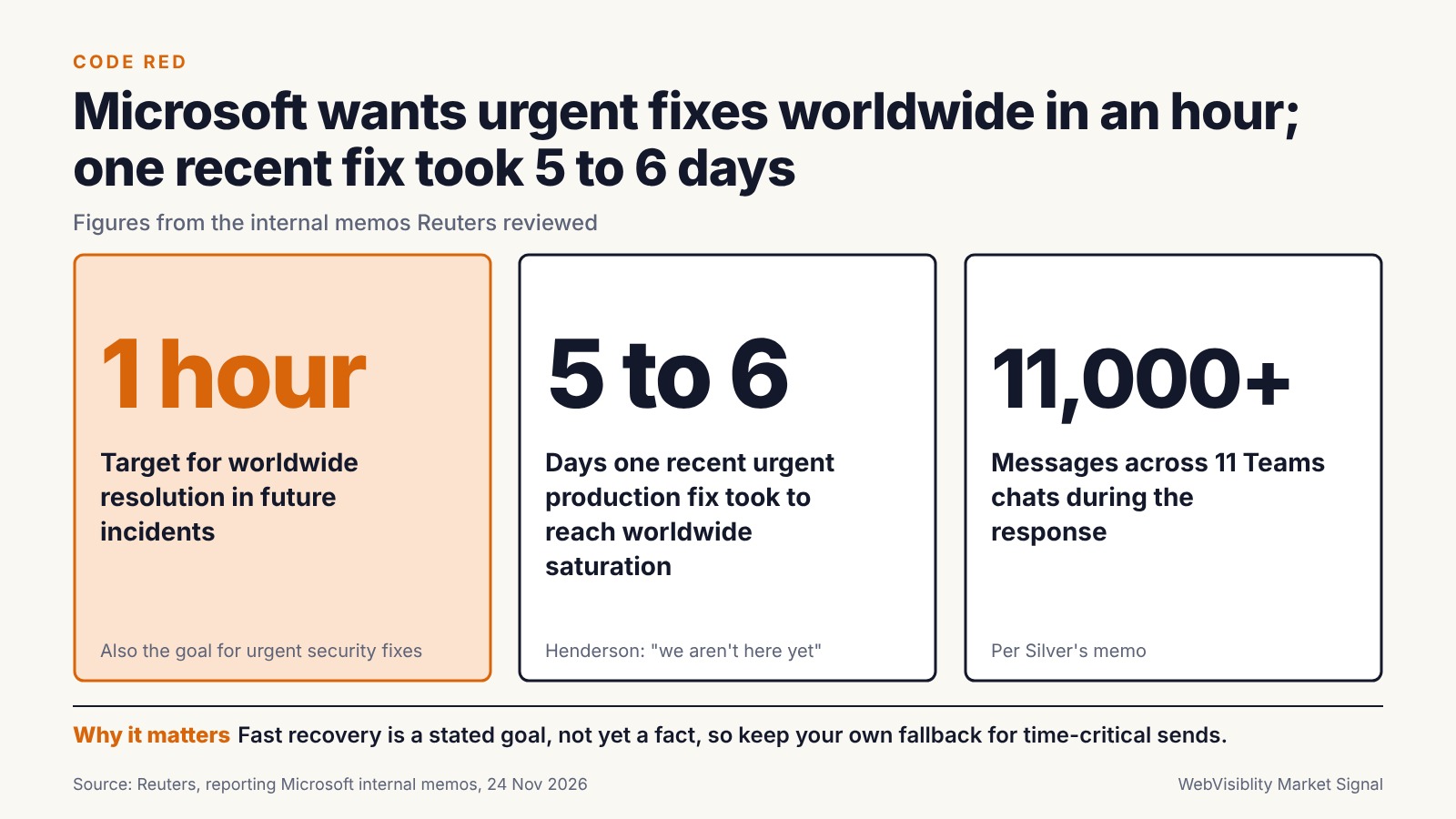
| Goal for future worldwide incidents | Resolve within one hour |
| Code Red reported by | Reuters, 24 Nov, from internal memos |
Do this today
Tick each step as you do it. Your ticks stay on this device. See the full list.
For marketers
For software buyers and IT teams
The signal
- Code Red is Microsoft's highest level of urgency for the weaknesses the outage exposed, per the memos Reuters reviewed.
- Microsoft's report blames a latent defect in a Windows update on its gateway servers, set off by reduced capacity, a Teams traffic shift and peak North American load. It says the incident was not caused by AI tooling or a cyberattack.
- Services hit included Exchange Online, Outlook and Teams. For Copilot, most users could not launch the desktop apps or load the web apps, and most prompts failed or timed out.
- Engineers are working on five streams, and three are named: load shedding, geographic traffic partitioning and faster recovery.
- Jason Henderson, who leads Microsoft 365 Core, plans daily meetings and weekly reviews. On shipping urgent security fixes worldwide within an hour he wrote: "we aren't here yet."
- Microsoft's report lists 13 next steps, counted from its table, some due in late 2026 or early 2027 and some with no date. Not known: the two unnamed workstreams and how long Code Red will run.
Which of these are you?
Tap the one that fits you best. We show what this story changes for you.
What happened
Reuters reported on 24 November that Microsoft has launched a Code Red drive after a nearly day-long Microsoft 365 outage. The memos describe it as the most severe level of alert for fixing weak spots in Microsoft's engineering and response practices. Jason Henderson, president of Microsoft 365 Core, called the outage the most customer-impacting incident in the history of Exchange Online. Satya Nadella apologised publicly.
Microsoft's own report, dated 20 November, puts the start at 4:20 PM UTC on 12 November and says customers were no longer facing active impact at 4:10 PM UTC on 13 November, before it moved to monitoring and mail-backlog recovery. It lists four factors that combined: a defect in a Windows update on the gateway servers, nearly 14% of capacity out of service for routine work, a shift of Teams traffic onto the Exchange gateway at 1:07 AM UTC, and peak North American traffic. At the lowest point more than 80% of servers in the North American fleet were unresponsive, and within about two hours of the broad failures there, servers in every region were affected.
Most users could not reach their mailboxes in Outlook or other clients, and email delivery was delayed for most users. Microsoft 365 Copilot was hit hard: most users could not launch the desktop apps or load the web apps. Microsoft says no mail was lost. Reuters says the outage hit governments from Australia and Japan to the United States, delayed trading firms and disrupted airline communications. Amanda Silver, a corporate vice president, wrote that responders faced a fog of war, with more than 11,000 messages across 11 Teams chats.
How the outage unfolded
- Step 1July
A Windows update with a latent defect starts rolling out to the gateway servers.
- Step 212 Nov, 1:07 AM UTC
Teams traffic shifts to the Exchange gateway.
- Step 312 Nov, 4:20 PM UTC
Gateways stop responding; more than 80% of North American servers fail at the lowest point.
- Step 413 Nov, 4:10 PM UTC
Customers are no longer facing active impact, 23 h 50 min after the start.
Timeline
At 1:07 AM UTC a routing issue in US East moves Teams traffic onto the gateway shared with Exchange Online. At 4:20 PM UTC the outage begins.
At 4:10 PM UTC customers are no longer facing active impact, just under 24 hours after the start.
At 4:15 AM UTC Microsoft declares the incident resolved after extended monitoring.
Microsoft publishes a preliminary post-incident report.
Microsoft's final post-incident report lists four factors and 13 next steps.
Reuters reports the Code Red from internal memos.
“Code Red means that this is the highest priority work for our team.”
Who is affected
| Who | What changes | Impact |
|---|---|---|
| Email marketers | Email delivery was delayed for most users; the retry window went to 48 hours, but some delayed messages to inactive consumer mailboxes expired. | High |
| Teams users in sales and support | Teams features that depend on Exchange data, such as search, calendar and presence, may have stayed affected after traffic moved. | Medium |
| Teams using Copilot | Most users could not launch the Copilot desktop apps or load the web apps, and most prompts failed or timed out. | High |
| Vendors selling into Microsoft shops | Buyers may ask about recovery plans, since Microsoft says it is not yet at a one-hour standard for urgent security fixes. | Medium |
Why it matters
One front door carried email, Teams and parts of Copilot, and when it failed they failed together. For a marketing team that sounds like an IT story, but the exposure is commercial. Campaign emails, webinar reminders and sales follow ups all ran through the same service, and Microsoft said email delivery was delayed for most users. Microsoft also extended its email retry window from 24 to 48 hours so delayed messages were not returned as undeliverable, which is a reminder that a send date and a delivery date can differ by a day.
The second point is about AI assistants as a channel. Microsoft's report says most users could not launch Microsoft 365 Copilot's desktop apps or load its web apps, and most prompts failed or timed out. A brand that wants to be named by AI assistants cannot control whether a given assistant is up on a given day, and a buyer who asks one that is down gets no answer at all. That argues for measuring visibility across several assistants, not one, and for keeping the facts AI draws on, such as pricing and product pages, on your own site where they stay reachable.
Third, vendors that sell to Microsoft shops should expect resilience questions in security reviews and renewals. Henderson himself wrote that Microsoft cannot yet ship its most urgent security fixes worldwide within an hour ("we aren't here yet"), so a clear, honest answer about your own recovery plan is cheap to prepare and hard for a rival to fake.
By the numbers
What to do now
For marketers
- Check which campaign emails, webinar reminders and sales follow ups ran on Microsoft 365 during 12 to 13 November, and resend where needed.
- Keep a backup sending route for time-critical emails, such as webinar links.
- Measure AI visibility across several assistants, not only Copilot, so one outage does not hide your results.
- Prepare a short, honest answer on your own recovery plan for customer security reviews.
For software buyers and IT teams
- Ask Microsoft account contacts for the final post-incident report and its full list of fixes.
- Check whether your critical email and chat flows have a fallback during a Microsoft 365 incident.
- Review service credit terms in your Microsoft agreement before the next renewal.
Printable, one page, 11 checks. Enter your email and it opens right away.
We email you a copy. We never share your email and never send you sales emails.
Pick one. It takes 5 seconds and helps more people find these briefings. Your checklist opens straight after.
Have a work email? Use it instead and the checklist opens straight away.
Open it, then save it as a PDF or print it.
Know someone who would find this useful?
These steps are our recommendations based on this news, not statements from the companies involved.
What to watch
- The 13 next steps. Whether Microsoft meets the dates in its report: some are due in the fourth quarter of 2026, some in the first quarter of 2027, and some have no date.
- The one-hour test. Whether Microsoft hits its goal in the next worldwide incident, and whether the target means a full fix or only stopping the damage. Reuters does not say.
- The two unnamed workstreams. Reuters names three of five work streams.
- Customer response. Whether enterprise customers ask for compensation or resilience commitments.
Questions readers ask
What is Microsoft's Code Red?
It is Microsoft's most urgent internal alert for fixing engineering and response weaknesses. Per memos Reuters reviewed, it follows the 12 to 13 November Microsoft 365 outage and makes remediation the top priority.
Why did Microsoft declare Code Red?
Because a roughly 24-hour outage showed gaps in its systems and crisis response. Henderson called it the most customer-impacting incident in Exchange Online's history, and Microsoft wants faster recovery.
What caused the Microsoft 365 outage in November 2026?
Four conditions combined: a Windows defect from a July update, nearly 14% of capacity out for routine work, a Teams traffic shift onto the Exchange gateway, and peak North American load. Microsoft says it was not a cyberattack.
How long did the Microsoft 365 outage last?
Just under 24 hours of customer impact. Microsoft's report dates it from 4:20 PM UTC on 12 November to 4:10 PM UTC on 13 November, which is 23 hours 50 minutes. It declared the incident resolved at 4:15 AM UTC on 14 November.
Did the Microsoft outage affect Copilot?
Yes, heavily. Microsoft's report says most users could not launch Copilot's desktop apps or load its web apps, and most prompts failed or timed out.
Was the Microsoft outage caused by AI or a cyberattack?
No. Microsoft's report says the incident was not caused by a cyberattack and that the change was not caused by AI tooling. It traced the fault to a Windows defect on gateway servers.
What is Microsoft's one-hour target?
Microsoft wants any future worldwide incident resolved within an hour. Separately, Henderson wants urgent security fixes taken from detection to safe worldwide deployment in an hour, and wrote that Microsoft is not there yet.
Companies in this story
Sources
- Microsoft (report copy on GitHub Pages)Original
- CTV News (Reuters)
- Newsweek
- IBTimes UK
- BleepingComputer
- TechPowerUp
Researched, fact-checked and edited by the Market Signal desk. Read our editorial standards. Spotted an error? Email hello@webvisiblity.com and we will correct it.