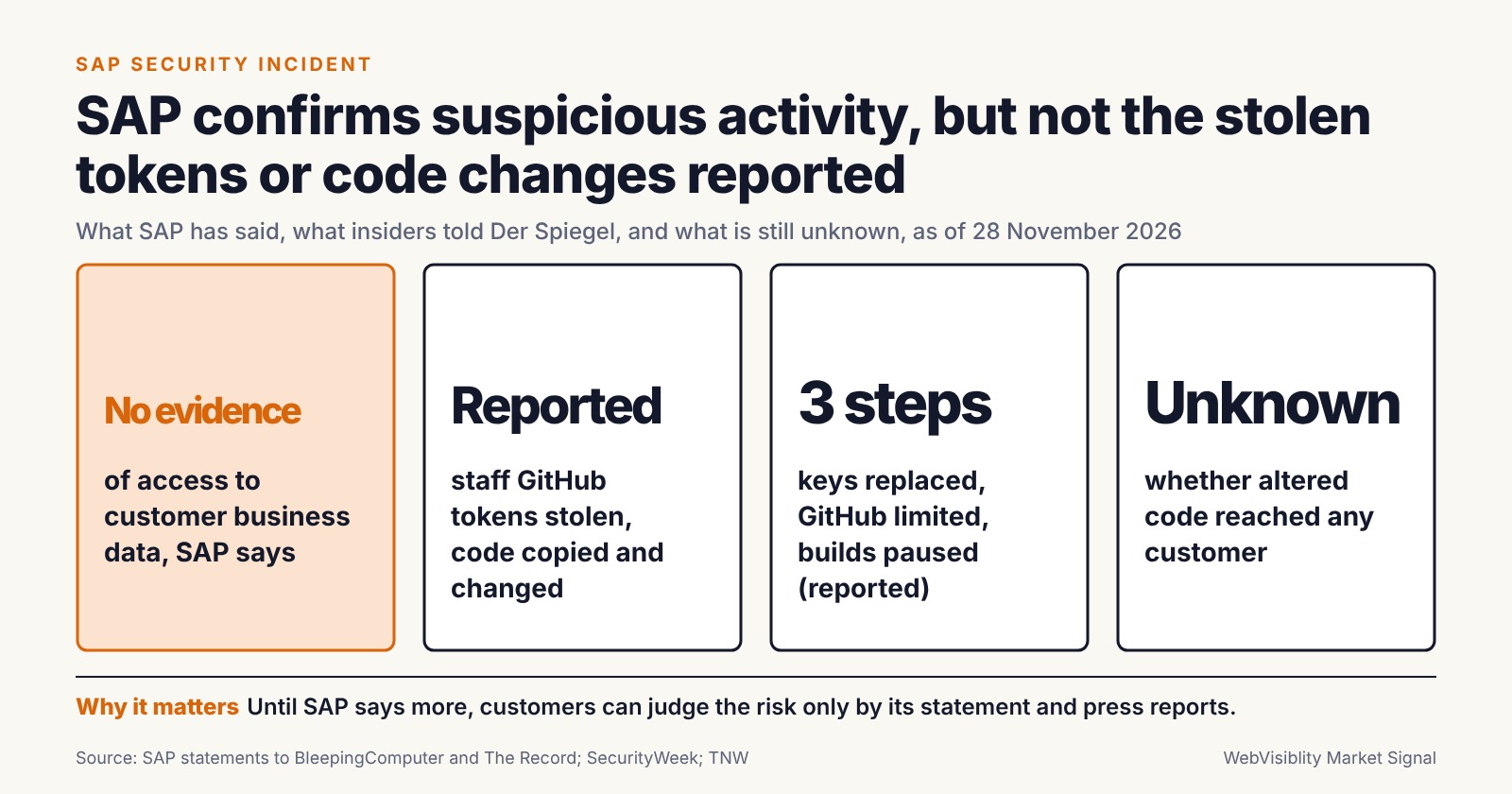
SAP has confirmed a cybersecurity incident after Der Spiegel reported that attackers reached its software development setup on GitHub. The company said it identified suspicious activity and took steps to protect customers, and that it has found no evidence of unauthorized access to customer business data so far. It has not confirmed the insider account that attackers stole employee authentication tokens and used them to copy and change source code.
At a glance
| Internal code name | Project Granite |
|---|---|
| First reported | Der Spiegel, Thursday 26 November |
| SAP on customer data | No evidence of unauthorized access so far |
| Reported response | Keys replaced, GitHub access limited |
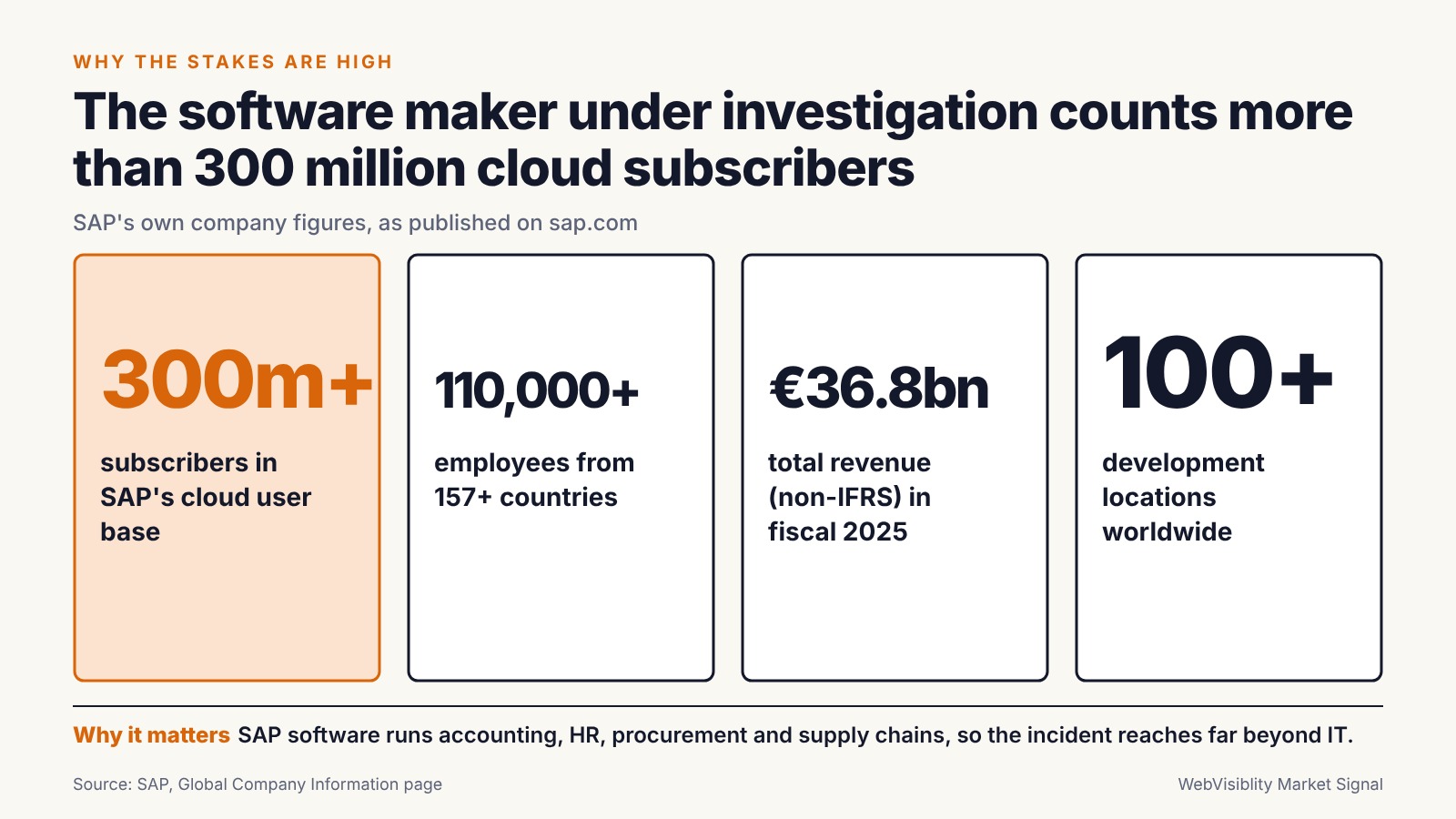
| SAP cloud user base | 300 million+ subscribers |
Do this today
Tick each step as you do it. Your ticks stay on this device. See the full list.
For marketers
For software buyers and IT teams
The signal
- SAP's statement covers customer business data only; it says nothing about whether its source code was copied or changed.
- Insiders told Der Spiegel the attackers copied and altered source code stored on GitHub, possibly with help from AI tools, which nobody has confirmed.
- SAP reportedly replaced signing keys, limited access to GitHub and suspended automated development work.
- None of the reports says tampered code reached customers, and SAP has not said either way.
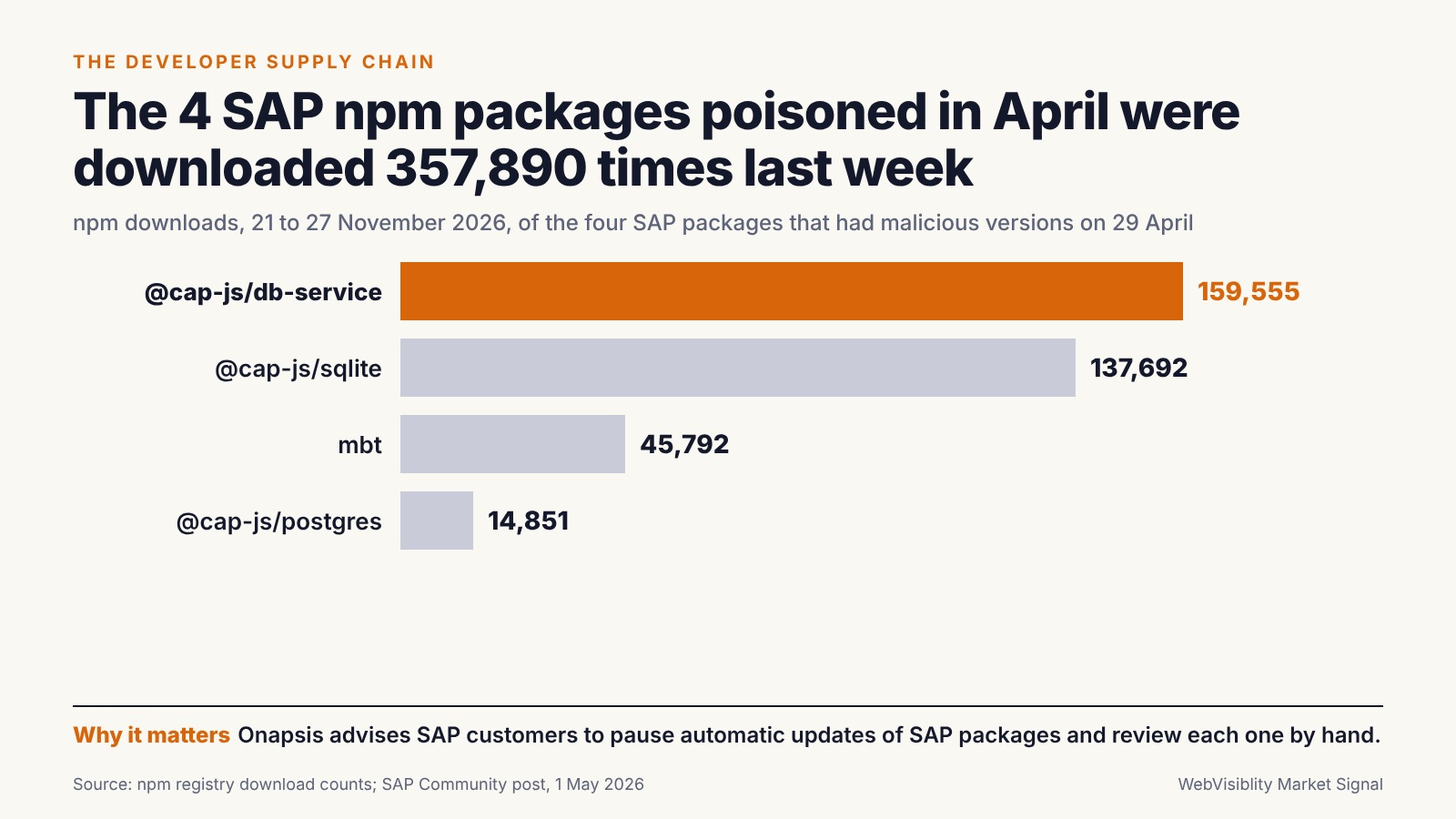
- Four SAP packages hit by a separate attack in April were downloaded 357,890 times in one week this month, which shows how widely SAP code flows to developers.
- Germany's cyber agency warned the same day that AI agent toolkits can now run attacks largely on their own.
Which of these are you?
Tap the one that fits you best. We show what this story changes for you.
What happened
Der Spiegel reported on Thursday, 26 November that SAP had been hit by an attack, citing company insiders and an internal notice to staff. SAP tracks the incident under the code name Project Granite and asked employees to keep its details confidential. According to an insider quoted by the magazine, the attackers obtained SAP employees' authentication tokens and used them to copy and modify source code on GitHub. Sources cited by Der Spiegel suggested the attack may have been assisted by AI; that has not been confirmed.
SAP confirmed the incident in statements to several outlets. It said it had identified suspicious activity, had promptly taken the measures needed to protect customers, and had so far found no evidence of unauthorized access to customer business data. A spokesperson declined to say which environments were affected or whether customers who pull code from SAP's GitHub repositories should act, and SAP declined to comment on the root cause.
German news agency dpa, which saw internal messages, reported that SAP had warned employees about suspicious GitHub activity several days before the story broke, and told them to check whether to change their logins. Handelsblatt reported that SAP replaced signing keys, the digital keys that prove its software is genuine, limited GitHub access and paused automated development work, affecting many teams.
It is still unclear whether the attackers reached proprietary code or only public material, and whether any altered code ended up in software delivered to customers. SAP has not named the attackers or said whether the incident is contained.
By the numbers
Timeline
Malicious versions of four SAP npm packages are published in a separate supply chain attack.
Germany's BSI warns that agentic AI attack frameworks can automate much of a cyberattack.
Der Spiegel reports the attack; SAP confirms it identified suspicious activity.
SAP tells reporters it has no evidence of access to customer business data so far.
Onapsis advises SAP customers to pause automated updates of SAP packages.
“Our customers trust us to protect their data, and that remains our highest priority.”
Who is affected
Asked to review SAP package updates by hand and watch for key changes.
Four SAP open-source packages saw 357,890 downloads in one week this month.
A short statement leaves insider accounts to shape what buyers and AI answers say.
Why it matters
SAP's software runs accounting, procurement, supply chains and HR for businesses and public bodies around the world, and its cloud user base passes 300 million subscribers. For a vendor in that position, the question buyers care about is not only whether data left the building but whether the code they install can still be trusted. SAP's statement answers the first point in one sentence and leaves the second open. Until it says more, the detailed account of the incident comes from insiders and reporters, not from SAP.
That gap matters beyond SAP. Buyers who ask ChatGPT, Perplexity or Google's AI Mode whether a vendor is safe get an answer built from what is published, and here the most detailed published sources are press reports. Any software company can learn from this: an incident page with dated facts, what is known, what is not and what customers should do gives AI search tools and human buyers a primary source to quote. AI monitoring of how assistants describe a brand's security record is worth adding to an incident plan, alongside the usual press monitoring.
The second lesson is about the developer supply chain. SAP publishes tools and packages that developers pull in automatically; four of them, attacked in April, still saw 357,890 downloads in a single week this month. Onapsis, a security firm that specialises in SAP, now tells customers to pin SAP libraries to stable versions and stop bots such as Dependabot and Renovate from updating them without review. SAP is the second software vendor in a week to report trouble involving staff GitHub access, after 1Password disclosed its incident on 25 November.
What to do now
For marketers
- Draft an incident page template now, with sections for confirmed facts, open questions, customer actions and dated updates.
- Ask ChatGPT, Perplexity and Google's AI Mode how they describe your company's security record, and note which sources they cite.
- Agree with security and legal who can publish what within the first 24 hours of an incident.
For software buyers and IT teams
- Ask SAP account teams whether any code or signing keys used in your products changed, and what to check.
- Pin SAP libraries to known versions and require a person to approve updates while the investigation runs.
- Add questions on source code protection and build signing to vendor security reviews.
Printable, one page, 10 checks. Enter your email and it opens right away.
We email you a copy. We never share your email and never send you sales emails.
Pick one. It takes 5 seconds and helps more people find these briefings. Your checklist opens straight after.
Have a work email? Use it instead and the checklist opens straight away.
Open it, then save it as a PDF or print it.
Know someone who would find this useful?
These steps are our recommendations based on this news, not statements from the companies involved.
What to watch
- A fuller SAP account. Whether SAP confirms or denies the reported token theft and code changes, and names the repositories involved.
- Code integrity. Any notice from SAP about signing key or certificate changes that customers must act on.
- The AI question. Whether investigators confirm that AI tools played a part; Germany's BSI says such toolkits now make attacks much cheaper to run.
- Other claims. A ransomware group listed SAP in late October over its Latin American operations; SecurityWeek says the two incidents do not appear to be connected.
What a vendor's incident page should cover
- Step 1Confirm
State what happened and when, in plain words, as SAP did for suspicious activity.
- Step 2Scope
Say which systems and data were and were not affected, including code integrity.
- Step 3Advise
Tell customers what to do now, such as checking signatures and key changes.
- Step 4Update
Add dated updates on the same page so press and AI tools find one current source.
Questions readers ask
Was SAP hacked?
SAP confirmed a security incident after spotting suspicious activity. Der Spiegel reported attackers used stolen employee tokens to reach SAP's GitHub environment; SAP has not confirmed those details.
Was SAP customer data stolen?
SAP says not so far. It told reporters it has found no evidence of unauthorized access to customer business data, while its investigation continues.
What is Project Granite at SAP?
It is the internal code name SAP uses for this security incident, according to an internal memo seen by Der Spiegel.
Did the attackers change SAP source code?
An insider told Der Spiegel they did, but SAP has not confirmed it. No report says altered code reached customers, and SAP has not addressed the point.
What should SAP customers do after the incident?
Onapsis advises using only SAP software from official channels, verifying signatures, pinning SAP libraries to stable versions and reviewing package updates by hand.
Was AI used in the SAP cyberattack?
It is not known. Sources cited by Der Spiegel suggested AI may have helped, but no one has confirmed it.
How should a software company tell customers about a security incident?
Publish a dated page that states what is confirmed, what is not yet known and what customers should do, then update it. Otherwise press reports become the main source.
Companies in this story
Sources
- BleepingComputer
- The Record by Recorded Future News
- SecurityWeek
- Cybersecurity Dive
- TNW
- BundOriginal
- SAP CommunityOriginal
- SAPOriginal
- npmOriginal
- npmOriginal
- npmOriginal
- npmOriginal
Researched, fact-checked and edited by the Market Signal desk. Read our editorial standards. Spotted an error? Email hello@webvisiblity.com and we will correct it.