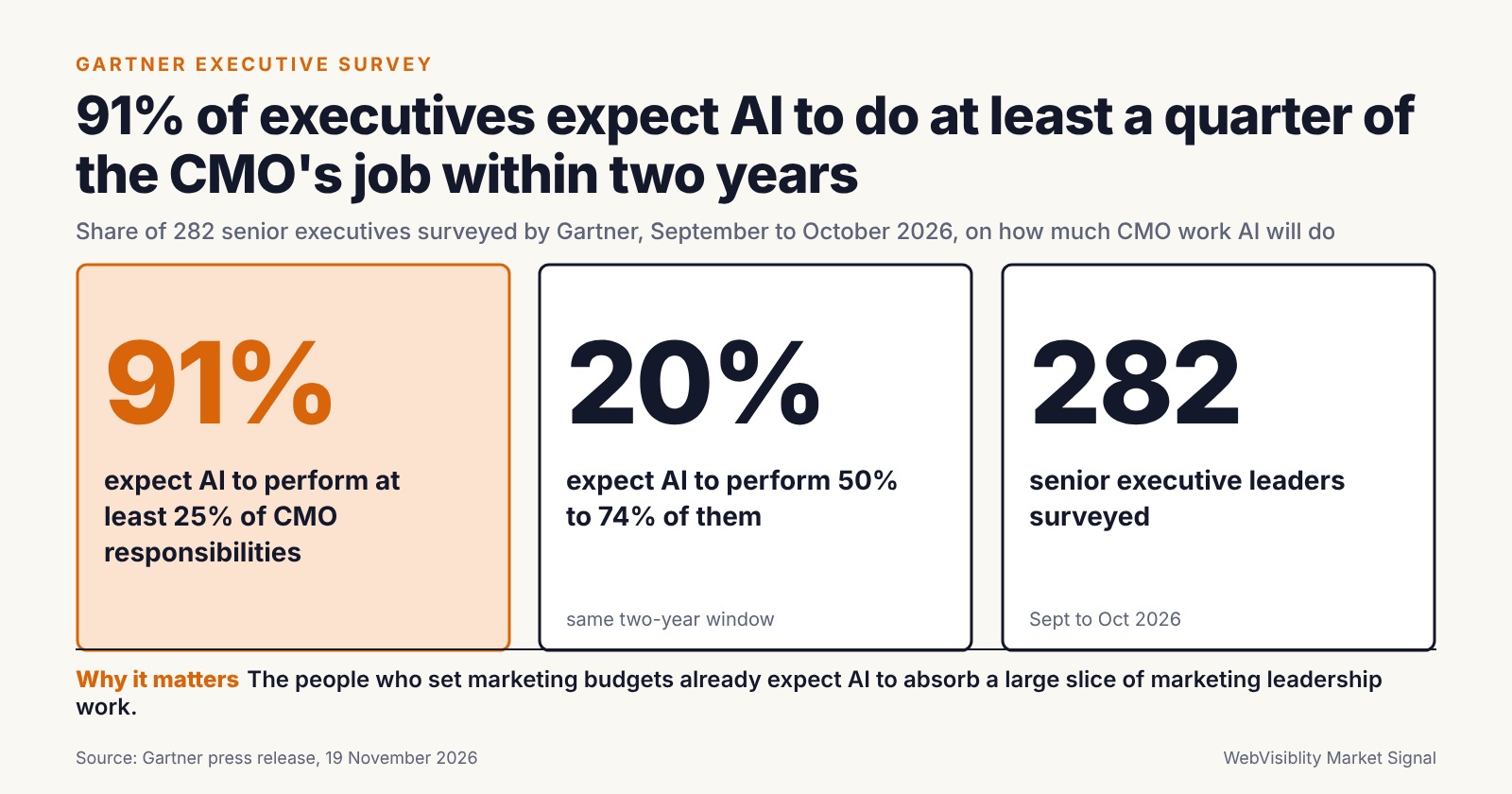
Gartner says 91% of C-level executives expect AI to perform at least a quarter of chief marketing officer responsibilities within the next two years. The firm surveyed 282 senior executive leaders from September through October 2026 and published the result on 19 November. One in five went further: 20% of respondents expect AI to handle 50% to 74% of current CMO duties in the same period.
At a glance
| Executives expecting AI to do 25%+ of CMO work | 91%, within two years |
|---|---|
| Executives expecting 50% to 74% | 20% of respondents |
| Survey base and dates | 282 leaders, Sept to Oct 2026 |
| Teams heavily reviewing AI strategy work | 73% of marketing functions |
| CMOs correcting AI brand errors | 42% of CMOs |
Do this today
Tick each step as you do it. Your ticks stay on this device. See the full list.
For marketers
For software buyers and IT teams
The signal
- Gartner analyst Christy Uher Ferguson says the risk for CMOs is spending too much time defending the role rather than leading the change.
- Gartner argues that deciding where a company should grow stays with marketing leaders, because those calls rarely come with perfect information.
- Separate Gartner data shows 64% heavily review creative made with AI and 50% heavily review execution and optimization work.
- Gartner says 34% of marketing leaders have emerging central AI guidance but lack well-defined policies.
- Gartner's release gives no breakdown by duty, so it does not say which CMO responsibilities executives expect AI to take.
- ANA's coverage pairs the result with a separate BCG study on how few CMOs have acted on AI; that study's figures are not used here.
Which of these are you?
Tap the one that fits you best. We show what this story changes for you.
What happened
Gartner's marketing practice asked senior executive leaders how much of the CMO's current work they expect AI to perform. The answer, released on 19 November, was that 91% expect at least one quarter within two years. The release does not break the result down by industry, company size or which duties would move to AI.
The firm framed the finding as a warning to marketing leaders rather than a forecast of job losses. Uher Ferguson said the companies getting the most value are not replacing marketing leadership but clearing away routine work so CMOs can spend time on decisions only they can make. IT-Online, which reprinted the findings on 26 November, and ANA, which covered it on 23 November, both led with the 91% figure.
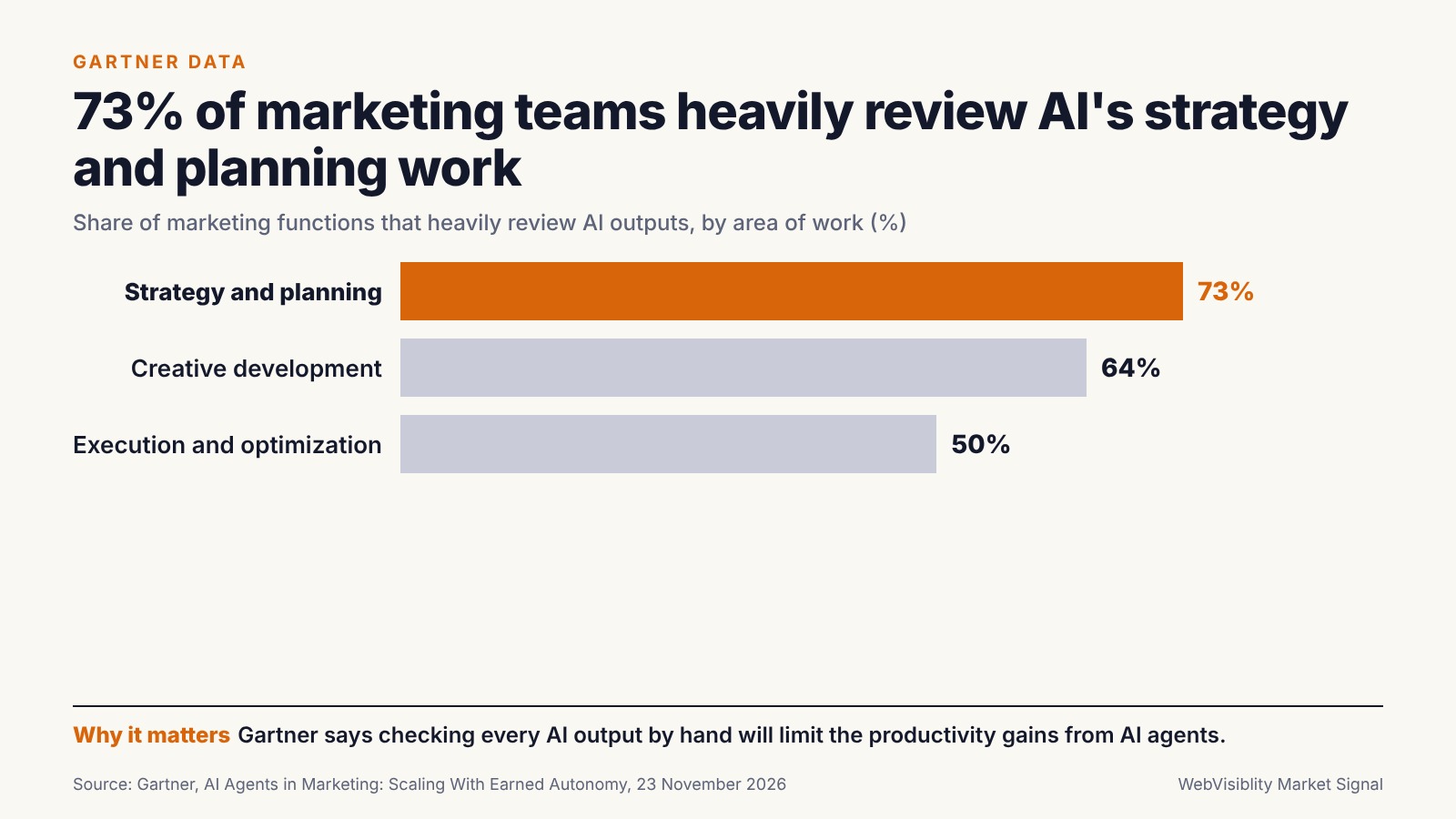
Four days after that release, Gartner published research on how marketing teams actually run AI. It found that most still treat AI output as a draft for a person to approve: 73% heavily review AI work in strategy and planning. Analyst Richard Tso said most teams govern agents with approval workflows designed for human-created work, and Gartner warns that universal review will cap productivity gains.
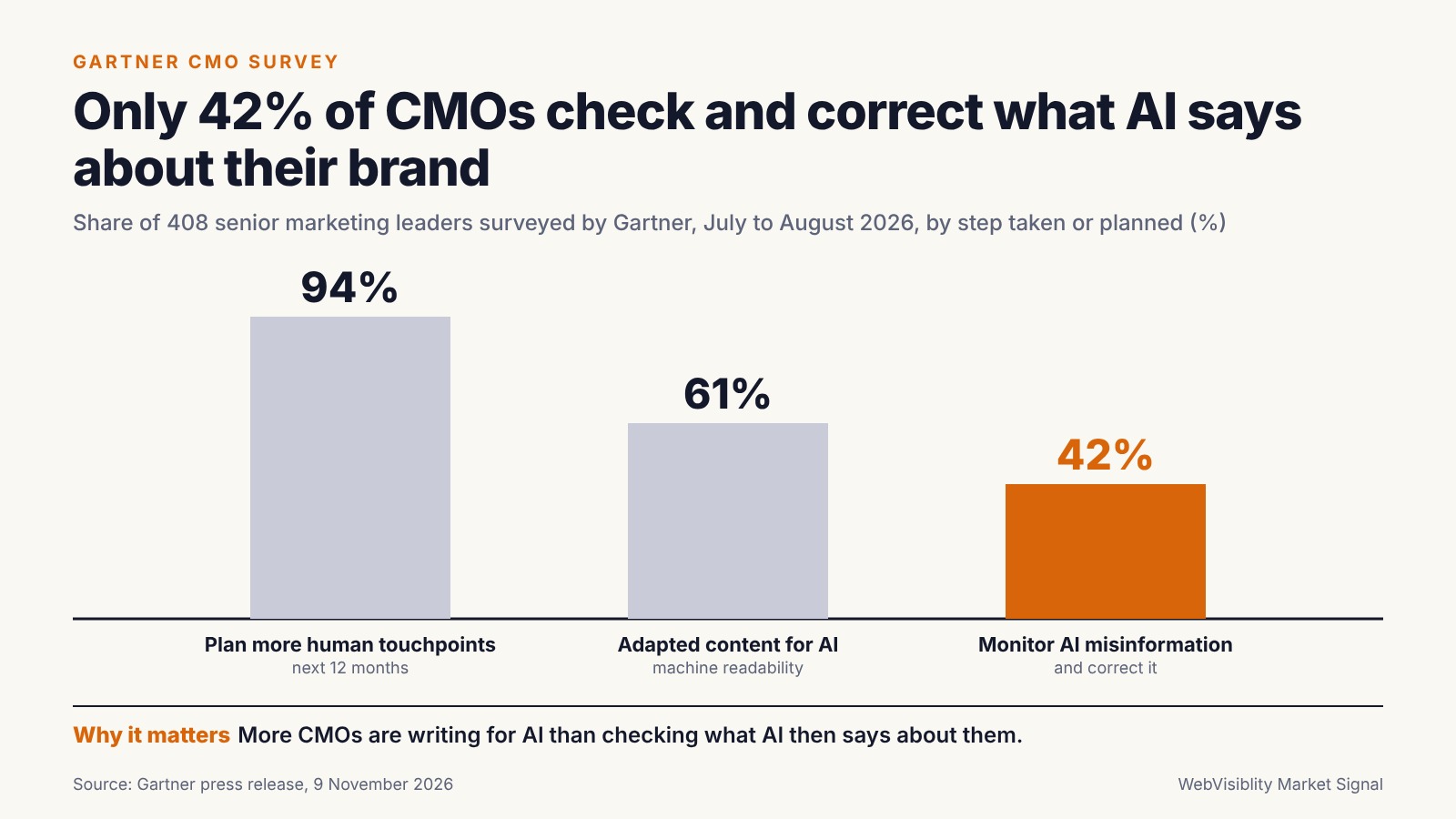
An earlier Gartner survey, of 408 senior marketing leaders in July and August, looked at the outside view of the brand. It found 61% of CMOs had adapted content to improve machine readability and visibility in AI-driven experiences, while 42% had taken steps to monitor and correct misinformation about their brands in AI output.
By the numbers
Timeline
Gartner reports 42% of CMOs monitor and correct AI misinformation about their brands.
Gartner publishes the 91% executive finding on CMO work and AI.
Gartner publishes its earned autonomy research on reviewing AI output.
ANA covers the survey for its members.
IT-Online runs the Gartner findings for its readers.
“AI will always have an answer. CMOs will still be accountable for the outcome and must bring the experience and judgment needed to determine whether it's the right one.”
How to give a marketing agent more authority
- 1Map
List which workflows an agent touches and who owns each one.
- 2Start low
Begin agents at levels that match business risk.
- 3Measure
Track errors and rework before widening what the agent may do.
- 4Assign
Name who stays accountable, since accountability does not transfer with authority.
Why it matters
The numbers describe a gap between the boardroom and the marketing floor. Executives who approve marketing budgets expect AI to take a large slice of leadership work soon, while Gartner's own data shows marketing teams still hand-check most AI output, with 73% heavily reviewing strategy and planning work. Plans for next year that assume both faster AI output and the same review steps will hit the bottleneck Gartner describes.
The brand side of the gap is easier to measure. Gartner found that 61% of CMOs have already rewritten content so AI systems can read it, but only 42% check and correct what those systems then say about the company. For B2B teams, that second step is where AI visibility work pays off: buyers who ask ChatGPT, Gemini or Perplexity about a vendor see the AI's version, not the brochure. Regular AI monitoring of brand answers is a task that can show progress to an executive team that expects AI to change marketing.
Gartner's advice on agents also gives marketing leaders a way to answer the 91% figure with a plan rather than a defence. Its research says teams should let agents earn greater authority through consistent performance, starting with low-risk work, and define who stays accountable before widening autonomy.
What to do now
For marketers
- Write down which of your own duties are routine enough to hand to AI, before someone else decides for you.
- Sort your AI workflows by risk and remove full human review from the lowest-risk ones first, with error tracking in place.
- Check what ChatGPT, Gemini and Perplexity say about your company each month and log every wrong claim.
For software buyers and IT teams
- Ask marketing AI vendors how their agents record decisions, so a named person can answer for each outcome.
- Ask whether permissions can be widened step by step rather than switched on in full.
- Request evidence of error rates on tasks like yours before granting an agent write access.
Printable, one page, 11 checks. Enter your email and it opens right away.
We email you a copy. We never share your email and never send you sales emails.
Pick one. It takes 5 seconds and helps more people find these briefings. Your checklist opens straight after.
Have a work email? Use it instead and the checklist opens straight away.
Open it, then save it as a PDF or print it.
Know someone who would find this useful?
These steps are our recommendations based on this news, not statements from the companies involved.
What to watch
- Which duties move. Gartner's release does not say which CMO responsibilities executives expect AI to take; the full report is for Gartner clients.
- Policy gaps. Watch whether the 34% without well-defined policies shrink as more agents get write access to marketing systems.
- Brand accuracy checks. The next Gartner CMO survey will show whether the 42% monitoring AI misinformation grows.
- 2027 planning. Gartner has set a January webinar on its 2027 leadership vision for tech CMOs.
Who is affected
Executives expect AI to take at least a quarter of their duties within two years.
Universal review of AI output constrains productivity gains, Gartner says.
Only 42% of CMOs check and correct what AI says about their brand.
Questions readers ask
Will AI replace the CMO?
Gartner does not say so. It found 91% of executives expect AI to do at least a quarter of CMO work within two years, and says leading companies use AI to clear routine work, not replace marketing leaders.
What percentage of CMO work will AI do?
Most executives expect at least 25%. In Gartner's survey of 282 senior executive leaders, 91% expected AI to perform at least a quarter of CMO responsibilities within two years, and 20% expected 50% to 74%.
When was the Gartner CMO AI survey conducted?
From September through October 2026. Gartner surveyed 282 senior executive leaders and published the results on 19 November 2026.
How many marketing teams review AI output?
Most of them. Gartner data shows 73% of marketing functions heavily review AI outputs for strategy and planning, 64% for creative development and 50% for execution and optimization.
What is earned autonomy for AI agents in marketing?
It is Gartner's approach where AI agents gain authority through demonstrated performance, starting with low-risk work, instead of every output going through human review.
How many CMOs monitor what AI says about their brand?
42%. Gartner's survey of 408 senior marketing leaders found 42% have taken steps to monitor and correct brand misinformation in AI-generated output, while 61% adapted content for machine readability.
Companies in this story
Sources
Researched, fact-checked and edited by the Market Signal desk. Read our editorial standards. Spotted an error? Email hello@webvisiblity.com and we will correct it.