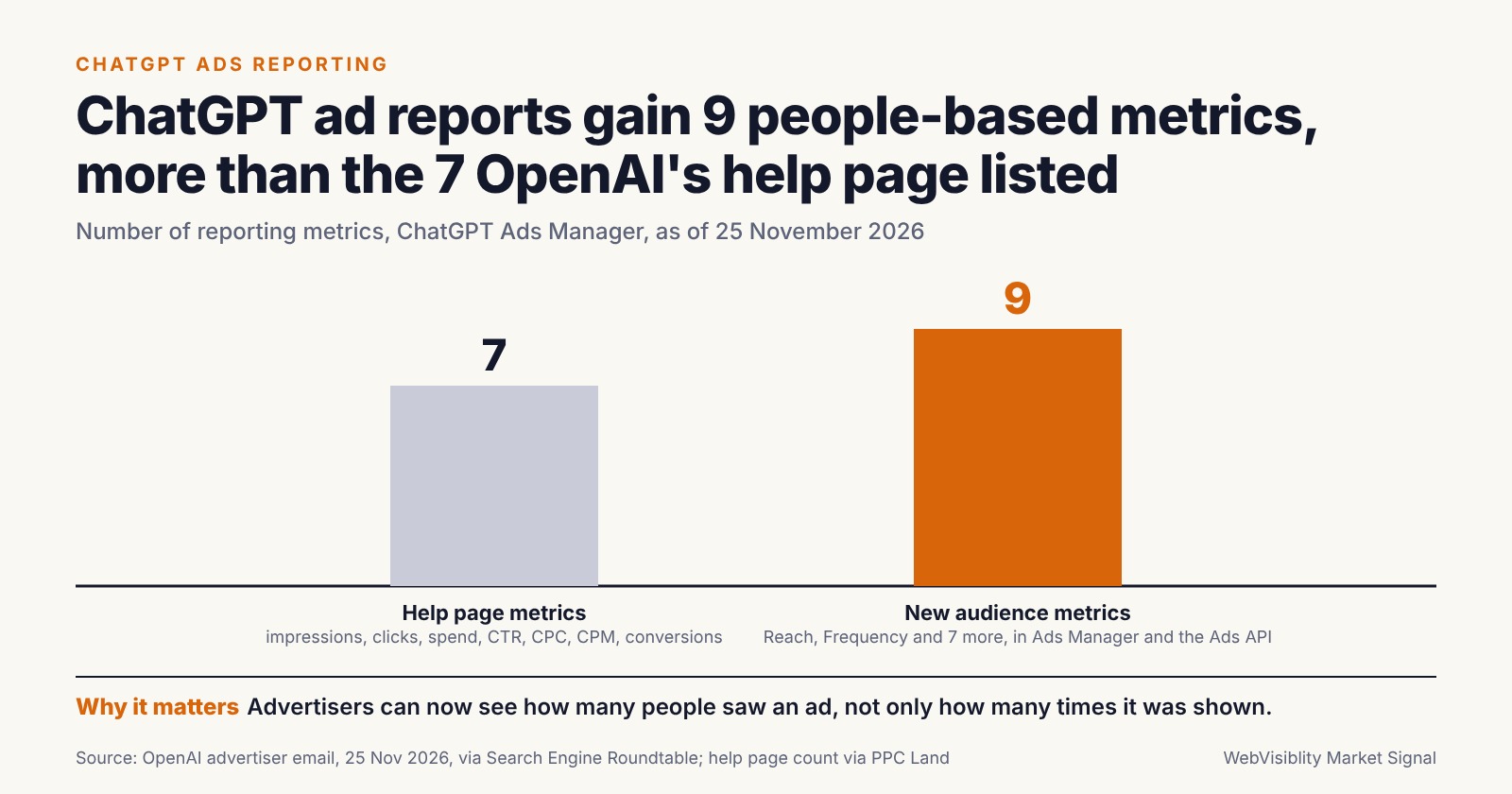
ChatGPT's ad reports used to count how often an ad was shown and clicked, but not how many people saw it. An OpenAI email to advertisers on 25 November changed that with Reach, Frequency and seven more audience metrics. The same email opened Business Agents, the branded assistants people can chat with inside ChatGPT, to eligible businesses in markets outside the U.S., without naming which ones.
At a glance
| New audience metrics | Nine, led by Reach and Frequency |
|---|---|
| Frequency, as defined | Impressions divided by Reach for the same period |
| Business Agents | Supported markets outside the U.S., not named |
| Agent insights | Deeper analysis after more than 25 conversations |
| Partner-app access | On by default from 9 December |
| ChatGPT Ads footprint | 89 countries, over 100,000 advertisers |
Do this today
Tick each step as you do it. Your ticks stay on this device. See the full list.
For marketers
For software buyers and IT teams
The signal
- Reach estimates how many unique people saw an advertiser's ads at least once in the chosen date range.
- The other seven are Click Reach, Click Frequency, Total Reach, Total Frequency, Unique CTR, Unique CPC and Cost per 1,000 Reached; OpenAI named them without defining them.
- The metrics sit in Ads Manager and the Ads API, under Edit columns, then Ad Viewers.
- Single image ads now show a Learn more link by default that opens the landing page already set.
- Rejected ads get more policy context, and OpenAI says its approval guidelines haven't changed.
- Sponsored Business Agents only run on campaigns with the Conversion optimization objective.
Which of these are you?
Tap the one that fits you best. We show what this story changes for you.
What happened
On 25 November OpenAI sent advertisers an email titled ChatGPT Ads Product Update. Search Engine Roundtable published the email that evening, and Search Engine Land and PPC Land followed with their own reports. It listed five changes: audience metrics, Business Agents outside the US, a Learn more link, a switch to hide sale prices in product-feed ads, and clearer notes on rejected ads.
The measurement change is the largest. Until now, Ads Manager reported impressions, clicks, spend and conversions. OpenAI's own Measure Results page still listed seven metrics on the day of the email, according to PPC Land. The new set counts people: Reach is the estimated number of unique viewers, and Frequency is total impressions divided by Reach. OpenAI calls both figures estimates and has not said how it identifies a unique person.
Business Agents launched in the US earlier in November. The email says eligible ecommerce and online service businesses in supported markets can now create and publish a Business Agent in Business Hub. Search Engine Land notes the announcement doesn't specify which additional markets are included. Advertisers with access can also run the agent as a paid placement. OpenAI's help page says that Sponsored Business Agents are rolling out over the coming weeks, and that a published agent does not start ad delivery by itself.
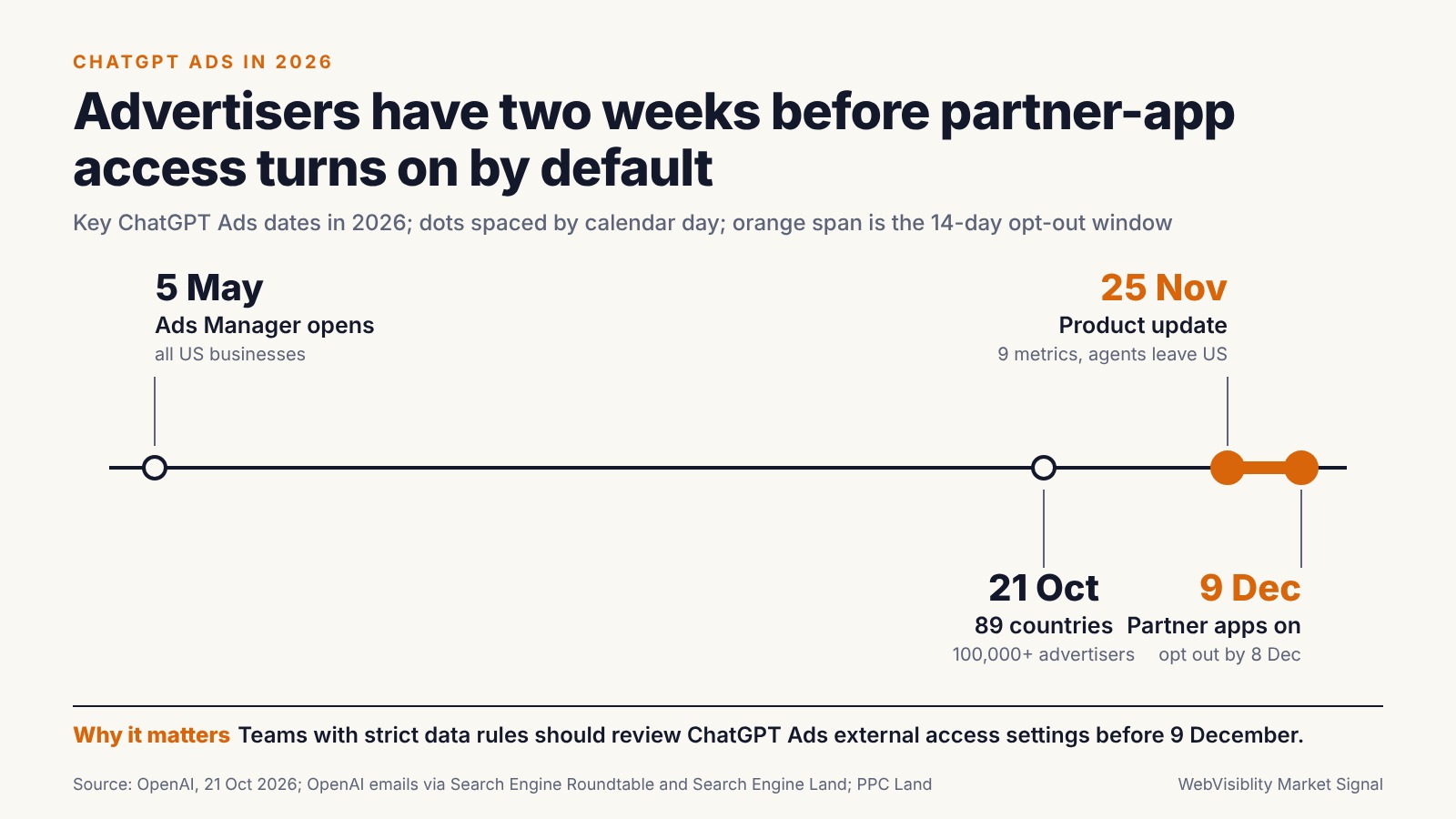
A second email, reported by Search Engine Land, changes account settings. From 9 December, ChatGPT Ads organisation settings will allow approved partner apps by default. Businesses that want to keep that access off must reply to OpenAI's notice by 8 December.
By the numbers
How a Sponsored Business Agent goes live
- 1Build
Open Business agent, then Agent builder, in the Ads Manager sidebar.
- 2Write
Fill in Business info and Guidelines; keep customer data and passwords out.
- 3Test
Ask likely customer questions and publish when answers are accurate.
- 4Attach
Turn on Enable agent chats in a Conversion optimization campaign.
Timeline
Ads Manager opens to all US businesses, reporting impressions, clicks and conversions.
ChatGPT Ads reaches 89 countries, with over 100,000 advertisers since launch.
Business Agents arrive in Business Hub, limited to the US.
OpenAI emails advertisers about Reach, Frequency and Business Agents outside the US.
Last day to opt out of partner-app access by replying to OpenAI.
Approved partner apps allowed by default in ChatGPT Ads settings.
“Advertisers don't receive individual chats or transcripts.”
Why it matters
ChatGPT ad spend can finally sit beside other channels on the same terms. B2B teams plan LinkedIn, YouTube and display buys around how many people they reach and how often. Without a people count, a ChatGPT campaign that showed one ad repeatedly to a small group looked the same as one that reached many buyers once. Reach and Frequency close that gap, though OpenAI has not explained how the estimates are built, so early numbers deserve caution before they move budget.
The Business Agent rules shape what a buyer hears. A sponsored agent answers from the business information and guidelines the advertiser writes in Agent builder, and OpenAI's help page says ads do not influence ChatGPT's answers. That leaves two separate jobs. The paid agent says what the company tells it to say. ChatGPT's own answers, the part that decides whether a brand is named in AI search at all, still come from what the model finds and trusts on the open web. AI visibility work and ChatGPT ads now run side by side rather than one replacing the other.
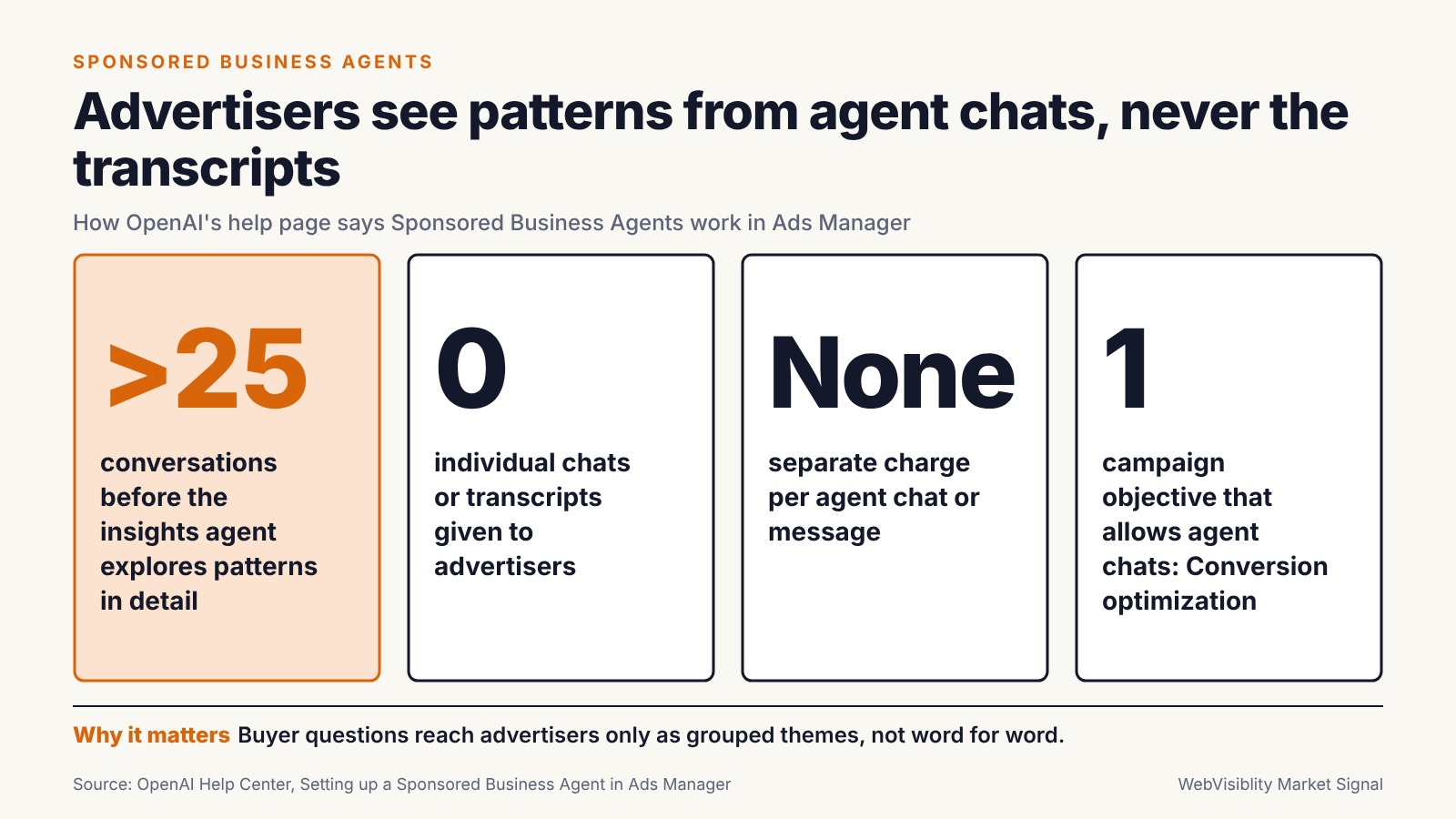
The feedback loop is thin by design. Advertisers get patterns from agent chats, such as the questions asked most often, but not transcripts, and deeper analysis needs more than 25 conversations. For a B2B firm with a small target market, that threshold may take time to reach. AI monitoring of what ChatGPT says about the brand outside the ad slot remains the steadier signal of how buyers meet the company there.
Who is affected
Can plan ChatGPT buys on reach and frequency like other channels.
Can now publish a Business Agent if their market is supported.
Partner-app access becomes the default on 9 December.
What to do now
For marketers
- Add Reach and Frequency columns in Ads Manager and compare them with the frequency you accept on LinkedIn or YouTube.
- Decide before 8 December whether partner apps should reach your ChatGPT Ads account, and reply to OpenAI if not.
- Check what ChatGPT says about your company without ads, since a sponsored agent does not change those answers.
For software buyers and IT teams
- Treat a sponsored agent as the vendor speaking; it is labelled as an ad and answers from what the vendor wrote.
- Confirm prices and terms on the vendor's own site after chatting with its agent.
- Ask vendors which ChatGPT ad partners can see your data if you share accounts with an agency.
Printable, one page, 11 checks. Enter your email and it opens right away.
We email you a copy. We never share your email and never send you sales emails.
Pick one. It takes 5 seconds and helps more people find these briefings. Your checklist opens straight after.
Have a work email? Use it instead and the checklist opens straight away.
Open it, then save it as a PDF or print it.
Know someone who would find this useful?
These steps are our recommendations based on this news, not statements from the companies involved.
What to watch
- Named markets. Which countries OpenAI lists for Business Agents, since the email named none.
- Metric definitions. Whether OpenAI defines the seven secondary metrics and how it counts a unique person.
- Hub and Ads Manager link. OpenAI says it is working on linking the two so one agent serves both.
- 9 December. How many advertisers turn partner-app access off before it becomes the default.
- Help pages. Whether OpenAI's reporting page catches up with the nine new metrics.
Questions readers ask
Does ChatGPT Ads report reach and frequency?
Yes. Since 25 November, Ads Manager and the Ads API show Reach and Frequency, plus seven related audience metrics, alongside impressions and clicks.
How does OpenAI calculate frequency in ChatGPT ads?
Frequency is total impressions divided by Reach for the same date range. Reach is OpenAI's estimate of unique people who saw the ads at least once.
Are ChatGPT Business Agents available outside the US?
Yes, for eligible ecommerce and online service businesses in supported markets outside the US. OpenAI has not named which countries are supported.
Can advertisers read conversations with their ChatGPT business agent?
No. OpenAI says advertisers don't receive individual chats or transcripts. An Insights tab shows patterns, such as the most common questions, where available.
Do ChatGPT ads change what ChatGPT recommends?
OpenAI says no. Its help page states that ads do not influence ChatGPT's answers, and OpenAI says its ads are clearly labeled and separate from answers.
Is there an extra charge for Sponsored Business Agent chats?
No. The campaign's existing billing settings apply, with no separate charge for an agent conversation or for each message.
How do I stop partner apps accessing my ChatGPT Ads account?
Reply to OpenAI's notification email by 8 December. Otherwise approved partner apps are allowed by default from 9 December, though each still needs a user to authorise it.
Companies in this story
Sources
- OpenAI Help CenterOriginal
- Search Engine Roundtable
- Search Engine Land
- PPC Land
- Search Engine Land
- OpenAI
Researched, fact-checked and edited by the Market Signal desk. Read our editorial standards. Spotted an error? Email hello@webvisiblity.com and we will correct it.