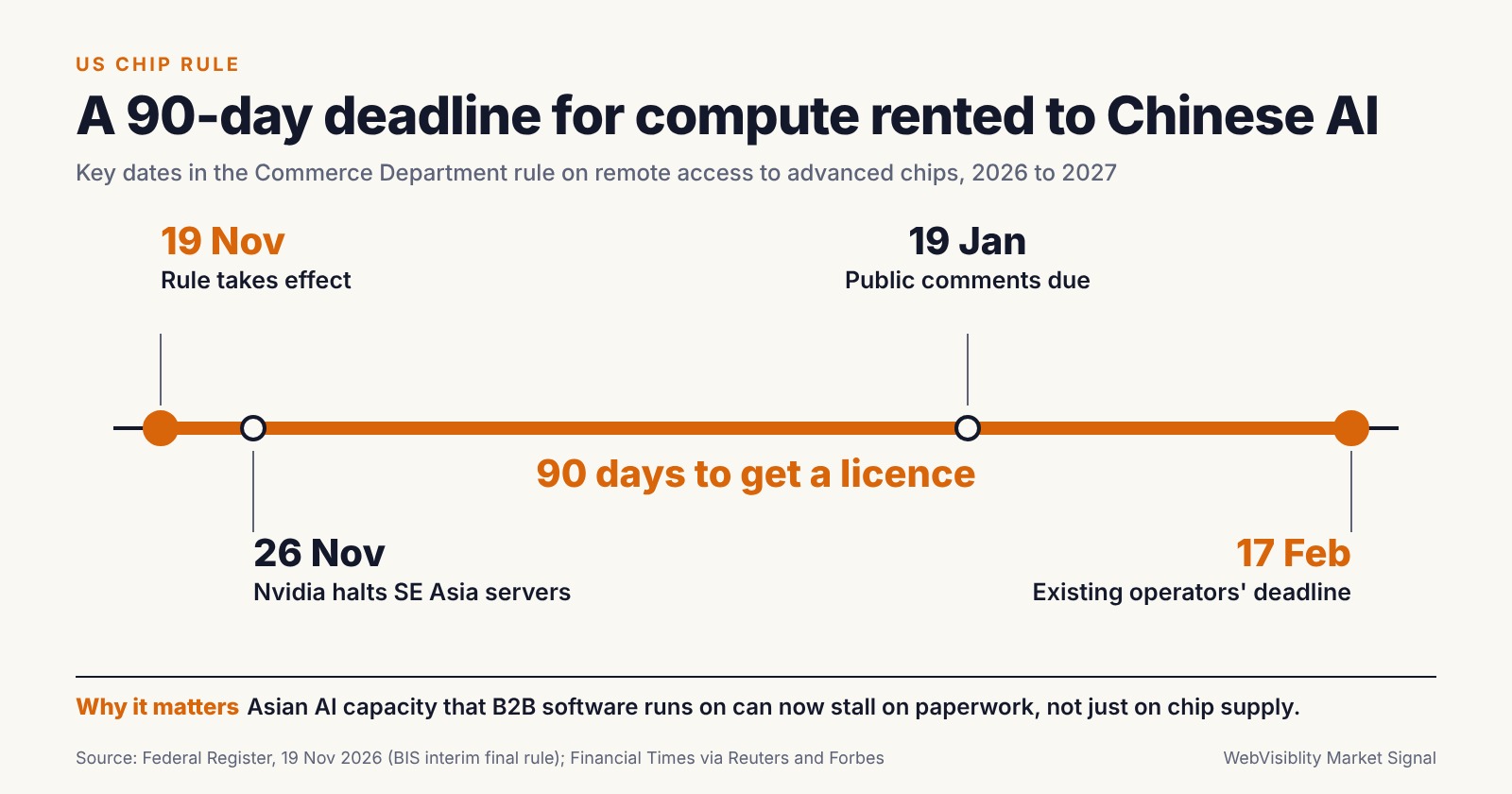
Washington has moved its chip controls from the loading dock to the server rack. A Commerce Department rule that took effect on 19 November requires a licence when a data center anywhere gives Chinese-headquartered companies more than 12,000,000 aggregate TPP of computing power, and operators already doing so have 90 days to obtain a licence. The first effects are showing up in Southeast Asia.
At a glance
| Rule in force | 19 November 2026 |
|---|---|
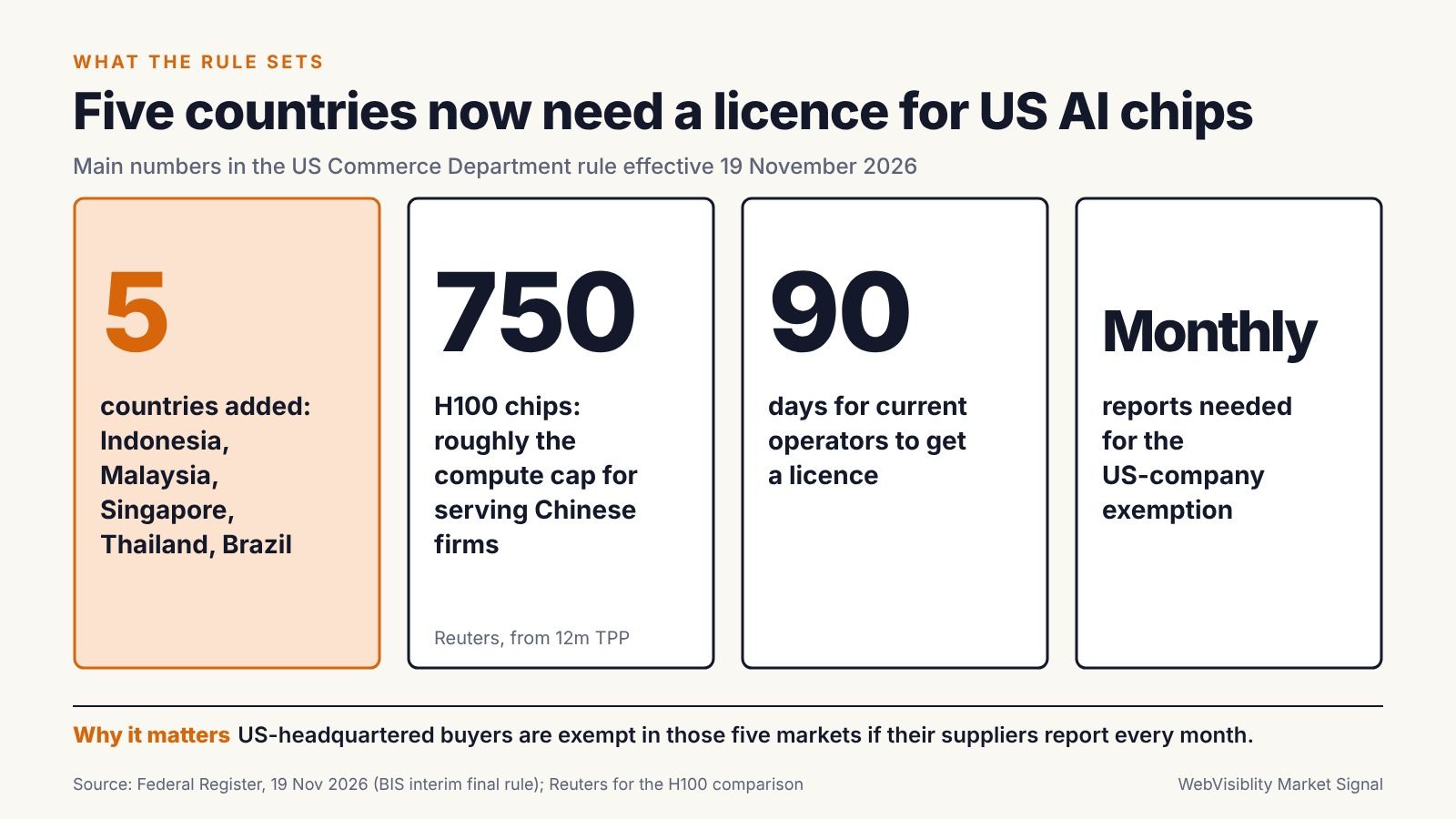
| Countries newly needing a chip licence | Indonesia, Malaysia, Singapore, Thailand, Brazil |
| Compute threshold | 12,000,000 aggregate TPP |
| Rough H100 equivalent | about 750 chips |
| Deadline for existing operators | 90 days |
| Comments due | 19 January 2027 |
Do this today
Tick each step as you do it. Your ticks stay on this device. See the full list.
For marketers
For software buyers and IT teams
The signal
- The licence trigger is who uses the compute: firms headquartered in Macau or Country Group D:5, which includes China.
- Compute used only for commercial recommender systems is exempt; generative AI is not.
- US-headquartered buyers in the five countries are exempt if exporters file monthly reports.
- Nvidia reportedly told partners to stop shipping servers to Malaysia, Singapore, Thailand and Indonesia.
- Lenders paused billions in funding tied to ByteDance, Alibaba and Tencent, Bloomberg reported.
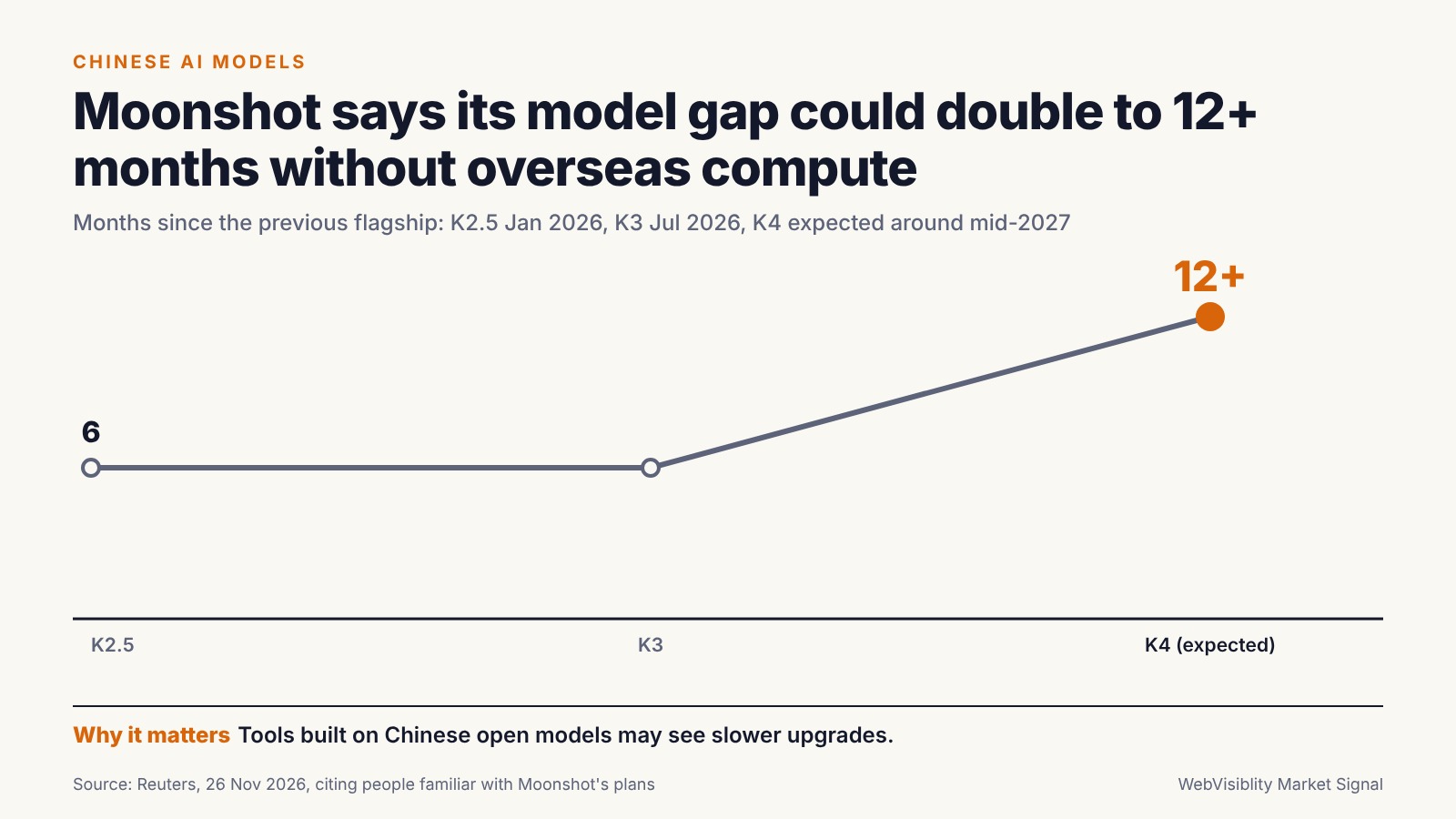
- Moonshot AI expects its release gap could go from six months to a year or longer.
Which of these are you?
Tap the one that fits you best. We show what this story changes for you.
What happened
The Bureau of Industry and Security published the interim final rule, titled Addressing Remote Access to Advanced Semiconductors, in the Federal Register on 19 November, the same day it took effect. Forbes had reported the plan three days earlier as a move to close a loophole that let Chinese firms use Nvidia chips without importing them.
The rule does four things. It adds a licence requirement for advanced chips going to data centers, wherever they are, that will give companies headquartered in Macau or a Country Group D:5 destination access to more than 12,000,000 aggregate TPP, either at one site or through linked data centers. Reuters puts that threshold at roughly 750 Nvidia H100s. Operators already serving such customers must get a licence within 90 days or face future restrictions. Compute used only for commercial recommender systems, the kind that ranks products for online shops and social feeds, is exempt, but the definition excludes any system that generates text, images, audio, video or software. Second, it requires a licence to send advanced chips to Indonesia, Malaysia, Singapore, Thailand or Brazil, unless the end user's parent company is in the United States and the exporter files monthly reports. Third, it tightens the rules for chip foundries and packagers. Fourth, it formally rescinds the never-enforced AI Diffusion Rule.
The market reaction came within a week. Bloomberg reported that lenders paused billions in funding for Asian data-center projects linked to ByteDance, Alibaba and Tencent. On 26 November the Financial Times reported, citing three sources, that Nvidia told manufacturing partners including Dell and Supermicro that it would not allow their servers to be shipped to Malaysia, Singapore, Thailand and Indonesia. It is not clear whether that pause is temporary. Reuters reported the same day that Z.AI's next flagship, GLM-5.5, could slip into 2027, and that Moonshot AI expects its interval between major releases to stretch from six months to a year or longer if it loses overseas computing access.
By the numbers
How the rule reaches a data center
- Step 1Check the customer
Operators must know if a client's parent is headquartered in D:5 or Macau.
- Step 2Measure the compute
The trigger is access to more than 12,000,000 aggregate TPP.
- Step 3Check the use
Compute used only for recommender systems is exempt.
- Step 4Apply
Existing operators have 90 days to get a licence.
- Step 5Report
Exporters serving US-owned users in the five countries file monthly reports.
Timeline
Commerce Department rule on remote chip access is reported by Forbes.
Interim final rule published and in force.
Lenders pause Asian data-center funding, Bloomberg reports.
Nvidia halts server shipments to four countries, the FT reports.
Deadline for public comments on the rule.
End of the 90-day window for existing operators.
“marks an important shift in US semiconductor controls from regulating where advanced chips physically go to who ultimately accesses the compute they provide”
Why it matters
Many AI features in B2B software run on rented cloud capacity, and this rule makes the identity of the renter a legal question. A data center in Singapore or Malaysia that sells capacity to a Chinese-owned customer now needs paperwork it did not need a month ago, and the financing behind new capacity is already on hold in places. Software vendors that host AI features in Southeast Asia, and buyers who chose regional hosting for speed or data rules, should expect questions about where workloads run and who else shares the cluster.
The carve-out is worth reading closely. The rule treats commercial recommender systems as low risk but says the exemption does not cover anything that generates text or images. That is the same line that separates a classic product recommendation engine from an AI search or answer engine. For marketing technology, it means ranking and personalisation tools keep a clear path, while generative features such as AI search, ad copy writing and chat assistants fall under the stricter rule when the provider has a parent in China and uses compute above the threshold.
There is also a slower effect on the AI models themselves. Some chat widgets, content tools and AI visibility trackers use Chinese open-weight models as a low-cost option. If Moonshot and Z.AI release less often, teams relying on them should not plan around fast upgrades. US-headquartered buyers keep access in the five newly listed countries, but only if their suppliers file monthly reports, which adds a compliance step to contracts.
Who is affected
| Who | What changes | Impact |
|---|---|---|
| SaaS vendors hosting AI in Southeast Asia | Data-center partners may face licence checks and paused financing. | High |
| Martech and AI search tools with Chinese parents | Generative features fall outside the recommender exemption. | High |
| Teams using Chinese open-weight models | Upgrades may arrive less often if release gaps double. | Medium |
| US-owned buyers in the five countries | Keep access, but suppliers must file monthly reports. | Low |
What to do now
For marketers
- List the AI features in your product that run in Singapore, Malaysia, Thailand, Indonesia or Brazil, and who hosts them.
- Ask your cloud and model providers in writing whether the 19 November rule affects their capacity or timelines.
- Prepare a short, factual hosting and compliance page so buyers and AI assistants can answer where your AI runs.
For software buyers and IT teams
- Add a question on hosting location and parent-company ownership to AI vendor reviews.
- Ask vendors that use Chinese open-weight models how they would handle slower model updates.
- Check renewal terms for AI tools hosted in the five newly listed countries before the 17 February 2027 deadline.
Printable, one page, 11 checks. Enter your email and it opens right away.
We email you a copy. We never share your email and never send you sales emails.
Pick one. It takes 5 seconds and helps more people find these briefings. Your checklist opens straight after.
Have a work email? Use it instead and the checklist opens straight away.
Open it, then save it as a PDF or print it.
Know someone who would find this useful?
These steps are our recommendations based on this news, not statements from the companies involved.
What to watch
- Licence decisions. BIS says it will review applications case by case; the first approvals or refusals will show how strict it is.
- Nvidia's pause. Whether the halt on Southeast Asian server shipments is temporary or lasting.
- Data-center finance. Whether the deals Bloomberg says were paused restart under licences.
- Comments. The rule is interim, with comments open until 19 January 2027.
- Chinese model launches. Timing of Z.AI's GLM-5.5 and Moonshot's Kimi K4, both reported as at risk of delay.
Questions readers ask
What is the new US rule on remote access to AI chips?
It is a Commerce Department rule, in force since 19 November 2026, that requires a licence when overseas data centers give Chinese-headquartered firms large amounts of US-chip compute.
Which countries now need a licence for advanced US AI chips?
Five were added: Indonesia, Malaysia, Singapore, Thailand and Brazil. Shipments to end users whose parent company is in the United States are exempt if the exporter files monthly reports.
How much compute triggers the licence requirement?
More than 12,000,000 aggregate TPP made available to companies headquartered in China, Macau or other D:5 countries. Reuters says that is roughly 750 Nvidia H100s.
Did Nvidia stop shipping servers to Southeast Asia?
Reportedly, yes. The Financial Times said Nvidia told partners such as Dell and Supermicro not to ship servers to Malaysia, Singapore, Thailand and Indonesia; whether the pause is temporary is unclear.
Are AI recommendation engines covered by the chip rule?
No, if used only to rank products or content. The rule exempts commercial recommender systems but not any system that generates text, images, audio, video or software.
When do existing data centers need a licence?
Within 90 days of 19 November 2026, which falls on 17 February 2027. Operators already serving covered customers must obtain a licence or face future restrictions.
Will Chinese AI models be released more slowly?
Possibly. Reuters reports Z.AI's GLM-5.5 could slip into 2027 and Moonshot expects gaps between major releases of a year or more without overseas compute.
Companies in this story
Sources
Researched, fact-checked and edited by the Market Signal desk. Read our editorial standards. Spotted an error? Email hello@webvisiblity.com and we will correct it.