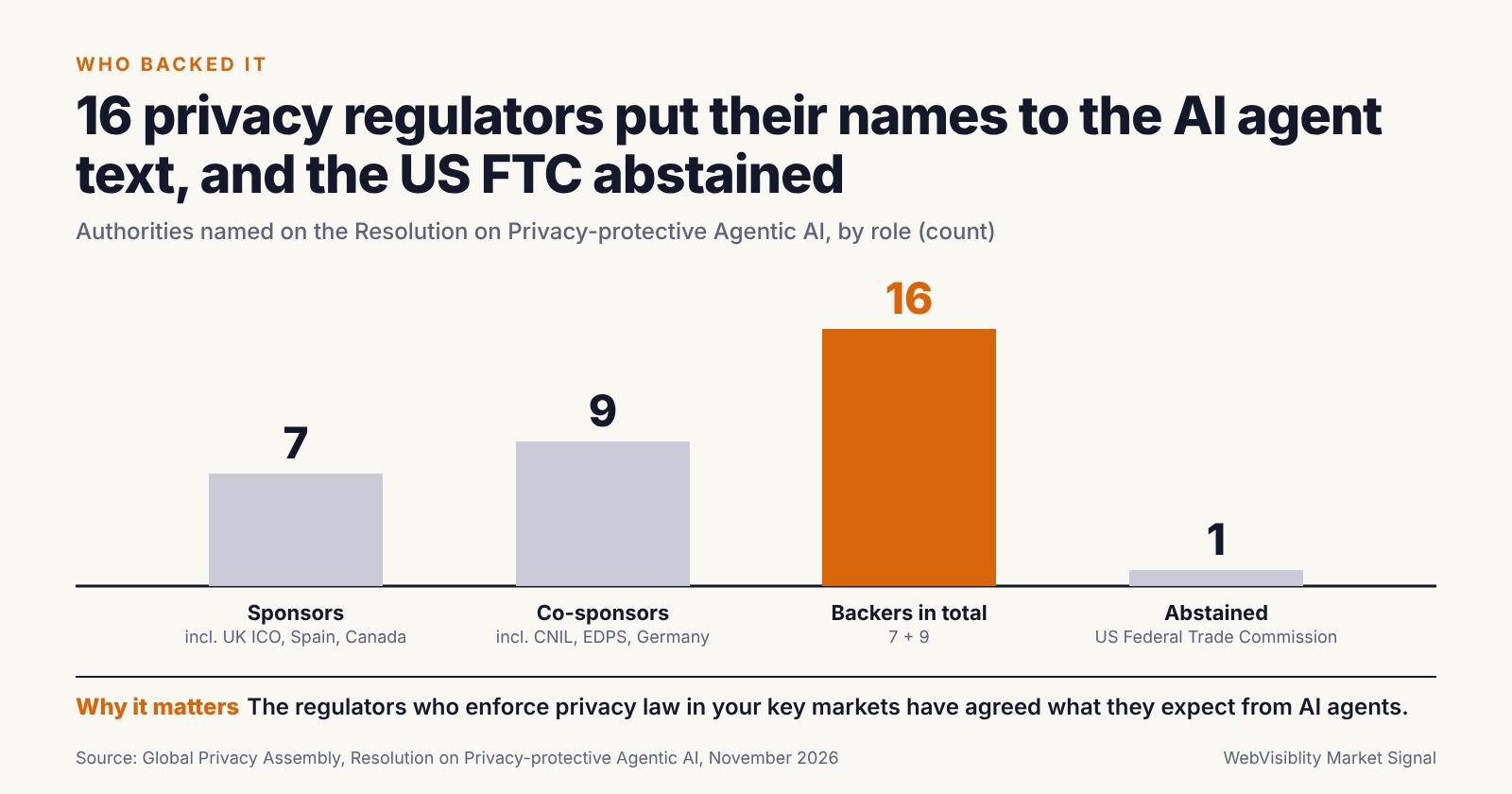
Privacy regulators meeting in Brussels have agreed that a company remains accountable for personal data handled by its AI agents, including data an agent pulls in on its own or passes to outside tools. The resolution was backed by seven sponsors and nine co-sponsors, among them the UK's ICO and France's CNIL, while the US Federal Trade Commission abstained.
At a glance
| Adopted | Closed Session, 16 and 17 November, in Brussels |
|---|---|
| Backed by | 7 sponsors and 9 co-sponsors, 16 authorities in all |
| Abstained | The US Federal Trade Commission |
| Legal force | None of the five texts is a law; they guide regulators |
| Risk areas named | Six, from dynamic tool use to unapproved agents |
| Next assembly | 2027 in Nairobi, Kenya |
Do this today
Tick each step as you do it. Your ticks stay on this device. See the full list.
For marketers
For software buyers and IT teams
The signal
- Firms should not assume an agent will recognize or comply with their own rules and limits.
- Regulators want an up-to-date inventory of approved systems, with their tools, data sources and permissions.
- Agents should keep records of tool calls, inputs and outputs, and those logs must follow privacy rules too.
- People should be told when they are interacting with an AI agent, in a clear and timely way.
- Staff wiring agents into company systems without appropriate approval is named as a risk in its own right.
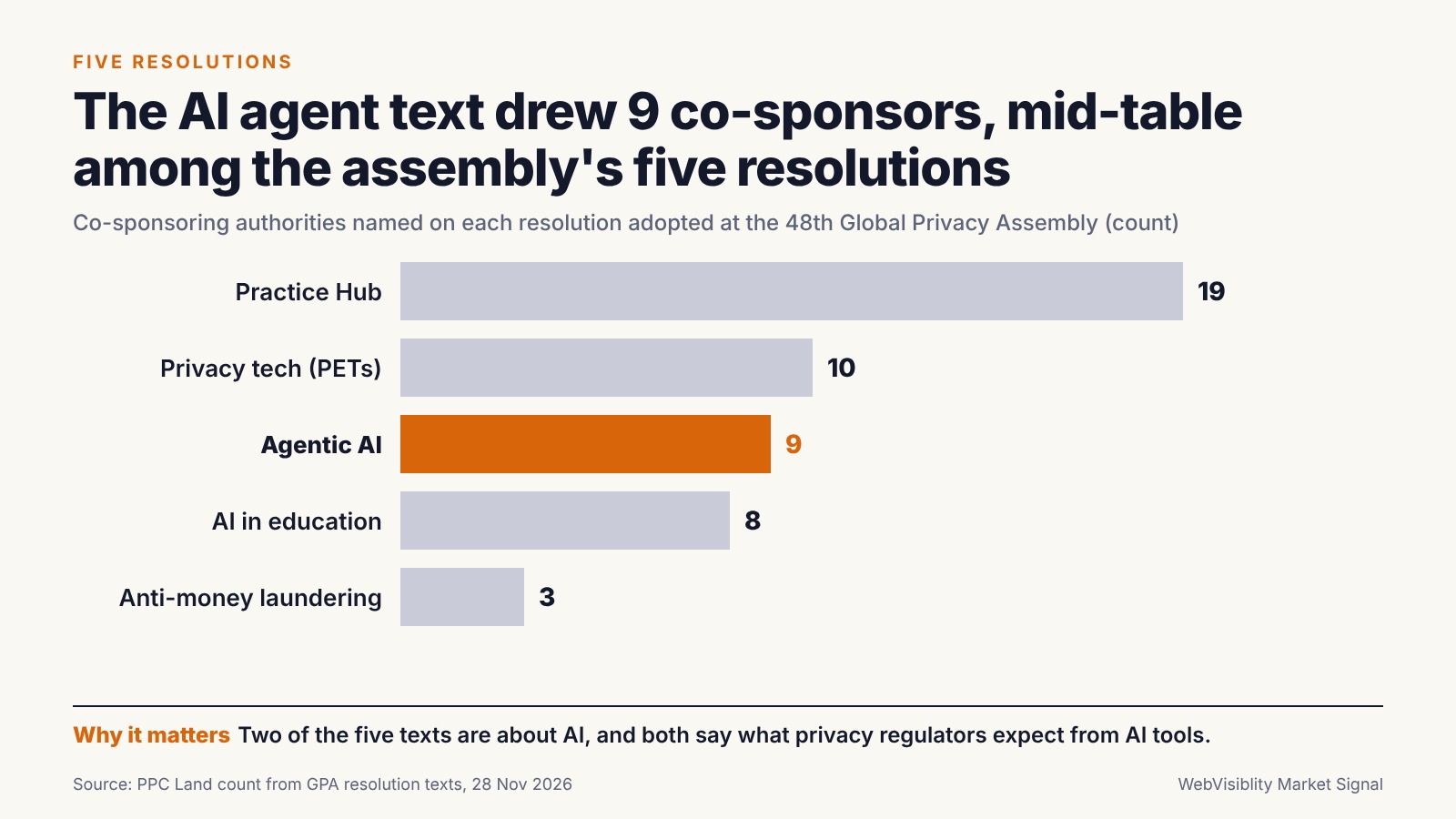
- The assembly also adopted texts on AI in education, privacy-enhancing technologies, money-laundering checks and a Practice Hub.
Which of these are you?
Tap the one that fits you best. We show what this story changes for you.
What happened
The Global Privacy Assembly, the yearly meeting of the world's data protection authorities, held its 48th conference in Brussels this month. In a two-day Closed Session on 16 and 17 November, more than 200 members adopted five resolutions and a strategic plan for 2027 to 2030. PPC Land, citing the CNIL, puts the membership at more than 130 authorities from more than 80 countries.
One of the five texts deals with AI agents. It borrows the OECD's definition of an agent as software that perceives and acts upon its environment with some autonomy, using tools to reach goals. Its scope is limited to agents that process personal data inside public and private organisations, so a company's own marketing, sales or service agents fall under it.
The resolution lists six areas where agents make privacy harder. Agents may call tools from a series of different organizations, so a user may not know where personal data will flow. They may keep a working memory that holds personal data longer than needed. They can be manipulated into giving the wrong parties access, and it can be hard to tell what a person did from what their agent did on its own. Each tool and connection widens the attack surface, and organisations chasing efficiency may cut the points where an agent pauses for a human.
The text then sets out the safeguards regulators expect, from impact assessments before launch to the ability to pause or stop execution and, where practicable, reverse an agent's actions. The operative part has four paragraphs: it calls on organisations to weigh these risks, and asks the assembly's AI working group to keep sharing knowledge and to examine possible guidance, with no deadline set.
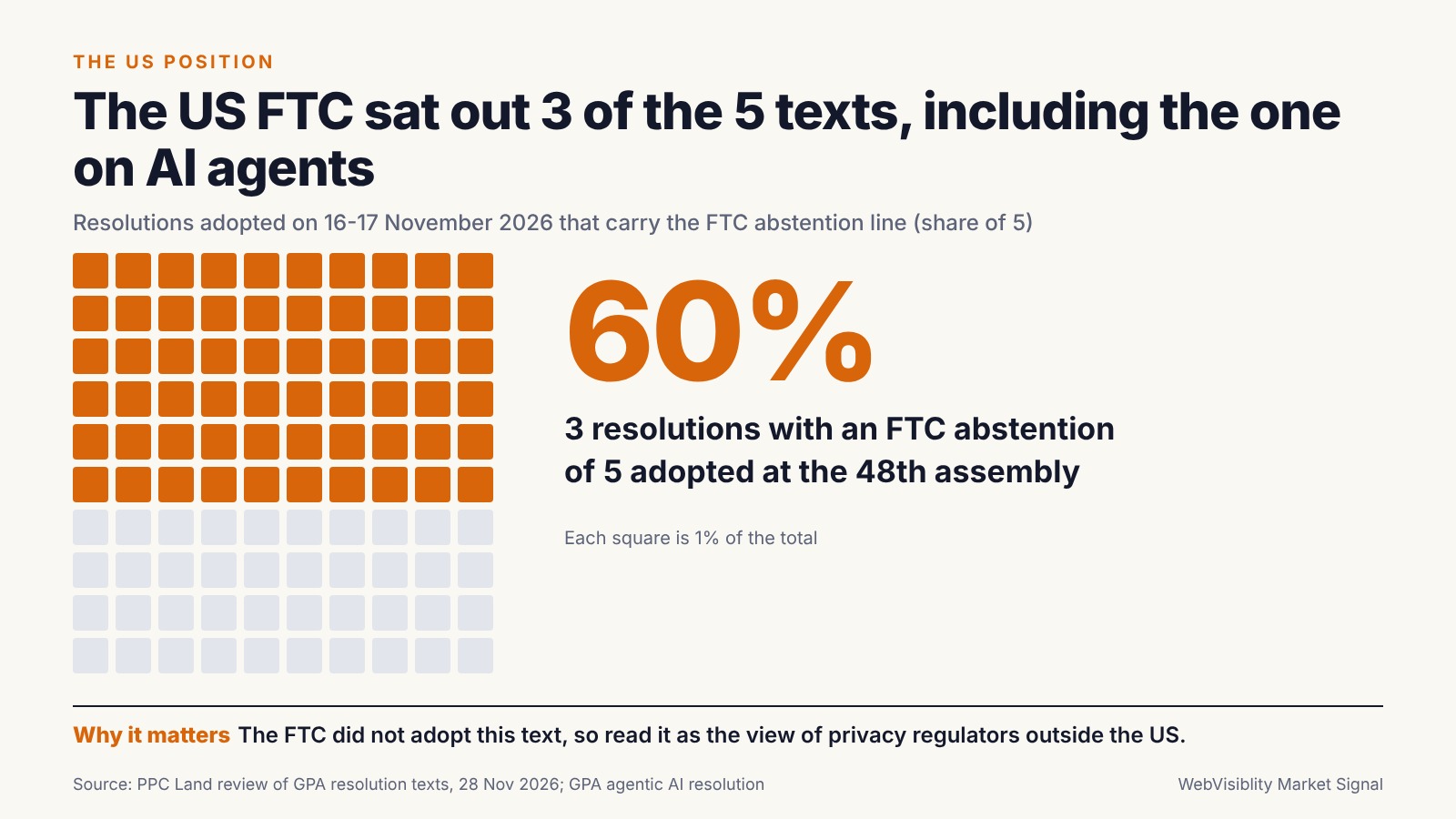
The text was sponsored by authorities from Canada, Catalonia, Hong Kong, South Korea, Spain, Switzerland and the UK. Its last line records that the United States Federal Trade Commission abstains. PPC Land found the same line on three of the five texts. Digital Watch reported the package on 20 November, and PPC Land published its full reading of the texts on 28 November.
By the numbers
How to get your AI agents ready for a privacy regulator's questions
- 1List every agent
Build an inventory of approved systems that reach customer data, with tools, data sources and permissions.
- 2Name an owner
Give each agent a person accountable for design, use, and outcomes.
- 3Cut access
Limit each agent to the minimum data and capabilities its task needs.
- 4Keep records
Log tool calls, inputs and outputs, and set retention rules for those logs.
- 5Add a stop button
Make sure someone can pause or stop execution, and route significant decisions to a human.
Timeline
The GPA's Closed Session opens in Brussels, with more than 200 members.
The session ends with five resolutions adopted, including the one on agentic AI.
The assembly publishes its press release as the open programme starts.
Digital Watch reports the five resolutions and the 2027 to 2030 strategy.
PPC Land publishes a reading of all five texts, counting sponsors and paragraphs.
“Organizations should not assume that such systems will recognize or comply with organizational rules, contextual expectations or limitations.”
Who is affected
The company answers for what an agent does with lead and customer data, even when it acts autonomously.
Buyers will ask for logs, permission controls and a way to pause or stop the agent.
People should be told when they are interacting with an agent and offered a human route.
Why it matters
Most marketing and sales teams now test AI agents that read CRM records, draft outreach, answer chat visitors or update lead data. Every one of those tasks touches personal data, and the resolution is explicit that the deploying company answers for it, including processing initiated autonomously by AI agents. A vendor's promise that its agent behaves is not a defence. The regulators also tell organisations not to assume an agent will follow internal rules on its own, which means controls have to sit outside the agent: permissions, limits and logs.
The second point is about who switches agents on. The text names unauthorized or ungoverned deployment as a separate risk: staff connecting agents to company data, tools and accounts without sign-off, bypassing contracts and access controls. Marketing is one of the busiest places for that kind of self-serve adoption. A team that cannot list which agents can reach its customer data, and who approved them, would struggle to answer a regulator. SecurityBrief's contributor makes the same point: a yardstick that many regulators endorse tends to find its way into investigations.
Third, disclosure. Regulators want people told when they are interacting with an AI agent and able to reach a suitably qualified and authorized human when an agent's decision significantly affects them. For customer-facing agents on a website or in a sales chat, that is a design requirement, not a footnote. It also fits a wider pattern: the UK's FCA has told agent makers they may need a licence, and Australia's AI inquiry wants firms held to account for their agents. Clear public pages on how a company's agents use data also give buyers who research vendors in AI search something accurate to find.
What to do now
For marketers
- List every AI agent your team uses that can read CRM, email or chat data, with who approved it.
- Add a plain line to website chat and outreach agents telling people they are talking to AI, with a way to reach a person.
- Ask each agent vendor in writing whether you can see its tool-call logs and switch the agent off immediately.
For software buyers and IT teams
- Add questions on logging, permissions, memory and a stop control to your AI agent vendor checklist.
- Ask whether the agent's memory is kept separate for each user or can be turned off.
- Run a data protection impact assessment before any agent touches customer or employee data.
Printable, one page, 11 checks. Enter your email and it opens right away.
We email you a copy. We never share your email and never send you sales emails.
Pick one. It takes 5 seconds and helps more people find these briefings. Your checklist opens straight after.
Have a work email? Use it instead and the checklist opens straight away.
Open it, then save it as a PDF or print it.
Know someone who would find this useful?
These steps are our recommendations based on this news, not statements from the companies involved.
What to watch
- Guidance from the working group. The assembly asked its AI working group to examine developing guidance for organizations that deploy agents; no date is set.
- National regulators. Sponsors such as the ICO and Spain's AEPD may turn the text into their own guidance or use it in investigations under existing law.
- The US gap. The FTC abstained from three of the five texts; watch whether US guidance on agents takes a different line.
- Nairobi 2027. The next assembly is hosted in Nairobi, Kenya, where follow-up work on agents may be reported.
Questions readers ask
What did the Global Privacy Assembly say about AI agents?
It said organisations remain accountable for personal data processed by their AI agents, even when an agent acts on its own or uses outside tools, and listed safeguards regulators expect.
Is the GPA resolution on agentic AI legally binding?
No. PPC Land notes that none of the five texts is a law. They are positions and work plans for regulators who enforce existing privacy law at home.
Which regulators backed the agentic AI resolution?
Seven sponsors, including the UK's ICO, Spain's AEPD and Canada's privacy commissioner, plus nine co-sponsors such as the CNIL, the EDPS and Germany's federal commissioner.
Did the US FTC support the AI agent privacy resolution?
No. The text records that the United States Federal Trade Commission abstains from its adoption. PPC Land found the same abstention on three of the five resolutions.
What safeguards do privacy regulators expect for AI agents?
Impact assessments, limited permissions, testing, monitoring, logs of tool calls, an inventory of approved agents, and the ability to pause or stop execution, with human review for significant decisions.
Do companies have to tell customers they are talking to an AI agent?
The resolution says people should be informed when they are interacting with an AI agent. It is guidance, but national law may already require similar notice.
Companies in this story
Sources
- Global Privacy AssemblyOriginal
- Global Privacy Assembly
- PPC Land
- Digital Watch Observatory
- SecurityBrief
Researched, fact-checked and edited by the Market Signal desk. Read our editorial standards. Spotted an error? Email hello@webvisiblity.com and we will correct it.