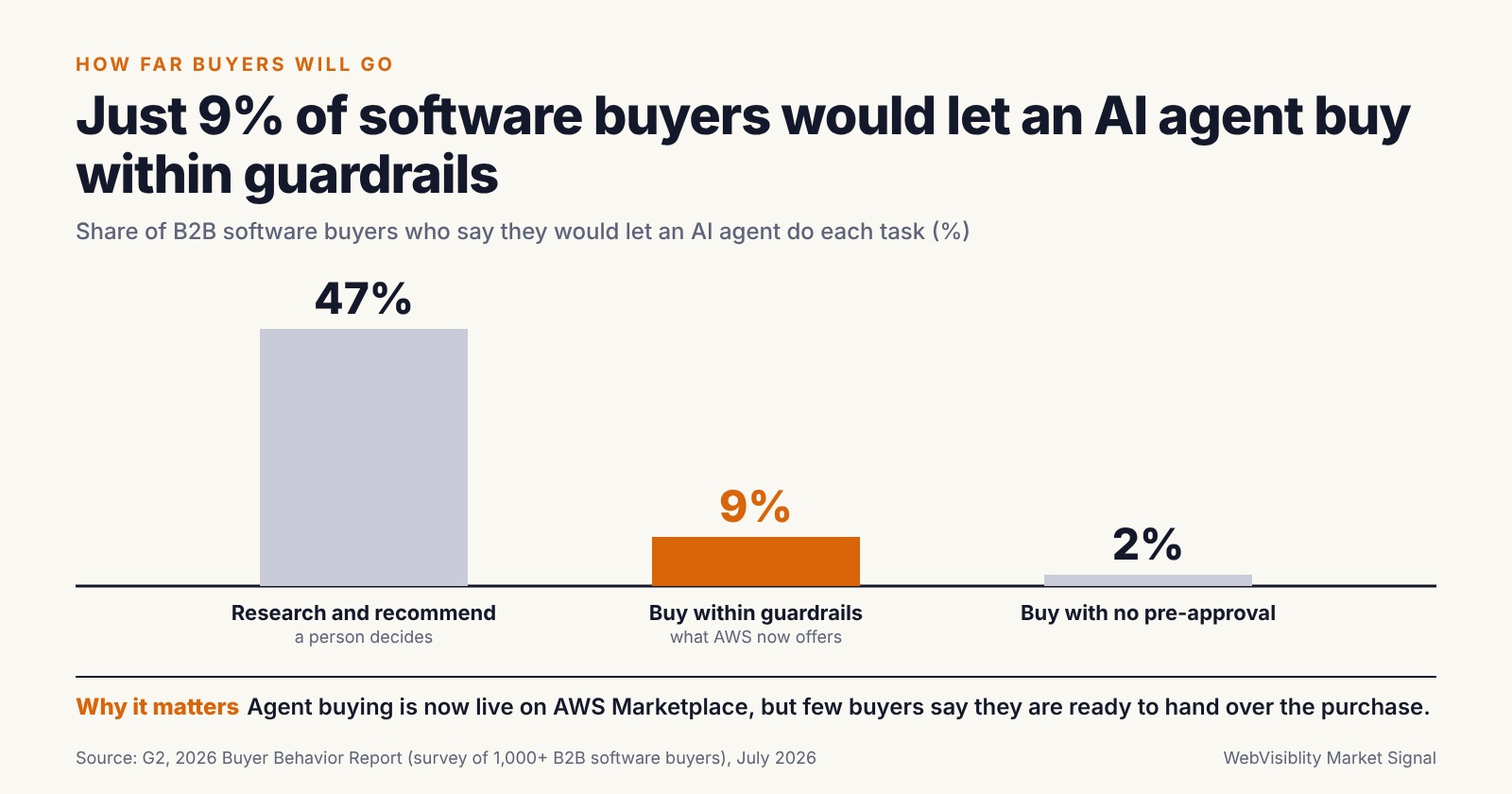
AWS said on 19 November that agent mode in its Marketplace now carries a buyer's request through discovery, purchase, and deployment, so one conversation can end with software bought and running. Fortune reported that companies can give these agents a budget and set rules for which purchases still go to a person. The timing is pointed: in a G2 survey published in July, only 9% would let an agent buy within guardrails.
At a glance
| Announced | 19 November 2026, on the AWS What's New page |
|---|---|
| What agent mode does | Finds products, checks vendor security, completes the purchase and deploys supported products |
| Where | All Regions where AWS Marketplace is available |
| Agent spending | Paid through the x402 agentic payment protocol and settled in US dollars on the AWS bill |
| Conversion | 6% to 7% of agent mode buyers convert, AWS's Matt Yanchyshyn told Constellation Research |
| Buyer readiness | 9% of buyers would let an agent buy within guardrails; 2% without pre-approval |
Do this today
Tick each step as you do it. Your ticks stay on this device. See the full list.
For marketers
For software buyers and IT teams
The signal
- Buyers can ask for documents such as SOC 2 reports and get a criterion-by-criterion assessment against the CAIQ security questionnaire.
- Constellation Research reports that the new Trust Agent covers more than 1,000 vendors and 4,500 of about 35,000 listings at launch, using data from Vanta and Drata.
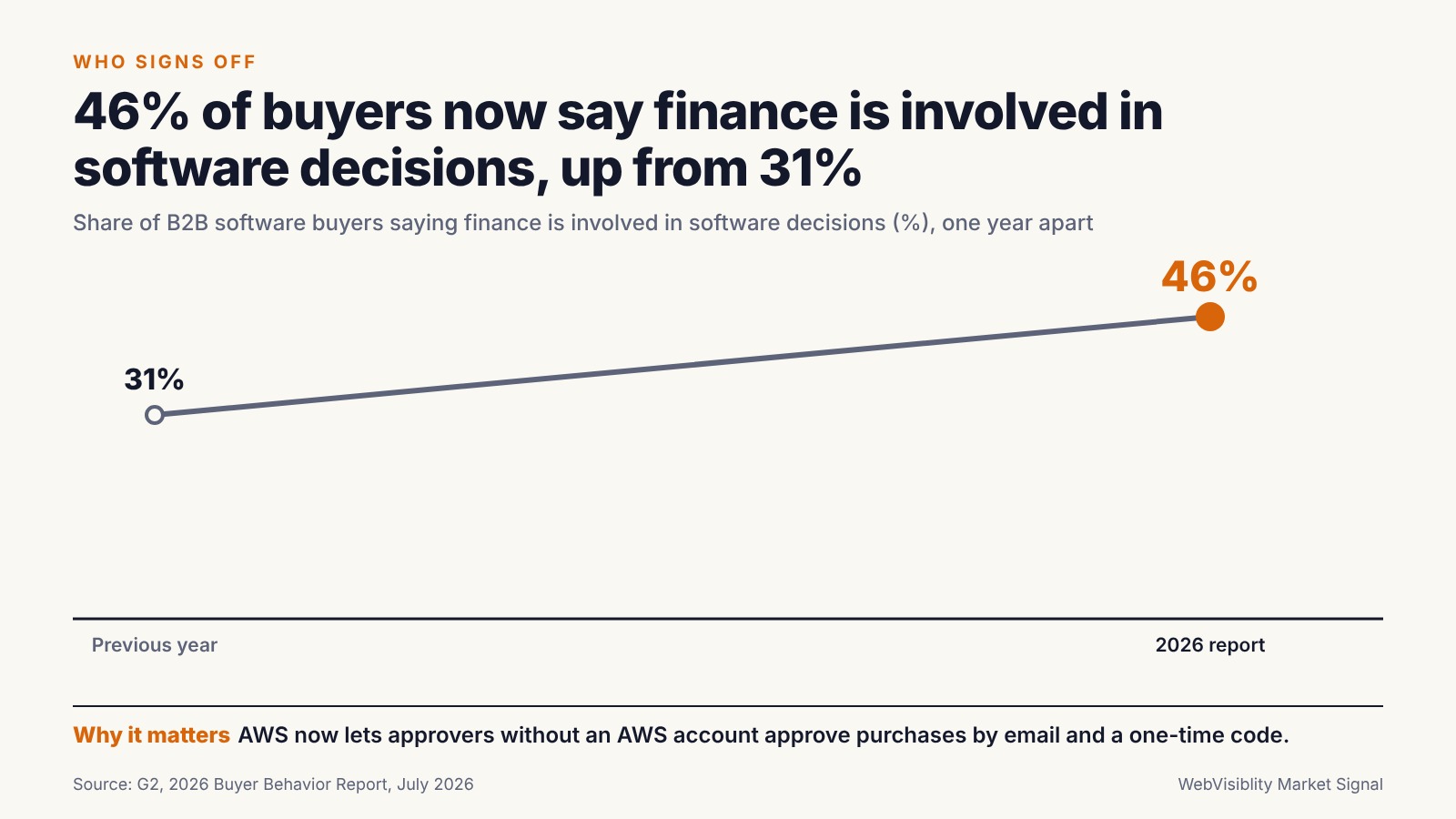
- Approvers without an AWS account receive an email, confirm a one-time passcode and approve or reject in a browser; Coupa and SAP Ariba are connected.
- Before deploying, agent mode proposes a plan with estimated monthly cost and waits for the buyer's approval.
- A new Express Checkout lets small businesses pay by credit card with no AWS account required, according to Constellation Research.
- Sellers also get a demand center that drafts emails, landing pages, sponsored search copy, Constellation Research reports.
Which of these are you?
Tap the one that fits you best. We show what this story changes for you.
What happened
AWS Marketplace is Amazon's catalogue of third-party software, data and services that companies buy on their AWS bill. It added a conversational agent mode in late 2025, which an AWS blog described as a conversational discovery experience. The 19 November update takes that assistant past the search stage. A buyer describes a use case once, and agent mode now recommends software, services, AI agents and multi-product bundles, reviews the seller's security documents, explains pricing and terms, and completes the order after the buyer confirms.
For products that support it, the assistant also looks at the buyer's AWS environment, proposes a deployment plan with a cost estimate, then deploys after the buyer approves. Constellation Research reports that this Deployment Agent runs through CloudFormation, can clean up after a failed deployment or a trial that does not convert, and works only if the buyer opts in.
The bigger change is who presses buy. Matt Yanchyshyn, who runs AWS Marketplace, told Fortune that each company sets the limits, and that a human handoff on every purchase is fine if a company wants it. Developers can also let agents pay for individual API calls. Superpower Daily, summarising AWS's technical post, reports that an agent's request is checked against a session spending limit before a payment token is issued, and that AWS's own sample shows a $0.01 purchase inside a $0.05 session budget. Constellation Research reports that these payments use the x402 protocol through Amazon Bedrock AgentCore and land on the normal AWS bill.
None of the sources cited here gives prices for the new agents, and AWS's own announcement does not name x402 or the individual agents. Those details come from the reporting cited here.
By the numbers
Timeline
AWS adds a category for AI agents to its Marketplace, CIO Dive reports.
An AWS blog describes agent mode as a conversational discovery experience.
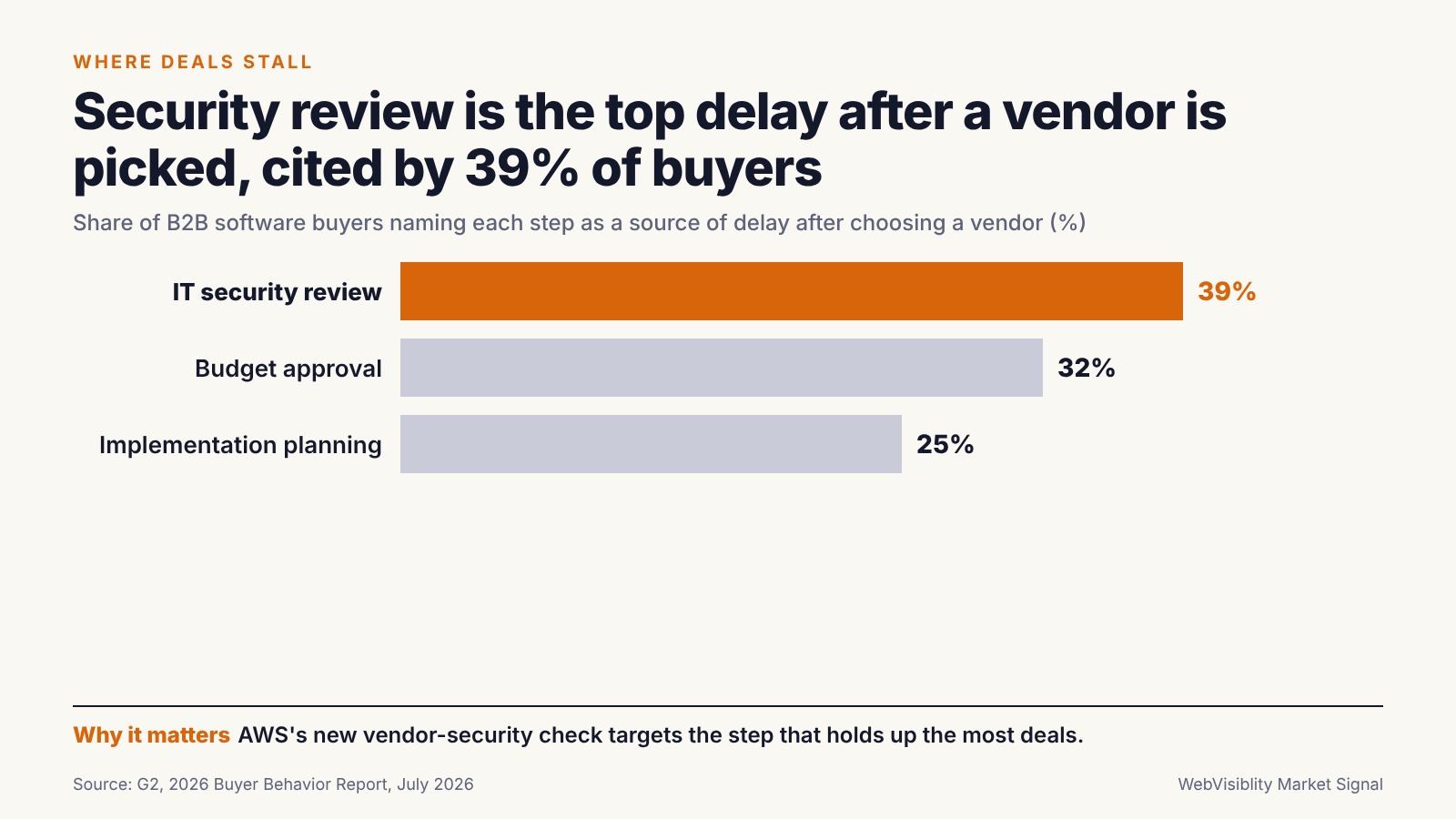
G2 finds IT security review is the single biggest source of delay after a vendor is chosen.
AWS expands agent mode to assess, buy, and deploy software.
Fortune reports companies can pre-authorize agents to act without human approval.
“People aren't searching with keywords anymore.”
How an agent buys on AWS Marketplace
- 1Describe
The buyer states a use case and gets recommended software and services.
- 2Check
Agent mode assesses SOC 2 and other documents against the CAIQ.
- 3Buy
It explains terms and completes the purchase once the buyer confirms, or within preset rules.
- 4Deploy
For supported products it proposes a plan with estimated monthly cost, then deploys on approval.
Why it matters
The first reader of a software listing may no longer be a person. Yanchyshyn told Fortune that buyers now describe a use case instead of typing a keyword like database. When an agent turns that description into a shortlist, the words that win are the ones that state plainly what a product does, who it is for, what it costs and how it deploys. Constellation Research reports that AWS's new Use Case Explorer already recommends products from AWS case studies and documentation, so published material shapes what the agent suggests.
Security paperwork is turning into a sales asset. G2's survey found IT security review was cited by 39% of buyers as the biggest delay after picking a vendor, rising to 50% among enterprise buyers. The Trust Agent puts a vendor's compliance record in front of the buyer at the moment of choice, and Drata's chief executive Adam Markowitz told Fortune that a review can mean checking a vendor against 50 to 60 requirements. A vendor whose SOC 2 report and questionnaire answers are current and available is easier for the agent to clear.
Buyers are not handing over the wallet yet. In the same G2 study, 47% would let an agent research and recommend while people decide, against 9% who would let it buy within guardrails. Vanta's Bill Fitzgerald told Fortune that large deals will always have a human in the loop. Fitzgerald expects agents to take on more small, high-volume purchases fully on their own. For those, Yanchyshyn's figure that 6% to 7% of agent mode buyers convert, as reported by Constellation Research, is the only early benchmark.
Who is affected
An agent now reads listings, terms and security records before a buyer sees a shortlist.
Buyers describe use cases instead of typing a keyword, so listing copy must answer plain questions.
Approvals can run through Coupa and SAP Ariba or an email with a one-time code.
Express Checkout takes a card with no AWS account required.
What to do now
For marketers
- Rewrite your AWS Marketplace listing around the use cases buyers describe, in the words a buyer would type into a chat.
- Put your current SOC 2 report and completed security questionnaire where the listing can reach them.
- State pricing, contract length and deployment steps on the listing in plain sentences an agent can quote.
- Ask your AWS partner contact whether your product supports agent mode deployment and x402 pay-per-request.
For software buyers and IT teams
- Decide which purchase types and amounts an agent may complete alone before anyone turns the feature on.
- Bring finance and security into the rule-setting, since they still approve the larger deals.
Printable, one page, 10 checks. Enter your email and it opens right away.
We email you a copy. We never share your email and never send you sales emails.
Pick one. It takes 5 seconds and helps more people find these briefings. Your checklist opens straight after.
Have a work email? Use it instead and the checklist opens straight away.
Open it, then save it as a PDF or print it.
Know someone who would find this useful?
These steps are our recommendations based on this news, not statements from the companies involved.
What to watch
- Adoption numbers. The announcement gives no count of agent mode users or of purchases agents complete alone.
- Pricing for sellers. None of the reports gives fees for the new agents or the demand center.
- Rival stores. Watch whether Microsoft and Google add the same budget-based buying to their own cloud marketplaces.
- Trust Agent coverage. Constellation Research puts launch coverage at 4,500 of about 35,000 listings; watch how fast that grows.
Questions readers ask
Can AI agents buy software on AWS Marketplace?
Yes. Since 19 November 2026, agent mode can complete the purchase after the buyer confirms, and companies can give agents a budget and rules that let them make some purchases without a person approving each one.
What is AWS Marketplace agent mode?
It is a conversational assistant in AWS Marketplace. A buyer describes what they need, and it recommends, assesses, buys and deploys software, services and AI agents.
How does AWS Marketplace check a vendor's security?
Buyers can request documents such as SOC 2 reports and get a criterion-by-criterion assessment against the CAIQ questionnaire. Constellation Research reports that data comes from Vanta and Drata.
Do I need an AWS account to buy on AWS Marketplace now?
Not for small businesses using Express Checkout, which Constellation Research says accepts a social login and a credit card with no AWS account required.
How do AI agents pay on AWS Marketplace?
Developers can let agents pay per request through the x402 agentic payment protocol in Amazon Bedrock AgentCore, with charges in US dollars on the AWS bill, according to Constellation Research.
Will companies let AI agents buy software?
Few say so today. G2 found 9% would let an agent buy within guardrails and 2% without pre-approval, while 47% would let it research and recommend.
What should software vendors on AWS Marketplace do?
Make listings describe use cases in plain words, keep security documents current, and state pricing and deployment steps clearly, since an agent now reviews terms and security before buying.
Companies in this story
Sources
- Amazon Web ServicesOriginal
- Fortune
- Constellation Research
- DigitalToday
- Superpower Daily
- G2
- CIO Dive
- Amazon Web Services
Researched, fact-checked and edited by the Market Signal desk. Read our editorial standards. Spotted an error? Email hello@webvisiblity.com and we will correct it.