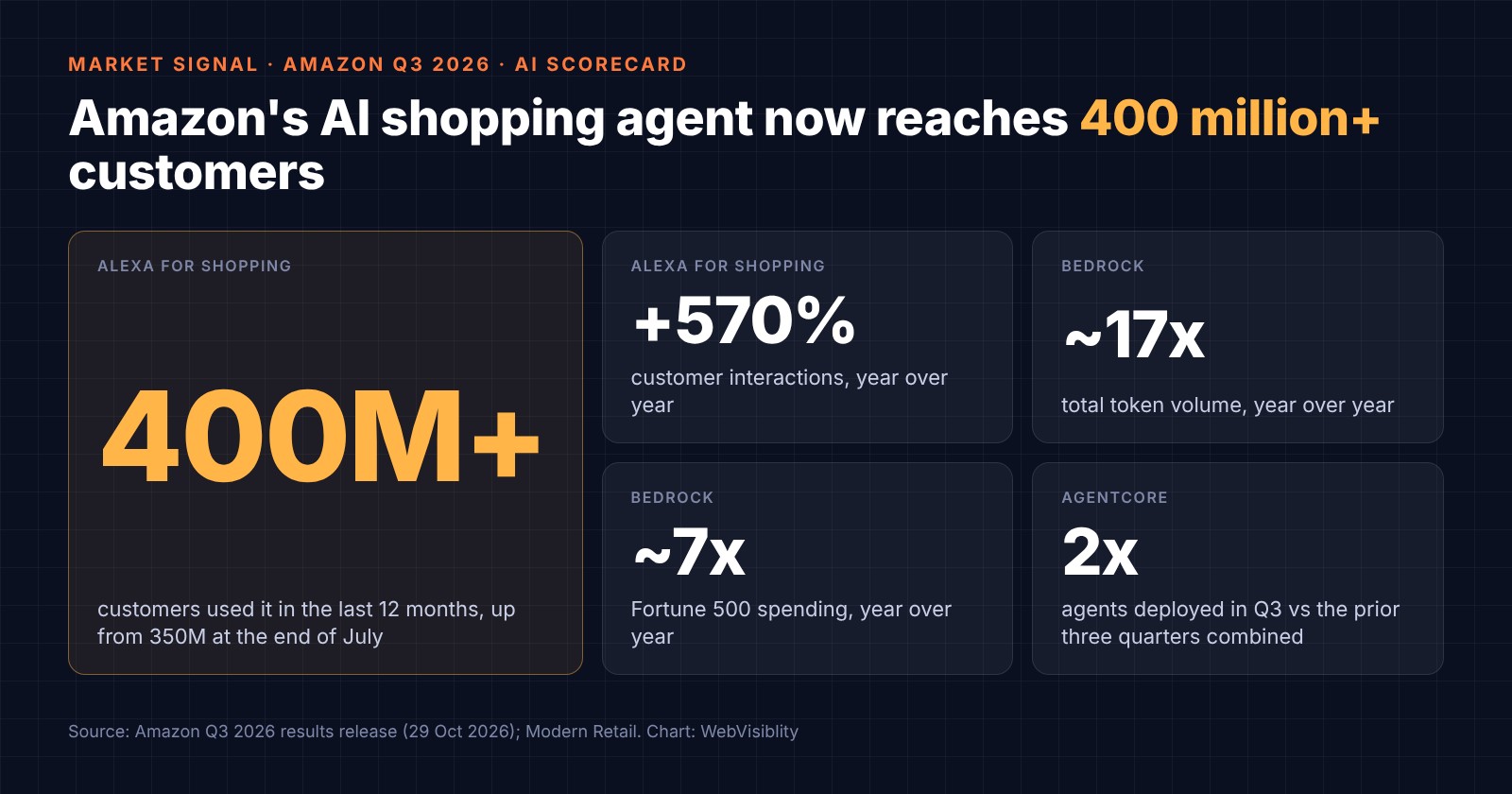
Amazon reported third quarter net sales of $201.9 billion on 29 October, up 12% from a year earlier [1][3]. AWS sales rose 39% to $46.0 billion, which Amazon called its fastest growth in nearly five years [1]. The same release said more than 400 million customers used Alexa for Shopping, its AI shopping assistant, in the last 12 months, with interactions up 570% [1]. Shares fell about 6% in early after-hours trading [3][4].
At a glance
| Net sales | $201.9 billion, up 12%; up 13% excluding currency moves [1] |
|---|---|
| AWS sales | $46.0 billion, up 39%; $184 billion annualized run rate [1] |
| Operating income | $28.1 billion, from $17.4 billion; margin 13.9%, Amazon's highest ever [1] |
| Alexa for Shopping | 400 million+ customers in 12 months; interactions up 570% [1] |
| Advertising revenue | $19.6 billion [4][5]; growth of 12% excluding currency moves [1] |
| Free cash flow | Outflow of $42.4 billion over twelve months [1] |
The signal
- More than 400 million customers used Alexa for Shopping in the last 12 months, up from 350 million at the end of July, Modern Retail reported [1][2].
- Amazon launched Amazon Ads Agent and made Full-Funnel Campaigns available to all U.S. advertisers, where its AI plans, runs and tunes a campaign from initial inputs [1].
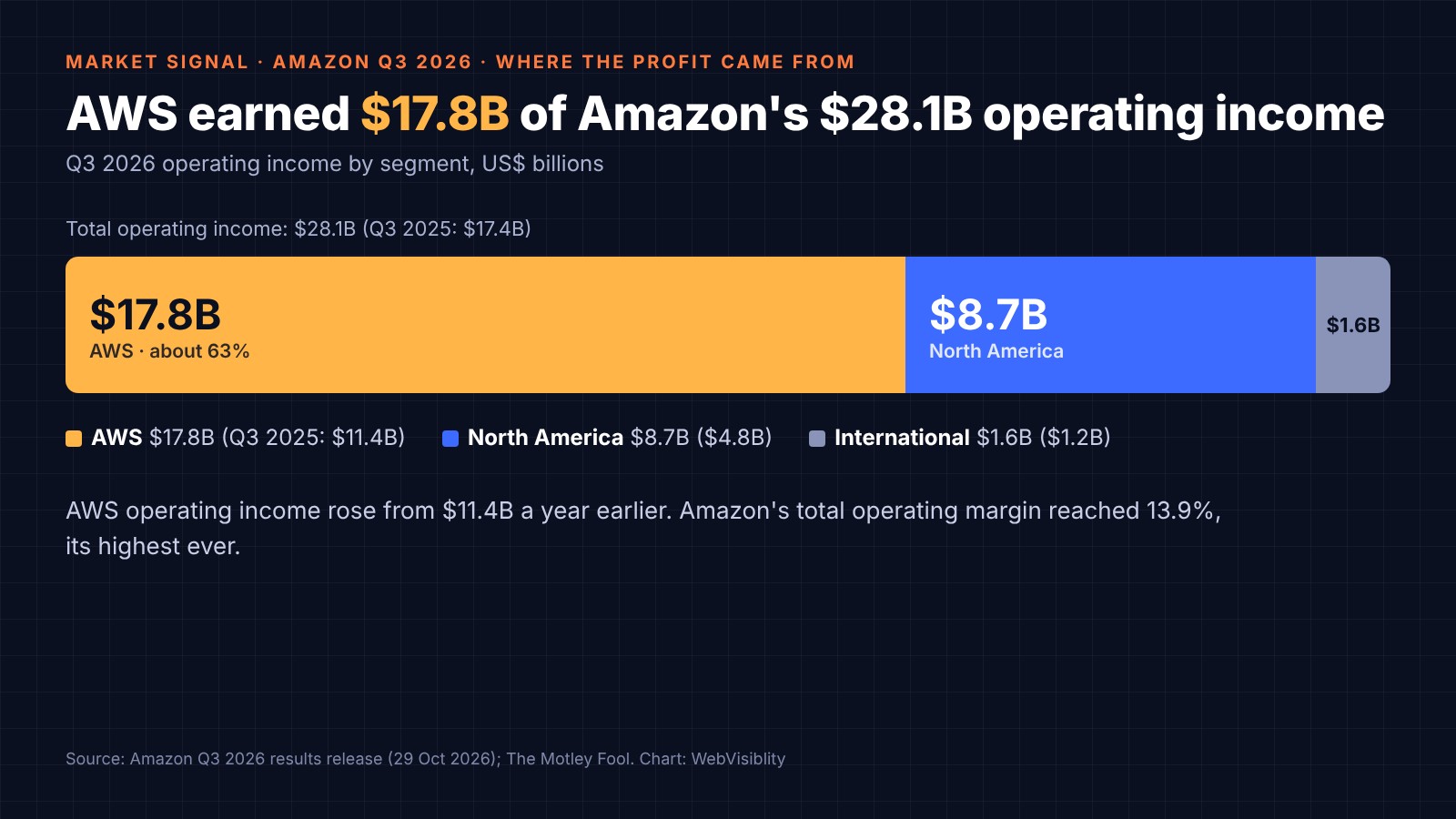
- AWS sales grew 39% to $46.0 billion and AWS produced $17.8 billion of Amazon's $28.1 billion operating income [1].
- Fortune 500 spending on Amazon Bedrock rose nearly 7 times and total Bedrock token volume nearly 17 times, year over year [1].
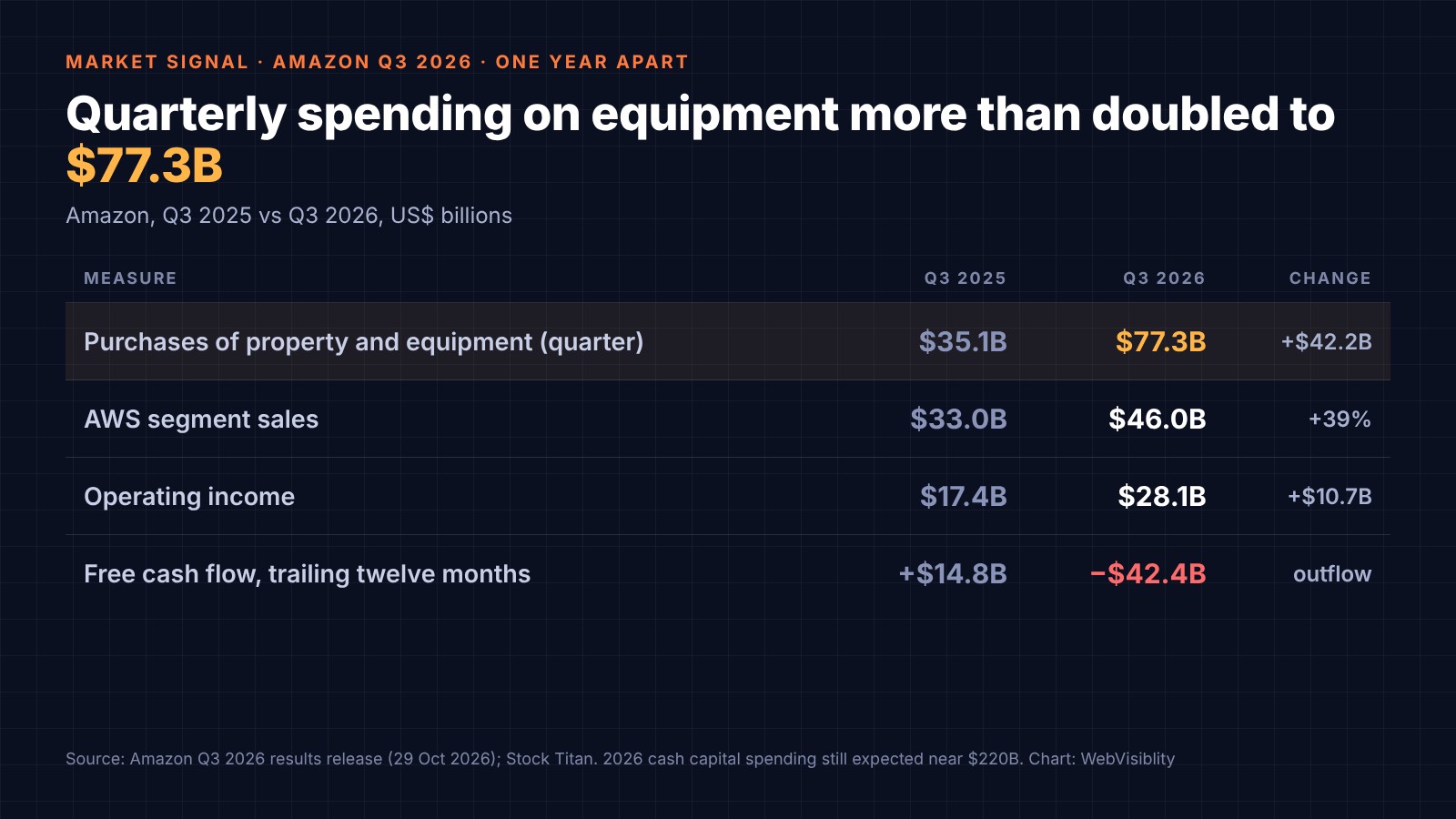
- Purchases of property and equipment reached $77.3 billion in the quarter, against $35.1 billion a year earlier, and twelve month free cash flow turned to an outflow of $42.4 billion [1][5].
What happened
Amazon published its third quarter results after the U.S. market closed on 29 October [1][3]. Net sales were $201.9 billion, up 12%, or 13% without a $0.9 billion currency drag [1]. Amazon noted that Prime Day moved into the second quarter this year in most large countries, and said growth would have been about 400 basis points higher without that shift [1].
The cloud. AWS sales grew 39% to $46.0 billion, and its operating income rose to $17.8 billion from $11.4 billion [1]. Chief executive Andy Jassy put the AWS run rate at $184 billion and said Amazon projects AWS growth above 40% in both 2027 and 2028 [1][5]. Inside AWS, Fortune 500 spending on Bedrock, the service that runs AI models for customers, grew nearly 7 times, and Bedrock now offers built-in web search for OpenAI models so answers can draw on current information [1]. Tens of thousands of customers use AgentCore, its agent-building service, and they deployed twice as many agents in the quarter as in the prior three quarters combined [1].
The storefront. Alexa for Shopping, the assistant that was called Rufus until a rebrand in May, passed 400 million customers over 12 months [1][2]. On the earnings call Jassy said shoppers who use it spend 50% more than those who do not, Modern Retail reported [2]. Amazon did not publish a sales figure tied to the assistant.
The ad desk. Advertising revenue was $19.6 billion [4][5]. Amazon put growth at 12% excluding currency moves, held back by Prime Day timing, and expects growth in the high teens in the fourth quarter [1]. It also launched Amazon Ads Agent, a single AI platform that can act for advertisers, and opened Full-Funnel Campaigns, which combine sponsored ads, display, video and streaming TV in one campaign, to all U.S. advertisers [1].
The bill. Net income was $20.7 billion, or $1.89 a share, against $21.2 billion a year earlier, when Anthropic investment gains of $9.5 billion lifted the total [1]. Proactive and 24/7 Wall St. reported a consensus estimate of $1.96 a share [4][6]. Twelve month free cash flow swung to an outflow of $42.4 billion as AI spending rose, and Amazon still expects about $220 billion of cash capital spending in 2026 [1]. For the fourth quarter it guided to net sales of $240.0 billion to $247.0 billion [1].
By the numbers
Timeline
Amazon releases an AI shopping assistant, then known as Rufus [2].
The assistant is renamed Alexa for Shopping [2].
Alexa for Shopping counts 350 million customers at the end of July [2].
Amazon reports Q3: 400 million+ Alexa for Shopping customers, AWS up 39%, Amazon Ads Agent launched [1].
Amazon guides to net sales of $240.0 billion to $247.0 billion and ad growth in the high teens [1].
“Though we anticipate working with horizontal agents, we believe Alexa for Shopping is going to be the primary shopping agent customers use to shop Amazon.”
How an Amazon sale can now run through AI
- 1The advertiser sets inputs
Full-Funnel Campaigns take initial inputs; Amazon's AI plans, runs and tunes the rest [1].
- 2The ads reach shoppers
Sponsored ads, display, video and streaming TV run as one campaign [1].
- 3The shopper asks the agent
Alexa for Shopping reached 400 million+ customers in 12 months [1].
- 4The agent answers
Jassy says users of the assistant spend 50% more, Modern Retail reported [2].
Why it matters
Discovery is moving into an agent Amazon controls. Shoppers who once typed into a search box and scrolled through filters can now ask an assistant, and Amazon says that assistant reached more than 400 million customers in a year [1]. Jassy's line about horizontal agents matters here: Amazon expects assistants from other companies to shop too, but wants its own agent to be the main one on its store [2]. Brands that sell through Amazon now have two audiences to satisfy: the shopper and the agent that answers for them. Product titles, specs and reviews have to make sense as answers, not only as keywords.
Ad buying is being handed to software. Full-Funnel Campaigns ask the advertiser for initial inputs and leave planning, running and tuning to Amazon's AI [1]. That saves hours, but it also moves decisions about channel mix and bids out of the marketer's hands. Advertising revenue of $19.6 billion shows how much money now flows through that system [4][5]. Teams that keep clear goals, clean first party data and their own measurement will be better placed to judge whether the agent is spending well.
Enterprise buyers are building their own answer engines. Bedrock token volume grew nearly 17 times and Fortune 500 spending nearly 7 times [1]. With web search now built into OpenAI models on Bedrock [1], the internal assistants that procurement and IT teams build can pull live information from the open web. A vendor's public pages, pricing and documentation are increasingly read first by these tools, before any sales call.
What to do now
For marketers
- Ask Alexa for Shopping the questions your buyers ask and record whether your products appear in the answers.
- Rewrite product titles and bullet points so each states the facts an assistant needs: use case, size, compatibility and price basis.
- Before switching to Full-Funnel Campaigns, set goals and a holdout test so you can judge the AI's spending yourself.
- Check that your public pricing, specs and documentation pages are current, since enterprise AI tools with web search may read them first.
For software buyers and IT teams
- When an AI assistant recommends a product, open the source listing and check the specs before ordering.
- Ask vendors whether their product facts are kept current on the marketplaces and sites your team's AI tools read.
- Treat AI shopping summaries as a starting point and compare at least two options yourself.
Printable, one page, 10 checks. Enter your email and it opens right away.
We email you a copy. We never share your email and never send you sales emails.
Pick one. It takes 5 seconds and helps more people find these briefings. Your checklist opens straight after.
Have a work email? Use it instead and the checklist opens straight away.
Open it, then save it as a PDF or print it.
Know someone who would find this useful?
These steps are our recommendations based on this news, not statements from the companies involved.
What to watch
- Sales credit for the agent. Amazon gave usage figures for Alexa for Shopping but no revenue tied to it; any such figure would show how much buying the agent drives [1].
- Ads Agent results. Whether Amazon's fourth quarter ad growth reaches the high teens it guided to, with Full-Funnel Campaigns open to all U.S. advertisers [1].
- Outside shopping agents. How Amazon treats horizontal agents from other AI companies, after Jassy said it expects to work with them [2].
- The spending bill. Whether 2026 cash capital spending lands near the $220 billion Amazon expects, and how long free cash flow stays negative [1].
Who is affected
Discovery moves to an assistant used by 400 million+ customers, so listings must work as answers [1].
Full-Funnel Campaigns hand planning and tuning to Amazon's AI, so own measurement matters more [1].
Enterprise agents on Bedrock can search the web, so public pages are read by AI before people [1].
Questions readers ask
What is Alexa for Shopping?
Alexa for Shopping is Amazon's AI shopping assistant, previously called Rufus and renamed in May 2026. More than 400 million customers used it in the 12 months to the third quarter [1][2].
How many people use Amazon's AI shopping assistant?
More than 400 million customers in the last 12 months, according to Amazon's third quarter release, up from 350 million at the end of July [1][2]. Interactions grew 570% year over year [1].
How fast did AWS grow in Q3 2026?
AWS sales rose 39% to $46.0 billion in the third quarter of 2026, which Amazon called its fastest growth in nearly five years. Its annualized run rate is $184 billion [1].
What is Amazon Ads Agent?
Amazon Ads Agent is a single AI platform for advertisers that gives insights and answers and can take actions on their behalf. Amazon launched it with its Q3 2026 results [1].
Did Amazon beat earnings expectations in Q3 2026?
No on profit per share. Amazon earned $1.89 a share against a $1.96 consensus reported by Proactive and 24/7 Wall St., though AWS sales beat estimates [1][4][6].
Companies in this story
Sources
Researched, fact-checked and edited by the Market Signal desk. Read our editorial standards. Spotted an error? Email hello@webvisiblity.com and we will correct it.