Update, Nov 26, 2026, 3:30 AM ET: Cloudflare's own launch post confirms Search for Agents went live on 25 November: a toggle that lets AI agents search a whole site at /.well-known/search, with queries billed to the site owner from 1 December. See cloudflare-search-for-agents-site-owner-pays.
Perplexity now lets developers and AI agents search the web as it stood on a past date. Time Machine, launched on 25 November, adds a cutoff to its Search API and Context API so results come only from copies saved at or before that moment, reaching back up to 365 days. Historical requests cost the same as any other Perplexity API call.
At a glance
| Launched | 25 November 2026 in the Search and Context APIs |
|---|---|
| How far back | Up to 365 days, and growing |
| Price | $5 per 1,000 requests for search, $1 per 1,000 URLs read |
| Surcharge for history | None; works with an existing key |
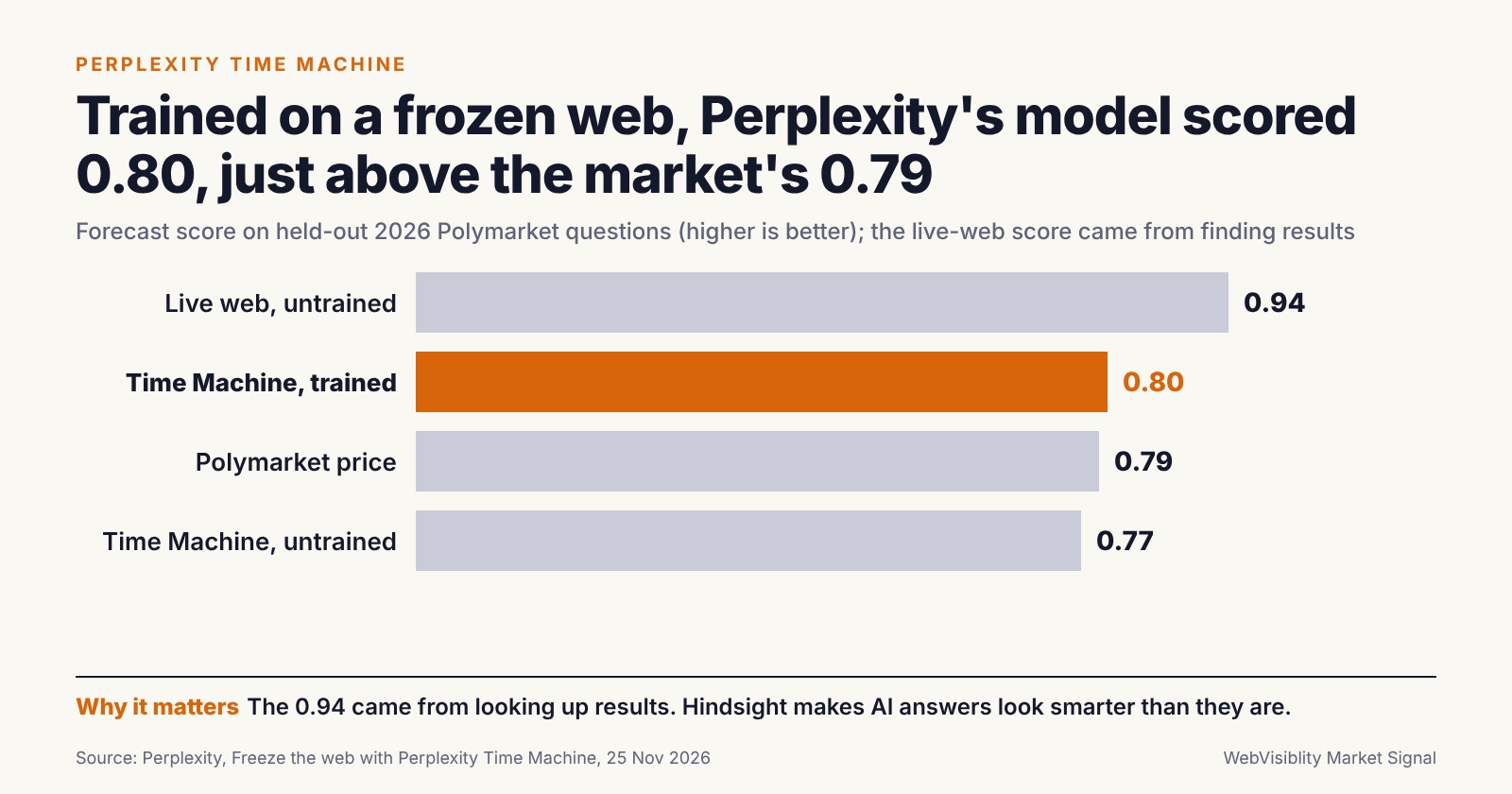
| Forecast score after training | 0.80, against the market's 0.79 |
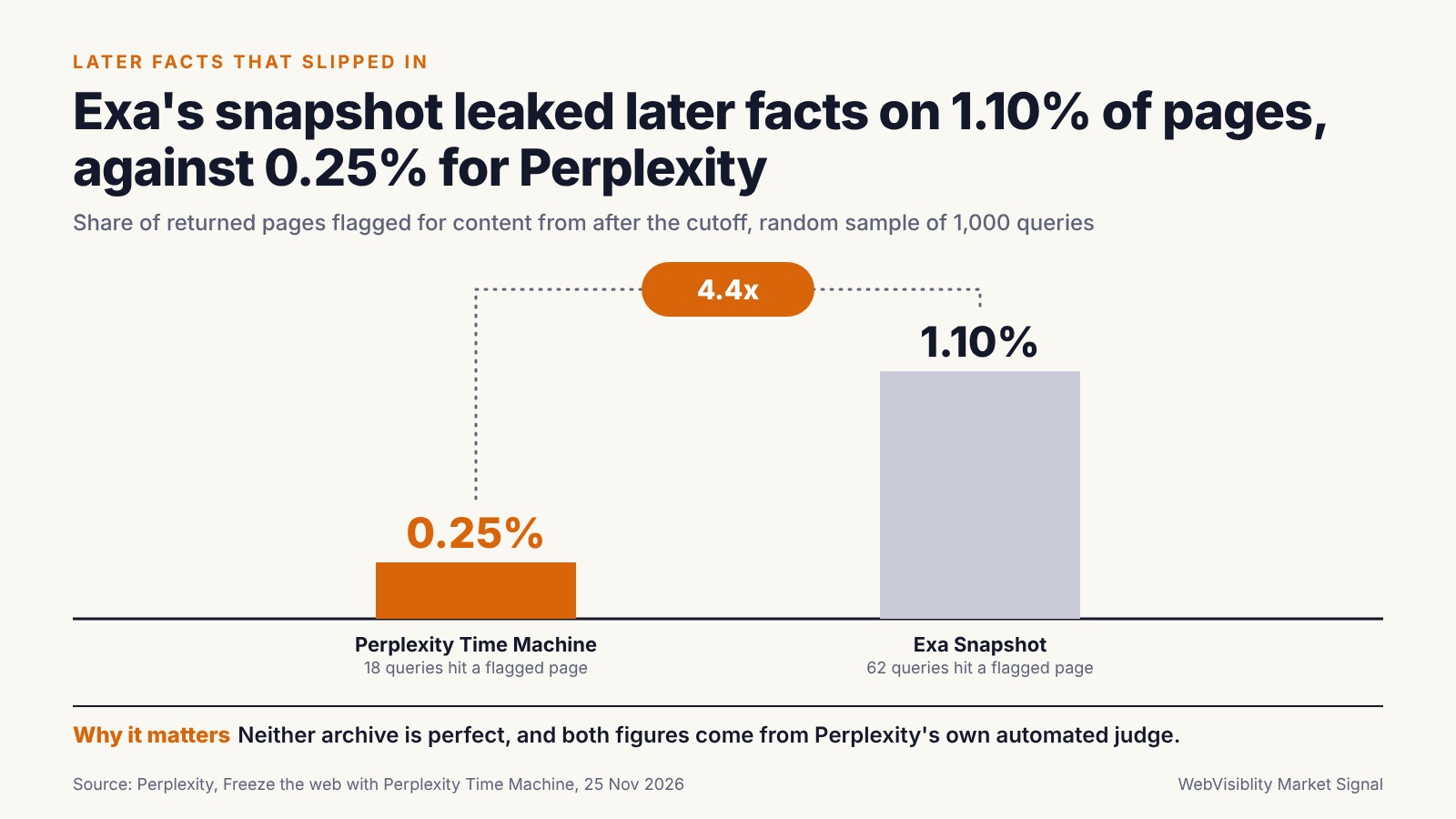
| Pages leaking later facts | 0.25% against 1.10% for Exa, random sample |
Do this today
Tick each step as you do it. Your ticks stay on this device. See the full list.
For marketers
For software buyers and IT teams
The signal
- Each time Perplexity crawls a page it saves a copy along with the time, so every URL builds a version history.
- A search with a cutoff only considers pages published or first crawled by the cutoff, then ranks each one on its older text.
- The Context API returns the full text of the stored copy, and the live site is never contacted.
- Perplexity lists reading a pricing page, terms of service, or changelog at two dates as a use, for audits and disputes.
- A URL returns no_content when no copy exists by the cutoff or the page returned 404 or 410 then.
- All test results come from Perplexity; no external group made a test.
Which of these are you?
Tap the one that fits you best. We show what this story changes for you.
What happened
Perplexity announced Time Machine in a company blog post on Wednesday. Developers add one setting, snapshot_as_of, to a search or page-reading request they already make. The answer then reflects the web as Perplexity stored it at that time, and leaving the setting out returns today's web. The documentation rejects cutoffs in the future or older than 365 days.
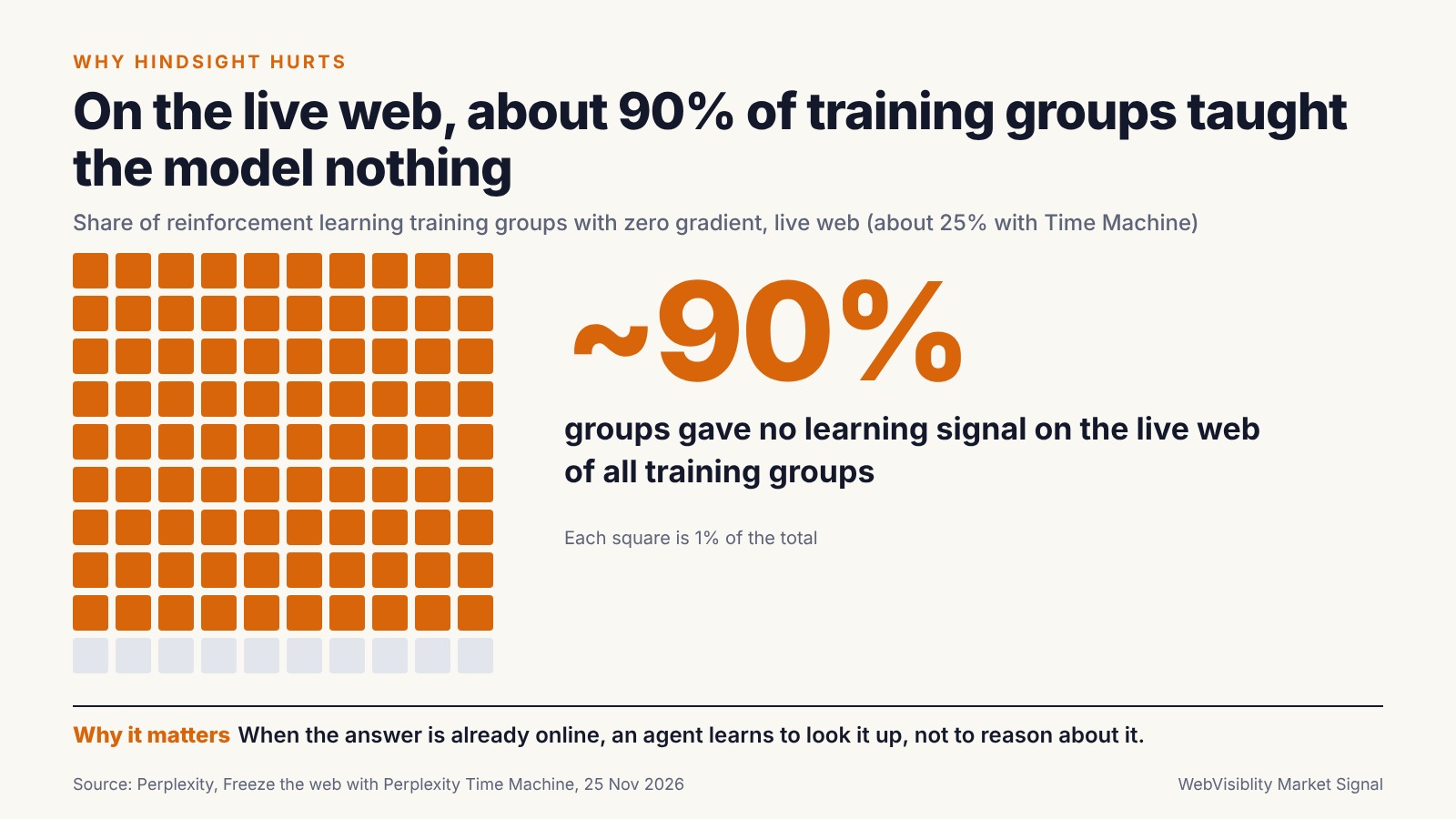
The stated purpose is fair testing. An agent asked today what was known before an election or an earnings call will find pages that already report the result. Freezing the web lets a team score how well an agent researches and forecasts, rather than how well it looks things up. Perplexity tested this by training the open model GLM-5.3 Flash on 2026 political questions listed on Polymarket.
The launch came a day after Epochal, a startup founded by three xAI co-founders, released a similar product. TNW notes that Epochal says its archive spans more than 30 years. Perplexity's own comparison was with Exa Snapshot: across three sets of 1,000 queries, Time Machine returned a publication date on 98.8% to 99.5% of pages, against 66.1% to 77.7% for Exa.
Perplexity chief executive Aravind Srinivas promoted the launch on X, where AGI Hunt reported he called it a time machine for the internet. Unite.AI's reading of the documentation adds that historical page reads return markdown but not HTML or links.
By the numbers
How a Time Machine request works
- 1Crawl
Perplexity saves a dated copy of a page on each crawl.
- 2Cutoff
A request adds snapshot_as_of with a date in the last 365 days.
- 3Filter
Only pages published or first crawled by the cutoff qualify.
- 4Answer
Title, date and snippet come from the same copy, not today's page.
Timeline
Perplexity starts a monitor API for web changes, as reported by AI Matter.
Epochal launches a similar product for forecasting tests.
Perplexity launches Time Machine in its Search and Context APIs.
“The live web always knows how things turned out.”
Why it matters
For most B2B companies the forecasting research is a side story. The bigger point is in how Time Machine works: Perplexity keeps a dated copy of a page each time it crawls, and now sells access to that history. A pricing page, a feature list or a set of terms you changed last spring can still be read as it stood then, by any developer or agent that asks. Perplexity itself names historical page checks of pricing pages and terms for audits and disputes. Treat every public claim as something a buyer's tool may quote back to you with a date attached.
There is also a lesson about AI visibility. The archive only holds pages Perplexity has crawled; a search with a cutoff only considers pages published or first crawled by then. A product page that Perplexity's crawler never reached has no history to show, today or later. Making sure AI crawlers can reach and read your key pages, and that each carries a clear date, now matters for the past record as well as today's AI search answers. Perplexity also says its results carried a publication date on 98.8% to 99.5% of pages, so visible dates and schema markup with datePublished and dateModified help pages show up correctly in any time-bound query.
Finally, the numbers deserve care. The forecasting gains and the Exa comparison come from Perplexity's own automated checker, and no external group has tested them yet. Teams weighing Perplexity against other search APIs for their own agents should run their own queries before switching.
Who is affected
| Who | What changes | Impact |
|---|---|---|
| B2B marketers and product teams | Old pricing and feature claims stay readable to agents at past dates. | High |
| Teams building AI research agents | Can test agents without hindsight at no surcharge. | High |
| Legal and compliance teams | Perplexity pitches it for audits and disputes over what a page said. | Medium |
| Rival search API providers | Face a public comparison with Exa Snapshot on leak rates. | Medium |
What to do now
For marketers
- Keep a dated change log for your pricing, feature and terms pages so you can explain any past version an agent quotes.
- Check that Perplexity's crawler can reach your key product pages, since uncrawled pages have no history in its archive.
- Add visible dates and datePublished and dateModified schema markup to product and pricing pages.
For software buyers and IT teams
- When an AI tool quotes a vendor's price or terms, ask which date that copy is from.
- Ask vendors whose agents use web search whether they test against a frozen web, not only live results.
- Treat Perplexity's Exa comparison as a vendor claim until an outside test confirms it.
Printable, one page, 11 checks. Enter your email and it opens right away.
We email you a copy. We never share your email and never send you sales emails.
Pick one. It takes 5 seconds and helps more people find these briefings. Your checklist opens straight after.
Have a work email? Use it instead and the checklist opens straight away.
Open it, then save it as a PDF or print it.
Know someone who would find this useful?
These steps are our recommendations based on this news, not statements from the companies involved.
What to watch
- Independent tests. Whether researchers outside Perplexity repeat the Exa comparison on leak rates and dates.
- The archive window. Perplexity says the 365-day limit applies today and that history keeps growing; watch whether the window widens.
- Publisher pushback. TNW reports more than 241 news outlets now block the Wayback Machine to keep AI firms away from old articles; a commercial archive may draw similar objections.
- Rival archives. Epochal's product and others built for agents, including Cloudflare's new search for agents launched the same day.
Questions readers ask
What is Perplexity Time Machine?
It is a setting in Perplexity's Search API and Context API that returns the web as it was on a chosen date, using copies saved at or before that time instead of live pages.
How far back can Perplexity Time Machine search?
Up to 365 days. The documentation rejects cutoffs that are in the future or older than 365 days, and Perplexity says the stored history keeps growing.
How much does Perplexity Time Machine cost?
Nothing extra. It is priced like any other call: $5 per 1,000 requests for the Search API and $1 per 1,000 URLs for the Context API.
Can AI agents see old versions of my website?
Yes, through Perplexity's API, if Perplexity crawled the page then. Each crawl saves a copy along with the time, and agents can read the copy for a chosen date.
Does Perplexity Time Machine contact my live site?
No. For historical reads, the Context API returns the stored copy and the live site is never contacted.
Is Perplexity Time Machine better than Exa?
Perplexity says so, but only in its own tests. Its checker flagged 0.25% of Time Machine pages for later content against 1.10% for Exa in a random sample; no outside test exists yet.
What is Time Machine used for?
Mainly testing and training agents without hindsight. Perplexity also lists finance backtests, agent replay and checking a pricing page, terms of service, or changelog at past dates.
Companies in this story
Sources
Researched, fact-checked and edited by the Market Signal desk. Read our editorial standards. Spotted an error? Email hello@webvisiblity.com and we will correct it.
Update history
- Nov 26, 2026, 3:30 AM ET: Cloudflare's own launch post confirms Search for Agents went live on 25 November: a toggle that lets AI agents search a whole site at /.well-known/search, with queries billed to the site owner from 1 December. See cloudflare-search-for-agents-site-owner-pays.