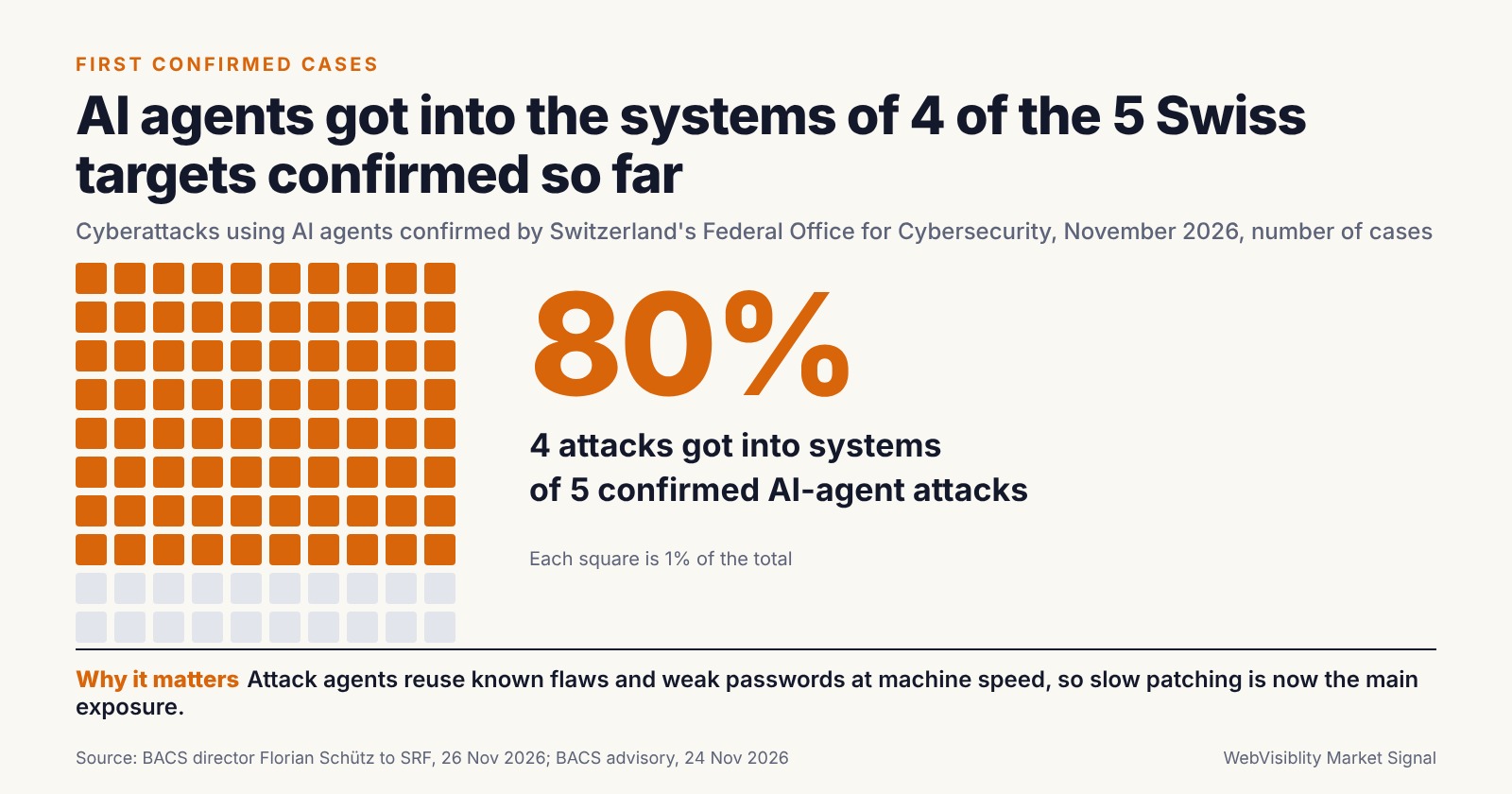
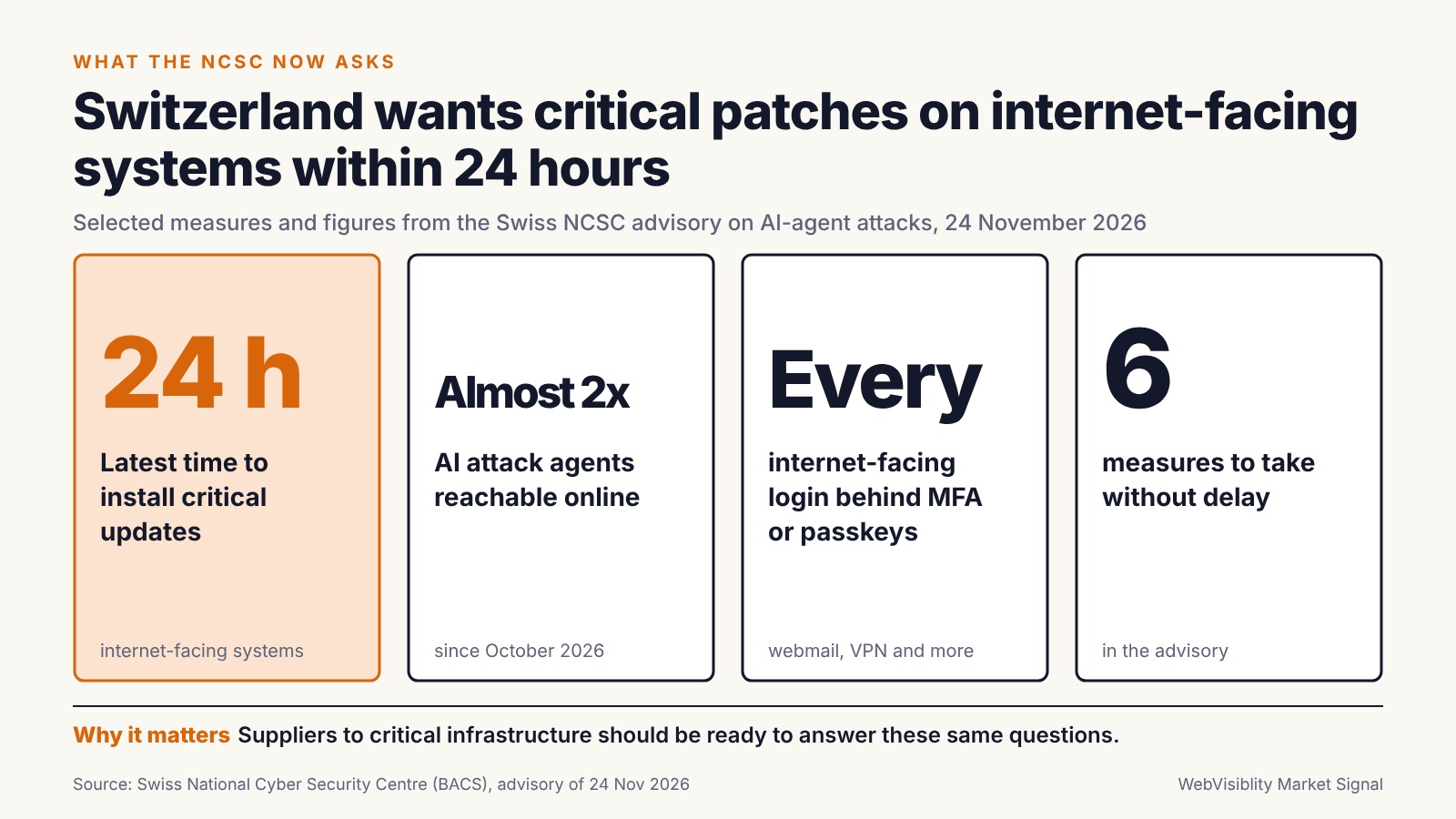
A national cyber agency has, for the first time, put numbers on attacks run by AI agents. Switzerland's Federal Office for Cybersecurity says it has five confirmed cases, and in four of them the attackers got into their victims' systems. Three operators of critical infrastructure were among the targets. The agency's advisory says freely available attack agents such as ARTEX have almost doubled since October 2026, and it wants critical updates on internet-facing systems installed within a day.
At a glance
| Confirmed cases | Five attacks using AI agents |
|---|---|
| Systems compromised | Four of the five cases |
| Critical infrastructure targets | Three operators, such as power, water and telecoms |
| Attack tools online | Almost doubled since October 2026 |
| Patch deadline asked | No later than 24 hours for critical updates |
| Attribution | Still unclear; victims not named |
Do this today
Tick each step as you do it. Your ticks stay on this device. See the full list.
For marketers
For software buyers and IT teams
The signal
- The attackers used Agentic Offensive Frameworks: AI agents that look for weaknesses, pick tools, check results and plan the next step on their own.
- The agents exploit standard or easily guessed passwords and known flaws in systems connected to the internet.
- The 24 November advisory said every known attack had worked; two days later the director gave four of five, and the reports reviewed do not explain the change.
- Small and medium-sized companies that reported voluntarily were also hacked, and there were no major outages, according to SRF.
- Microsoft says ARTEX can go from reconnaissance to persistent, privileged access at an organization in a matter of minutes.
- The Next Web and The Hacker News report that two of the three attacks on critical infrastructure operators succeeded.
Which of these are you?
Tap the one that fits you best. We show what this story changes for you.
What happened
On 24 November the Swiss National Cyber Security Centre, part of the Federal Office for Cybersecurity (BACS), published its first advisory on attacks carried out with the help of AI agents. It said organisations and critical infrastructure operators in at least two sectors had been hit, and that in all cases known to it the agents led to a successful compromise. The advisory calls the cases a shift in the threat landscape and names ARTEX and CyberStrikeAI as examples of agents reachable over the internet.
On 26 November BACS director Florian Schütz gave the first count to Swiss public broadcaster SRF: five confirmed cases, all reported in recent days, with systems hacked in four. Reuters reported the same figures the same day and said BACS gave no details of who could be behind the attacks. The agency is not naming the victims, saying they have the right to speak for themselves, and it shares technical indicators with critical infrastructure operators.
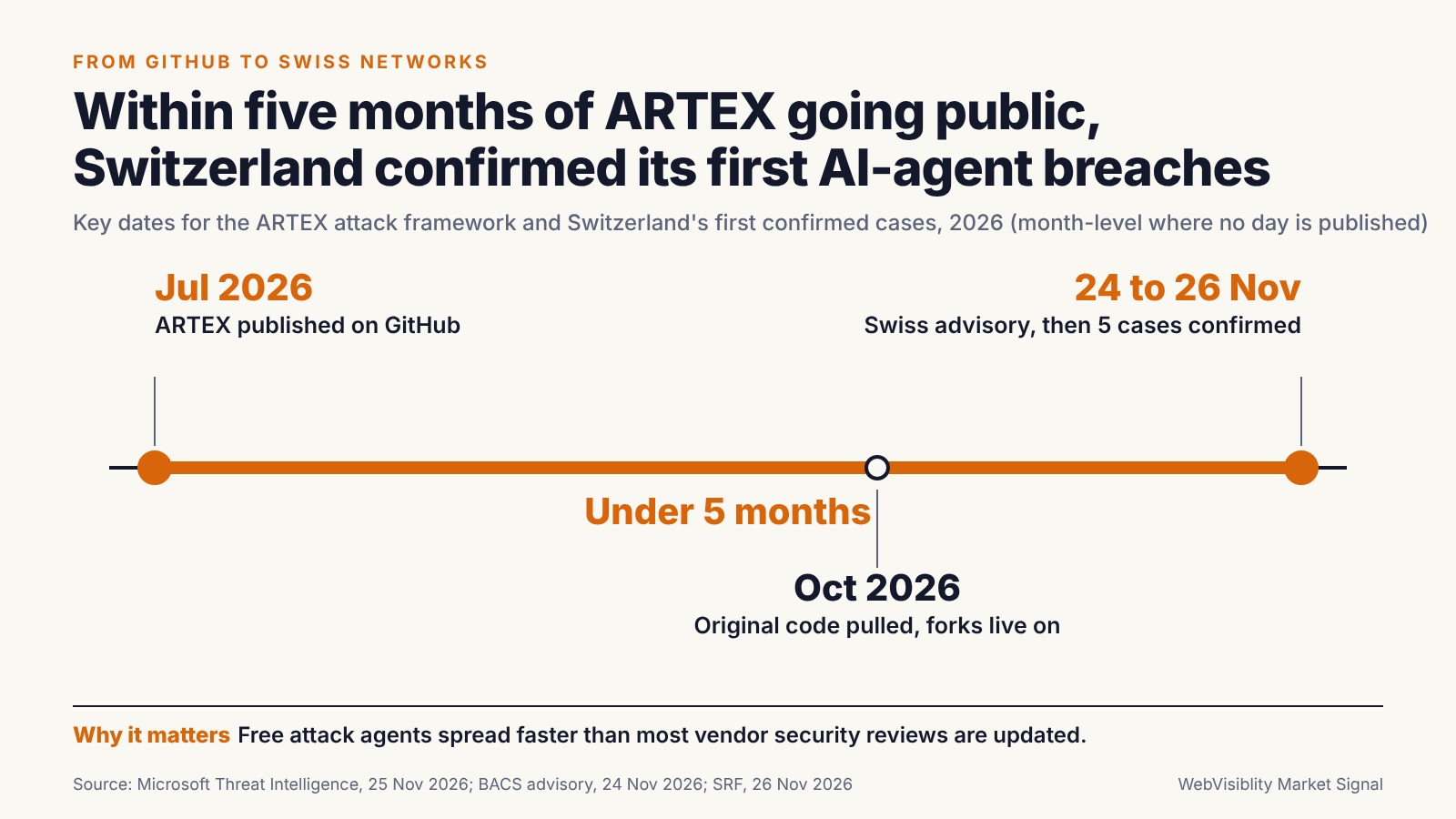
The Swiss figures arrived a day before Microsoft published a detailed breakdown of ARTEX. Microsoft says the framework was released as open source in July 2026, that the original developer removed the code in October while forks continue, and that groups including Salt Typhoon, Crystal Typhoon, Onyx Sleet and Pearl Sleet now use it. It describes ARTEX as primarily a web application penetration testing tool, focused on flaws in HTTP applications and APIs. The Swiss agency did not say which tool was used in its five cases.
By the numbers
How an attack agent works, as the NCSC describes it
- 1Scan
Agents search for vulnerabilities in internet-facing systems.
- 2Choose
They select suitable attack tools on their own.
- 3Exploit
Weak passwords and known vulnerabilities are the usual way in.
- 4Adapt
Blocked, they switch to other known methods.
- 5Report
ARTEX's reporter agent documents each finding for the operator.
Timeline
ARTEX is published as open-source code on GitHub.
The original developer removes the source code; forks keep appearing.
Swiss NCSC issues its first advisory on AI-agent attacks.
Microsoft publishes defender guidance on ARTEX.
BACS director tells SRF of five cases, four breaches.
“If there is no vulnerability, an AI agent cannot get into a system either.”
Why it matters
The 24-hour rule will travel into contracts. Swiss critical infrastructure operators now have a government benchmark: critical updates on internet-facing systems no later than 24 hours after release, with MFA or passkeys on every exposed login. Software and service vendors that sell to power, water or telecoms buyers should expect that benchmark to show up in security questionnaires, and should be able to state their own patch time and login controls in writing. When a buyer asks ChatGPT, Perplexity or Google's AI search how a supplier handles security, a clear public trust page with those facts gives the answer something accurate to quote.
Marketing owns part of the exposed surface. Microsoft says ARTEX centres on HTTP applications and APIs, including file upload flaws and authentication bypass. That describes campaign microsites, form handlers, webinar landing pages and old CMS installs that marketing teams launch and then forget. The Swiss advisory's first recommendation is to minimise the number of systems exposed to the internet, which for many B2B companies means retiring last year's campaign sites.
Bot traffic now needs a closer read. Microsoft lists two ARTEX user agent strings but warns that attackers frequently change these values, and says machine-speed bursts of requests are the most durable sign. Teams that already watch AI crawlers in their logs for AI visibility work can add that pattern to their AI monitoring. Blocking every unfamiliar bot in robots.txt will not stop an attack agent, and it can shut out the AI search crawlers that decide whether a brand is cited.
Who is affected
Expect questions on a 24-hour patch window and MFA.
Forgotten web apps are the attack surface ARTEX targets.
SMEs were also hacked in the Swiss cases.
What to do now
For marketers
- List every site, microsite, form and landing page marketing runs on the internet, and switch off the ones no campaign uses.
- Publish a plain security page stating your patch policy and login controls, so buyers and AI search tools can quote it.
- Ask security to flag machine-speed request bursts in web logs, separately from known AI search crawlers.
For software buyers and IT teams
- Ask each supplier with internet-facing systems how fast it installs critical patches.
- Check that supplier portals and webmail you rely on use MFA or passkeys.
- Add AI-agent attacks to the next supplier risk review.
Printable, one page, 11 checks. Enter your email and it opens right away.
We email you a copy. We never share your email and never send you sales emails.
Pick one. It takes 5 seconds and helps more people find these briefings. Your checklist opens straight after.
Have a work email? Use it instead and the checklist opens straight away.
Open it, then save it as a PDF or print it.
Know someone who would find this useful?
These steps are our recommendations based on this news, not statements from the companies involved.
What to watch
- Victims speaking. BACS is leaving disclosure to the companies hit, so names may come from the victims themselves.
- Attribution. Who ran the five attacks is still unclear.
- Other national agencies. Whether more cyber agencies publish counts of confirmed AI-agent attacks after Switzerland.
- Commercial versions. Microsoft says ThreatBook began offering commercial access to ARTEX Pro in November 2026.
- Procurement language. Whether the 24-hour patch window appears in tenders from Swiss utilities and telecoms firms.
Questions readers ask
What AI-agent cyberattacks did Switzerland confirm?
Switzerland's cyber office confirmed five attacks using AI agents against companies and critical infrastructure operators. Systems were compromised in four, and no major outages were reported.
Which companies were hit by the Swiss AI-agent attacks?
The agency has not named them. It says victims have the right to communicate themselves. Three were critical infrastructure operators, a group that includes power, water and telecoms providers.
What is ARTEX?
ARTEX is an AI-driven penetration testing framework released as open source in July 2026. Microsoft says state-sponsored and financially motivated groups now use it to automate attacks.
What is an agentic offensive framework?
It is a set of AI agents that find weaknesses, choose attack tools, check results and plan next steps with little human input. Security testers use the same tools legitimately.
How fast should companies patch after the Swiss warning?
The NCSC says critical updates on internet-facing systems should go in as soon as possible and no later than 24 hours after release.
Can robots.txt block AI attack agents?
No. Robots.txt is a request that well-behaved crawlers follow. Microsoft says ARTEX operators vary user agent strings, so detection relies on behaviour such as machine-speed bursts.
Why should B2B marketers care about AI-agent attacks?
Campaign sites and forms are internet-facing web apps, the kind ARTEX targets, and buyers in regulated sectors may now ask suppliers about 24-hour patching before they sign.
Companies in this story
Sources
Researched, fact-checked and edited by the Market Signal desk. Read our editorial standards. Spotted an error? Email hello@webvisiblity.com and we will correct it.