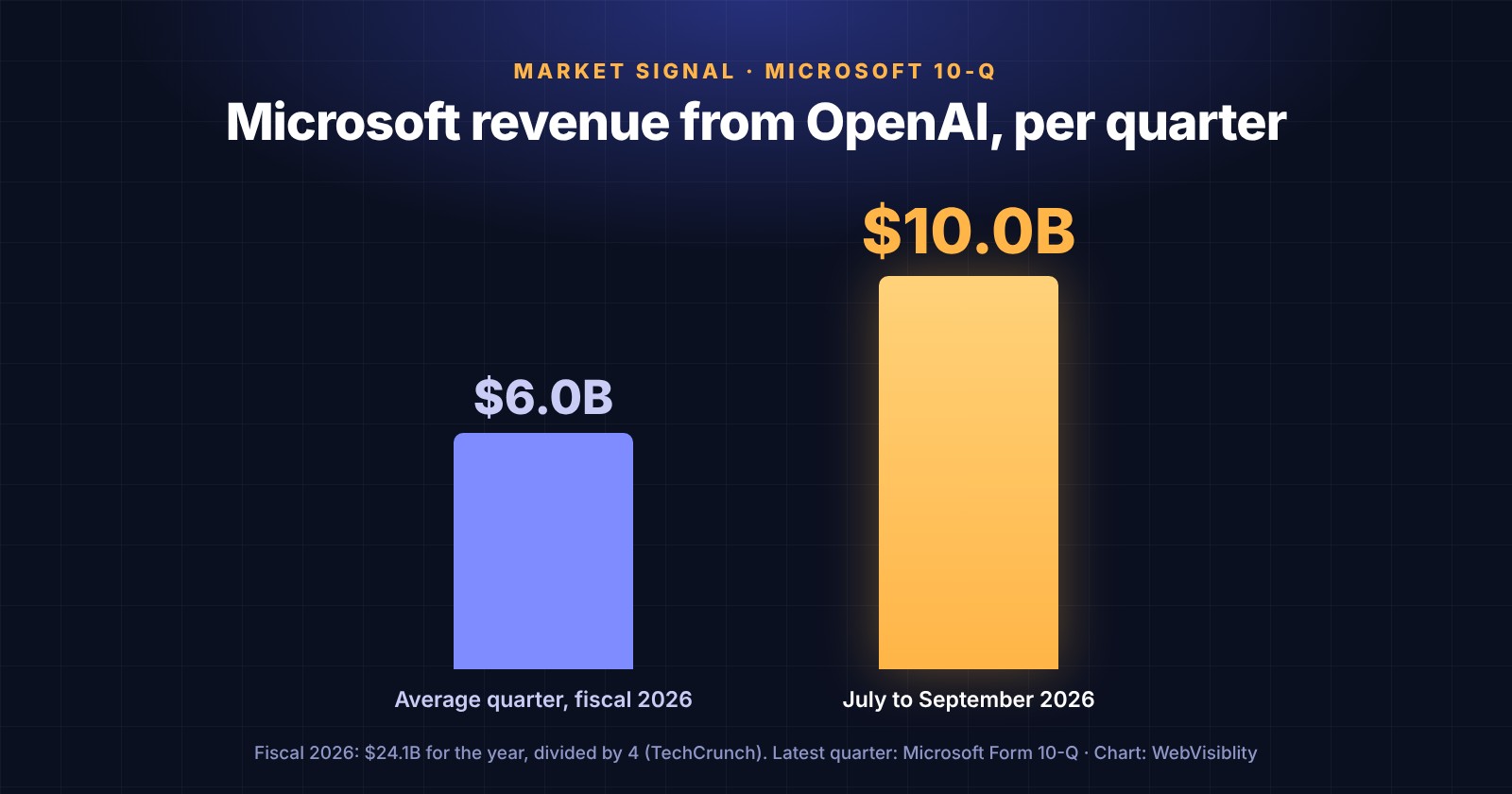
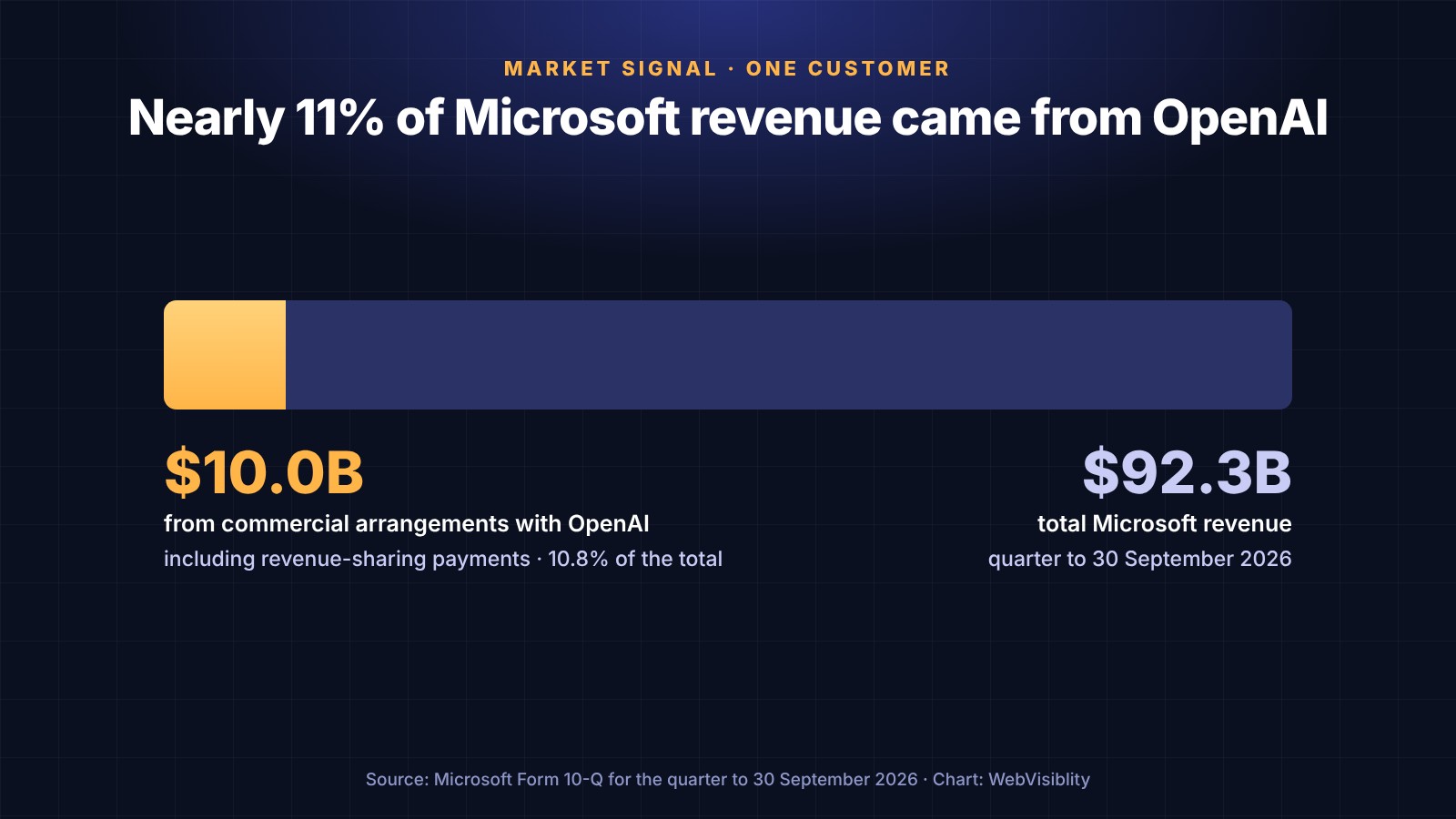
Microsoft reported $10.0 billion of revenue from its commercial arrangements with OpenAI, including revenue-sharing payments, for the three months to 30 September 2026 [1]. That is 10.8% of the $92.3 billion Microsoft earned in the quarter [1]. One customer, the company behind ChatGPT, now brings in nearly one dollar in every nine.
At a glance
| What | Revenue from commercial arrangements with OpenAI, including revenue-sharing payments [1] |
|---|---|
| Amount | $10.0 billion in the quarter to 30 September 2026 [1] |
| Share of Microsoft revenue | 10.8% of $92.3 billion [1] |
| Fiscal 2026, full year | $24.1 billion, as reported by TechCrunch from Microsoft's annual report [2] |
| Owed by OpenAI at quarter end | $7.2 billion, up from $6.0 billion on 30 June [1] |
| Microsoft's stake | About 24%, on an as-converted basis [1] |
| Where it was disclosed | Microsoft's Form 10-Q, filed with its results on 28 October 2026 [1][2] |
| Not disclosed | How much is revenue sharing and how much is Azure cloud services [2] |
The signal
- Microsoft booked $10.0 billion of revenue from OpenAI in one quarter, 10.8% of its $92.3 billion total [1].
- That is well above the quarterly average of the last fiscal year, when OpenAI brought in $24.1 billion over twelve months [1][2].
- The filing does not split the figure between OpenAI's revenue-sharing payments and its spending on Azure cloud services [2].
- OpenAI owed Microsoft $7.2 billion at the end of September, up from $6.0 billion in June [1].
- For B2B marketers, the money confirms that ChatGPT and Microsoft Copilot are now large, paid channels where buyers ask for vendor advice.
What happened
Microsoft reported results for the quarter to 30 September 2026, the first quarter of its 2027 fiscal year, on Wednesday, 28 October [1][3]. Revenue was $92.3 billion, up 19% on a year earlier [3]. Azure, its cloud business, grew 48% [3][4].
The number that drew the headlines sits in a note about investments in Microsoft's Form 10-Q, the quarterly report every listed U.S. company files with the SEC. Microsoft said it recorded $10.0 billion of revenue from commercial arrangements with OpenAI, inclusive of revenue-sharing payments [1]. Because Microsoft owns about 24% of OpenAI and accounts for the stake under the equity method, OpenAI counts as a related party, which is why the figure has to be disclosed [1].
TechCrunch, which first reported the figure, noted that Microsoft recorded $24.1 billion of revenue from OpenAI in the whole of fiscal 2026 [2]. At the latest quarter's pace, that would be about $40 billion a year [2]. The filing does not say how much of the $10.0 billion came from OpenAI's share of its own revenue and how much from OpenAI buying cloud computing on Azure, and TechCrunch said it had asked Microsoft for more detail [2].
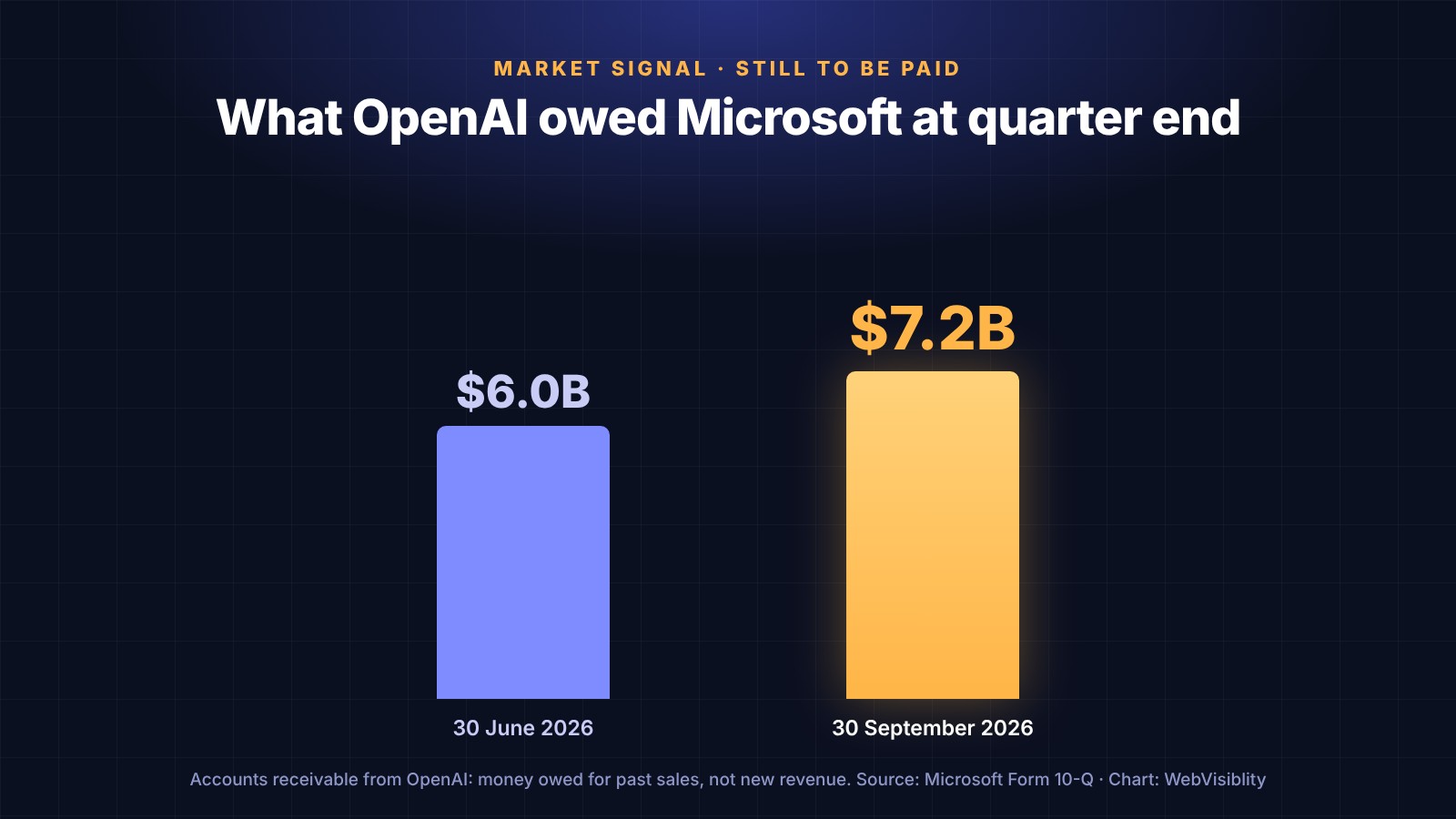
Two other lines in the filing round out the picture. OpenAI owed Microsoft $7.2 billion at the end of September, up from $6.0 billion at the end of June [1]. That is money due for past sales, not extra revenue. And Microsoft's interest in OpenAI is now about 24% [1], down from roughly 25% in June, according to TechCrunch, which said Microsoft did not explain the change [2].
By the numbers
Timeline
Microsoft and OpenAI restructure their partnership. Microsoft holds about 27% after the recapitalization, and OpenAI commits to buy an additional $250 billion of Azure services [2][6].
A new agreement makes Microsoft's license non-exclusive and keeps OpenAI's revenue-share payments to Microsoft running through 2030, subject to a cap [6][7].
Microsoft's fiscal 2026 ends with $24.1 billion of revenue from OpenAI for the year [2]. OpenAI owes $6.0 billion [1].
The quarter closes: $10.0 billion of revenue from OpenAI, $7.2 billion owed, about 24% ownership [1].
Microsoft reports quarterly results and publishes the figure in its Form 10-Q [1][3].
“Customer demand continues to exceed available supply.”
Who is affected
| Who | What changes | Impact |
|---|---|---|
| B2B marketers | ChatGPT and Copilot are large, growing places where buyers ask for vendor advice, so what they say about your company matters more each quarter [4][8]. | High |
| Companies on Microsoft 365 | Copilot daily users rose nearly 50% in a quarter [4]. Your own staff and your buyers' staff are using it for research. | Medium |
| Cloud customers | Microsoft says demand still exceeds supply [4], so large AI and cloud projects may face capacity limits. | Medium |
| Investors | One related party now supplies nearly 11% of revenue, and what it owes is rising [1]. | Medium |
Why it matters
ChatGPT is now a channel with a price tag. For three years, marketers have argued about whether AI assistants matter to how buyers choose vendors. A single customer paying Microsoft $10.0 billion in three months [1] settles one part of that argument: the companies behind these assistants are spending at a scale that only makes sense if people use them every day. In a 2026 Semrush survey of US B2B professionals who use AI at work, 71% had used ChatGPT for product research [8]. When a buyer asks ChatGPT which suppliers to shortlist, the answer works like a first page of results.
One partnership, two places where buyers ask. Microsoft earns from OpenAI's growth, and it also sells its own assistant, Copilot, inside Microsoft 365. On the earnings call, Satya Nadella said Copilot daily users were up nearly 50% on the previous quarter and more than five times on a year earlier [4]. For a B2B company, that means two assistants to check, not one: ChatGPT, which many buyers use on their own, and Copilot, which many of them now have at work.
The money is moving from links to answers. In the same quarter, Unite.AI reports that Microsoft's search and advertising revenue was $6.6 billion [5]. Microsoft now records more revenue from one AI partner than from the search ads business that used to send buyers to your website. That does not mean search is fading, and the two figures measure different things. It does show where the growth is.
What the figure does not tell you. The 10-Q does not split revenue sharing from cloud spending [2], so it cannot be used to work out OpenAI's own revenue. A revenue-share rate of 20% has been reported in the past, but neither company has confirmed it [2]. Treat any OpenAI revenue estimate built from this number as a guess.
How OpenAI's growth becomes Microsoft revenue
- 1People pay OpenAI
Companies and individuals pay for ChatGPT and for OpenAI's developer platform.
- 2Revenue share
OpenAI passes a share of its revenue to Microsoft, through 2030 and up to a cap [6][7].
- 3Azure computing
OpenAI buys cloud computing from Microsoft, including a commitment to $250 billion more of Azure services [2].
- 4Booked by Microsoft
Both count as revenue from commercial arrangements with OpenAI: $10.0 billion this quarter [1].
What to do now
For marketers
- Ask ChatGPT the questions your buyers ask, such as 'best [your category] for [your industry]', and note which companies it names.
- Ask Microsoft Copilot the same questions. Buyers inside Microsoft 365 companies may ask it first, and its answers can differ from ChatGPT's.
- Make sure your website says plainly what you do, for whom and where, so any AI assistant can match you to the question.
- Repeat the check every month. The assistants change their answers as they grow, and a one-off check goes out of date fast.
For software buyers and IT teams
- If your teams use Copilot or ChatGPT to research suppliers, agree on how AI shortlists are checked before a decision.
- Microsoft says AI demand still exceeds supply, so allow extra time when planning large AI or cloud projects.
Printable, one page, 11 checks. Enter your email and it opens right away.
We email you a copy. We never share your email and never send you sales emails.
Pick one. It takes 5 seconds and helps more people find these briefings. Your checklist opens straight after.
Have a work email? Use it instead and the checklist opens straight away.
Open it, then save it as a PDF or print it.
Know someone who would find this useful?
These steps are our recommendations based on this news, not statements from the companies involved.
What to watch
- The split. Whether Microsoft says how much of the $10.0 billion is revenue sharing and how much is Azure [2].
- The cap. OpenAI's revenue-share payments run through 2030 under a total cap [6], which Technology Magazine, citing The Information, put at $38 billion [7]. Once the cap is reached, that part of the income stops.
- What OpenAI owes. Receivables rose by $1.2 billion in a quarter [1]. A continued rise would be worth a closer look.
- Capacity. Amy Hood said demand still exceeds supply and expects capital spending of more than $50 billion next quarter [4].
- Copilot adoption. Microsoft did not update its Copilot seat count this quarter [4]. Daily users are the number to follow.
Questions readers ask
How much revenue did Microsoft make from OpenAI?
$10.0 billion in the quarter to 30 September 2026, from commercial arrangements with OpenAI including revenue-sharing payments [1]. That is 10.8% of Microsoft's $92.3 billion revenue for the quarter [1].
Where did the $10 billion figure come from?
From Microsoft's Form 10-Q for the first quarter of fiscal 2027, in a note on its investments. OpenAI is a related party because Microsoft owns about 24% of it, so the revenue must be disclosed [1].
Is the $10 billion OpenAI's revenue share or Azure spending?
Both are included, but the filing does not say how much of each [1][2]. TechCrunch said it asked Microsoft for a breakdown [2].
How much of OpenAI does Microsoft own?
About 24% on an as-converted basis at 30 September 2026 [1]. TechCrunch reported it was about 25% in June and roughly 27% after the October 2025 recapitalization [2].
How much does OpenAI owe Microsoft?
$7.2 billion at 30 September 2026, up from $6.0 billion at 30 June [1]. This is money due for past sales, not new revenue.
Does Microsoft still get a share of OpenAI's revenue?
Yes. Under the April 2026 agreement, OpenAI keeps paying Microsoft a share of its revenue through 2030, subject to a total cap [6]. The cap has been reported at $38 billion, but neither company has confirmed it [7].
What does this mean for B2B marketers?
It shows that AI assistants are now large, paid channels. 71% of US B2B professionals who use AI at work have used ChatGPT for product research [8], and Copilot daily users rose nearly 50% in a quarter [4]. Check what both assistants say when buyers ask for suppliers in your category.
Companies in this story
Sources
Researched, fact-checked and edited by the Market Signal desk. Read our editorial standards. Spotted an error? Email hello@webvisiblity.com and we will correct it.