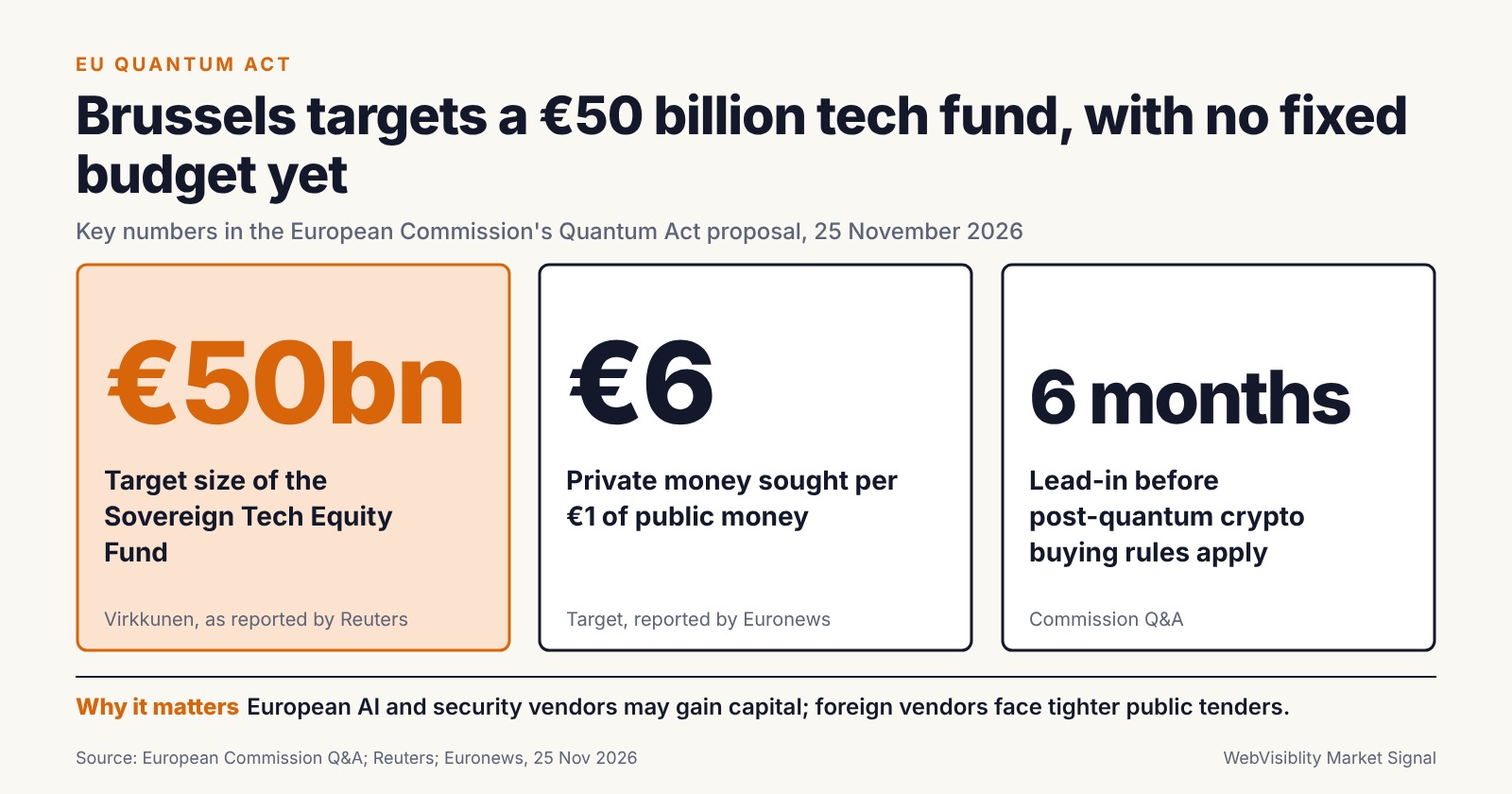
The European Commission on 25 November proposed a Quantum Act that would restrict eligible providers to Union-controlled entities and approved partners when public bodies buy quantum technology. The same law would let Brussels create a Sovereign Tech Equity Fund, whose targeted scale is €50 billion, to buy stakes in companies across quantum and the full AI stack.
At a glance
| Fund's targeted scale | €50 billion |
|---|---|
| Fixed budget in the proposal | None allocated |
| Private money sought | Up to €6 per €1 of public money |
| Quantum-safe buying rule starts | Six months after entry into force |
| Critical parts with no EU supplier | 9 of 47 |
| Next step | Parliament and Council review |
Do this today
Tick each step as you do it. Your ticks stay on this device. See the full list.
For marketers
For software buyers and IT teams
The signal
- Public quantum tenders would be open to Union-controlled entities and partners allowed under international agreements, not to everyone.
- Reuters reports that bidders from Horizon Europe partner countries and WTO procurement signatories could also take part.
- The Commission says this is not a blanket made-in-EU rule for every component.
- Some public administrations under NIS2 would have to buy post-quantum cryptography in new tenders.
- The equity fund would invest across AI, cybersecurity, biotech and chips as well as quantum.
- IBM told Euronews the law shouldn't rule out non-European companies from public tenders.
Which of these are you?
Tap the one that fits you best. We show what this story changes for you.
What happened
Henna Virkkunen, the Commission's executive vice-president for tech sovereignty, presented the draft in Strasbourg. The Commission calls it an enabling framework rather than a rulebook for quantum itself. It has three main pillars: research excellence, bringing quantum technology into use, and keeping systems and supplies secure.
Two parts change how technology is bought. First, when public bodies procure quantum technology, the Act would require security of supply, interoperability and lifecycle support, and would restrict eligible providers to companies controlled from inside the Union or allowed in under its international-cooperation rules. Reuters quotes the draft as saying it is necessary to restrict procurement for security reasons. Second, certain digital purchases by public administrations covered by the NIS2 cyber law would have to include post-quantum cryptography, encryption built to resist quantum attacks, for tenders started six months after the law takes effect. Where no suitable product exists, the buyer would need a documented migration plan. Existing systems do not have to be replaced.
The money side is less settled. The Commission's own Q&A says no fixed budget is allocated; the proposal only gives it the power to set up the Sovereign Tech Equity Fund with the European Investment Bank and member states. Virkkunen said €50 billion marked the targeted scale. Euronews reports the aim is to draw up to €6 of private money for every euro of public money, and to have the fund running by 2028 at the latest. The Financial Times first reported the plan, according to TNW.
By the numbers
How the Quantum Act becomes law
- 1Proposal
Commission presents the Quantum Act on 25 November 2026.
- 2Negotiation
Parliament and Council amend and agree the text.
- 3Entry into force
20 days after publication in the Official Journal.
- 4Crypto rule
Post-quantum buying applies to tenders started six months later.
- 5Fund
Aim to have it running by 2028 at the latest.
Timeline
Commission adopts the Quantum Europe Strategy, which promised a Quantum Act.
FT reports the fund plan; the Commission confirms it the same day.
Commission proposes the Quantum Act and the equity fund in Strasbourg.
Target for the fund to be operational by 2028, when the next EU long-term budget starts.
Goal for Europe to be a global leader in quantum.
“We want quantum technologies developed in Europe to be manufactured here and used here.”
Why it matters
The procurement clause is the part B2B sellers should read twice. In a public quantum tender, eligibility would depend on whether a supplier is Union-controlled or covered by a partner agreement. A US or Asian vendor with a strong European team may still need to show where control sits. Large US suppliers already see the risk: IBM and Cisco both told Euronews the law should keep international partners in play. Watch whether that wording survives negotiation, because buy-European rules in one critical technology tend to become templates for the next.
The post-quantum cryptography rule creates demand on a fixed clock. Public administrations under NIS2 would need quantum-safe products in tenders started six months after entry into force, or a written migration plan. Security vendors selling into Europe will be asked, by procurement teams and increasingly by AI search tools those teams use for first research, whether their products support post-quantum algorithms. If the answer is not stated plainly on your own pages, an AI assistant has nothing to cite, which is a direct AI visibility gap.
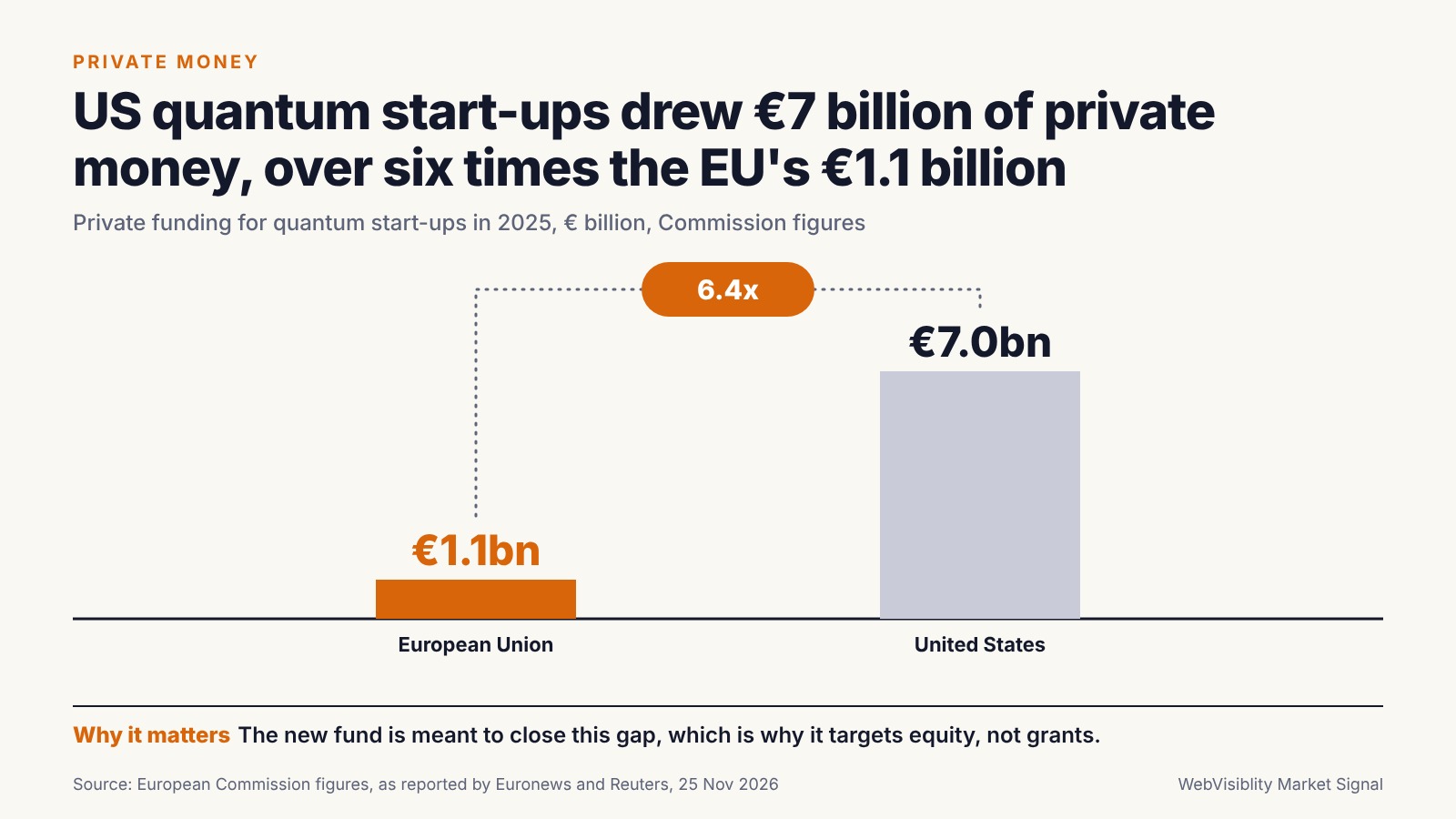
The fund matters for competitive sets. A vehicle aimed at the full AI stack with a €50 billion target would give more European AI and infrastructure companies the capital to scale, and more of them will appear on EU buyers' shortlists. Europe today draws only around 5% of global venture capital, according to the FT as cited by TNW, so the change will be gradual and depends on how much public money the member states actually commit.
Who is affected
Public tenders open only to Union-controlled entities or approved partners.
New demand for post-quantum cryptography in NIS2 tenders.
Possible equity from a fund targeting €50 billion.
EU buyers will ask who controls the company and where products are made.
What to do now
For marketers
- Add a plain statement of corporate control and EU presence to your public-sector pages.
- Publish a clear page on your post-quantum cryptography support and roadmap, with dates.
- Ask ChatGPT and Perplexity which vendors offer post-quantum encryption in Europe and note who gets named.
For software buyers and IT teams
- List which of your planned purchases could fall under NIS2 and the six-month crypto rule.
- Ask current security vendors for a written post-quantum migration plan.
- Check whether your quantum or security suppliers would qualify as Union-controlled.
Printable, one page, 11 checks. Enter your email and it opens right away.
We email you a copy. We never share your email and never send you sales emails.
Pick one. It takes 5 seconds and helps more people find these briefings. Your checklist opens straight after.
Have a work email? Use it instead and the checklist opens straight away.
Open it, then save it as a PDF or print it.
Know someone who would find this useful?
These steps are our recommendations based on this news, not statements from the companies involved.
What to watch
- The control test. How the final text defines a Union-controlled entity, and which partner countries qualify.
- Real money. Whether member states and the EIB commit cash, since the proposal sets no fixed budget.
- Industry asks. The quantum industry group QuIC wants €300 to €500 million of procurement within six months of entry into force.
- Supply gaps. Plans for the 9 of 47 critical components that have no EU supplier today.
Questions readers ask
What is the EU Quantum Act?
It is a draft EU law from 25 November 2026 to turn quantum research into products, secure supply chains and prepare for post-quantum cryptography. Parliament and Council must still agree it.
How big is the EU Sovereign Tech Equity Fund?
Its targeted scale is €50 billion, according to Henna Virkkunen. The proposal itself allocates no fixed budget, so the final amount depends on later funding decisions.
Can non-EU companies bid for EU quantum contracts?
Only in some cases. Eligible providers would be Union-controlled entities plus firms allowed under international agreements, which Reuters says include Horizon Europe partners and WTO procurement signatories.
Does the Quantum Act require post-quantum cryptography?
Yes, for certain public administrations under NIS2, in tenders started six months after the law takes effect. Existing systems do not have to be replaced.
What technologies will the Sovereign Tech Equity Fund invest in?
Quantum plus other critical technologies, including AI, cybersecurity, biotech and chips. The Commission says it could invest across the full AI stack.
When will the EU Quantum Act take effect?
Not yet. The Parliament and the Council must review it first. Once adopted, it would enter into force 20 days after publication in the EU's Official Journal.
How much does Europe spend on quantum compared with the US?
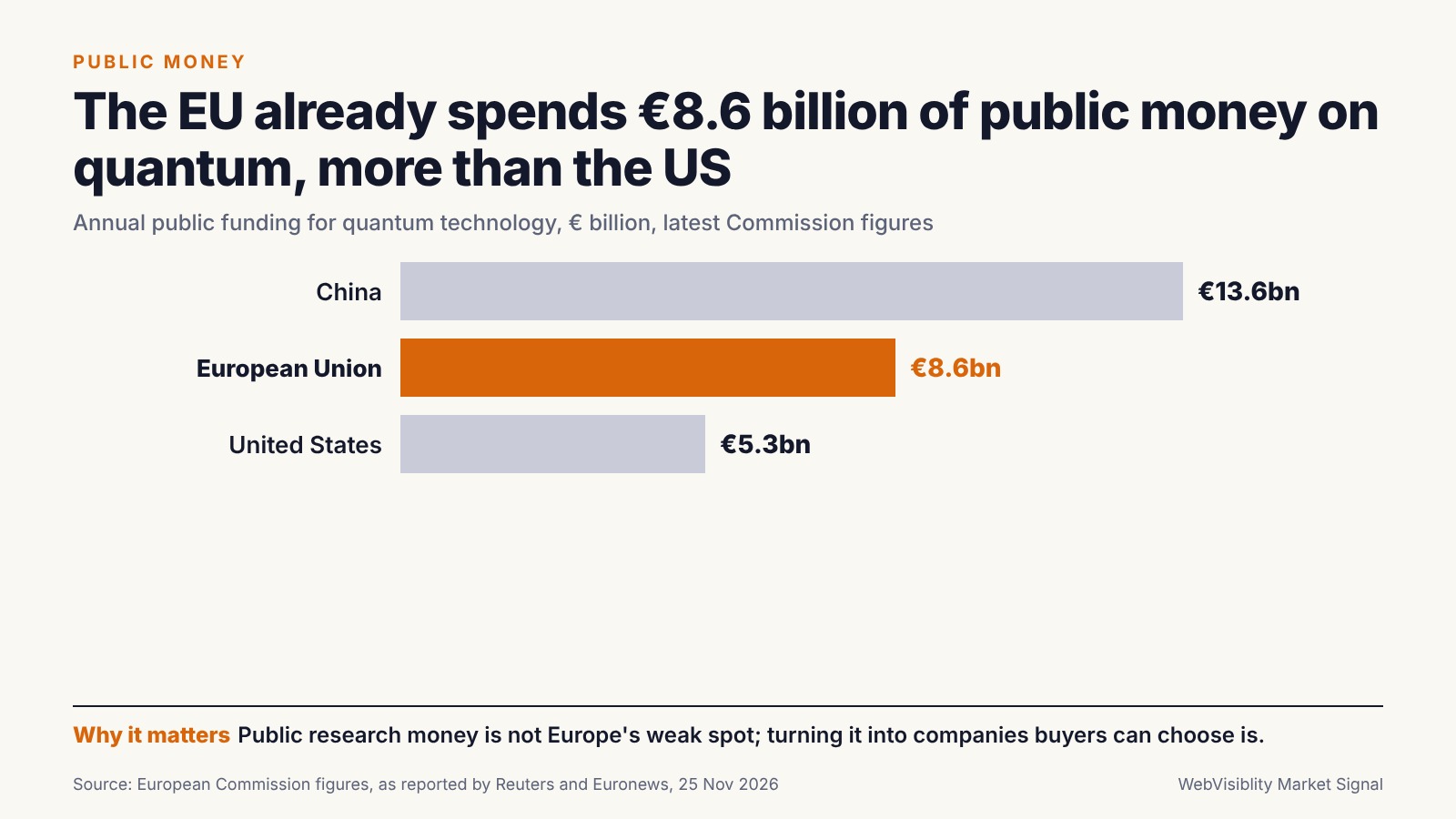
Commission figures reported by Reuters put EU public quantum funding at €8.6 billion against €5.3 billion in the US, but private start-up funding at €1.1 billion against €7 billion.
Companies in this story
Sources
- European CommissionOriginal
- European CommissionOriginal
- Reuters
- Euronews
- TNW
- European CommissionOriginal
Researched, fact-checked and edited by the Market Signal desk. Read our editorial standards. Spotted an error? Email hello@webvisiblity.com and we will correct it.