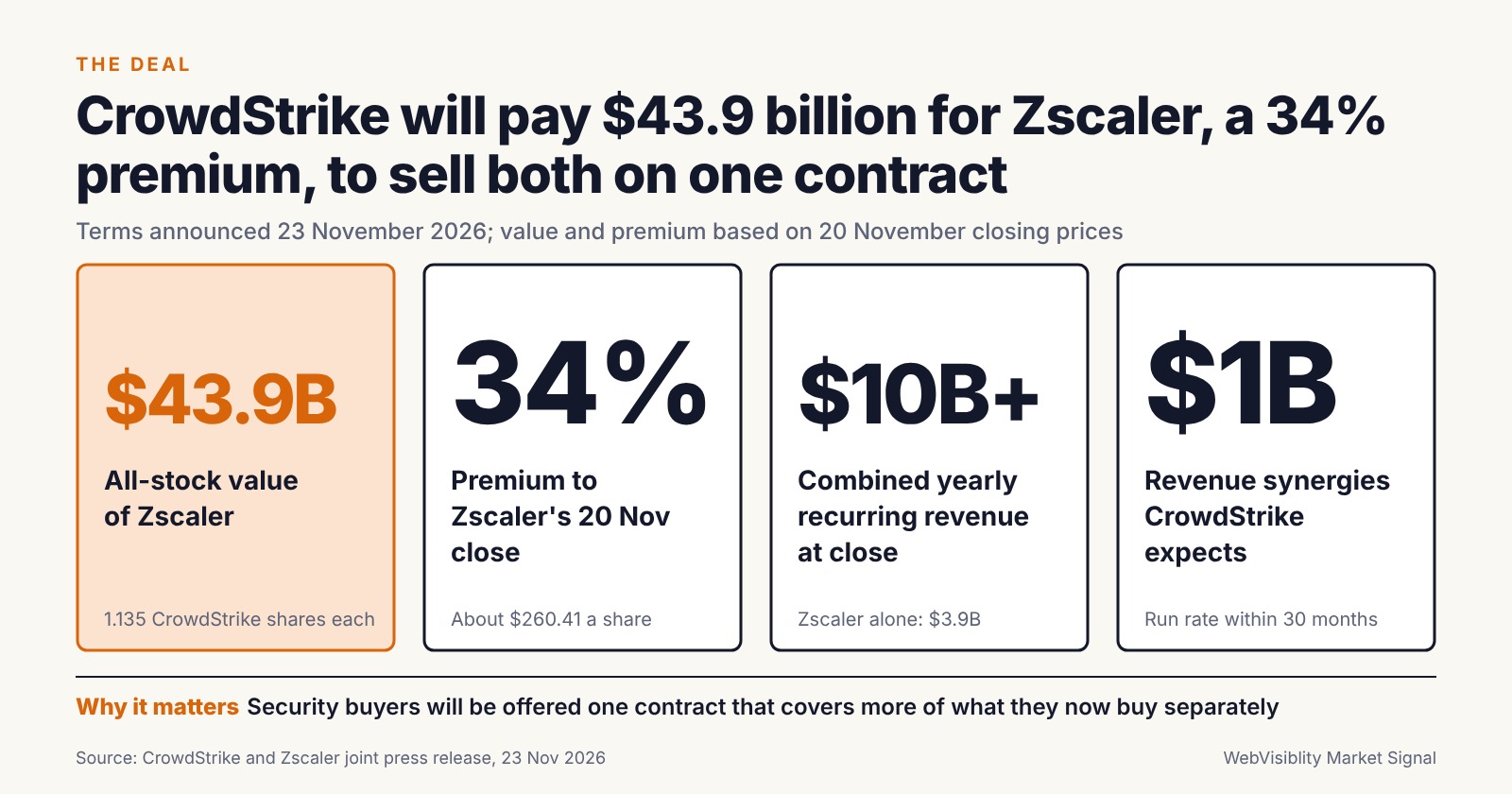
CrowdStrike has agreed to buy Zscaler in an all-stock deal that values it at about $43.9 billion, and plans to sell both companies' products on a single Falcon Flex contract. Palo Alto Networks chief executive Nikesh Arora replied two days later that the pair are trying to cover 70% of what his company already does, and called that a validation of his own strategy.
At a glance
| Announced | 23 November 2026, with quarterly results |
|---|---|
| Deal value | About $43.9 billion, paid in shares |
| Price per Zscaler share | About $260.41, a 34% premium |
| Combined revenue base | More than $10 billion of yearly recurring revenue |
| Expected close | Second half of fiscal 2028, CrowdStrike's year |
| Still needed | Zscaler shareholder and regulatory approval |
Do this today
Tick each step as you do it. Your ticks stay on this device. See the full list.
For marketers
For software buyers and IT teams
The signal
- Zscaler holders get 1.135 CrowdStrike shares for each share, and end up with about 15.9% of the company.
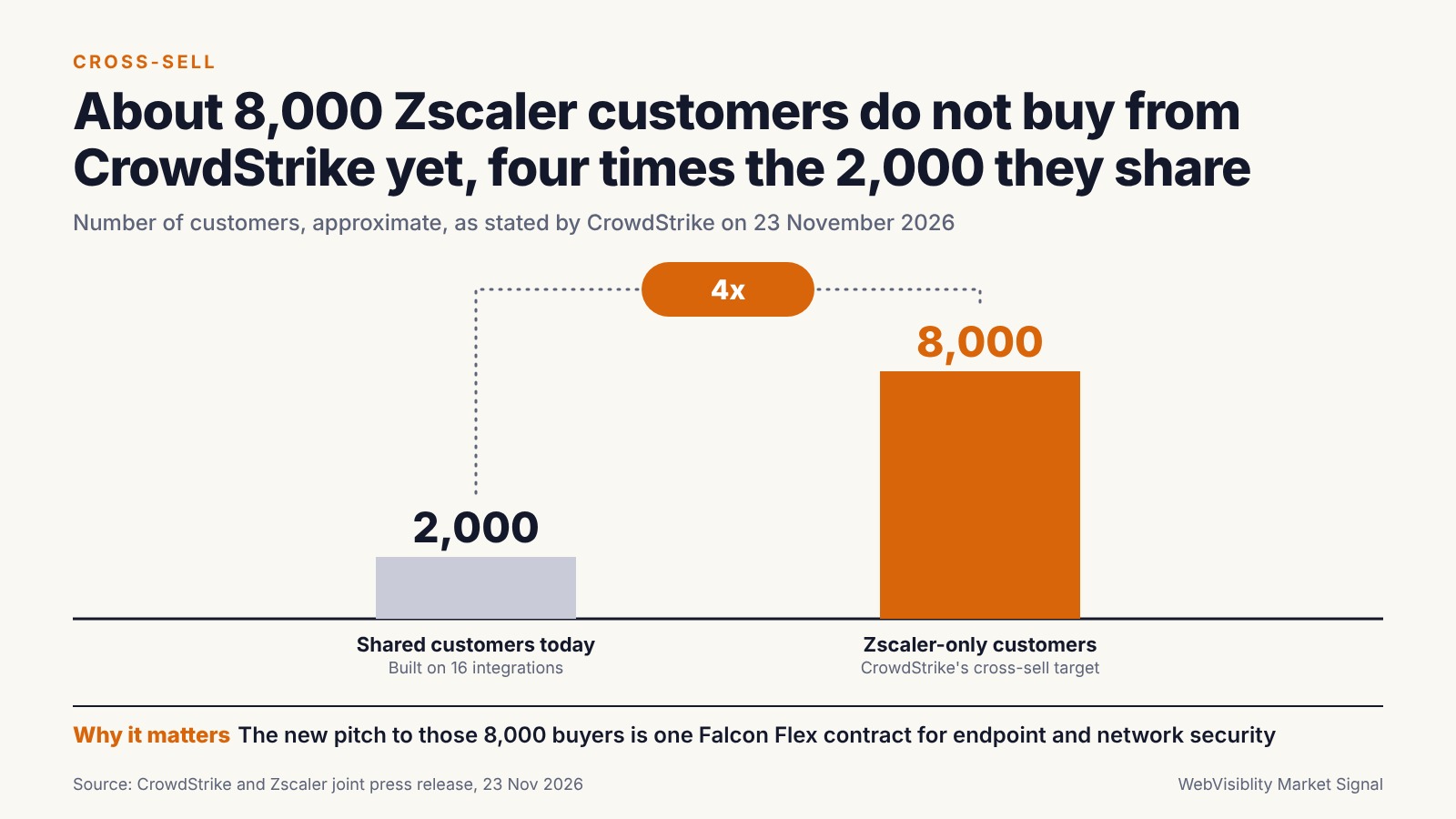
- About 8,000 Zscaler customers do not use CrowdStrike yet, a group CrowdStrike now plans to cross-sell to.
- After closing, buyers can add either company's tools on a single Falcon Flex contract.
- Palo Alto's Arora says he has bought 40 companies in eight years to build the same kind of platform.
- B. Riley, Daiwa and Macquarie cut Zscaler to Neutral within two days, since its price now tracks CrowdStrike's.
- Forrester's Madelein van der Hout says the network was the biggest gap left in CrowdStrike's platform.
Which of these are you?
Tap the one that fits you best. We show what this story changes for you.
What happened
On 23 November 2026 CrowdStrike and Zscaler announced a definitive agreement for CrowdStrike to buy Zscaler. Zscaler shareholders will receive 1.135 CrowdStrike shares for each Zscaler share, which valued Zscaler at an enterprise value of about $43.9 billion using CrowdStrike's closing price on 20 November. That works out at roughly $260.41 a share, a premium of about 34% to where Zscaler closed that day. Both boards approved the deal, and founder Jay Chaudhry, whose holdings make up about 34% of Zscaler's shares, has agreed to vote for it.
The two companies do different jobs. CrowdStrike protects devices, cloud workloads and logins through its Falcon platform. Zscaler sits between users, AI agents and the applications they reach, checking each connection under a zero trust model. They have worked together since 2019, and today share about 2,000 customers across 16 product integrations. CrowdStrike chief executive George Kurtz framed the purchase around AI: the network now connects agents to data, and CrowdStrike wants one control plane to govern them.
The commercial promise matters as much as the technology. CrowdStrike says Zscaler's products will move onto Falcon Flex, its existing contract model, so customers can commit once and expand across both product lines. Zscaler will also be sold through CrowdStrike's integrators, resellers and cloud marketplaces. CrowdStrike expects about $1 billion of yearly revenue synergies within 30 months of closing and $500 million of cost savings within 18 to 24 months, mostly from data centers, vendors and operations.
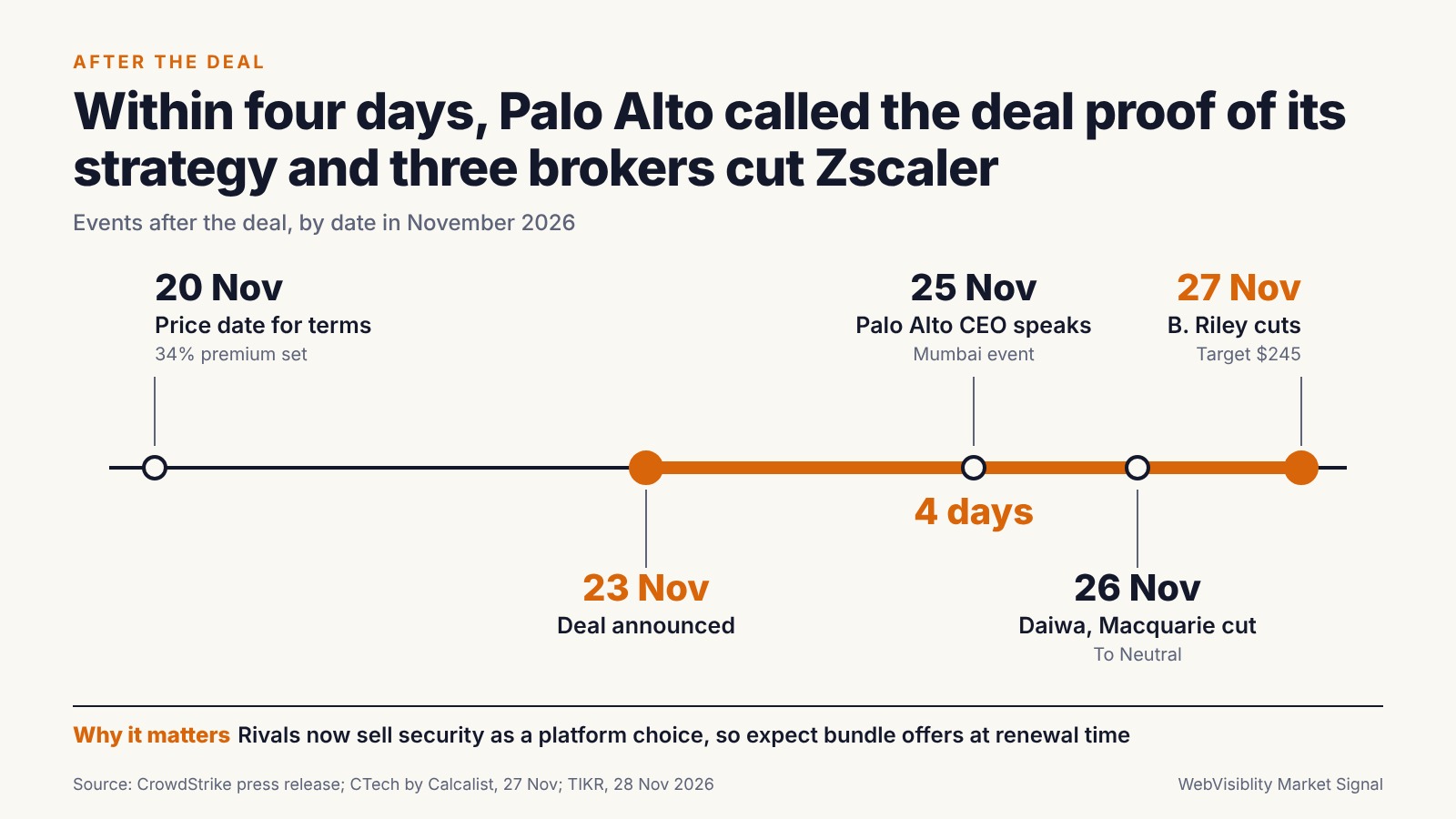
Reaction came quickly. Speaking at an event in Mumbai on Wednesday 25 November, Palo Alto Networks chief executive Nikesh Arora said the deal shows the market moving toward integrated platforms, the approach Palo Alto calls platformization. TD Cowen analyst Shaul Eyal told Cybersecurity Dive the combined company will compete more effectively against Palo Alto. On the stock side, B. Riley cut Zscaler to Neutral on 27 November, a day after Daiwa and Macquarie did the same, because a pending all-stock deal ties Zscaler's price to CrowdStrike's.
Nothing changes for customers yet. The deal still needs Zscaler shareholder and regulatory approval, and the companies say they will operate independently until it closes. TIKR puts the expected window at August 2027 to January 2028.
By the numbers
How to handle a security vendor merger at renewal
- Step 1Map your overlap
List every CrowdStrike, Zscaler and Palo Alto product you run, with renewal dates.
- Step 2Ask about the bundle
Ask your account team how Falcon Flex pricing would treat both product lines after closing.
- Step 3Protect your terms
Seek renewal terms that hold if the deal is delayed or blocked, since approvals are still pending.
- Step 4Price the alternative
Get a competing platform quote; Palo Alto has offered steep incentives to switch before.
- Step 5Check the roadmap
Ask which integrations change after closing, given the 16 existing integrations.
Timeline
CrowdStrike's closing price sets the $43.9 billion value used in the terms.
The companies announce the all-stock agreement alongside quarterly results.
Palo Alto's Nikesh Arora calls the deal a validation of our strategy in Mumbai.
B. Riley becomes the third firm in two days to cut Zscaler to Neutral.
“Our thesis all day was that our customers don't want to buy solutions from multiple providers.”
Who is affected
| Who | What changes | Impact |
|---|---|---|
| Security and IT buyers | Expect platform bundles on one contract at renewal, and weigh fewer vendors against more dependence on one. | High |
| Point-solution security vendors | Buyers will ask why they need a separate tool, as platforms close the biggest gap left. | High |
| B2B software marketers | Category lines are moving, so check how AI assistants describe your company against integrated platforms. | Medium |
Why it matters
Security is the clearest test yet of a question every B2B software category now faces: do buyers want the best tool for each job, or one supplier for most of them? The two largest pure security vendors are now betting heavily on the second answer. Palo Alto says it has spent about $45 to $50 billion on acquisitions to get there, and CrowdStrike is spending close to that again in one move. When Arora says customers would like somebody to integrate capabilities across multiple strands of cybersecurity, he is describing the pitch his sellers will make at every renewal.
For buyers, the practical change is the contract, not the product. CrowdStrike's promise that customers can commit once and expand means pricing will reward putting more of the security budget with one vendor. That can cut admin work and integration cost. It also concentrates risk, and the companies themselves list integrating their businesses among the things that could go wrong. Anyone renewing either product before the deal closes should ask what the bundle price looks like, and what happens to their terms if the merger is delayed or blocked.
Smaller security and network vendors face a harder sales conversation. Forrester's van der Hout told Cybersecurity Dive that consolidation only works while there is something left to consolidate, which describes many of them. Their buyers will now be asked why they need a separate tool at all. Vendors in that position need a short, specific answer about what they do that a platform does not, published where buyers look. More of that first look now happens in AI search: a buyer asking ChatGPT or Perplexity for SASE or endpoint options will get an answer shaped by how each company is described across the web. Firms whose category is being absorbed should check their AI visibility for the questions buyers ask, not only their Google rankings.
What to do now
For marketers
- Rewrite your product page's first paragraph to say plainly what you do that a security platform bundle does not.
- Ask ChatGPT, Perplexity and Google's AI Mode for the top vendors in your category and note whether you are named.
- Add a short comparison page for buyers weighing your tool against an all-in-one platform, with facts they can check.
For software buyers and IT teams
- List every CrowdStrike, Zscaler and Palo Alto product you run, with contract end dates.
- Ask both vendors in writing how pricing and support terms change if the merger closes, is delayed or is blocked.
- Get one competing platform quote before any renewal that falls before closing.
Printable, one page, 11 checks. Enter your email and it opens right away.
We email you a copy. We never share your email and never send you sales emails.
Pick one. It takes 5 seconds and helps more people find these briefings. Your checklist opens straight after.
Have a work email? Use it instead and the checklist opens straight away.
Open it, then save it as a PDF or print it.
Know someone who would find this useful?
These steps are our recommendations based on this news, not statements from the companies involved.
What to watch
- The S-4 filing. CrowdStrike will file a registration statement on Form S-4 with the full merger terms and the background to the talks.
- Regulators. The deal needs regulatory approvals; any second request from US or EU authorities would push the timetable out.
- Bundle offers. Whether Palo Alto answers with new incentives, after it previously offered steep incentives to win customers from rivals.
- The deal spread. TIKR says a widening gap between Zscaler's price and the offer would signal doubt about the deal.
Questions readers ask
How much is CrowdStrike paying for Zscaler?
The all-stock deal values Zscaler at about $43.9 billion, or roughly $260.41 a share based on CrowdStrike's 20 November closing price, a premium of about 34%.
When will the CrowdStrike Zscaler deal close?
CrowdStrike expects it to close in the second half of its fiscal 2028, which TIKR puts at August 2027 to January 2028, subject to approvals.
What happens to existing Zscaler customers?
Nothing changes until closing, as both companies operate independently until then. Afterwards, Zscaler products are planned to join CrowdStrike's Falcon Flex contract.
What did Palo Alto Networks say about the CrowdStrike Zscaler deal?
CEO Nikesh Arora said the pair are trying to cover 70% of what Palo Alto does and called the deal a validation of its platform strategy.
What is platformization in cybersecurity?
It is selling many security tools from one vendor on shared data and one contract. CTech describes it as a move away from specialized security vendors toward a few integrated platforms.
Why did analysts downgrade Zscaler after the deal?
Because each Zscaler share will become 1.135 CrowdStrike shares, its price now moves with CrowdStrike's, leaving little upside of its own while the deal is pending.
Companies in this story
Sources
Researched, fact-checked and edited by the Market Signal desk. Read our editorial standards. Spotted an error? Email hello@webvisiblity.com and we will correct it.