Canada has turned a cloud provider's ownership into a line on the customer's invoice. On 26 November the federal government added C$700 million to the AI Compute Access Fund, lifting it to C$1 billion, and rewrote how much it repays. Small and medium-sized companies now get back up to 80% of eligible costs when they rent AI compute from a sovereign provider, and up to 50% from other providers with infrastructure in Canada. A multinational's Canadian entity sits in the lower 50% group even when its data never leaves the country.
At a glance
| New money | C$700 million top-up, fund now C$1 billion |
|---|---|
| Sovereign provider rate | Up to 80% of eligible costs |
| Canadian-based provider rate | Up to 50% of eligible costs |
| Project size | C$100,000 to C$5 million in compute costs |
| Who can apply | Firms with less than 500 full-time equivalent staff |
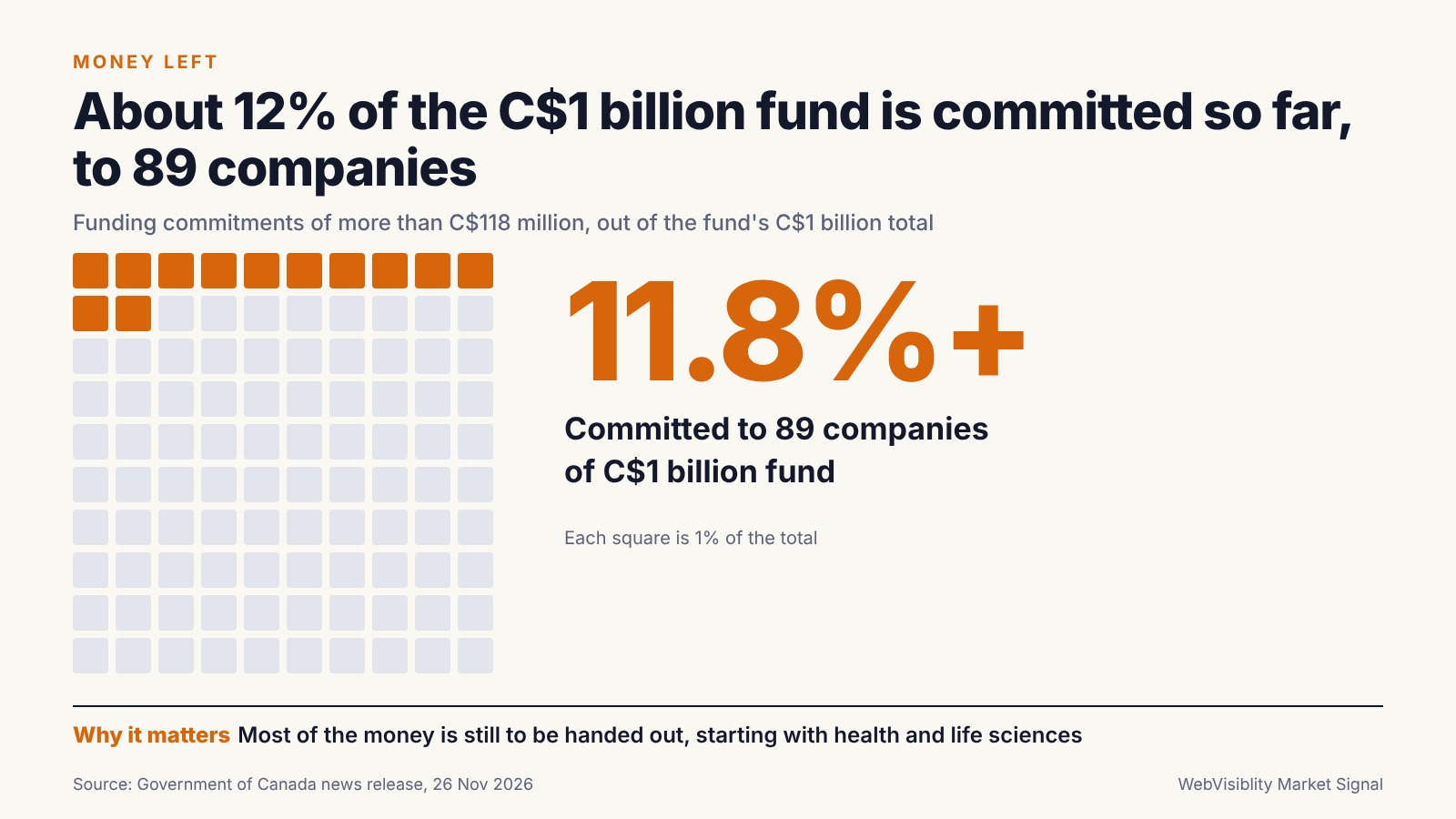
| Committed so far | More than C$118 million for 89 companies |
Do this today
Tick each step as you do it. Your ticks stay on this device. See the full list.
For marketers
For software buyers and IT teams
The signal
- A sovereign provider must be Canadian-owned, with governance and decision-making in Canada, plus Canadian infrastructure, data storage and incorporation.
- Multinationals with Canadian entities whose infrastructure and data stay in Canada are treated as Canadian-based providers, so their customers get the lower rate.
- Recipients must use Canadian compute service providers, under the program guide.
- Moving data to a sovereign compute provider is an eligible cost; moving it to any other provider is not.
- The first call is for health and life sciences, with a statement of interest due by 17 December 2026.
- Minister Evan Solomon said the first phase drew 1,500 asks against an expected couple of hundred, according to BetaKit.
Which of these are you?
Tap the one that fits you best. We show what this story changes for you.
What happened
Evan Solomon, Canada's Minister of Artificial Intelligence and Digital Innovation, announced the fund's next phase in Toronto. The C$700 million comes from the national AI strategy, AI for All, and sits on top of the initial $300 million investment made under the 2024 sovereign compute strategy. The government says the phase brings key changes to the program: priority for sovereign compute, wider eligibility and new cost-sharing levels.
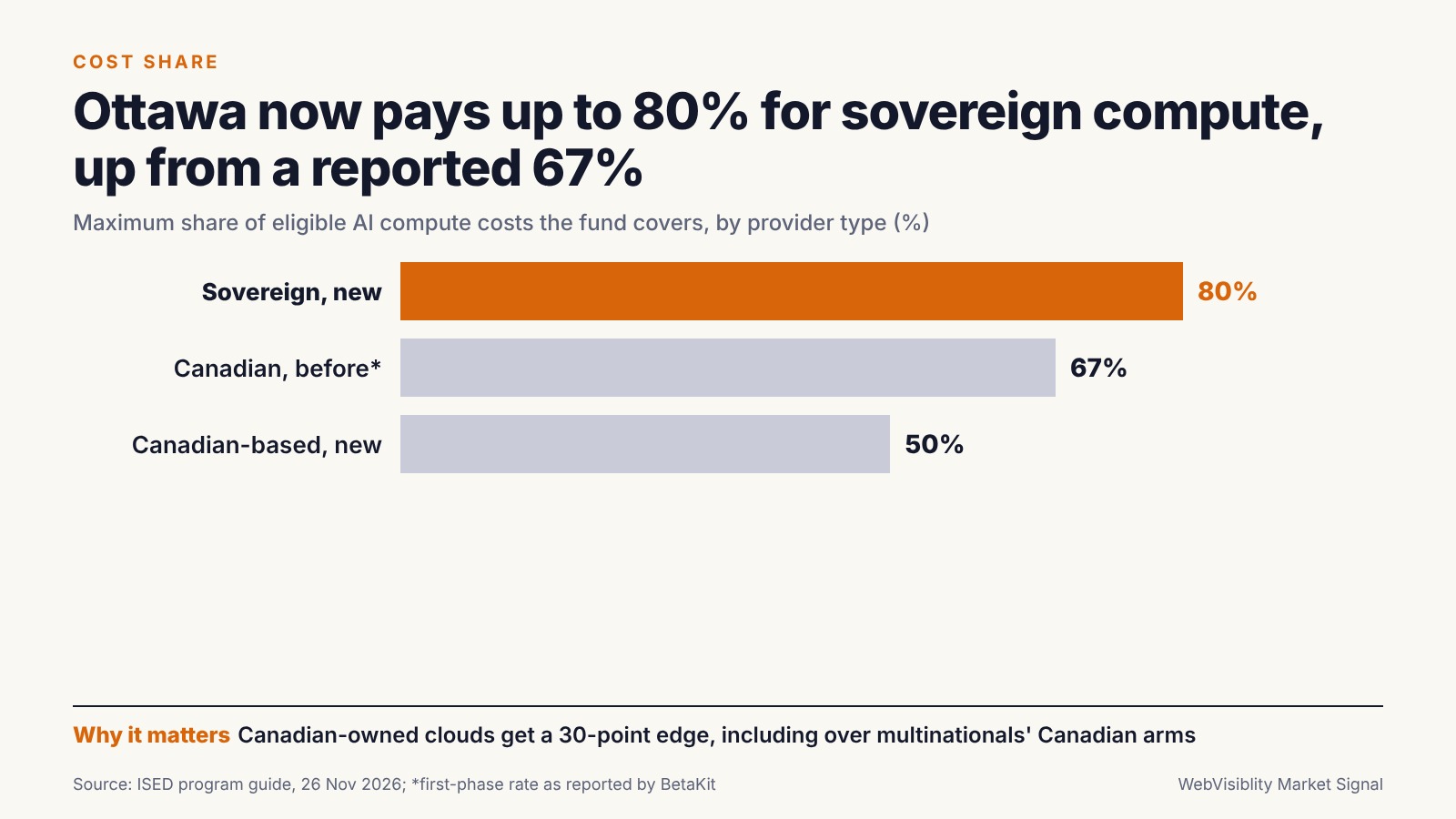
The program guide, updated the same day, spells out the split. Contributions cover up to 80% of the eligible costs from sovereign AI compute providers and up to 50% from Canadian-based ones, and a company may mix the two. Eligible spending includes core compute, storage, AI processing, monitoring and security, for training, inference or fine-tuning. Projects must end no later than March 31, 2030. Applicants must be generating revenue or show investor interest, and need compute contracts, invoices or similar documents in place or in progress when they apply.
BetaKit reports that the first phase covered 67 cents on the dollar for Canadian compute providers; the government pages read for this briefing do not state the old rate. The minister also named 45 new recipients sharing more than $52 million, among them Solink, myStoria and Ultimarii, according to BetaKit's list of recipients. The Next Web notes the fund now stands at C$1B, up from C$300M, and Crypto Briefing reports that the top-up more than triples it. The government has not published a list of providers that qualify as sovereign on the pages reviewed.
By the numbers
How a company claims the higher rate
- Step 1Check size
Fewer than 500 full-time equivalent staff, building AI products.
- Step 2Pick provider
Choose a sovereign provider for up to 80%, or Canadian-based for 50%.
- Step 3Sign compute
Have contracts or invoices in place or in progress.
- Step 4Declare interest
Send a statement of interest by 17 December.
- Step 5Apply
If invited, file by January 4, 2027.
Timeline
Fund announced with up to $300 million in the sovereign compute strategy.
Ottawa announces support for 44 Canadian companies.
C$700 million top-up, new 80% and 50% rates, 45 more recipients.
Deadline for statements of interest in the health call.
Full applications due for the health and life sciences call.
“Canadian ideas need Canadian computing power.”
Why it matters
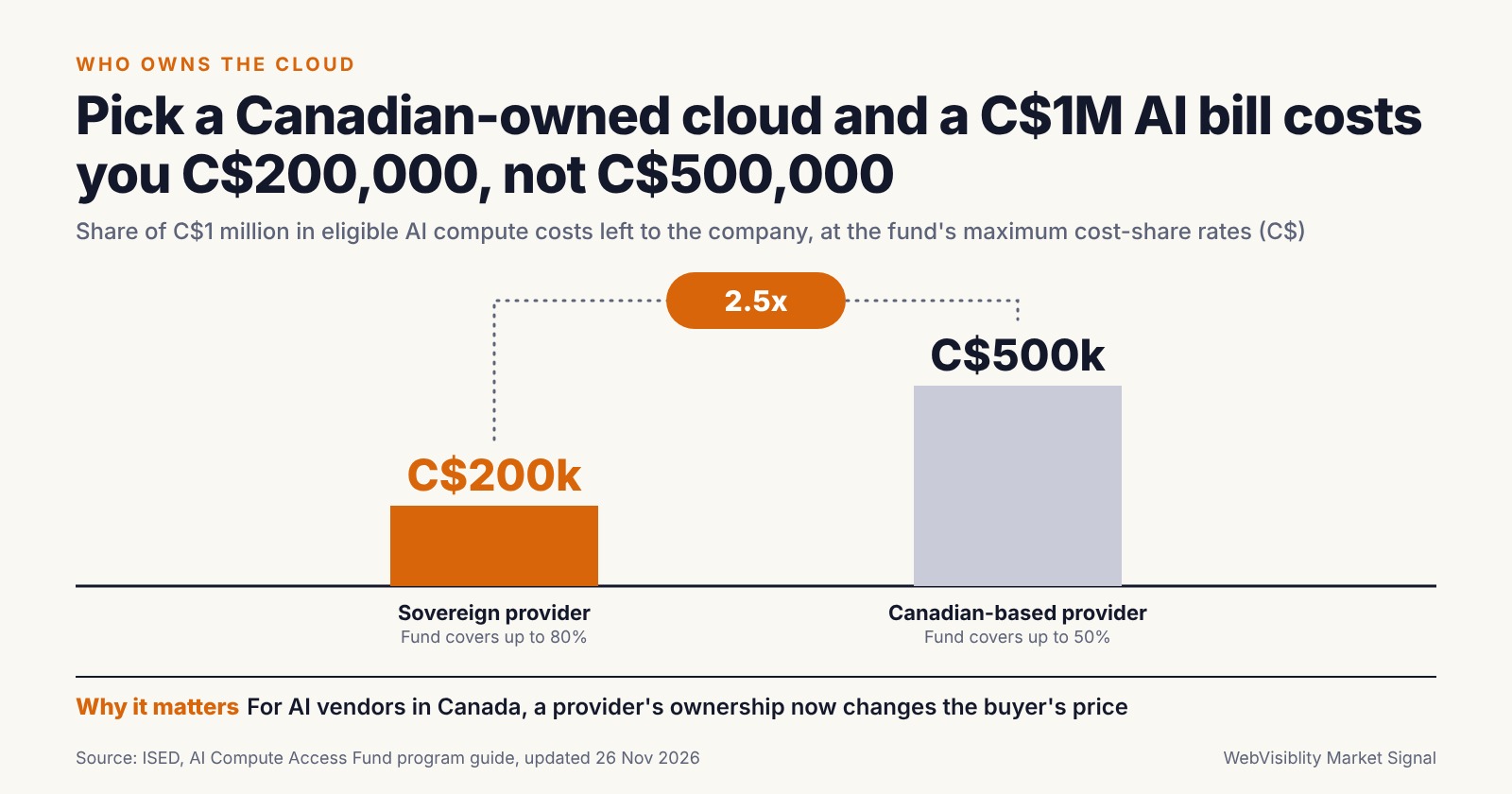
Ownership is now a price input. For a Canadian AI company with C$1 million in eligible compute, the maximum rates leave C$200,000 to pay at a sovereign provider and C$500,000 at a Canadian-based one, a gap that a hyperscaler's Canadian region cannot close by keeping data at home. Cloud, GPU and AI platform vendors selling into Canada should expect procurement to ask about ownership and governance, not only data location, and should answer in writing before the question is asked.
That answer also needs to be findable. Founders preparing a statement of interest will search for which providers count as sovereign, and many will put that question to ChatGPT, Perplexity or Google's AI search. With no official provider list in the pages reviewed, AI answers will lean on what providers publish about themselves. A provider that states its incorporation, Canadian ownership, data location and governance on one clear page, backed by Organization schema markup, gives AI visibility tools and buyers the same facts to quote.
The health call creates a short buying window. Applicants need contracts, invoices, or other documentation for compute in place or in progress at the time of application, and statements of interest close on December 17, 2026. Vendors with customers in health and life sciences AI have a few weeks in which a signed compute agreement helps the buyer qualify.
Who is affected
| Who | What changes | Impact |
|---|---|---|
| Canadian-owned cloud and GPU providers | Customers can get up to 80% back, a clear sales argument. | High |
| Hyperscalers selling in Canada | Canadian regions earn the 50% rate, not the top one. | Medium |
| Vendors to health and life sciences AI firms | Buyers need compute contracts before applying in December. | Medium |
What to do now
For marketers
- If you sell compute or AI platforms in Canada, publish one page stating incorporation, ownership, data location and governance against the five sovereign tests.
- Ask ChatGPT, Perplexity and Google which Canadian cloud providers are sovereign, and record whether your company is named and described correctly.
- Give sales a short note on which fund rate your customers qualify for, with the program guide link.
For software buyers and IT teams
- Get written confirmation from each compute provider of which category it falls into before you apply.
- Price your project at both rates, since a mix of providers is allowed.
- Check that data migration costs count only when moving to a sovereign provider.
Printable, one page, 10 checks. Enter your email and it opens right away.
We email you a copy. We never share your email and never send you sales emails.
Pick one. It takes 5 seconds and helps more people find these briefings. Your checklist opens straight after.
Have a work email? Use it instead and the checklist opens straight away.
Open it, then save it as a PDF or print it.
Know someone who would find this useful?
These steps are our recommendations based on this news, not statements from the companies involved.
What to watch
- Which providers qualify. Whether ISED publishes a list of sovereign compute providers or leaves applicants to document it, as the program guide currently asks.
- The next sector calls. The government says the fund will run targeted calls in priority sectors; only health has been named.
- Hyperscaler responses. Whether multinationals restructure Canadian units to meet the Canadian-owned test.
- The 500 megawatts. Budget 2026 promised to bring 500 megawatts of sovereign AI compute online, which would add sovereign supply.
- How fast money moves. Commitments stand at more than $118 million out of C$1 billion.
Questions readers ask
What is Canada's AI Compute Access Fund?
It is a federal program that repays part of the cloud AI compute costs of Canadian small and medium-sized firms. After a C$700 million top-up on 26 November 2026, it totals C$1 billion.
How much does the AI Compute Access Fund cover?
Up to 80% of eligible costs from a sovereign, Canadian-owned provider, and up to 50% from other providers with Canadian infrastructure. Projects can include C$100,000 to C$5 million in compute costs.
What counts as a sovereign compute provider in Canada?
One that runs infrastructure in Canada, stores and processes data there, is incorporated in Canada, is Canadian-owned, and keeps governance and decision-making authority in Canada.
Do AWS, Microsoft Azure or Google Cloud qualify for the 80% rate?
The guide does not name companies. It says multinationals with Canadian entities that keep infrastructure and data in Canada are treated as Canadian-based providers, which carry the 50% rate.
Who can apply to the AI Compute Access Fund?
Canadian-registered firms and not-for-profits with less than 500 full-time equivalent employees, developing AI products, with Canadian R&D teams and either revenue or proof of investor interest.
When is the AI Compute Access Fund deadline?
For the health and life sciences call, statements of interest are due December 17, 2026 at 11:59 p.m. ET, and invited full applications by January 4, 2027.
Why does this matter to B2B marketers outside Canada?
It shows governments pricing AI infrastructure by who owns it. Vendors selling into public programs should publish clear ownership and data facts so buyers and AI assistants can confirm eligibility quickly.
Companies in this story
Sources
Researched, fact-checked and edited by the Market Signal desk. Read our editorial standards. Spotted an error? Email hello@webvisiblity.com and we will correct it.