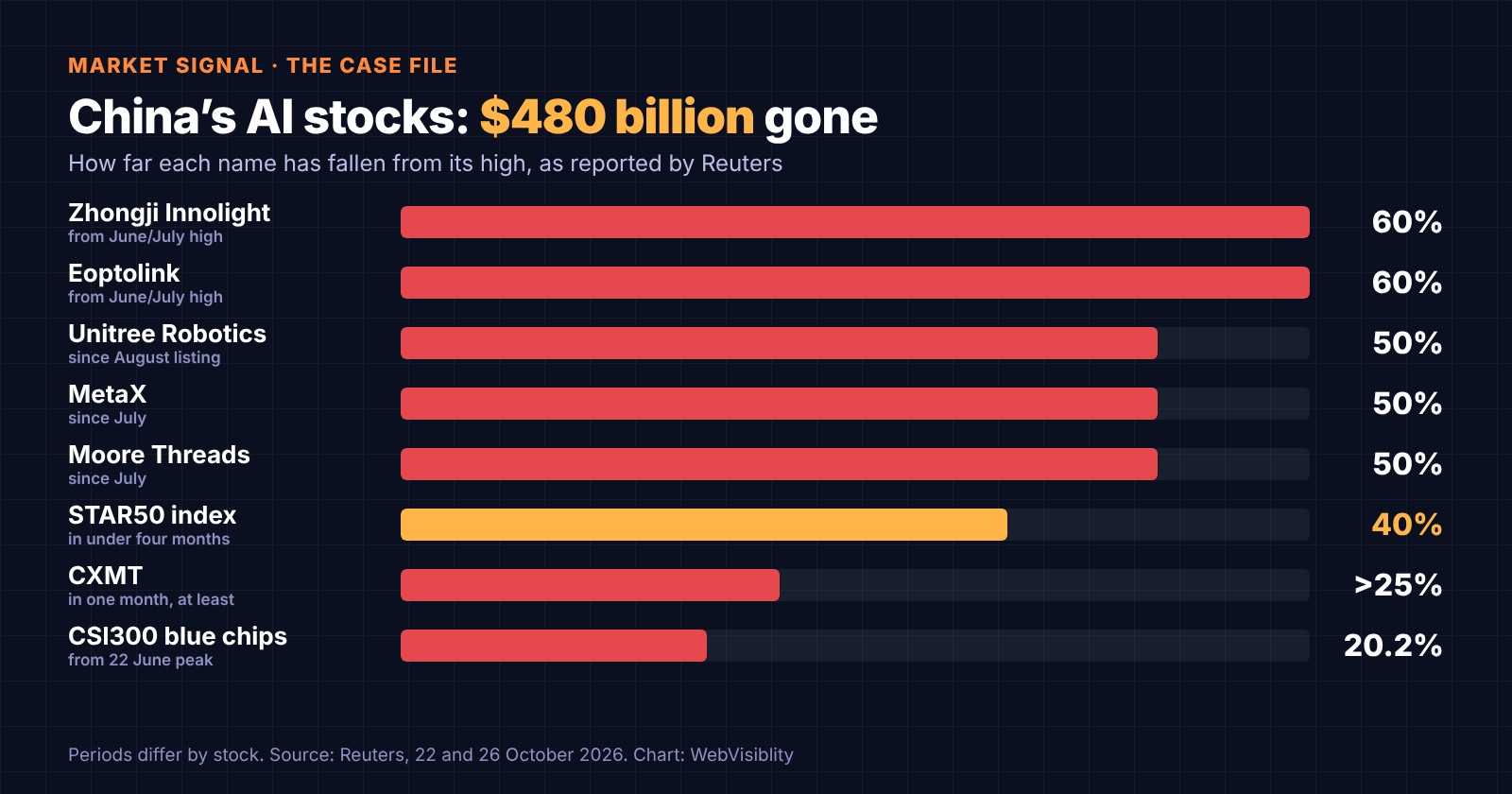
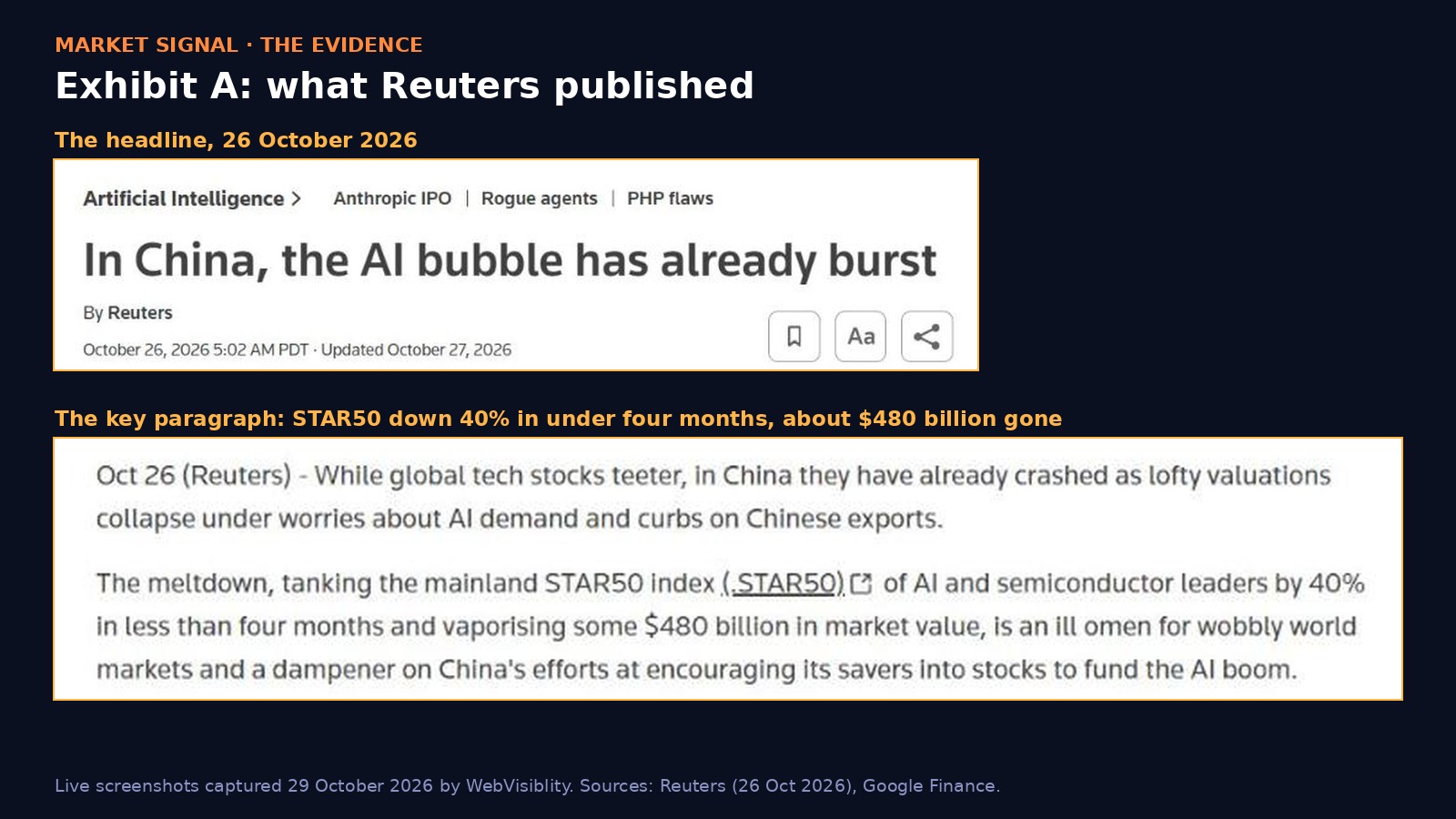
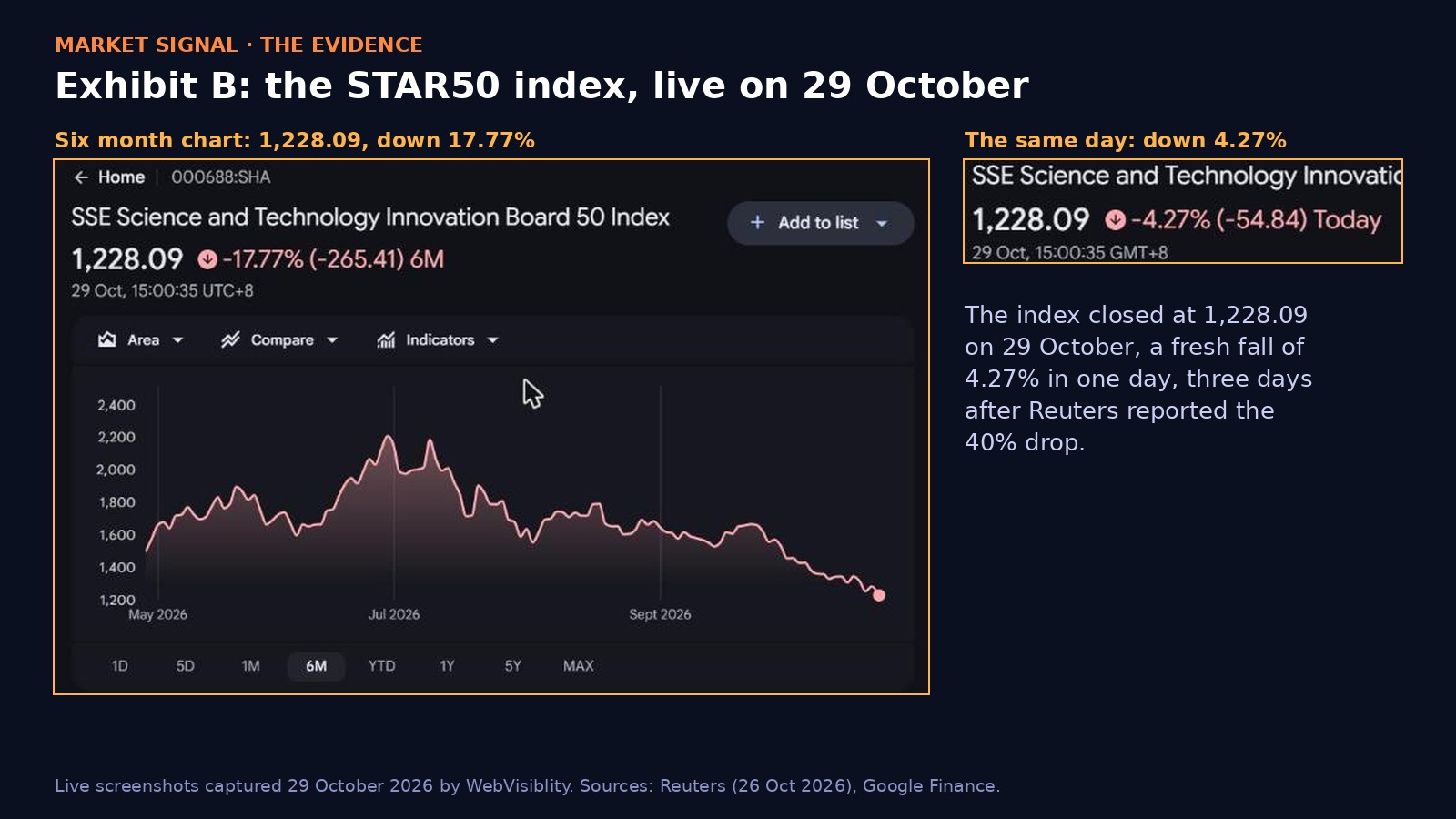
China's STAR50 index of AI and semiconductor leaders fell 40% in less than four months, wiping out about $480 billion in market value, Reuters reported on 26 October [1][2]. Days earlier the blue-chip CSI300 confirmed a bear market, closing 20.2% below its 22 June peak [4]. Traders told Reuters there was no obvious selling trigger [1][3]. The fall has not stopped: on 29 October the STAR50 dropped another 4.27% to 1,228.09 [8].
At a glance
| STAR50 fall | 40% in less than four months [1][2] |
|---|---|
| Market value lost | About $480 billion [1][2] |
| CSI300 blue chips | 20.2% below the 22 June peak; bear market confirmed on 22 October [4] |
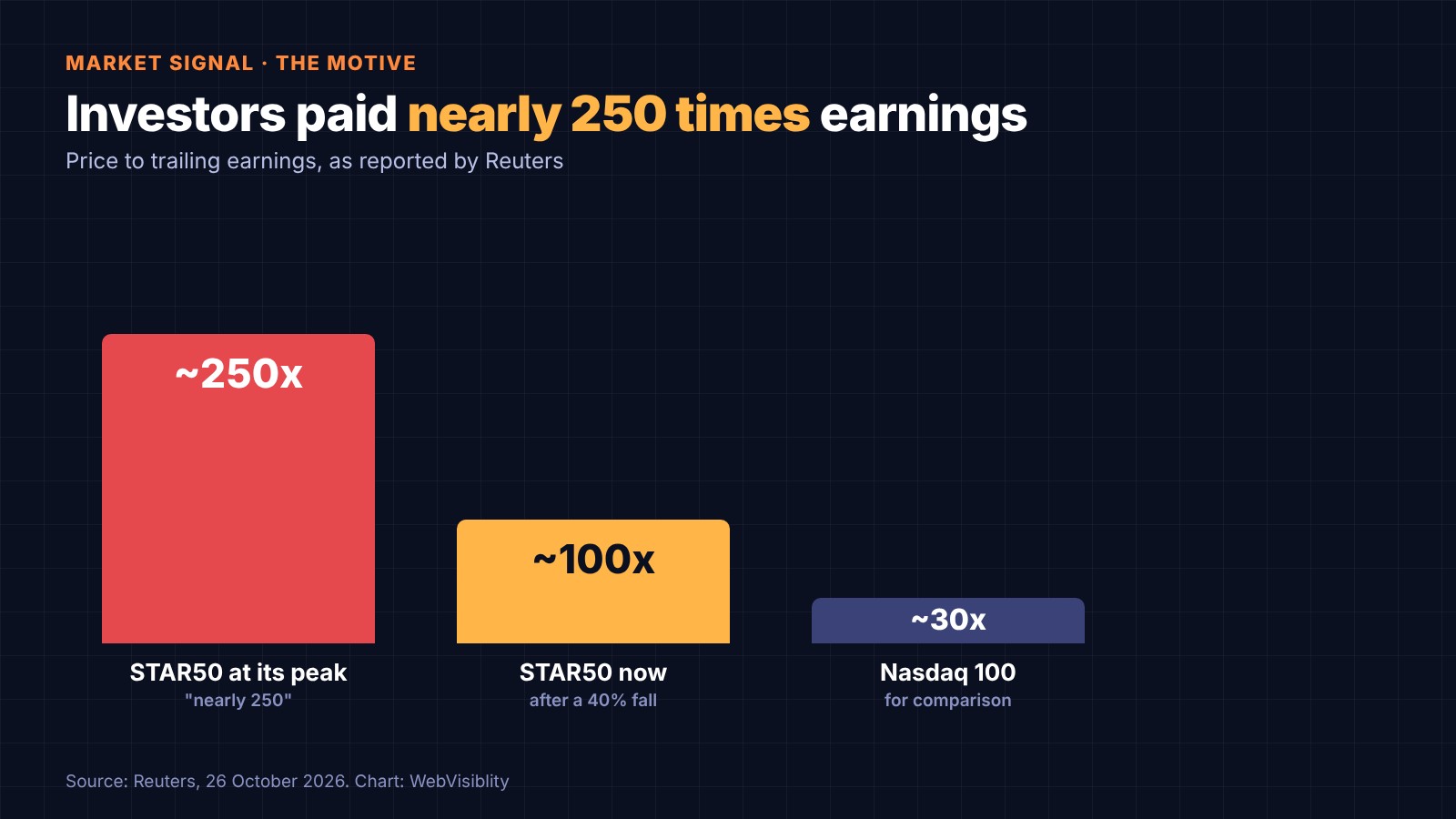
| STAR50 valuation | About 100 times trailing earnings, down from nearly 250 [1][2] |
| Nasdaq 100 valuation | About 30 times earnings, for comparison [1][2] |
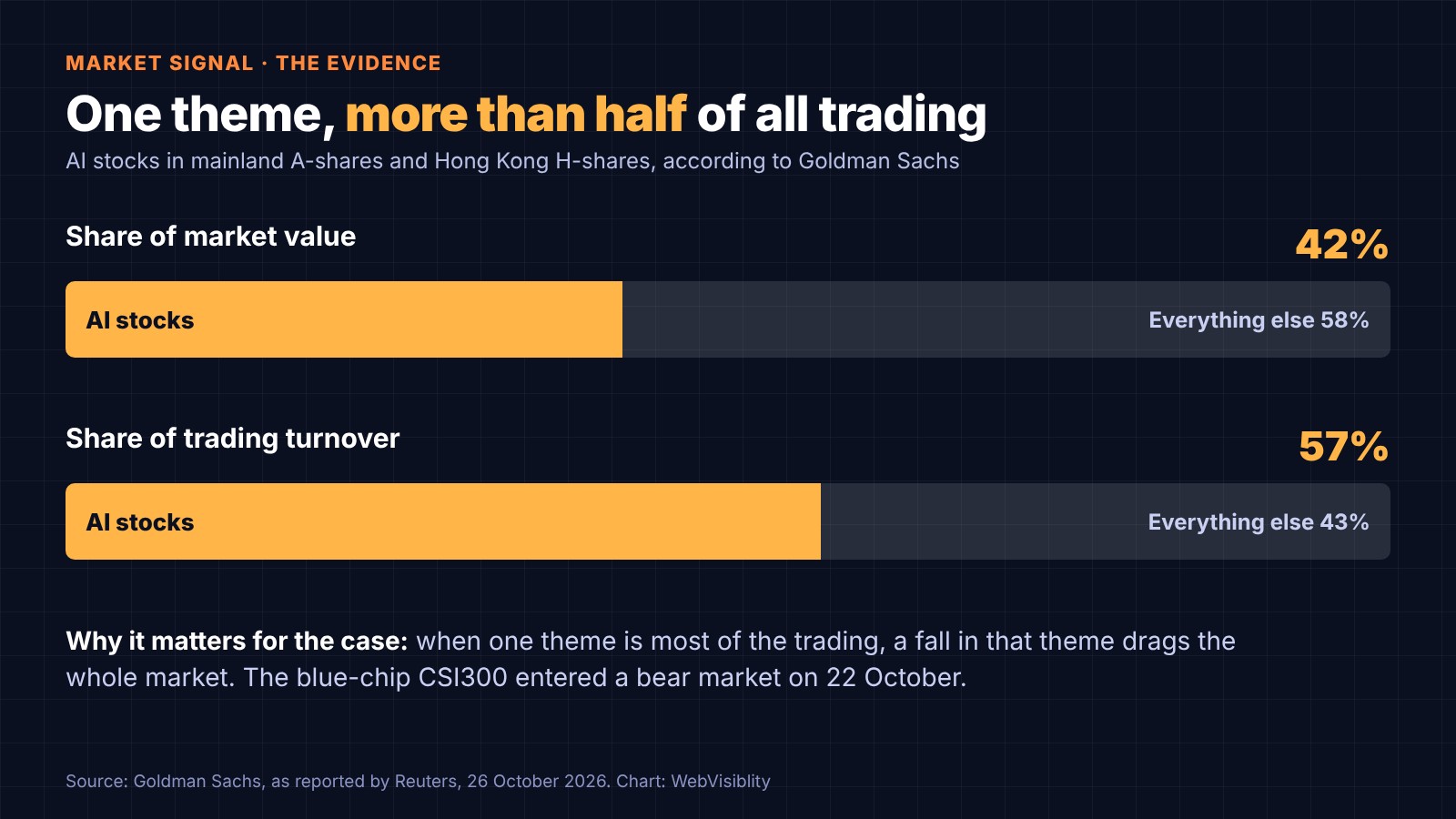
| AI share of China's market | 42% of market value and 57% of turnover, according to Goldman Sachs [1][3] |
The signal
- The STAR50 lost 40% and about $480 billion in under four months [1].
- Robot maker Unitree, whose listing was 8,000 times oversubscribed by retail buyers, has halved since it began trading in August [1][3].
- Optical parts makers Zhongji Innolight and Eoptolink are down roughly 60% from their June and July highs, as Washington moves toward barring them from U.S. data centres [1][3].
- AI stocks make up 42% of China's market value and 57% of trading, according to Goldman Sachs, so their fall drags the whole market [1][3].
- Traders named no single trigger: high prices, tax bills, export curbs and a regulatory push against leverage all played a part [1][3][4].
What happened
The crime scene. Two years of rallying in Chinese AI stocks, fuelled by promises of economic stimulus, have reversed [2]. The STAR50, the index of mainland AI and semiconductor leaders, fell 40% in less than four months and erased about $480 billion of value [1][2]. On 22 October the CSI300 blue-chip index closed at 4,036.30, its lowest since July 2025 and 20.2% below its 22 June peak, which confirmed a bear market [4]. That same day the Hang Seng Tech index slid 5% to a two-year low [4].
The victims. The losses are spread across the names that led the rally. Unitree Robotics drew retail orders for 8,000 times the shares on offer and has halved since its August debut [1][3]. Memory chipmaker CXMT lost more than a quarter of its value in a month [1][3]. MetaX and Moore Threads, which jumped 700% and 400% on their debuts last year, have each halved since July [1][2]. Zhongji Innolight and Eoptolink are down about 60% from their summer highs [1][2].
The suspects. Reuters found no smoking gun, but four suspects keep coming up in the evidence:
- The price itself. At the peak the STAR50 traded at nearly 250 times trailing earnings. It is still near 100 times, against about 30 for the Nasdaq 100 [1][2].
- Washington. The U.S. is moving toward banning Innolight and Eoptolink from supplying American data centres, and traders cite the wider threat of bans on Chinese data centre equipment [1][3].
- Beijing. Authorities pushed to curb leverage and high frequency trading, and state-backed investors sold into rallies to calm the market [1][3]. A campaign to collect income tax on offshore trusts pushed some founders to sell assets, according to Hao Hong of Lotus Asset Management [4].
- The crowd. Fund manager Dong Baozhen told Reuters the market "later evolved into a speculative crazy bull," adding: "And now we see the bubble bursting" [1][2].
By the numbers
Timeline
MetaX and Moore Threads jump 700% and 400% on their stock market debuts [1][2].
The CSI300 blue-chip index sets its closing peak [4].
Unitree Robotics lists, with retail orders for 8,000 times the shares on offer [1][3].
The CSI300 closes 20.2% below its June peak, confirming a bear market. Hang Seng Tech hits a two-year low [4].
Reuters reports the STAR50 is down 40% in under four months, about $480 billion of value gone [1][2].
The STAR50 falls a further 4.27% in one day to 1,228.09 [8].
“All bubbles inevitably burst.”
How the AI rally turned into a bear market
- 1Stimulus hopes
Promises of economic stimulus fuelled a two year rally in Chinese AI stocks [2].
- 2Retail rush
Debuts soared: MetaX rose 700% and Unitree's listing was 8,000 times oversubscribed [1][3].
- 3Pressure builds
Valuations near 250 times earnings, U.S. ban threats, tax bills and curbs on leverage [1][3][4].
- 4The fall
The STAR50 lost 40% and the CSI300 entered a bear market [1][4].
Why it matters
The motive is concentration. When one theme is 42% of a market's value and 57% of its trading, as Goldman Sachs estimates for AI in China, a correction in that theme becomes a correction in everything [1][3]. That is why a sector selloff turned into a bear market for the blue chips [4].
For B2B marketers, the clues point to a price war and a shakeout. Fund manager Wang Zhuo expects Chinese chipmakers and AI suppliers to end up in a price war [3]. Hao Hong of Lotus Asset Management says the selloff will halt many companies trying to list [1][3]. Cheaper chips and models can lower the cost of AI tools that marketing teams use, but a shakeout also means some AI vendors may cut back, change prices or disappear. The U.S. moves against Chinese data centre suppliers add a second risk: where an AI product runs, and on whose hardware, now affects whether it can be sold in some markets [1][3].
The case is not closed. Goldman Sachs still keeps Innolight and CXMT on its list of recommended Chinese AI stocks, and BNP Paribas strategist William Bratton sees buying opportunities for careful investors [1][3]. Even after the fall, the STAR50's earnings multiple is more than three times the Nasdaq 100's [1].
What to do now
For marketers
- List the AI tools your team relies on and note which company runs each one and where it is hosted.
- For each critical tool, write down a fallback in case the vendor raises prices, cuts features or closes.
- If you sell AI products, prepare plain answers on where your models and data run, because buyers now ask.
- Keep claims about AI cost savings modest and sourced; price shifts may come fast if a price war starts.
For software buyers and IT teams
- Ask AI vendors about funding, runway and hosting before signing long contracts.
- Prefer monthly or exit-friendly terms for new AI tools until prices settle.
- Check whether any AI hardware or service you buy could be affected by U.S. restrictions on Chinese data centre suppliers.
Printable, one page, 9 checks. Enter your email and it opens right away.
We email you a copy. We never share your email and never send you sales emails.
Pick one. It takes 5 seconds and helps more people find these briefings. Your checklist opens straight after.
Have a work email? Use it instead and the checklist opens straight away.
Open it, then save it as a PDF or print it.
Know someone who would find this useful?
These steps are our recommendations based on this news, not statements from the companies involved.
What to watch
- The U.S. data centre ban. Whether Washington formally bars Innolight and Eoptolink from supplying U.S. data centres [1][3].
- Beijing's next move. Whether state-backed investors stop selling into rallies, or start buying, after the CSI300 bear market [1][4].
- The listing queue. Whether Chinese AI and chip companies delay planned listings, as Hao Hong expects [1][3].
- The Nasdaq. U.S. AI stocks led a 6% drawdown in the Nasdaq from a record high three weeks earlier, so watch whether the selloff spreads [1][3].
Who is affected
| Who | What changes | Impact |
|---|---|---|
| B2B marketers | A price war among Chinese chip and AI suppliers, if it comes, can cut AI tool costs, while a shakeout can remove vendors [1][3]. | Medium |
| AI and SaaS vendors | Fewer listings and lower valuations make funding harder for AI companies tied to China's market [1][3]. | High |
| Investors | AI is 42% of China's market value, so the theme now moves the whole market [1][3]. | High |
Questions readers ask
Did China's AI bubble burst?
Many investors say yes. China's STAR50 index of AI and chip leaders fell 40% in under four months, erasing about $480 billion, and fund managers told Reuters the bubble is bursting [1][2].
How much did Chinese AI stocks fall?
The STAR50 index fell 40% in less than four months, about $480 billion of market value [1]. Some leaders fell further: Zhongji Innolight and Eoptolink are down about 60% from their highs [1][2].
What caused the China AI stock crash?
Traders named no single trigger. They cite very high valuations, tax bills, the threat of U.S. bans on Chinese data centre equipment, and a regulatory push against leverage, with state-backed investors selling into rallies [1][3][4].
What is the STAR50 index?
The STAR50 is the index of the 50 largest companies on Shanghai's STAR Market, which lists China's AI and semiconductor leaders. It trades at about 100 times trailing earnings, down from nearly 250 [1][2].
Is China's stock market in a bear market?
Yes. The CSI300 blue-chip index closed 20.2% below its 22 June peak on 22 October, confirming a bear market [4].
Companies in this story
Sources
- ReutersOriginal
- Business Day (Reuters)
- Daily Sabah (Reuters)
- Devdiscourse (Reuters)
- Futurism
- Decrypt
- bdnews24.com (Reuters)
- Google Finance
Researched, fact-checked and edited by the Market Signal desk. Read our editorial standards. Spotted an error? Email hello@webvisiblity.com and we will correct it.