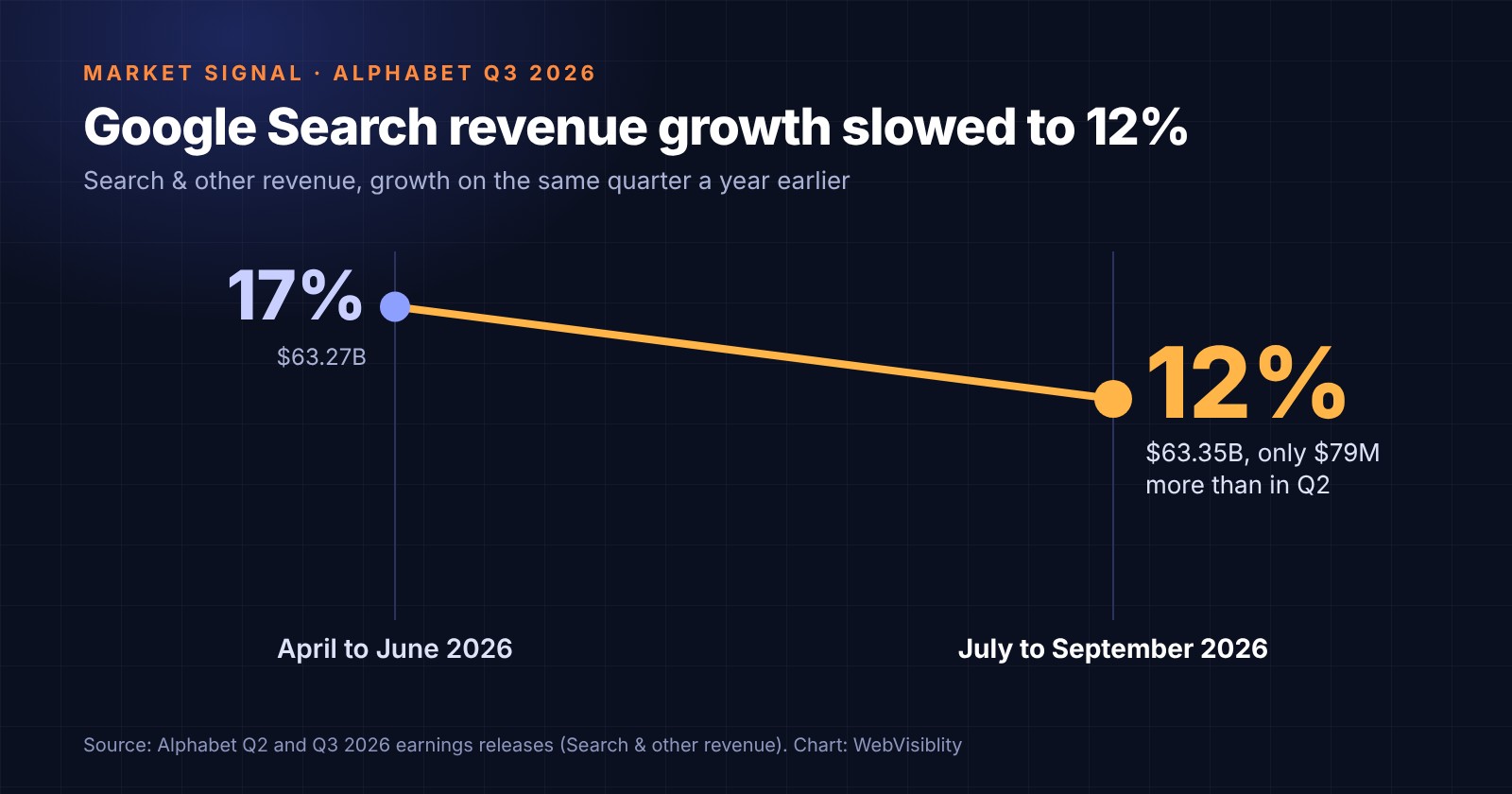
Google Search & other revenue reached $63.35 billion in the three months to 30 September 2026, up 12% on a year earlier [1]. In the previous quarter growth was 17% [2][3]. On the earnings call, chief business officer Philipp Schindler listed lower monetization in AI Mode among the reasons, alongside currency and weaker retail and media spending [3][9]. Google is answering by selling ads inside AI Mode in more countries and in follow-up questions [6].
At a glance
| Search & other revenue | $63.35 billion, up 12% from $56.57 billion [1] |
|---|---|
| Previous quarter | $63.27 billion, up 17% [2][3] |
| Alphabet revenue | $127.6 billion, up 25% [1] |
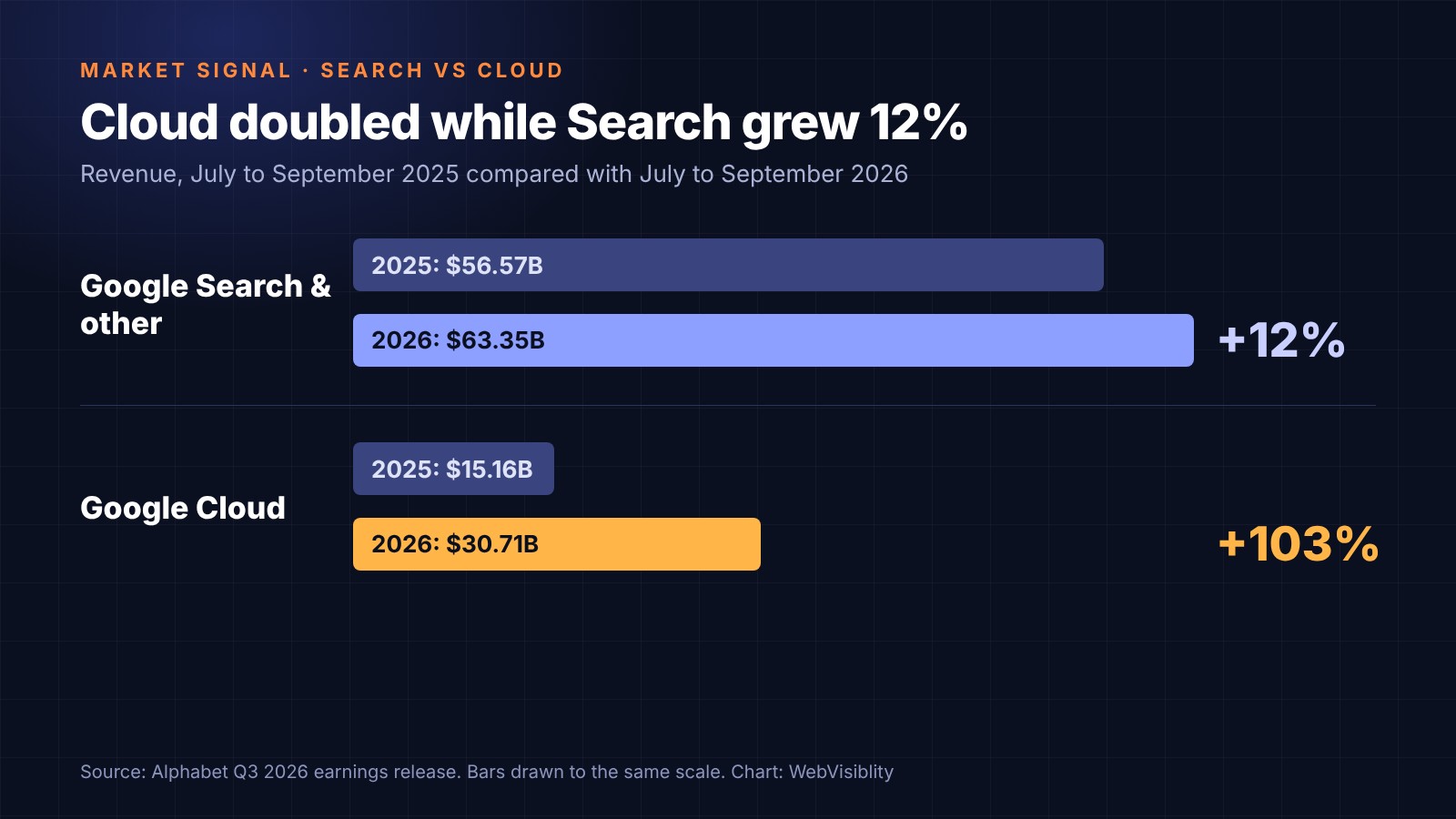
| Google Cloud revenue | $30.71 billion, up 103% [1] |
| Search queries | Year on year query growth at its highest in five years, according to Alphabet [1] |
| Reasons given for slower Search growth | Currency, retail and media spending, and lower monetization in AI Mode [3][9] |
| AI Mode ads | Expanding to 10 more markets, with multiturn ads launching in the U.S. [3][6] |
| Not disclosed | AI Mode user numbers, AI Mode revenue, and paid click or price per click data [1][8] |
The signal
- Search & other revenue grew 12% to $63.35 billion, after 17% growth in the second quarter and 19% in the first [1][3].
- The quarter added only $79 million of Search revenue on the quarter before [2][8].
- Alphabet says its query growth is the fastest in five years, including commercial queries, so people are searching more while each search earns less growth [1][4].
- Google named lower monetization in AI Mode as one of three reasons for the slowdown [3][7][9].
- Ads in AI Mode now reach 10 more countries, and in the U.S. they can appear on follow-up questions [6].
What happened
Alphabet published results for the quarter to 30 September 2026 on Wednesday, 28 October [1]. Total revenue rose 25% to $127.6 billion, and Pichai said the company is now on a half-trillion dollar revenue run rate [1][4]. Google Cloud more than doubled, from $15.16 billion to $30.71 billion [1].
Search told a different story. Google Search & other revenue was $63.35 billion, up 12% on the $56.57 billion of a year earlier [1]. In the April to June quarter it was $63.27 billion, up 17% [2]. Search Engine Journal and Analytics India Magazine both note that growth was 19% in the first quarter of 2026, so this is the second slowdown in a row [3][5]. Measured against the quarter before, Search revenue barely moved [2][8].
Alphabet's own release says the opposite trend holds for usage. Its AI investments are driving overall Search query growth, including commercial queries, and query growth is the highest in five years [1]. On the call, Schindler gave three reasons for weaker revenue growth: currency movements, softer retail and media advertising, and lower monetization in AI Mode, Google's chat style search tab [3][9]. He added that most AI Mode queries are incremental, meaning they would not have happened as ordinary searches [3][7].
The same day, Google said ads in AI Mode are scaling in Australia, Canada, India, Kenya, Malaysia, New Zealand, Nigeria, Pakistan, the Philippines and Singapore, with Brazil, Mexico and the U.K. planned for the fourth quarter [3][6]. In the U.S. it is launching multiturn ads, which show on answers to follow-up questions [6]. According to Search Engine Journal, existing Search, Shopping and Performance Max campaigns are eligible by default and cannot opt out of AI Mode on their own [3].
Other AI figures in the release: the Gemini app has reached one billion users, up from 950 million monthly active users in the second quarter, and Google's own model APIs handle nearly 32 billion tokens per minute [1][2].
By the numbers
| What | Figure | Source |
|---|---|---|
| Google Search & other revenue, third quarter 2026 | $63.35 billion | Alphabet |
| Search & other growth on a year earlier | 12% | Alphabet |
| Search & other growth, previous quarter | 17% | Alphabet |
| Google Cloud revenue growth | 103% | Alphabet |
| Gemini app users | one billion | Alphabet |
Figures exactly as published.
Timeline
Google says AI Mode has passed 1 billion monthly active users, as reported by PPC Land [8].
Second quarter results: Search & other revenue $63.27 billion, up 17%. Gemini app at 950 million monthly active users [2].
Third quarter ends with Search & other revenue of $63.35 billion, up 12% [1].
Alphabet reports results. Google cites lower AI Mode monetization and expands AI Mode ads to 10 more markets, plus multiturn ads in the U.S. [1][3][6]
“Our AI investments are driving overall Search query growth, including commercial queries.”
How an ad now reaches a buyer inside AI Mode
Why it matters
More of the searches that matter to B2B sellers now happen inside an AI answer. Pichai says AI Mode queries are on average three times longer than traditional searches, and one in five AI Mode searches worldwide uses voice, images or documents [8][9]. Schindler described many of them as upper funnel queries with high value commercial intent [7]. For a software or services company, that is the stage where a buyer asks what kind of product to look at and which suppliers to compare, long before a brand search or a demo request.
Google earns less from those searches today, and its fix is more ad space inside them. Search revenue grew far more slowly than queries [1][3], and Google's response is to show ads on AI Mode answers in 10 more countries and on follow-up questions in the U.S. [6]. Search Engine Roundtable reports Google's claim that sponsored and organic product listings in AI Mode already get similar click-through rates [6]. Paid placement inside AI answers is becoming a normal line in a search budget, and because existing campaigns are switched on by default [3], some advertisers will appear there without having planned for it.
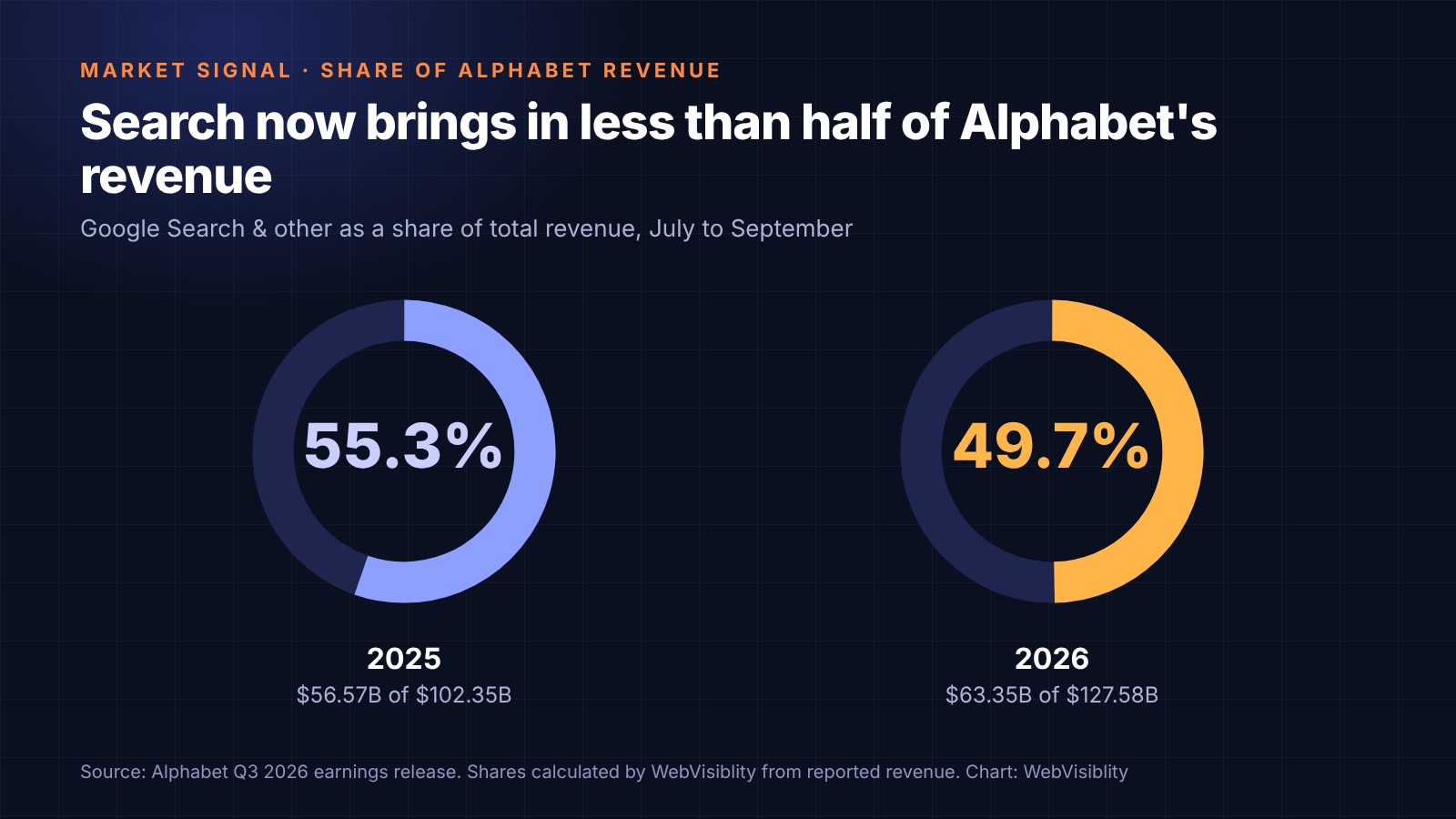
The free part of the answer still decides who gets shortlisted. Ads sit beside the AI answer; the answer itself names the companies Google's systems judge most relevant. A company that is missing from that text cannot buy its way into it, which makes clear, consistent information about what it sells, and for whom, more valuable than before. By WebVisiblity's calculation from the reported figures, Search now brings in 49.7% of Alphabet's revenue, down from 55.3% a year earlier [1], but at $63.35 billion a quarter it remains the largest place where buyers start their research.
What to do now
For marketers
- Ask Google AI Mode five long questions a buyer in your category would ask, and note which companies the answers name.
- Ask a follow-up to each answer, the way a real buyer would, and record whether your company appears at that step.
- Review your Search, Shopping and Performance Max campaign reports for AI Mode placements and decide whether the spend fits your plan.
- Rewrite key pages so they state plainly what you sell, to whom and in which countries, in words an AI answer can reuse.
For software buyers and IT teams
- When a team uses AI Mode to build a supplier list, ask them to separate sponsored listings from the written answer.
- Check any vendor shortlist from an AI answer against independent sources before inviting vendors to pitch.
- Ask your search agency how it will report AI Mode ad results separately from normal Search ads.
Printable, one page, 12 checks. Enter your email and it opens right away.
We email you a copy. We never share your email and never send you sales emails.
Pick one. It takes 5 seconds and helps more people find these briefings. Your checklist opens straight after.
Have a work email? Use it instead and the checklist opens straight away.
Open it, then save it as a PDF or print it.
Know someone who would find this useful?
These steps are our recommendations based on this news, not statements from the companies involved.
What to watch
- AI Mode figures. Alphabet gave no new AI Mode user count this quarter [8]. A new number would show how fast buyers are moving to it.
- Ad results. Whether advertisers see AI Mode ads, and multiturn ads in particular, perform close to normal Search ads [6].
- The fourth quarter. Alphabet's finance chief expects a slightly larger currency headwind and harder comparisons with last year [3].
- Brazil, Mexico and the U.K. The next three markets due to get AI Mode ads this quarter [3][6].
- Spending. Capital spending was $51.36 billion this quarter, with 2026 guidance of $195 billion to $205 billion kept and a significant rise expected in 2027 [1][9].
Who is affected
More early research happens in AI Mode, where the written answer decides which companies a buyer sees first [7][8].
Questions readers ask
How much did Google Search grow in Q3 2026?
Google Search & other revenue grew 12% to $63.35 billion in the quarter to 30 September 2026 [1]. Growth was 17% in the second quarter [2][3].
Why did Google Search revenue growth slow?
Google cited currency movements, weaker retail and media advertising, and lower monetization in AI Mode [3][9]. It did not say how much each factor contributed.
Does Google AI Mode have ads?
Yes. Ads in AI Mode are expanding to 10 more countries, including Australia, Canada and India, with Brazil, Mexico and the U.K. planned next [3][6].
What are multiturn ads in Google AI Mode?
They are ads shown on AI Mode answers to a user's follow-up questions, launching in the U.S. [6]. They are labelled Sponsored [6].
Can advertisers opt out of AI Mode ads?
Not separately, according to Search Engine Journal. Existing Search, Shopping and Performance Max campaigns are eligible by default [3].
Companies in this story
Sources
- AlphabetOriginal
- Alphabet
- Search Engine Journal
- 9to5Google
- Analytics India Magazine
- Search Engine Roundtable
- The Register
- PPC Land
- Yahoo Finance (MarketBeat)
Researched, fact-checked and edited by the Market Signal desk. Read our editorial standards. Spotted an error? Email hello@webvisiblity.com and we will correct it.