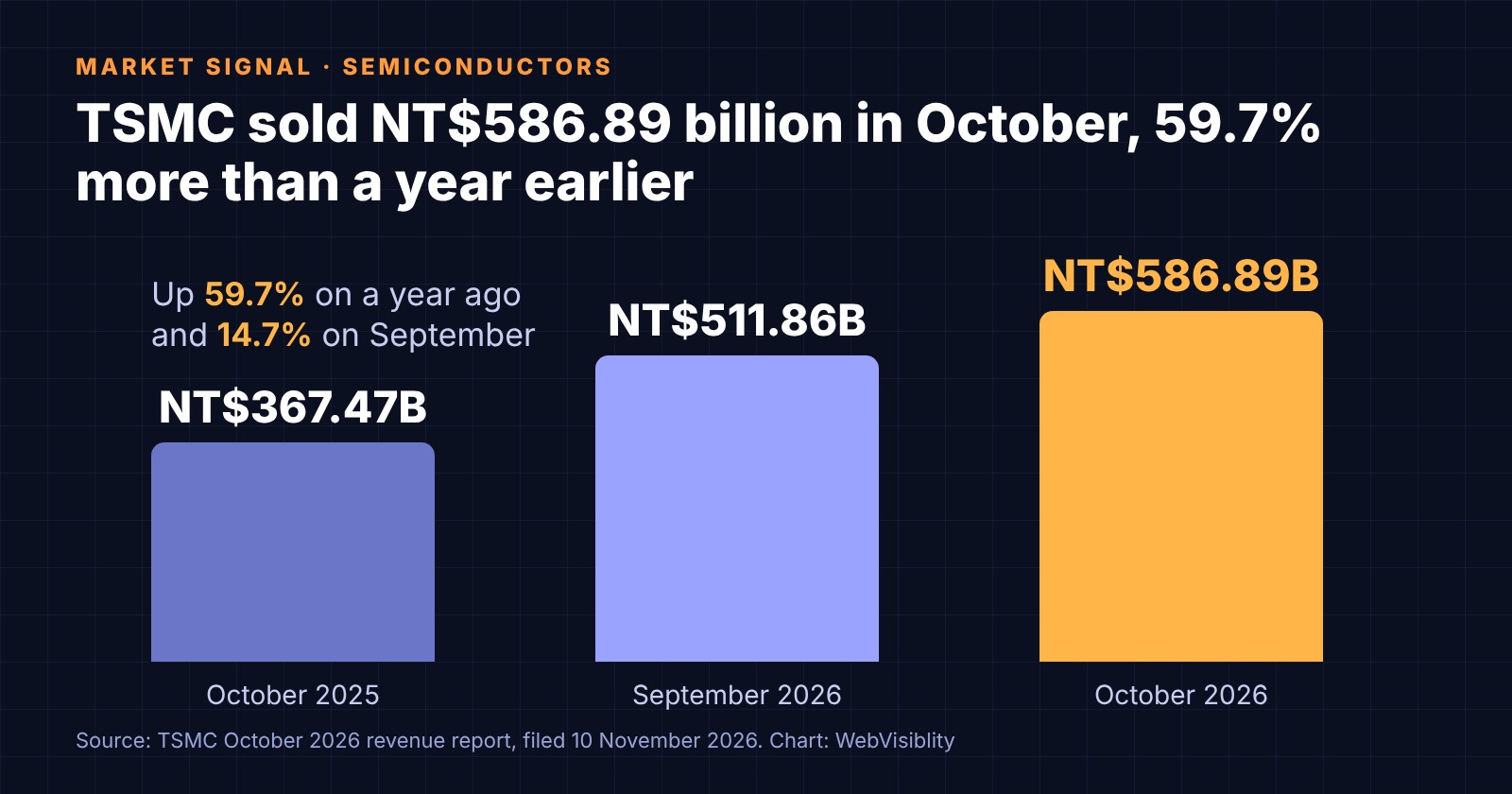
TSMC reported revenue of NT$586.89 billion for October 2026, up 14.7% on September and 59.7% on October 2025 [1]. Revenue for the first ten months reached NT$4,485.62 billion, up 43.3% on the same period of 2025 [1]. In its own forecast for the fourth quarter, TSMC had guided to US$52.3 billion to US$54.3 billion [3].
At a glance
| October 2026 revenue | NT$586.89 billion [1] |
|---|---|
| Versus September 2026 | Up 14.7% from NT$511.86 billion [1][2] |
| Versus October 2025 | Up 59.7% from NT$367.47 billion [1] |
| January to October 2026 | NT$4,485.62 billion, up 43.3% [1] |
| Third quarter 2026 revenue | NT$1,494.24 billion, or US$46.72 billion [3] |
| Fourth quarter guidance | US$52.3 billion to US$54.3 billion, at NT$31.8 to US$1 [3] |
| Third quarter gross margin | 66.4% [3] |
The signal
- October revenue was NT$586.89 billion, up 14.7% on September and 59.7% on a year earlier [1].
- Ten-month revenue stands at NT$4,485.62 billion, 43.3% above the same months of 2025 [1].
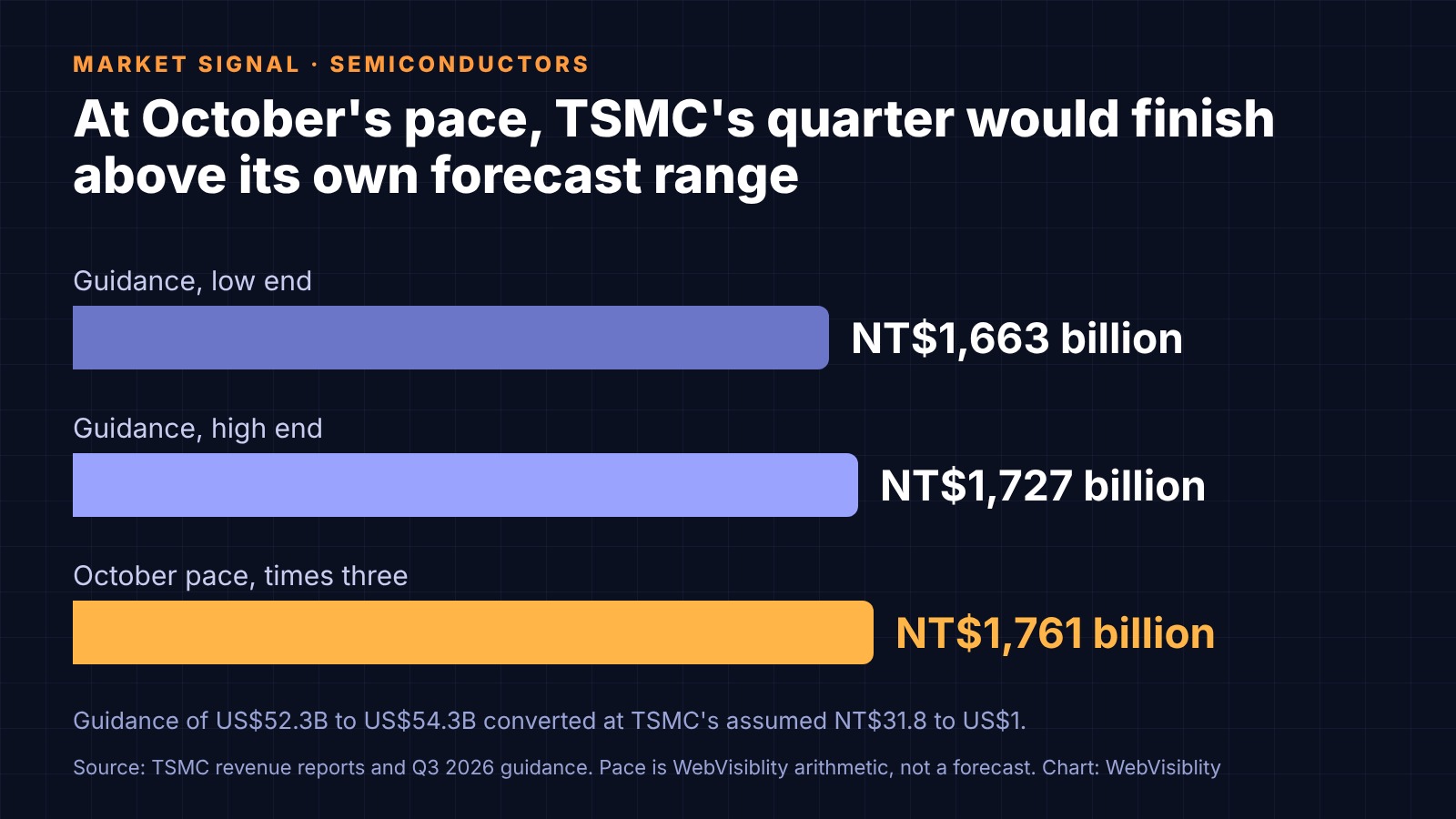
- TSMC guided the fourth quarter to US$52.3 billion to US$54.3 billion, which is NT$1,663 billion to NT$1,727 billion at the NT$31.8 rate it assumed [3].
- Three months at October's level would be NT$1,761 billion, about 2% above the top of that range. This is our arithmetic, not a forecast, and the real exchange rate may differ [1][3].
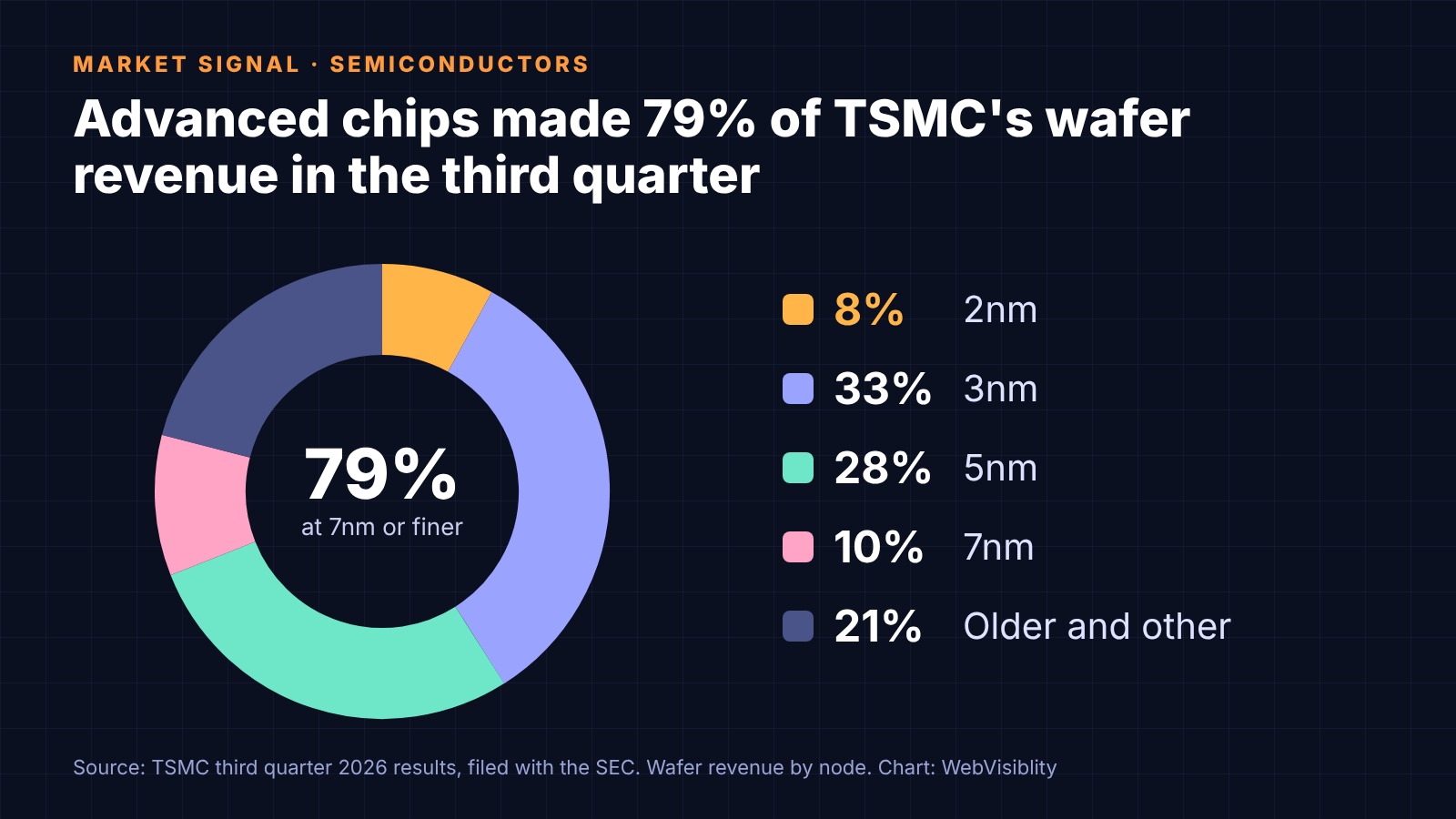
- Chips made on 7nm or finer processes were 79% of third quarter wafer revenue, and 3nm alone was 33% [3].
- TSMC's monthly report does not say which customers or products drove October. Investing.com and Dataconomy attribute the growth to demand for AI chips, which is their reading and not a figure in the filing [1][4][5].
What happened
TSMC filed its October 2026 revenue report on Tuesday 10 November. Net revenue was NT$586.89 billion, against NT$511.86 billion in September and NT$367.47 billion in October 2025 [1][2]. That is a rise of 14.7% in a month and 59.7% in a year [1].
Over January to October, revenue added up to NT$4,485.62 billion, 43.3% more than the NT$3,130.44 billion of the same months last year [1]. Through September, the growth rate for the year was 41.1%, so October pulled the ten-month figure higher [2].
The month sits above the company's recent run rate. Third quarter revenue was NT$1,494.24 billion, which averages about NT$498 billion a month, so October was roughly 18% above that average (our arithmetic) [3]. In the same results, TSMC gave a fourth quarter forecast of US$52.3 billion to US$54.3 billion, a gross margin of 65% to 67% and an operating margin of 56.5% to 58.5%, using NT$31.8 to US$1 [3].
The third quarter results also show where the money comes from. Wafers made on 3nm were 33% of wafer revenue, 5nm 28%, 7nm 10% and the new 2nm 8%, so advanced processes together were 79% [3]. TSMC's finance chief, Wendell Huang, said the quarter was "supported by strong demand for our leading-edge process technologies" [3].
By the numbers
Timeline
TSMC reports September revenue of NT$511.86 billion, up 54.6% on a year earlier [2].
TSMC reports third quarter revenue of NT$1,494.24 billion and guides the fourth quarter to US$52.3 billion to US$54.3 billion [3].
TSMC reports October revenue of NT$586.89 billion, up 59.7% on a year earlier [1].
Investing.com and Dataconomy report the figures and link the rise to demand for AI chips [4][5].
“supported by strong demand for our leading-edge process technologies”
How to read a chip maker's monthly sales
- 1Start with the filing
Read the company's own report, which gives the exact total and the comparison periods [1].
- 2Compare to its forecast
Convert the guidance to the same currency before comparing, as the exchange rate changes the answer [3].
- 3Separate fact from cause
The report gives totals; reasons such as AI demand are claims to check, not figures in the filing [1].
- 4Wait for the quarter
One month can swing, so confirm with the quarterly results in January [3].
Why it matters
TSMC makes chips for much of the AI industry's hardware, so its monthly sales are one of the earliest public numbers on whether spending on AI is still growing. Its own filing does not name customers or say how much of October came from AI [1]. Investing.com and Dataconomy tie the jump to AI chip demand, and Investing.com reports that chief executive C.C. Wei expects that demand to run well into 2027 and that output will likely fall short of demand in coming quarters, which is the company's view and not a measured result [4][5]. What the filing does show is a company selling about 18% more per month than it did on average a quarter earlier [3].
For B2B vendors the practical point is cost and supply. Chips are what AI tools are built on, and the same buyers who pay for AI software are asking vendors which tools they use and what those tools cost to run. When the supplier of the most advanced chips keeps growing this fast, expect AI product prices and capacity to stay a topic in procurement calls, not a settled matter.
The second point is about how buyers research. Budget holders now ask AI assistants to shortlist vendors in areas such as AI infrastructure, data centres and chip supply chains. A company that serves these markets, whether it makes equipment, sells software to manufacturers or advises on supply, gains from clear public pages about what it does, its customers and its figures, because assistants quote what they can find and check.
What to do now
For marketers
- Publish a plain page that states what you sell, who uses it and one result with a date.
- Ask Claude, ChatGPT and Gemini which vendors they recommend in your category and save the answers.
- If you sell to the AI or chip supply chain, list your certifications, customers and locations in text, not only in images.
- Update your pricing or capacity page whenever the facts change, and date it.
For software buyers and IT teams
- Ask each AI vendor which chips or cloud capacity it depends on and what happens if prices change.
- Agree in the contract how the vendor will tell you about price changes.
Printable, one page, 9 checks. Enter your email and it opens right away.
We email you a copy. We never share your email and never send you sales emails.
Pick one. It takes 5 seconds and helps more people find these briefings. Your checklist opens straight after.
Have a work email? Use it instead and the checklist opens straight away.
Open it, then save it as a PDF or print it.
Know someone who would find this useful?
These steps are our recommendations based on this news, not statements from the companies involved.
What to watch
- November revenue. TSMC reports it in December; a second month near NT$587 billion would put the quarter above its own range [1][3].
- The exchange rate. The forecast assumes NT$31.8 to US$1, and a different rate changes the comparison [3].
- Margin. TSMC guided to a gross margin of 65% to 67% for the fourth quarter, against 66.4% in the third quarter, so watch the actual figure in January [3].
- 2nm share. 2nm was 8% of wafer revenue in the third quarter, and TSMC expects a steep ramp [3].
- Capacity. Investing.com reports TSMC expects output to fall short of demand in coming quarters; watch for any new capacity figures [4].
- Customer detail. Whether TSMC or its customers say how much of the growth comes from AI chips [1].
Who is affected
Demand signals stay strong, so clear public proof of customers and results matters more in shortlists [1].
Ask vendors about capacity and price changes, since chip supply sits under every AI product [3].
Check what AI assistants say about your category and your brand before planning campaigns [1].
Compare forecasts and actuals in one currency before quoting growth [3].
Questions readers ask
What was TSMC's revenue in October 2026?
NT$586.89 billion. That is up 14.7% on September and 59.7% on October 2025, according to TSMC's filing of 10 November 2026 [1].
How much has TSMC earned so far in 2026?
NT$4,485.62 billion in January to October, which is 43.3% more than the same ten months of 2025 [1].
What is TSMC's fourth quarter 2026 forecast?
US$52.3 billion to US$54.3 billion in revenue, with a gross margin of 65% to 67%, at an assumed NT$31.8 to US$1 [3].
Is TSMC beating its own forecast?
October alone is not enough to say. Three months at October's level would be about 2% above the top of the range at the forecast exchange rate, which is our arithmetic [1][3].
Does the TSMC report say AI drove the growth?
Not in the filing. It gives totals only. Investing.com and Dataconomy attribute the rise to AI chip demand, which is their reading, and TSMC's third quarter results cite leading-edge demand [1][3][4][5].
What share of TSMC sales is advanced chips?
79% of third quarter wafer revenue came from 7nm and finer processes: 33% from 3nm, 28% from 5nm, 10% from 7nm and 8% from 2nm [3].
Companies in this story
Sources
- SecOriginal
- TSMC
- SecOriginal
- Investing.com
- Dataconomy
Researched, fact-checked and edited by the Market Signal desk. Read our editorial standards. Spotted an error? Email hello@webvisiblity.com and we will correct it.