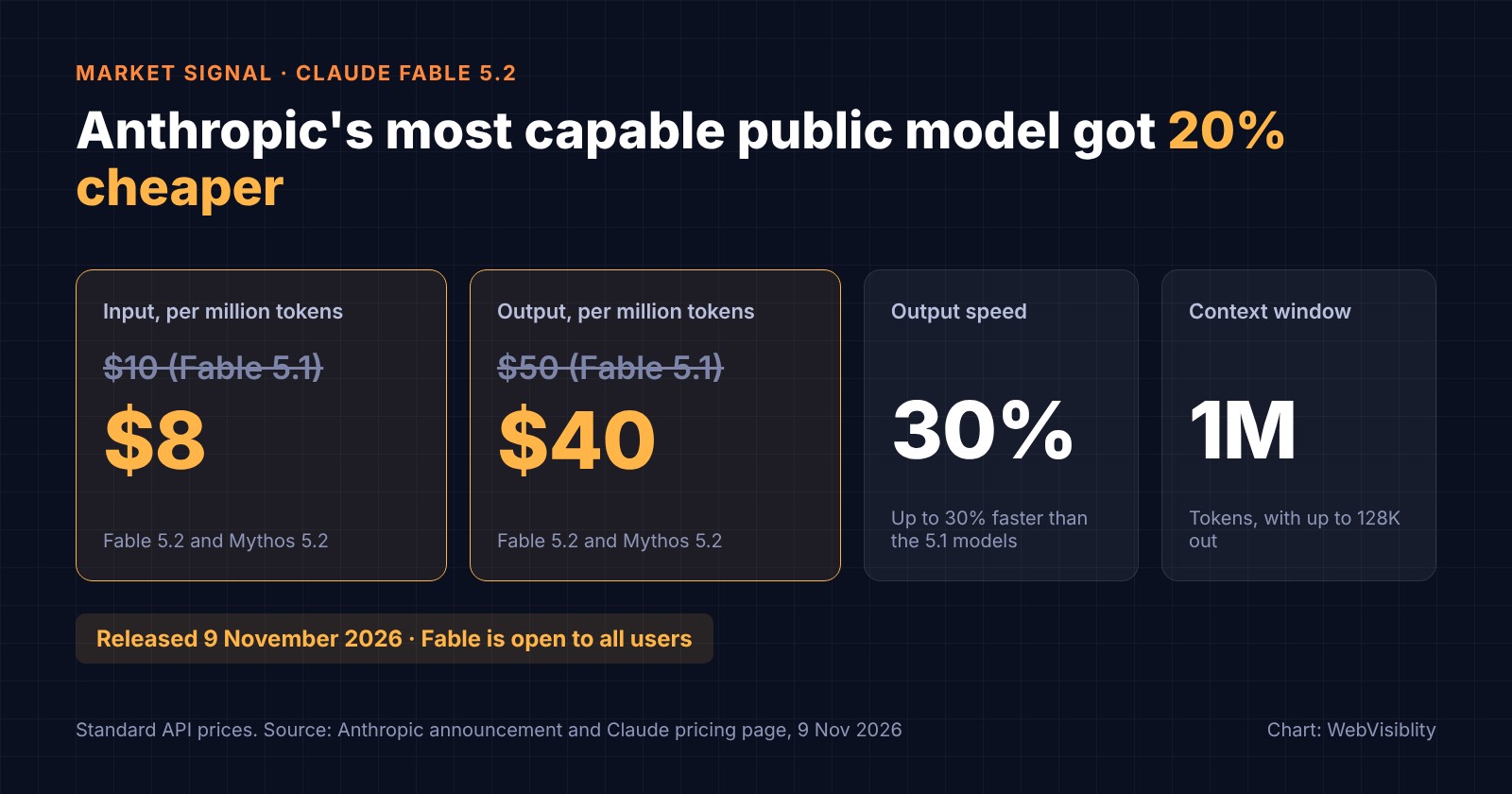
Anthropic released Claude Fable 5.2 and Claude Mythos 5.2 on 9 November, priced at $8 per million input tokens and $40 per million output tokens [1][2]. Fable 5.1 had cost $10 and $50, so both prices fell by a fifth [2][5][7]. In the same announcement, Anthropic said most coding and knowledge work should still start on the cheaper Claude Opus 5.5 [1].
At a glance
| Released | 9 November 2026 [1][3] |
|---|---|
| Fable 5.2 and Mythos 5.2 price | $8 input and $40 output per million tokens [1][2] |
| Fable 5.1 price | $10 input and $50 output per million tokens [2][7] |
| Fast mode | $16 input and $80 output, up to 2.5 times quicker generation [1][2] |
| Speed | Outputs up to 30% faster than the 5.1 models [1][6] |
| Context window | 1 million tokens, up to 128,000 tokens of output [3] |
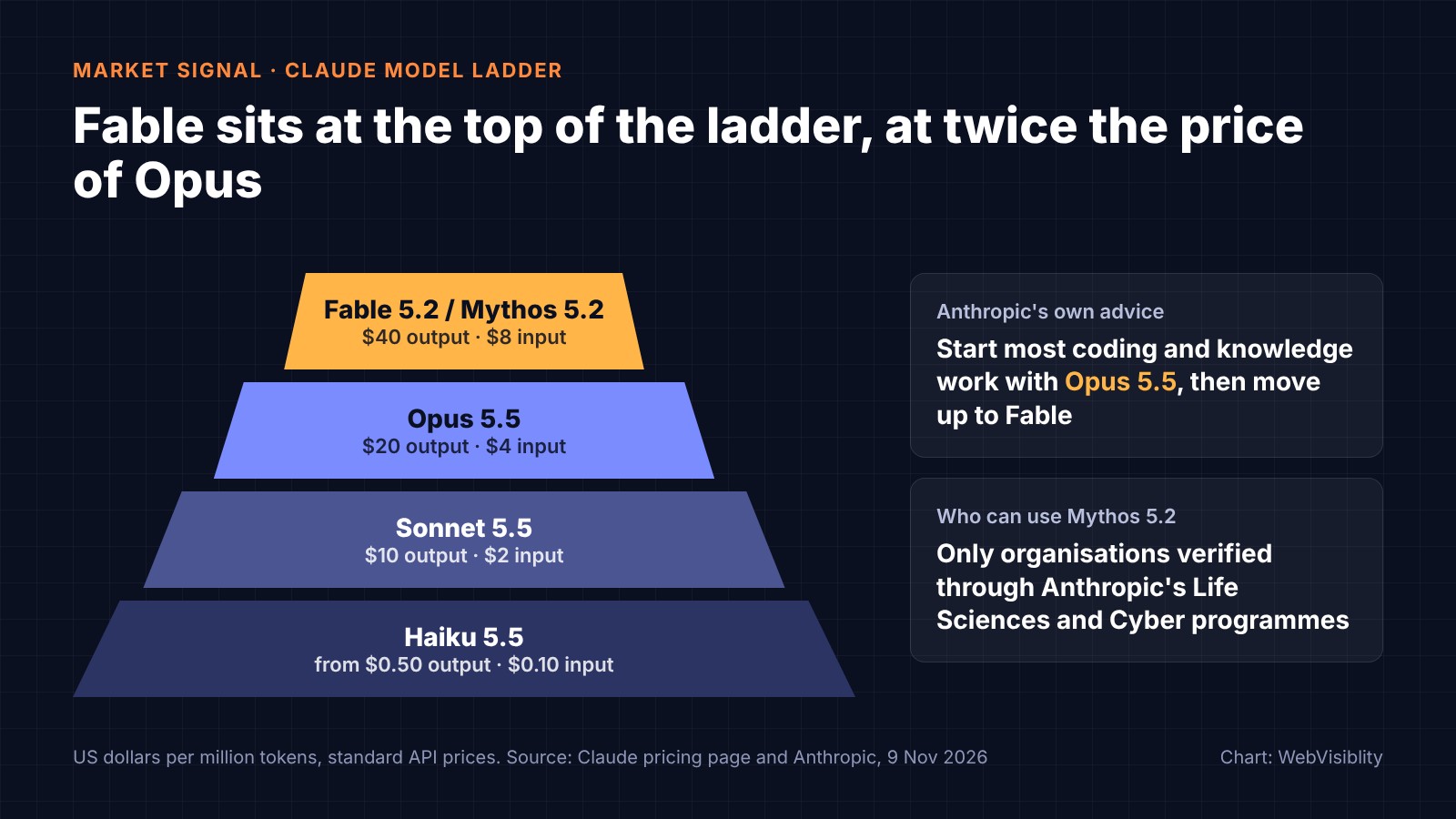
| Who can use Mythos 5.2 | Organisations verified through Anthropic's Life Sciences and Cyber programmes [1][3] |
The signal
- Fable 5.2 is open to all users, while Mythos 5.2 is the same model offered only to verified organisations [1][3].
- Opus 5.5 lists at $4 and $20 per million tokens, so Fable 5.2 still costs exactly twice as much on both input and output [2].
- Anthropic's model guide says most workloads start with Opus 5.5, and that Fable 5.2 is for cases where Opus still falls short at its highest effort settings [4].
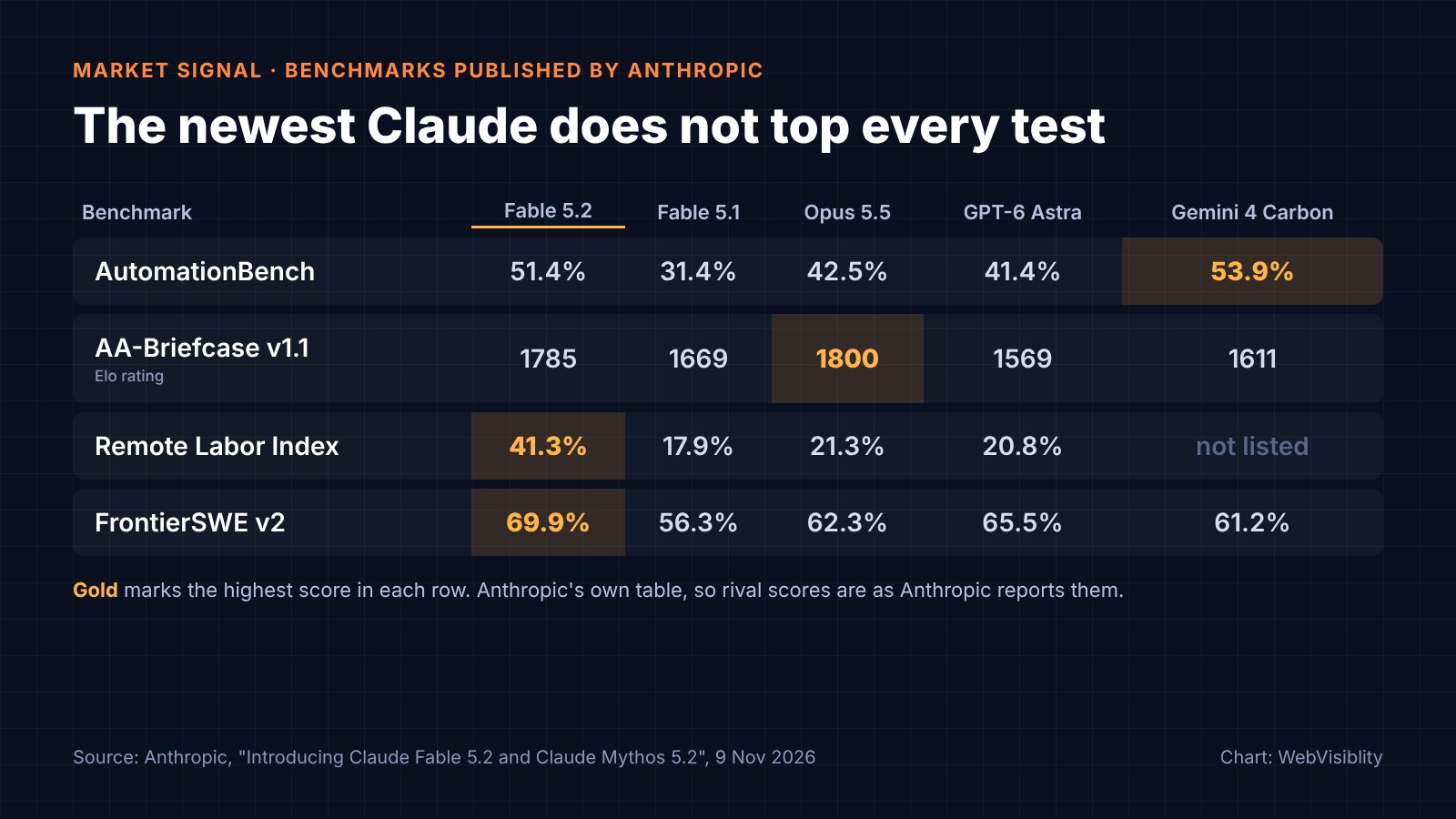
- In Anthropic's own benchmark table, Gemini 4 Carbon scores highest on AutomationBench and Opus 5.5 has the top Elo rating on AA-Briefcase [1].
- Fable 5.2 needs 30-day data retention and is not offered under zero data retention unless Anthropic expressly authorises it [3].
- MacRumors and The Next Web report that Fable 5.2 blocks about 55% fewer requests than Fable 5.1 in early testing [5][6].
What happened
Anthropic published Claude Fable 5.2 and Claude Mythos 5.2 on Monday 9 November [1][3]. The two share specifications and pricing: Fable 5.2 carries cybersecurity and biology safeguards that let Anthropic offer it to everyone, and Mythos 5.2 has the same capabilities for organisations that pass Anthropic's verification programmes [1][3].
The price is the clearest change. Anthropic's pricing page lists both new models at $8 per million input tokens and $40 per million output tokens, against $10 and $50 for Fable 5.1 [2]. A fast mode that generates tokens up to 2.5 times quicker costs $16 and $80 [1][2]. Batch requests get a 50% discount, which brings Fable 5.2 to $4 and $20 [2]. Anthropic also says the new models produce output up to 30% faster than the 5.1 versions [1].
Fable 5.2 is available through the Claude API, Amazon Bedrock, Google Cloud and Microsoft Foundry, with a 1 million token context window and up to 128,000 tokens of output [3]. Its earliest retirement date is 9 November 2027 [3].
Anthropic's headline result was mathematical. A team of 1,000 Fable 5.2 agents formalised Fermat's Last Theorem in 30 hours with minimal human help, the company said, while Opus 5.5 in the same setup completed 26% of the work in 18 hours [1]. An earlier formalisation by an unreleased research version of Claude took 11 days [1]. The company also said more than 90% of the changes merged into its core codebase are now written by Claude, with human guidance [1].
The launch lands weeks before Anthropic's planned stock market listing, which Yahoo Finance reports could come later this month [7].
By the numbers
Timeline
Anthropic releases Claude Fable 5.2 and Claude Mythos 5.2 [1].
The pricing page lists Fable 5.2 at $8 and $40 per million tokens, down from $10 and $50 for Fable 5.1 [2].
Anthropic reports 1,000 Fable 5.2 agents formalised Fermat's Last Theorem in 30 hours [1].
Anthropic's stock market listing could follow later this month, Yahoo Finance reports [7].
Earliest date Anthropic will retire Fable 5.2 [3].
“For most coding and knowledge tasks, we recommend that users start with Claude Opus 5.5, our strongest daily driver”
How Anthropic says to choose a Claude model
Why it matters
The most unusual line in the launch is the advice not to use the new model by default. Anthropic tells customers to start most coding and knowledge work on Opus 5.5, which costs half as much, and to move up to Fable 5.2 only when Opus falls short [1][4]. A vendor that tells its own buyers to pick the cheaper tier for most jobs is saying that model choice now depends on the task, not on which release is newest.
The benchmark table makes the same point. Fable 5.2 leads on the Remote Labor Index at 41.3%, nearly twice Opus 5.5's 21.3%, and on FrontierSWE v2 at 69.9% [1]. Yet on AutomationBench, Gemini 4 Carbon scores 53.9% against Fable 5.2's 51.4%, and on AA-Briefcase Opus 5.5 has a higher Elo rating than Fable 5.2 [1]. These are Anthropic's numbers about its own model and its rivals, so they show where the company itself admits a gap. For a B2B team buying AI for research, content or sales work, a single "best model" claim from any provider is weaker evidence than a test on its own tasks.
For B2B software companies that build on Claude and sell to enterprises, two details matter in procurement. The 20% cut lowers the cost of running Fable 5.2 inside a product, but it is still the most expensive tier [2]. And Fable 5.2 requires 30-day data retention and is not available under zero data retention without Anthropic's express approval [3], which buyers with strict data rules will ask about before they sign.
What to do now
For marketers
- Run one real content or research task on two models and compare the output before choosing a paid plan.
- Ask the AI vendors you use which model their product runs on and when they change it.
- If you sell software built on Claude, explain on a public page which model you use and why.
- Ask Claude, ChatGPT and Gemini to recommend vendors in your category, and save the answers to compare next month.
For software buyers and IT teams
- Ask each AI vendor about data retention terms before procurement review.
- Agree how a vendor will tell you when it changes the model behind its product.
Printable, one page, 11 checks. Enter your email and it opens right away.
We email you a copy. We never share your email and never send you sales emails.
Pick one. It takes 5 seconds and helps more people find these briefings. Your checklist opens straight after.
Have a work email? Use it instead and the checklist opens straight away.
Open it, then save it as a PDF or print it.
Know someone who would find this useful?
These steps are our recommendations based on this news, not statements from the companies involved.
What to watch
- Real-world prices. Whether rivals answer the $8 and $40 price with cuts of their own on their top models [2].
- Default choices in products. Whether software vendors that embed Claude switch their default from Opus 5.5 to Fable 5.2, or keep Fable as an upgrade [4].
- Independent tests. Whether outside benchmarks confirm the scores in Anthropic's table, including the tasks where rivals lead [1].
- Mythos access. How many organisations qualify for Mythos 5.2 through the verification programmes [1].
- The listing. Whether Anthropic's stock market debut happens this month, as Yahoo Finance reports it could [7].
Who is affected
| Who | What changes | Impact |
|---|---|---|
| B2B software vendors building on Claude | Running Fable 5.2 costs 20% less, but it is still twice the price of Opus 5.5 [2]. | High |
| Enterprise buyers of AI tools | Ask which model a tool runs on and whether it needs 30-day data retention [3]. | Medium |
| B2B marketers using AI for content and research | Test models on your own tasks; Anthropic's table shows no model wins every test [1]. | Medium |
| Security and life sciences teams | Mythos 5.2 needs verification through Anthropic's programmes before use [1]. | Low |
Questions readers ask
How much does Claude Fable 5.2 cost?
$8 per million input tokens and $40 per million output tokens on the standard API. Fast mode costs $16 and $80, and batch requests are half price [1][2].
Is Claude Fable 5.2 cheaper than Fable 5.1?
Yes. Fable 5.1 costs $10 per million input tokens and $50 per million output tokens, so Fable 5.2 is 20% cheaper on both [2][5].
What is the difference between Claude Fable 5.2 and Mythos 5.2?
They share the same specifications and price. Fable 5.2 has extra cybersecurity and biology safeguards and is open to all users; Mythos 5.2 is only for verified organisations [1][3].
Should I use Claude Fable 5.2 or Opus 5.5?
Anthropic recommends starting most coding and knowledge work on Opus 5.5, which costs half as much, and moving to Fable 5.2 when Opus falls short [1][4].
Is Claude Fable 5.2 better than GPT-6 and Gemini?
Not on every test. In Anthropic's own table, Fable 5.2 leads on several benchmarks, but Gemini 4 Carbon scores higher on AutomationBench [1].
Companies in this story
Sources
- AnthropicOriginal
- Claude Platform Docs (Anthropic)
- Claude Platform Docs (Anthropic)
- Claude Platform Docs (Anthropic)
- The Next Web
- MacRumors
- Yahoo Finance
Researched, fact-checked and edited by the Market Signal desk. Read our editorial standards. Spotted an error? Email hello@webvisiblity.com and we will correct it.