Sierra released version 1.0 of Personal Agent Protocol, or Poppy, on Friday 13 November. The open standard, which Sierra is developing with Meta, sets out how a person's own AI agent introduces itself to a company and learns what it is allowed to do. Meta's Muse agent now looks for Poppy first on every site it visits, and Shopify has enabled Poppy for every merchant on its platform.
At a glance
| Release | Poppy version 1.0, 13 November 2026 |
|---|---|
| Built by | Sierra with Meta and industry partners |
| Backers | More than 100 design partners, 60 of them new |
| Shopify | Every store publishes a Poppy file automatically |
| Meta Muse | Checks for Poppy first on every site |
| Early users | Mercury and Turkish Airlines live; Synchrony exploring |
| Built on | MCP, OpenAPI and UCP, with OAuth sign-in |
The signal
- Poppy covers the moment an agent shows up at a store, says who it is and learns its permissions.
- Shopify merchants need to do nothing; their stores now publish a Poppy file by default.
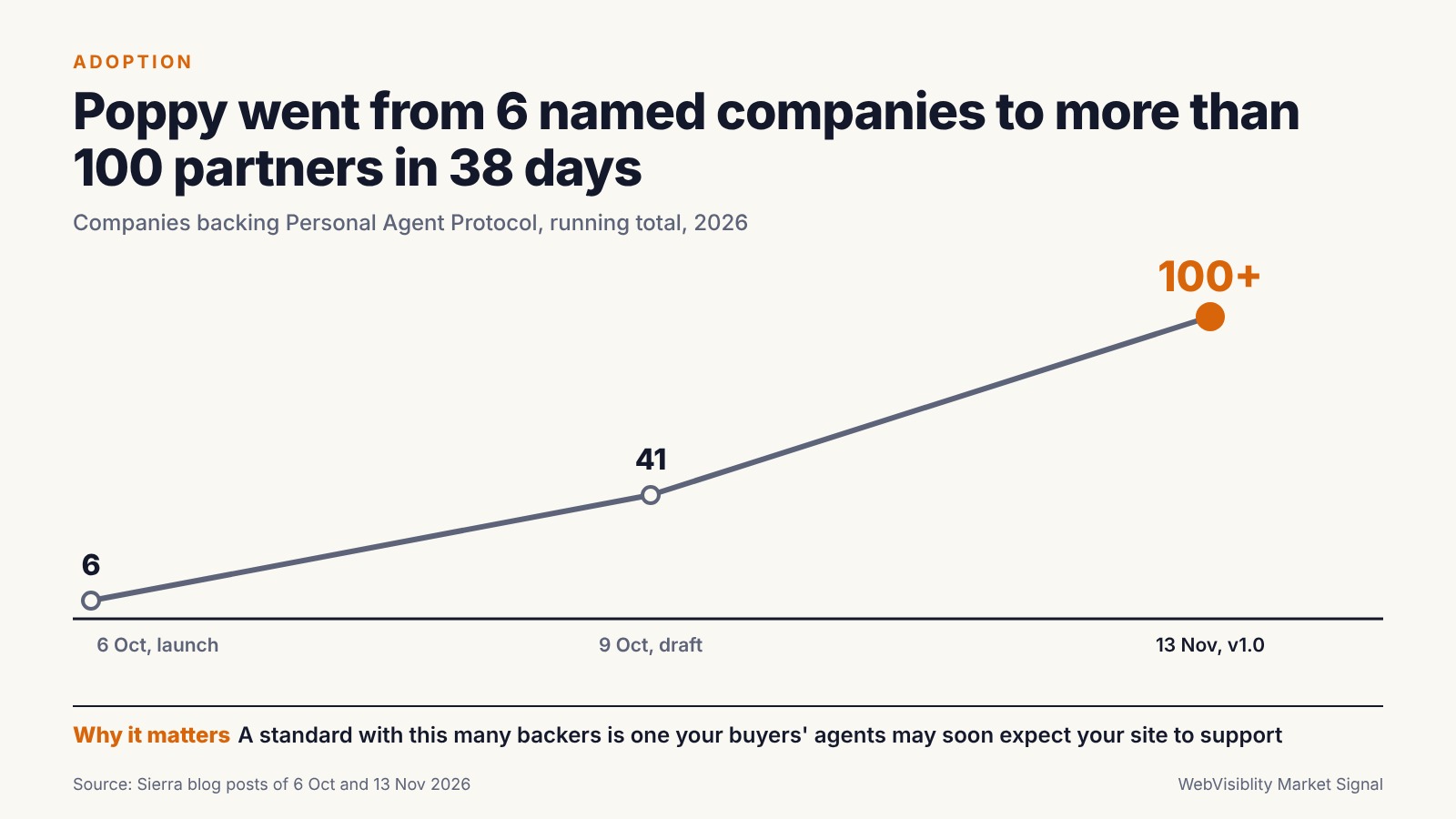
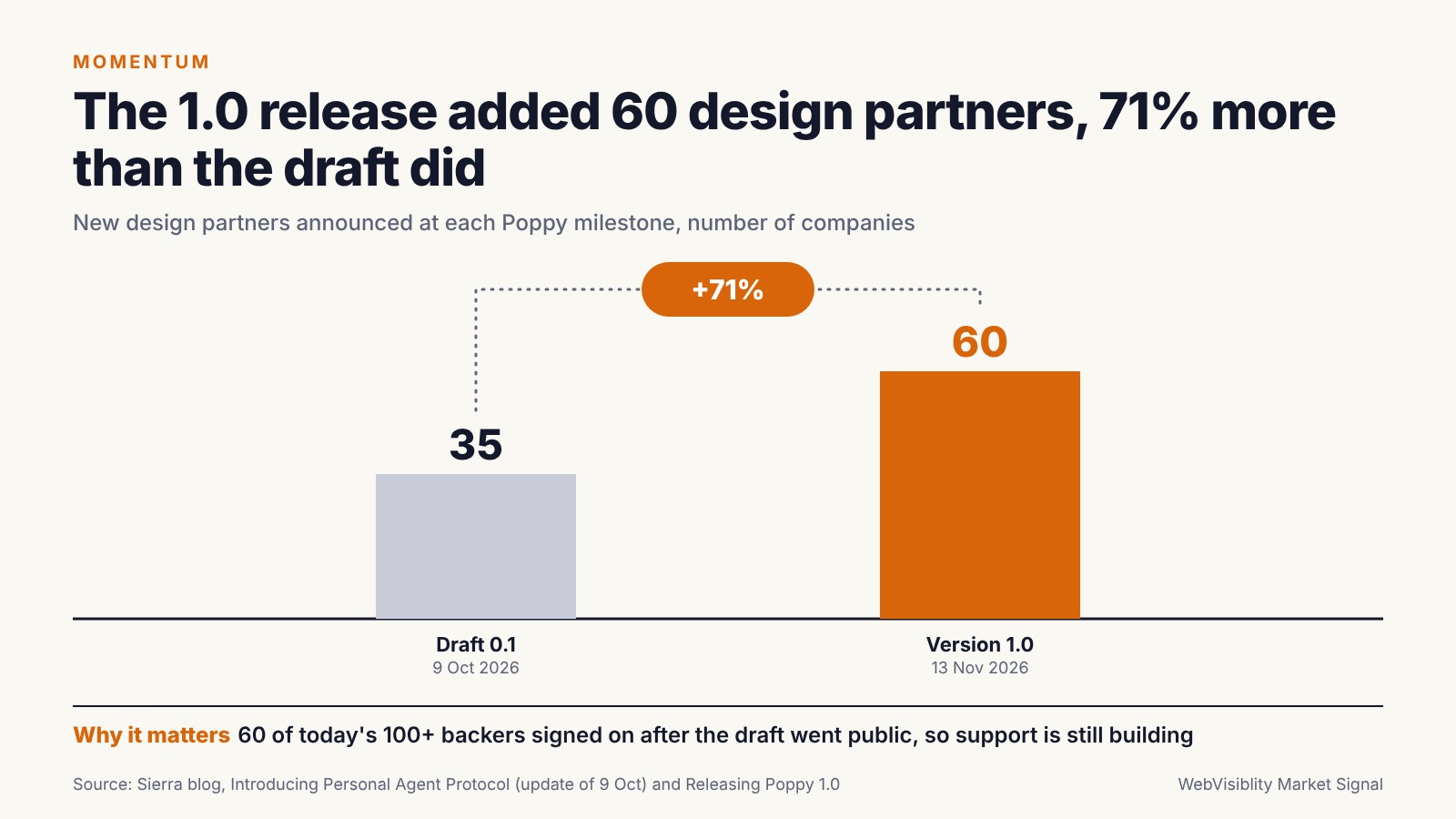
- Sierra says 60 new companies joined as design partners, taking the total past 100.
- The new names include Salesforce, Freshworks, Twilio, Zoom, Cisco and Delta Air Lines.
- Muse has been set up by more than 10 million people, The Next Web reports.
- The specification is still labelled a draft and allows changes that could break setups.
What happened
Sierra, the customer service AI company led by former Salesforce co-CEO Bret Taylor, published the 1.0 release in a post written by Taylor and Clay Bavor. Poppy lets a personal agent deal with a company through business agents, websites and APIs. The customer signs in with OAuth and controls what the agent may do over time.
The protocol was first shown on 6 October, when Sierra named Genesys, Instinct, Rocket, Shopify, Stripe and Walmart as launch partners. Three days later Sierra shared a draft with 35 new design partners, including Bank of America, OpenAI, Visa and United Airlines. Version 1.0 follows five weeks of testing by those partners against real sites, APIs and agents.
The 1.0 release adds a way for companies to adopt it in stages, starting with the basics, and lets them give the agent guidance and collect feedback from it. It also adds extensions, starting with a commerce extension co-authored by Shopify that lets an agent shop as a guest or sign in with the customer's account. Shopping itself, such as filling a cart and checking out, stays with Shopify's Universal Commerce Protocol. Unite.AI reports that a company publishes its settings in a file at /.well-known/poppy.json, and Sierra offers an implementation kit with a validator.
Three companies are named as live or in progress. Mercury customers can have an agent check balances and start payments that still pass through the account's approval policy. Turkish Airlines lets agents check fares and find Miles&Smiles upgrades that the customer approves before paying. Synchrony is exploring agent-led shopping across more than 500,000 merchant locations.
By the numbers
Timeline
Sierra and Meta announce Personal Agent Protocol with six named launch partners.
Draft spec shared with 35 new design partners, including OpenAI and Visa.
Version 1.0 released; 60 more companies join as design partners.
Shopify enables Poppy for every merchant; Muse checks for it first.
“Brands need a trusted way to know who an AI agent represents, what it's authorized to do”
How an agent uses Poppy at a company
- 1Arrive
The agent shows up at a store and says who it is.
- 2Read
It reads the company's Poppy file, which Unite.AI says sits at /.well-known/poppy.json.
- 3Sign in
For account tasks, the customer signs in through standard OAuth.
- 4Act
The agent works through the website, API or business agent the company offers.
Why it matters
Most AI search work so far has been about being named in an answer. Poppy is about the next step: what happens when a buyer's agent arrives at the site to act. A standard that Meta's agent looks for first means agents will soon judge a company partly on whether it offers a clear, machine-readable route for them, alongside what its pages say.
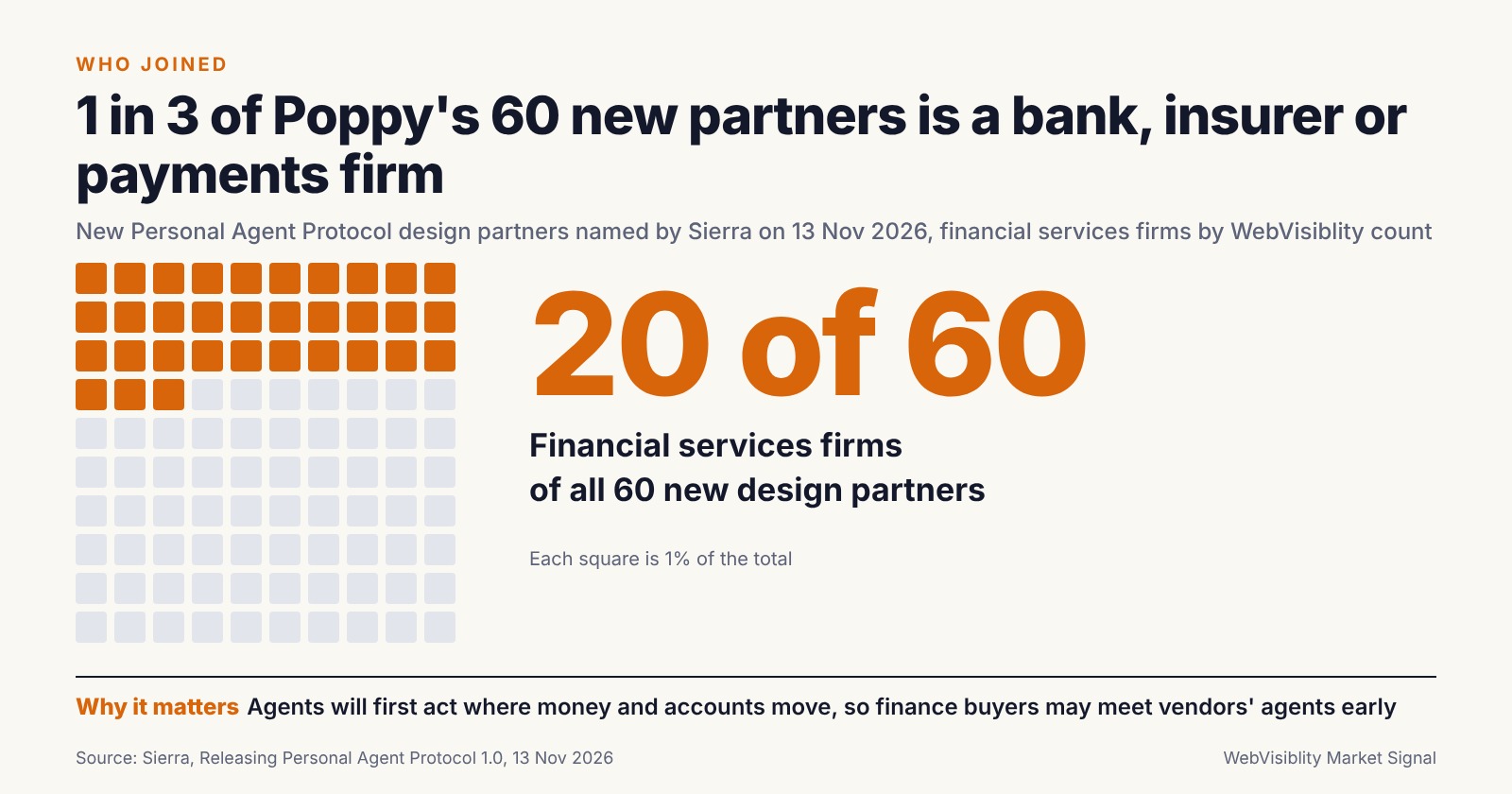
The partner list shows where this lands first for B2B. Our count finds 20 of the 60 new partners are banks, insurers, lenders or payments firms, and several of the rest sell the software B2B teams run on, from Salesforce, including Agentforce, to Freshworks, Braze, Twilio, Five9 and Zoom. If those platforms ship Poppy support the way Shopify did, many company sites could become agent-ready without their marketing teams lifting a finger, and the content and rules those sites expose will matter more than the switch.
There are limits. The spec still permits further fixes, including changes that are not backward compatible, and Sierra has not shared numbers on how many agent visits Poppy handles. Amazon is steering shoppers to its own agent instead of Muse, and Visa and Mastercard are building their own ID checks for agents, so Poppy may end up as one standard among several.
Who is affected
Support may arrive by default if platforms copy Shopify's switch-on.
Banks, insurers and payments firms make up a large share of new partners.
Agents may come through your business agent or API rather than a person.
A spec still labelled a draft means setups may need rework.
What to do now
For marketers
- Ask your website, CRM and help desk vendors whether they plan to support Poppy, and when.
- List the tasks a buyer's agent would want to do on your site, such as pricing, demos or support tickets.
- Check that pricing, product and policy pages are clear enough for an agent to act on without guessing.
- Decide which actions an agent may take alone and which need a human to approve.
For software buyers and IT teams
- Ask vendors whether your own agents will be able to reach them through Poppy or another standard.
- Treat Poppy support as an early signal, not a requirement, while the spec is still a draft.
Printable, one page, 10 checks. Enter your email and it opens right away.
We email you a copy. We never share your email and never send you sales emails.
Pick one. It takes 5 seconds and helps more people find these briefings. Your checklist opens straight after.
Have a work email? Use it instead and the checklist opens straight away.
Open it, then save it as a PDF or print it.
Know someone who would find this useful?
These steps are our recommendations based on this news, not statements from the companies involved.
What to watch
- Your platforms. Whether Salesforce and other design partners switch Poppy on for customers by default, as Shopify did.
- Muse usage. Meta has not given numbers; The Next Web puts set-ups at more than 10 million.
- Spec stability. Whether the draft label comes off and breaking changes stop.
- Rival standards. Amazon's own agent and the card networks' agent ID checks.
- Payments. Turkish Airlines is working on purchase inside the agent conversation; watch for wider checkout support.
Questions readers ask
What is Personal Agent Protocol (Poppy)?
Poppy is an open standard from Sierra and Meta that sets how a person's AI agent connects to a company, identifies itself and learns its permissions before acting through a website, API or business agent.
Who created Poppy?
Sierra, the AI customer service company led by Bret Taylor, created it with Meta. Sierra calls it a standard it is developing with Meta and industry partners, open for anyone to implement.
Does my Shopify store support Poppy?
Yes. Every Shopify store automatically publishes a Poppy file, so merchants do not need to set anything up. Carts and checkout still run through Shopify's Universal Commerce Protocol.
Which AI agents use Poppy?
Meta's Muse is the first named agent. It looks for Poppy first on every site it visits. Sierra has not named other agents that use it by default.
Is Poppy the same as MCP?
No. Poppy is largely built with existing standards such as MCP, OpenAPI and UCP. MCP and OpenAPI are routes a company can offer once Poppy has set up who the agent is.
How do I add Poppy to my website?
Sierra's implementation kit walks a company through setup and includes a validator. Companies can start with the basics and add capabilities over time.
Is Poppy 1.0 final?
Not fully. Unite.AI reports that the spec and kit label it draft 1.0, and that further fixes may include changes that are not backward compatible.
Companies in this story
Sources
Researched, fact-checked and edited by the Market Signal desk. Read our editorial standards. Spotted an error? Email hello@webvisiblity.com and we will correct it.