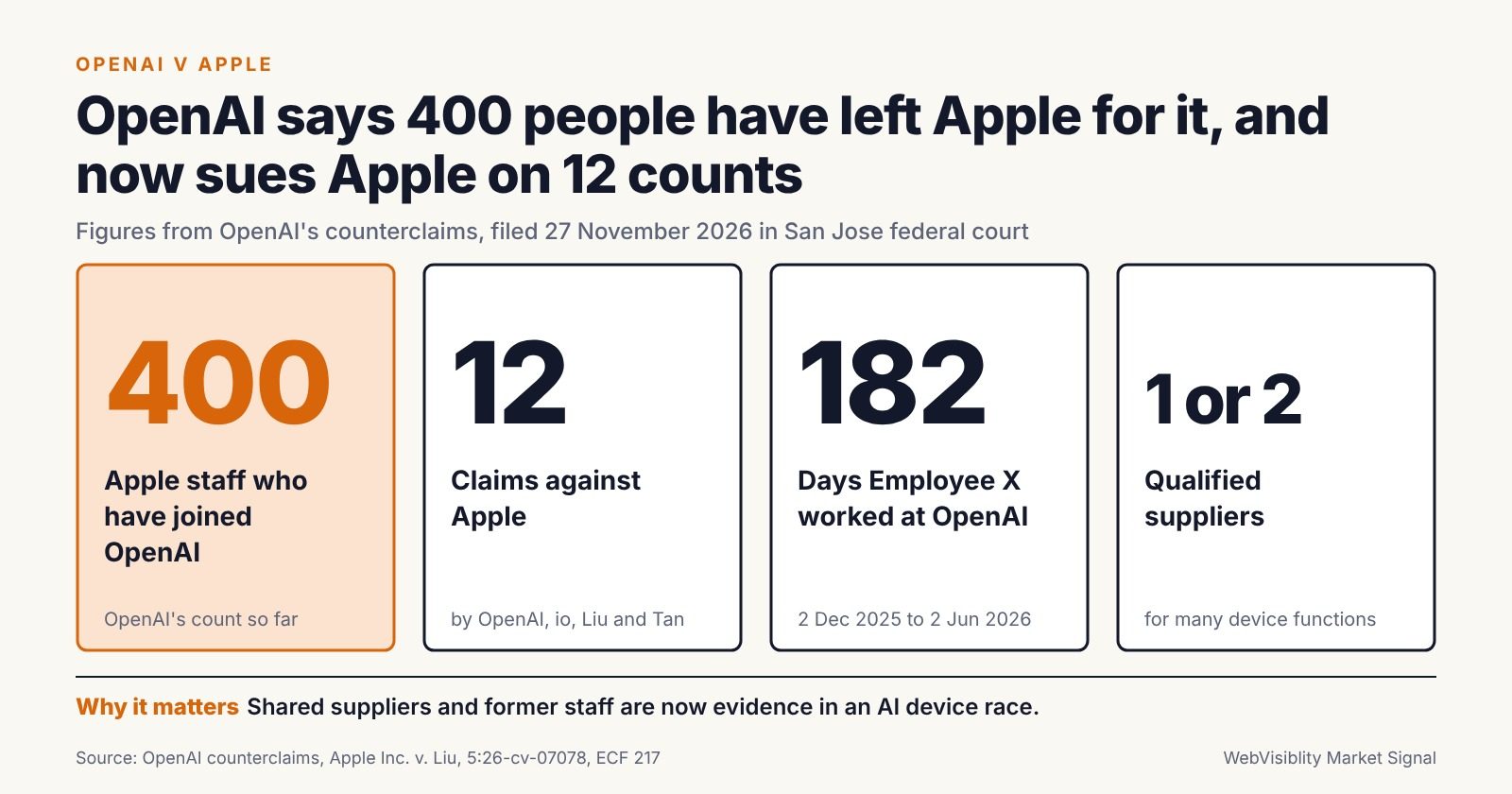
OpenAI filed counterclaims against Apple in San Jose federal court on Friday 27 November, four and a half months after Apple sued it over device secrets. The filing makes 12 claims in all. It says a former Apple worker spent six months at OpenAI, sent its unreleased hardware files to personal phones and then briefed senior Apple personnel on them. It also says Apple pushed hardware suppliers that serve both companies to limit their OpenAI work. Apple says the case is about OpenAI staff deliberately stealing its information.
At a glance
| Filed | 27 November 2026 |
|---|---|
| Claims against Apple | 12 causes of action |
| Apple staff who joined OpenAI | 400, OpenAI says |
| Apple's own suit | Filed 10 July 2026 |
| Trial | 19 July 2027, 9to5Mac reports |
Do this today
Tick each step as you do it. Your ticks stay on this device. See the full list.
For marketers
For software buyers and IT teams
The signal
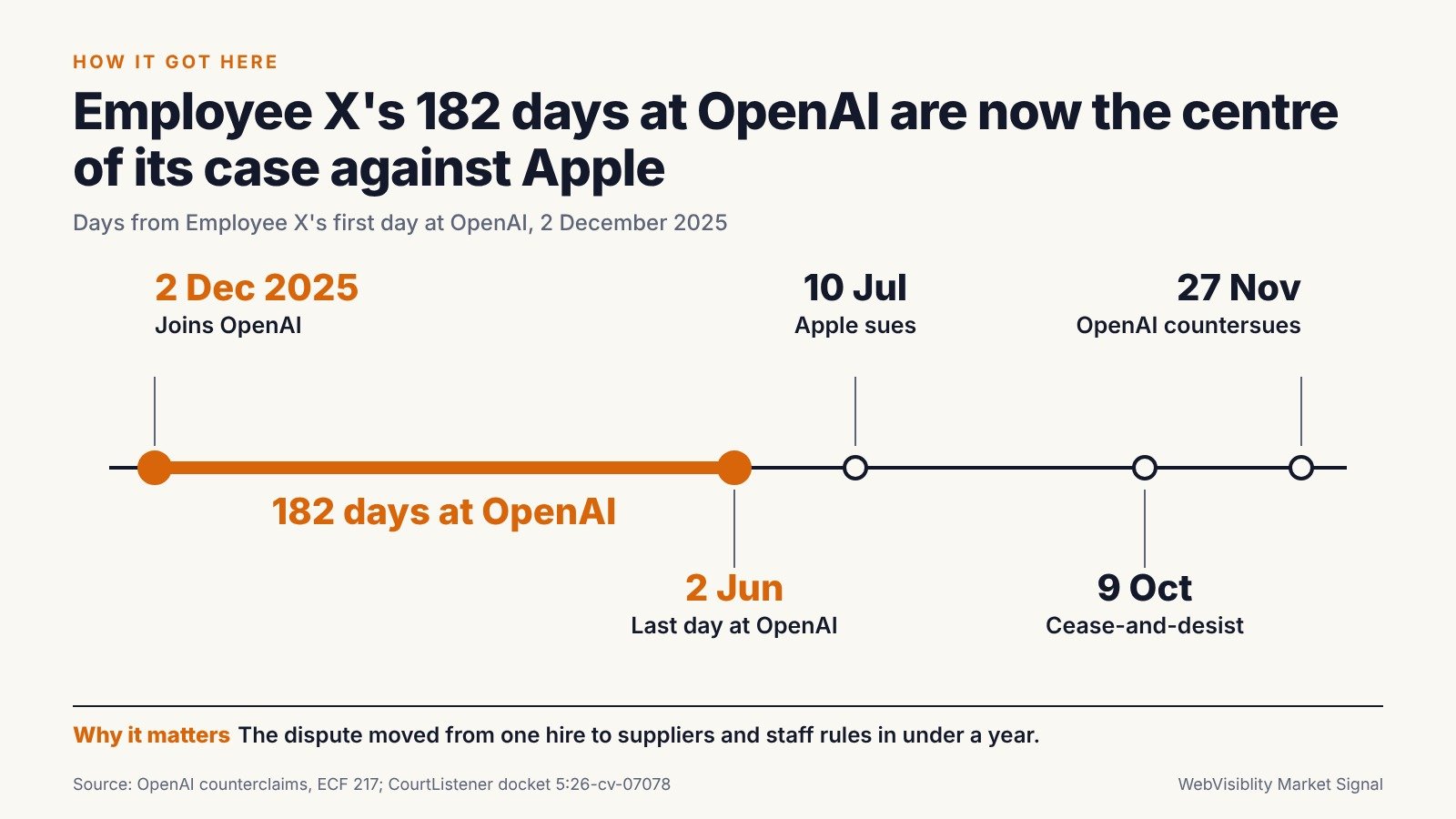
- OpenAI says an operations hire it calls Employee X joined on 2 December 2025, left on 2 June 2026 and rejoined Apple shortly after.
- The filing lists files he sent to personal numbers, including a 76-page supplier measurement procedure for an unreleased OpenAI part.
- OpenAI says Apple asked shared suppliers to name workers assigned to OpenAI, and that one key manufacturer dropped planned OpenAI work citing Apple's threats.
- Another supplier moved OpenAI parts to a separate overnight shift on a shared anodizing line after Apple objected, OpenAI says.
- OpenAI says 400 Apple employees have left for OpenAI so far, and calls Apple's suit an attempt to scare off the next ones.
- Apple says OpenAI has already been ordered to stop using Apple's confidential information.
Which of these are you?
Tap the one that fits you best. We show what this story changes for you.
What happened
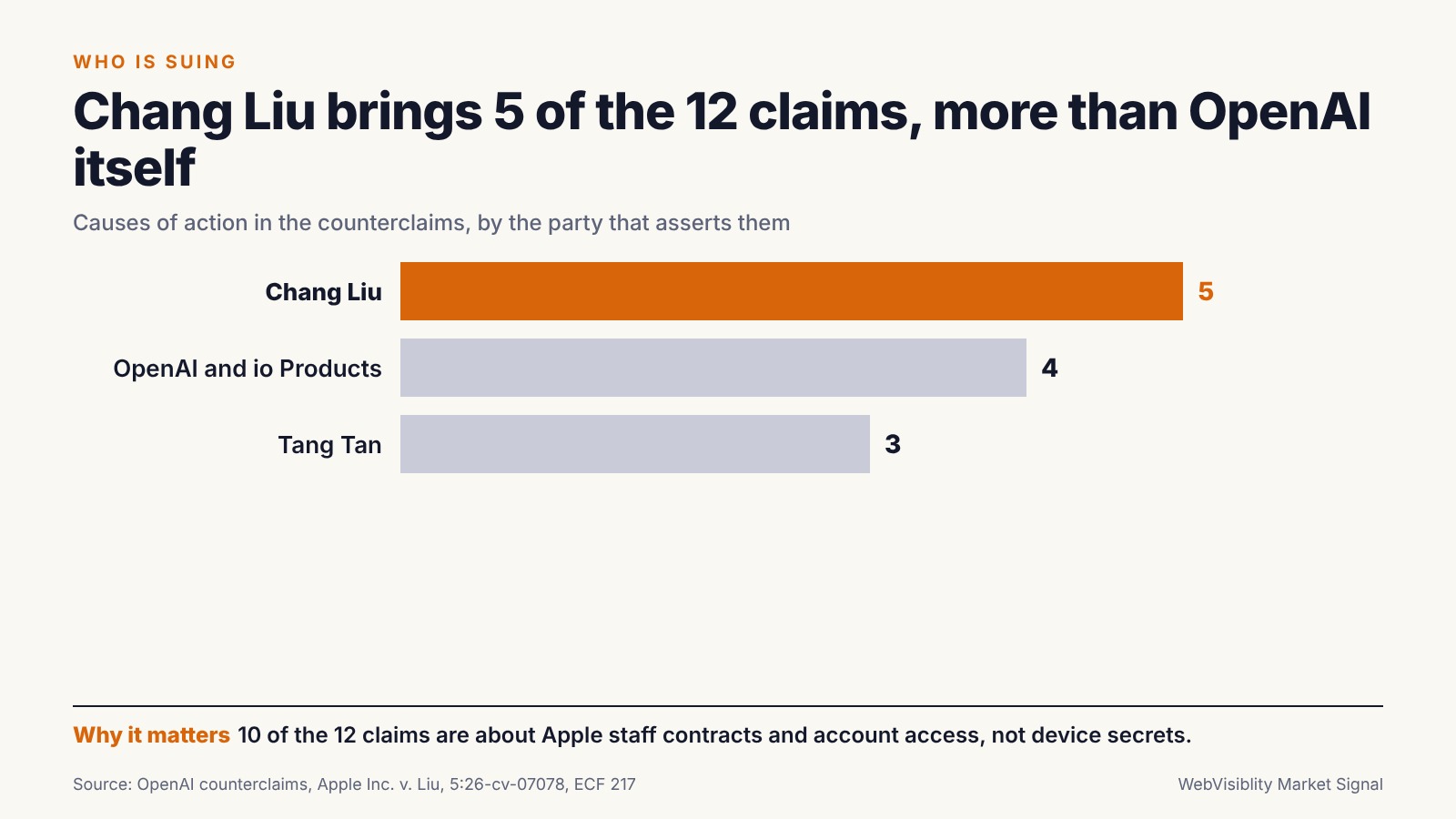
Apple sued OpenAI, its device unit io Products and two former Apple employees, Tang Tan and Chang Liu, on 10 July 2026. It says they took engineering and hardware details to help OpenAI's consumer device push. Tan spent 24 years at Apple and led product design for the iPhone and Apple Watch before co-founding io, which OpenAI bought in 2025.
On 27 November the defendants filed their answer, with counterclaims of their own. The core of OpenAI's case is Employee X. The filing says he worked on camera, enclosure and finishing quality at OpenAI, sent dozens of OpenAI documents to personal accounts over six months, and in July 2026 presented OpenAI's hardware work and roadmap to Apple's Asia-Pacific operations team at Apple's request. OpenAI says it sent Apple a cease-and-desist letter on 9 October and that Apple has refused to search for related documents in discovery.
The second strand is suppliers. OpenAI says that for many functions it has only one or two qualified suppliers, and that many of them also build for Apple. It accuses Apple of asking those firms for the names and assignments of staff working on OpenAI projects, and of moving orders away from suppliers that resist. Apple denied trying to suppress competition in AI device manufacturing, Reuters reported.
The third strand is people. OpenAI, Liu and Tan say Apple encourages staff to keep work files in personal iCloud accounts and to do Apple business over personal iMessage, then treats what is left there as stolen when they quit. Apple says it trains staff to keep work and personal files apart and does not pursue people who keep files by accident. Both sides have asked for a jury trial.
By the numbers
Timeline
Employee X starts at OpenAI after years at Apple.
His last day at OpenAI; he rejoins Apple shortly after.
Apple sues OpenAI, io Products, Chang Liu and Tang Tan.
OpenAI sends Apple a cease-and-desist letter about Employee X.
OpenAI and the employees file 12 counterclaims.
Apple's case is set for trial, 9to5Mac reports.
“OpenAI's counterclaims are a transparent attempt to distract from the substance of Apple's lawsuit, in which OpenAI has already been ordered to stop using Apple's confidential information.”
How to protect a shared-vendor relationship
- 1Map
List suppliers and agencies that also serve direct rivals.
- 2Separate
Agree in writing who on their team works on your account.
- 3Limit
Keep files out of personal cloud accounts and chat apps.
- 4Exit
Run a real handover when staff or vendors leave.
Why it matters
The device fight is a fight over where people reach AI. OpenAI says in the filing that it is building AI devices that threaten to outcompete Apple on what Apple views as its own turf. ChatGPT is already one of the AI search tools people use to research vendors. A ChatGPT device would give it a way to reach people without going through the iPhone. For anyone tracking AI visibility, that makes the result of this case part of the bigger question of which assistant buyers ask first.
The supplier claims read like a warning for any B2B vendor that serves two rivals. OpenAI describes a supplier told to name its OpenAI staff, another that split a shared production line by shift, and a third that walked away from planned work. None of this is proven yet, and Apple denies it. But the pattern is familiar to agencies, contract manufacturers and software firms with competing clients: the bigger customer asks for walls, and the smaller one pays for them.
The personal-account claims reach beyond hardware. Ten of the 12 claims concern Apple's staff agreements and access to personal accounts, not device secrets. Any company that lets staff mix work files with personal cloud accounts or messaging apps faces the same problem when people leave: it is hard to say what is still confidential and who may hold it.
What to do now
For marketers
- Check how ChatGPT describes your company today, before AI assistants move onto new devices.
- If your agency or vendors also serve a rival, ask how they keep the two teams and their files apart.
- Write a short rule for staff on not keeping campaign files or client data in personal cloud accounts.
For software buyers and IT teams
- Ask key suppliers whether another customer limits the staff or capacity they can give you.
- Put named-team and capacity commitments into supplier contracts where you depend on one or two vendors.
- Plan an exit handover for contractors so company files are returned and access is closed on their last day.
Printable, one page, 9 checks. Enter your email and it opens right away.
We email you a copy. We never share your email and never send you sales emails.
Pick one. It takes 5 seconds and helps more people find these briefings. Your checklist opens straight after.
Have a work email? Use it instead and the checklist opens straight away.
Open it, then save it as a PDF or print it.
Know someone who would find this useful?
These steps are our recommendations based on this news, not statements from the companies involved.
What to watch
- Apple's formal reply. So far Apple has answered only in a statement, calling the counterclaims a distraction.
- The trial date. Apple's case is set for July 2027, 9to5Mac reports.
- Supplier names. OpenAI's filing does not identify the suppliers; discovery may.
- OpenAI's first device. The filing calls its devices much-anticipated but gives no launch date or product details.
Who is affected
Big clients may ask them to name staff on rival work, as OpenAI alleges Apple did.
OpenAI says it is building AI devices, which would be a new place where buyers reach ChatGPT.
Work files in personal iCloud accounts blur what leaves with departing staff.
Questions readers ask
Why did OpenAI countersue Apple?
OpenAI says Apple used a rehired employee to learn its unreleased hardware plans, pressured shared suppliers and uses staff contracts to stop people leaving. It filed the claims as part of Apple's own trade secret case.
What is Apple suing OpenAI for?
Apple says OpenAI, io Products and two former Apple staff took confidential engineering information to help OpenAI build consumer devices. OpenAI and the employees deny it.
How many Apple employees have joined OpenAI?
OpenAI's filing says 400 Apple employees have left for OpenAI so far, and says Apple has threatened dozens of current or former staff over such moves.
What did Apple say about OpenAI's counterclaims?
Apple called them a transparent attempt to distract from its lawsuit, and said OpenAI has already been ordered to stop using Apple's confidential information.
Is OpenAI making its own device?
Yes, OpenAI says it is developing AI-enabled personal electronic devices. It bought Jony Ive's io Products in 2025, but has not given a launch date.
When is the Apple v. OpenAI trial?
Apple's case is scheduled for trial on 19 July 2027, according to 9to5Mac.
Companies in this story
Sources
Researched, fact-checked and edited by the Market Signal desk. Read our editorial standards. Spotted an error? Email hello@webvisiblity.com and we will correct it.