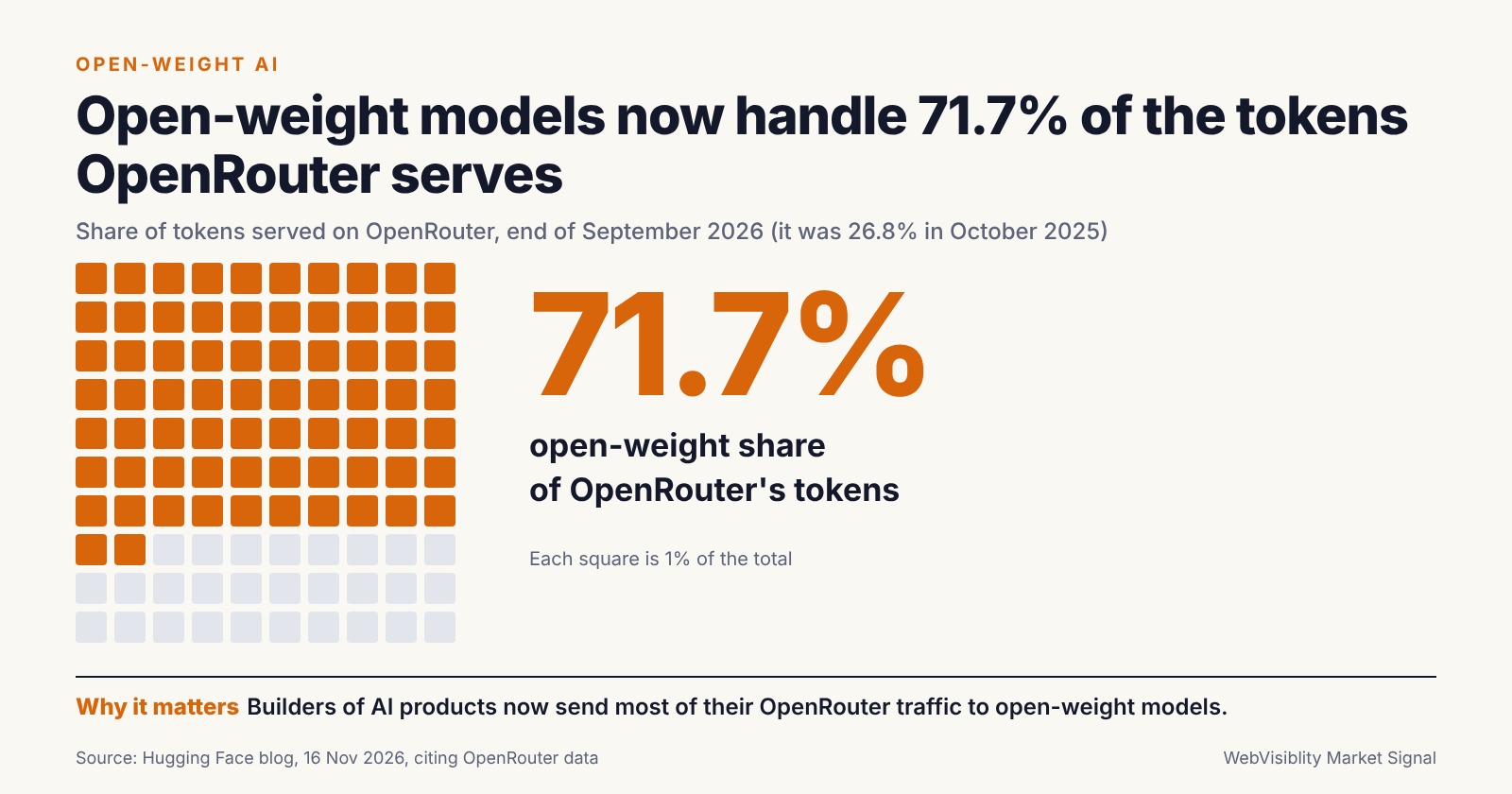
Hugging Face switched its Inference Providers from its own router to OpenRouter's on Monday 16 November. 160 models from 38 labs are reachable this way from day one. The same post shows open-weight models carried 71.7% of the tokens served on OpenRouter at the end of September, up from 26.8% in October 2025.
At a glance
| The change | Chat model requests on Hugging Face now go through OpenRouter |
|---|---|
| Models at launch | 160 models from 38 labs |
| Open-weight share | 71.7% of OpenRouter tokens at end of September 2026, from 26.8% |
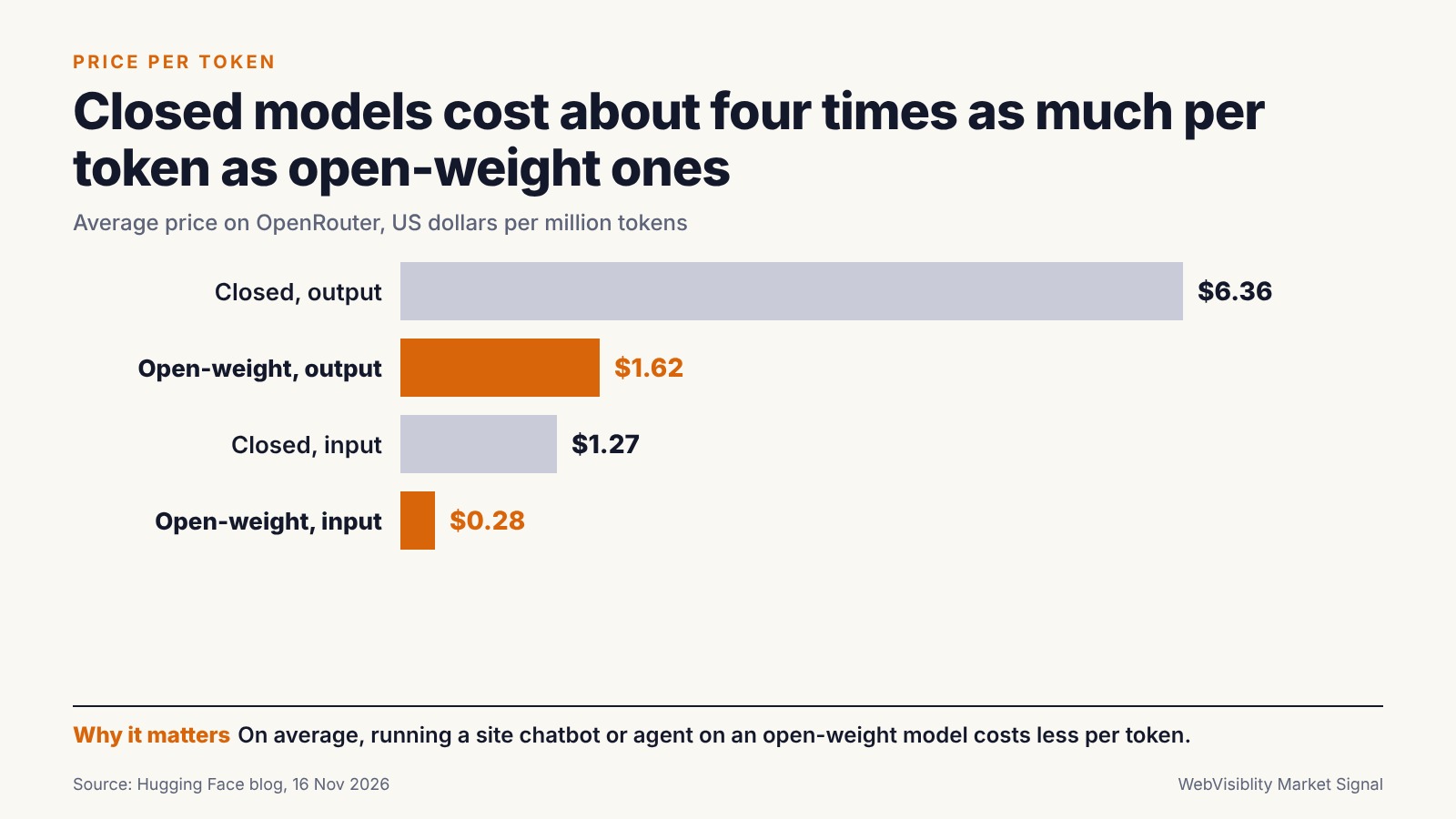
| Average price, open-weight | $0.28 input, $1.62 output per million tokens |
| Average price, closed | $1.27 input, $6.36 output per million tokens |
| Markup | None added by Hugging Face; you pay the provider's price |
| OpenRouter scale | 800 trillion tokens a month to over 10 million users |
Do this today
Tick each step as you do it. Your ticks stay on this device. See the full list.
For marketers
For software buyers and IT teams
The signal
- Hugging Face replaced its custom router with OpenRouter's for language models, billed to the Hugging Face account as before.
- Open-weight models peaked at 77.5% of OpenRouter tokens in July before easing to 71.7%.
- Weekly open-weight volume grew more than 60-fold in that period, against almost tenfold for closed models.
- Closed models cost about four times as much per token on average, by Hugging Face's figures.
- Using your own provider key for these chat models is no longer possible; image and video keys still work.
- The October routing test showed 46% fewer capacity errors, for 6.0% higher cost per request.
Which of these are you?
Tap the one that fits you best. We show what this story changes for you.
What happened
Hugging Face runs a service called Inference Providers, which lets developers call AI models hosted by outside companies through one Hugging Face account. Until Monday it picked the provider with its own software. It now hands that job to OpenRouter for language models, and requests are billed to the Hugging Face account or organization as before. Hugging Face says it does not add a markup. PRO users get $2 of monthly credits, and Team and Enterprise plans get $2 per seat.
OpenRouter says 160 models from 38 labs are available through Hugging Face from the start: every model it serves that also has a page on the Hugging Face Hub. Its list includes DeepSeek V4.1 Flash, Kimi K3.1 Pro, GLM 5.3, Qwen3.8 27B, NVIDIA Nemotron 3 Ultra and OpenAI's gpt-oss-120b. Developers can add :fastest or :cheapest to a model name to steer the choice of provider, or pin one by name.
There is one breaking change. Teams can no longer use their own API key with a provider for these language models. Image, video and audio generation stay outside OpenRouter, and custom keys for image and video still work. Linking an existing OpenRouter account to Hugging Face is planned but not yet live.
Both companies point to a test OpenRouter ran in October, when it rebuilt the routing. It measured 46% fewer capacity errors, 16.9% faster time to first token and 16.3% higher throughput, at 6.0% higher cost per request. Superpower Daily notes these results come from that October test, not from this integration.
By the numbers
| What | Figure | Source |
|---|---|---|
| Open-weight share of OpenRouter tokens, end Sept 2026 | 71.7% | Hugging Face |
| Open-weight share, October 2025 | 26.8% | Hugging Face |
| Models available at launch | 160 | OpenRouter |
| Open-weight output price, per million tokens | $1.62 | Hugging Face |
| Closed output price, per million tokens | $6.36 | Hugging Face |
Figures exactly as published.
Timeline
Open-weight models carry 26.8% of OpenRouter tokens.
The open-weight share peaks at 77.5%.
The share stands at 71.7% at month end.
OpenRouter rebuilds its routing and runs a live experiment.
Hugging Face switches Inference Providers to OpenRouter for language models.
“We built OpenRouter so developers can reach many models and providers through one API.”
How a chat request now travels on Hugging Face
- 1You call the model
Same Hugging Face token and code; existing code keeps working.
- 2OpenRouter picks
The router chooses a provider, or follows :fastest or :cheapest.
- 3Fallback
If the first provider fails, it retries on another.
- 4One bill
The cost lands on your Hugging Face account, with no markup.
Why it matters
The headline figure is about who powers AI products, not who uses chatbots. Developers on OpenRouter now send most of their tokens to open-weight models such as DeepSeek, Kimi and Qwen. In the week of the post, the single most used model there was DeepSeek V4.1 Flash, an open-weight one. Some of the assistants, agents and comparison tools your buyers meet may run on these models rather than on ChatGPT, Gemini or Claude. A brand check that tests only the big three chat apps can miss what these other tools say about you.
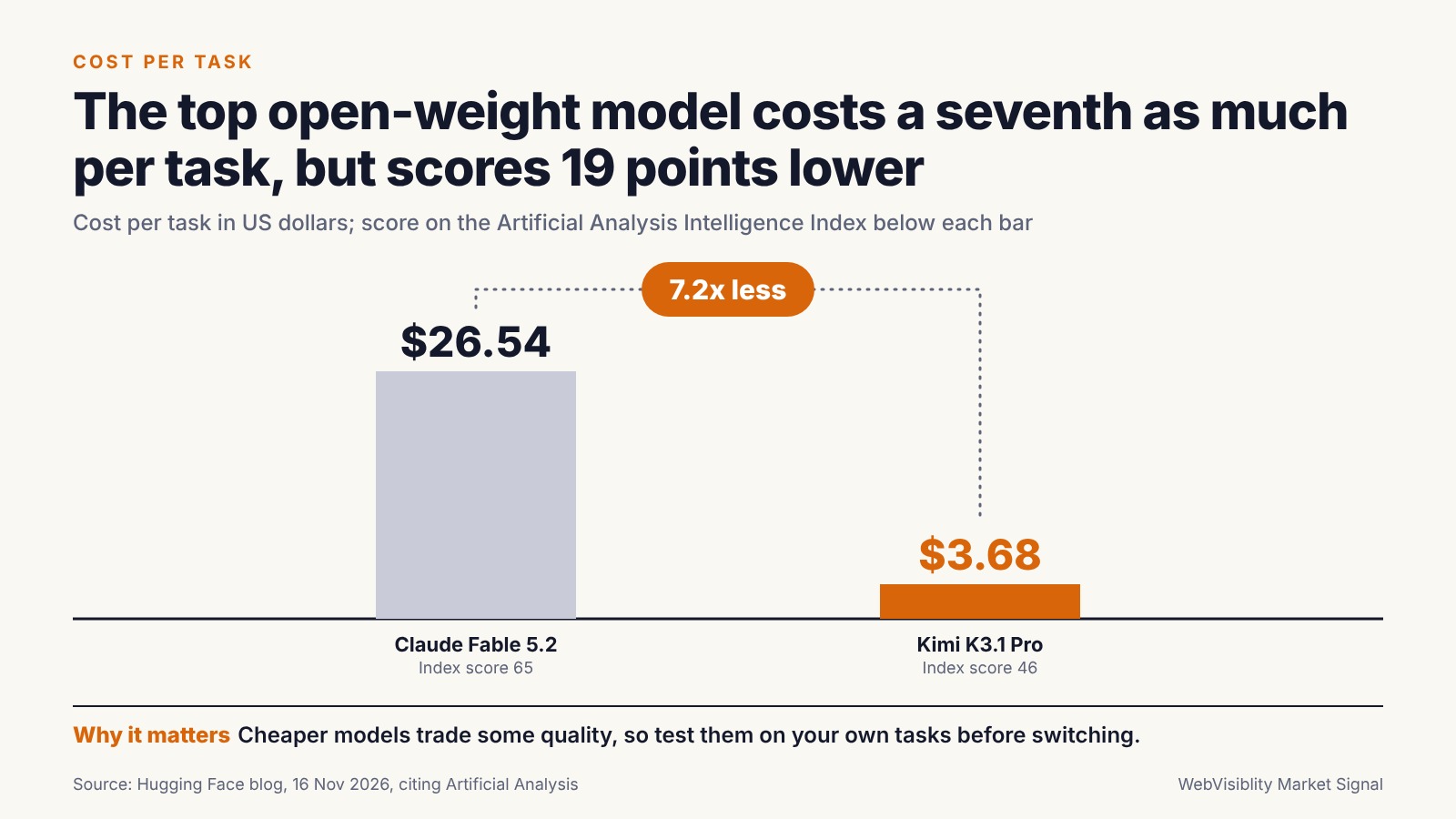
Price is the second reason. Hugging Face puts open-weight models at about a quarter of the price per token of closed models on average. For a marketing team running a support chatbot, a lead qualification agent or bulk content work, that gap shows up directly in the bill. Quality still differs: on the Artificial Analysis Intelligence Index, the best open-weight model scores 46 against 65 for Claude Fable 5.2, at about a seventh of the cost per task. Cheap is not the same as good enough, so the honest test is your own tasks.
For teams that already build on Hugging Face, the change is practical. One account now reaches 160 models from 38 labs, with no extra fee from Hugging Face. Anyone who used a personal provider key for chat models needs to check their setup, because that option has ended for those calls.
Who is affected
| Who | What changes | Impact |
|---|---|---|
| Brand and content teams | More AI tools may run on open-weight models; check what they say about you too. | High |
| Marketing ops building chatbots or agents | Open-weight tokens cost about a quarter as much on average. | High |
| Teams already on Hugging Face | Personal provider keys for chat models stop working; review setups. | Medium |
| B2B buyers | Lower-cost tools often score lower; the best open model trails by 19 index points. | Low |
What to do now
For marketers
- Add at least one open-weight model, such as DeepSeek or Kimi, to the AI answers you test for your brand.
- Price your site chatbot or agent on an open-weight model and compare it with your current bill.
- Run your own sample tasks on both model types before switching, since quality scores differ.
- If your team calls chat models through Hugging Face with a personal provider key, move that billing to the Hugging Face account.
For software buyers and IT teams
- Ask AI vendors which model powers their product, open-weight or closed.
- Check whether a cheaper AI tool's answers hold up on your own questions before you buy.
Printable, one page, 10 checks. Enter your email and it opens right away.
We email you a copy. We never share your email and never send you sales emails.
Pick one. It takes 5 seconds and helps more people find these briefings. Your checklist opens straight after.
Have a work email? Use it instead and the checklist opens straight away.
Open it, then save it as a PDF or print it.
Know someone who would find this useful?
These steps are our recommendations based on this news, not statements from the companies involved.
What to watch
- The open-weight share. Whether it climbs back toward the 77.5% July peak or keeps easing.
- More tasks. Hugging Face plans to route more task types through OpenRouter.
- Account linking. When existing OpenRouter accounts can be connected to Hugging Face.
- The quality gap. Whether open-weight scores close on the 65 that Claude Fable 5.2 posts.
Questions readers ask
What changed between Hugging Face and OpenRouter?
Hugging Face now sends language model requests on its Inference Providers service through OpenRouter's router instead of its own. Billing stays on the Hugging Face account, with no added markup.
How many models can you use through Hugging Face and OpenRouter?
OpenRouter says 160 models from 38 labs are available at launch. That is every model OpenRouter serves that also has a page on the Hugging Face Hub, not every Hub model.
What share of AI tokens go to open-weight models?
On OpenRouter, open-weight models served 71.7% of tokens at the end of September 2026, up from 26.8% in October 2025. This measures OpenRouter only, not the whole AI market.
Are open-weight AI models cheaper than closed models?
Yes, on average. Hugging Face gives $0.28 input and $1.62 output per million tokens for open-weight models, against $1.27 and $6.36 for closed ones on OpenRouter.
Can I still use my own API key on Hugging Face Inference Providers?
Not for the language models now routed through OpenRouter. Custom keys for image and video generation still work, according to Superpower Daily.
Does Hugging Face charge extra for OpenRouter routing?
No. Hugging Face says pricing doesn't change: you pay the provider's price on your Hugging Face bill. PRO users get $2 of credits a month.
What is the best open-weight model right now?
Hugging Face names Kimi K3.1 Pro as the best open-weight model on the Artificial Analysis Intelligence Index, scoring 46 against 65 for Claude Fable 5.2.
Companies in this story
Sources
- Hugging FaceOriginal
- OpenRouterOriginal
- AlphaSignal
- Superpower Daily
- 456X Research
Researched, fact-checked and edited by the Market Signal desk. Read our editorial standards. Spotted an error? Email hello@webvisiblity.com and we will correct it.