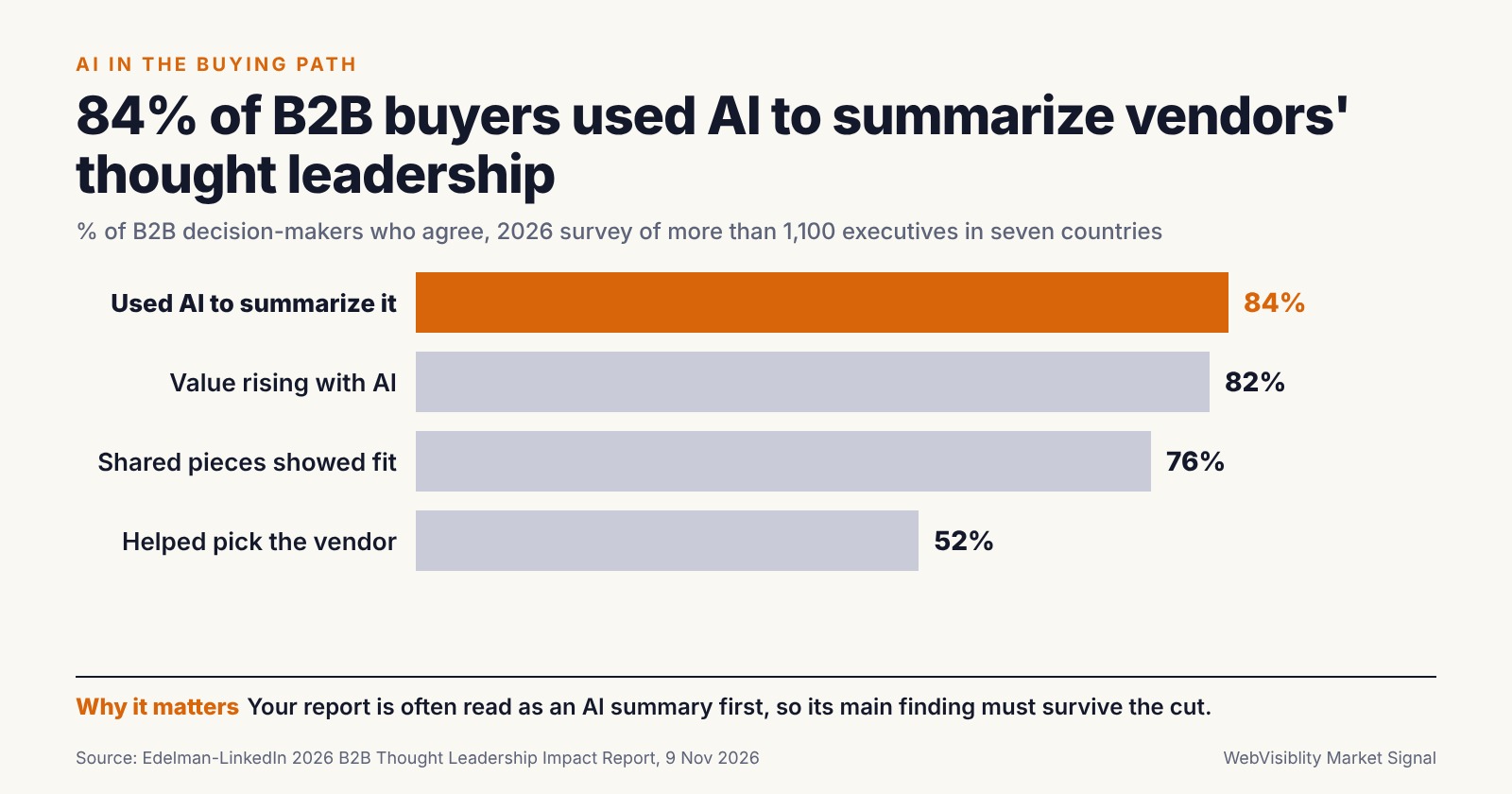
Most B2B buyers no longer read a vendor's reports and articles in full first. In the 2026 Edelman-LinkedIn study, 84% of B2B decision-makers used AI to summarize thought leadership while they evaluated vendors. The same survey of more than 1,100 management-level professionals finds the content matters more, not less: 82% say it is gaining value as AI becomes a common source of business answers.
At a glance
| Study | 2026 Edelman-LinkedIn B2B Thought Leadership Impact Report, the eighth edition |
|---|---|
| Sample | 1,135 business executives in seven countries, per O'Dwyer's |
| Fieldwork | Sept. 4 and 21, 2026, as reported by O'Dwyer's |
| Used AI to summarize | 84% of B2B decision-makers, during vendor evaluation |
| Dropped a vendor over it | Fifty-nine percent of final decision-makers cite poor or absent content |
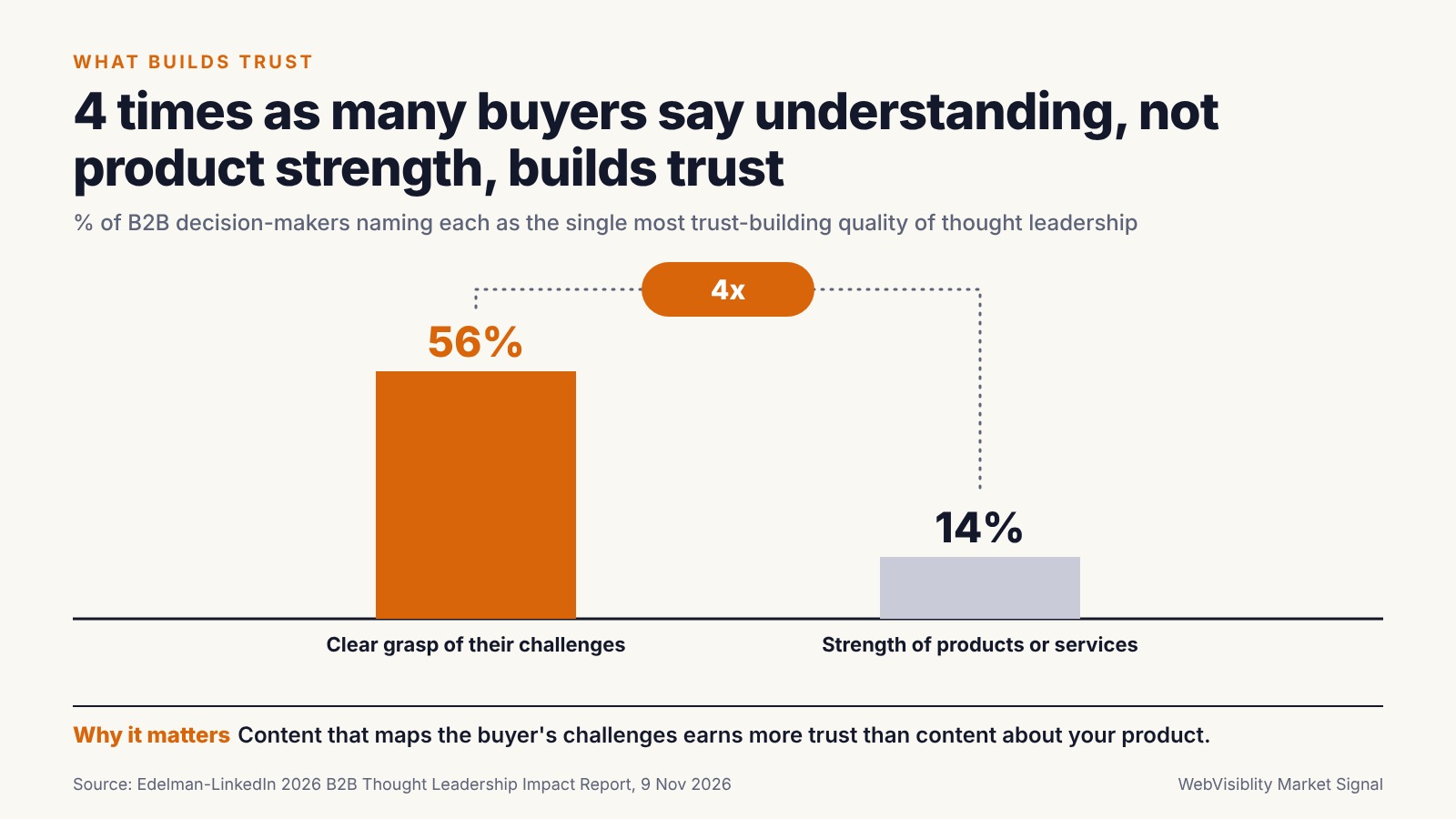
| Top trust builder | Understanding their challenges, chosen by 56% |
| Published | 9 November 2026, by Edelman |
The signal
- 84% of B2B decision-makers ran thought leadership through AI while weighing vendors.
- 82% say it is becoming more valuable as AI answers more business questions.
- Poor or missing content contributed to a vendor being removed for 59% of final decision-makers.
- Buyers rank understanding of their challenges far above product strength as a trust builder.
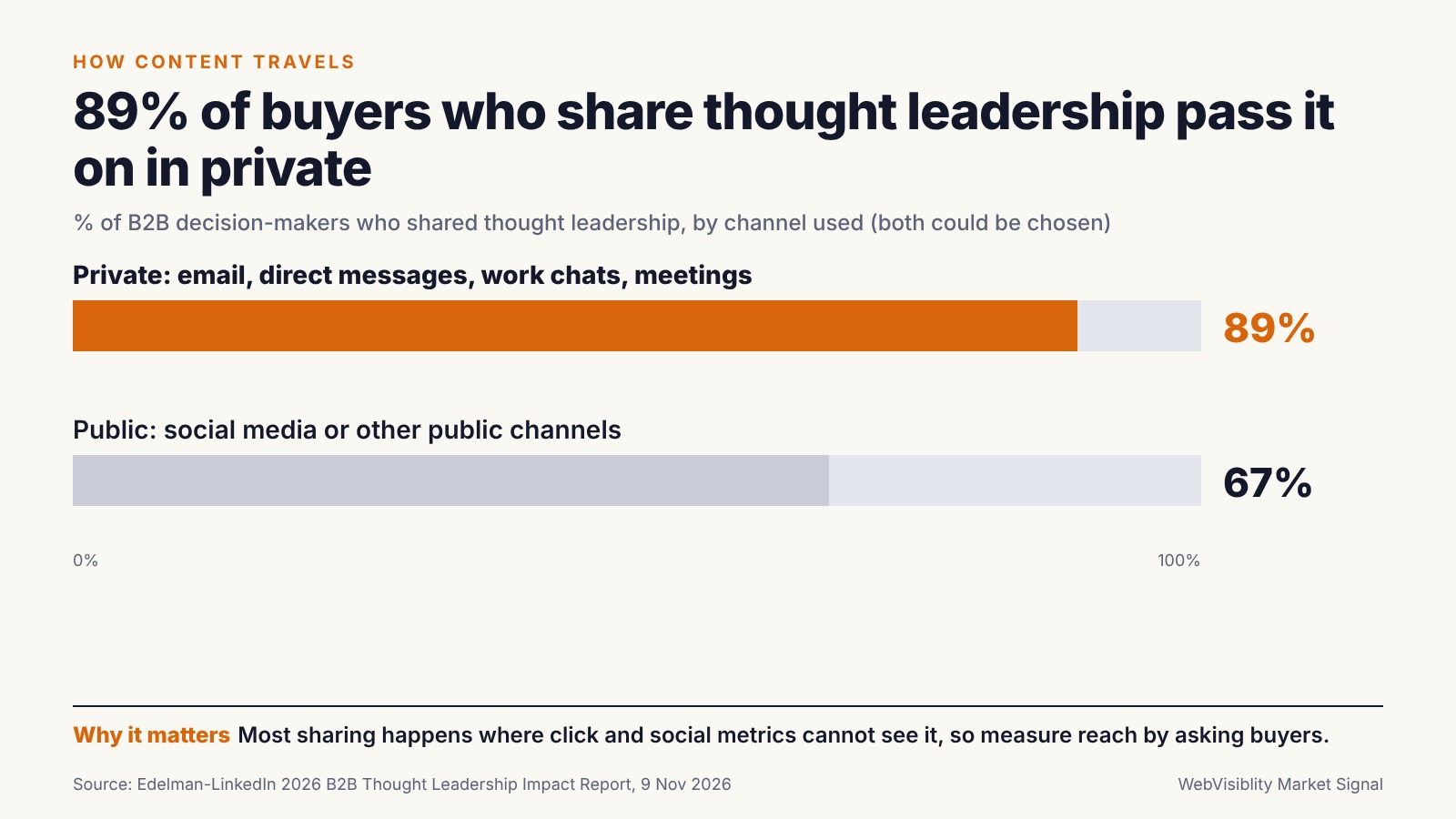
- Sharing is mostly hidden: 89% of sharers used private channels such as email and work chats.
- O'Dwyer's and PPC Land report that 78% researched a company after AI cited its content.
What happened
Edelman published the 2026 edition of its B2B thought leadership study with LinkedIn on 9 November. It is the eighth year of the series, and this edition is framed around how expert content makes B2B companies easier to find, trust and choose. Edelman describes the base as a survey of more than 1,100 business executives across seven countries.
The detail comes from trade press. O'Dwyer's puts the sample at 1,135 global business executives in the US, UK, Canada, Germany, India, Australia and Singapore, interviewed between 4 and 21 September. PPC Land gives the same total and splits it into 317 final decision-makers, 310 C-suite respondents and 495 people who supply thought leadership.
The headline AI figure is Edelman's own. During vendor evaluation, 84% of B2B decision-makers used AI to summarize thought leadership. O'Dwyer's reports that buyers also used AI to learn about a market (72%) and to compare vendors (67%). Both O'Dwyer's and PPC Land report that 78% of respondents researched a company after AI cited its thought leadership, and that 70% read or viewed the cited content.
The content still carries weight inside the buying group. In Edelman's figures, 76% of B2B decision-makers said pieces shared in the group helped them judge whether a vendor understood their needs, and 52% said it helped decide which vendor to pick.
By the numbers
See the figures as a table
| Decision-makers who used AI to summarize thought leadership | 84% |
| Decision-makers who say it is gaining value | 82% |
| Said shared pieces showed vendor understanding | 76% |
| Final decision-makers who dropped a vendor partly over it | 59% |
| Chose understanding of challenges as top trust builder | 56% |
Figures exactly as published. Source: Edelman
Timeline
Fieldwork starts, as reported by O'Dwyer's.
Fieldwork closes, per O'Dwyer's and PPC Land.
Edelman publishes the findings in a piece by Annie Dunleavy.
Social Media Today covers the rising value of thought leadership.
O'Dwyer's reports the sample, countries and AI use.
PPC Land publishes the full subgroup breakdown.
“Thought leadership is no longer just about shaping what buyers think. It's influencing what they do.”
How AI now sits in the buyer's reading path
- Step 1Summarize
Buyers ask AI to condense vendor content: 84% did so during evaluation.
- Step 2Follow the citation
Many then research the cited company, trade press reports.
- Step 3Share privately
Pieces move through email, DMs and work chats inside the buying group.
- Step 4Judge and shortlist
Shared content helped 52% decide which vendor to select.
Why it matters
The first reader of a white paper is now often a model. When 84% of decision-makers ask AI to condense vendor content during evaluation, the summary decides what a buyer takes away. A report that buries its finding on page nine, or hides its data in images, gives the AI little to carry forward. Clear claims, named figures and plain section headings are what survive being shortened.
The citation itself has become a lead source. O'Dwyer's and PPC Land both report that 78% researched a company after an AI tool cited its thought leadership. Yet suppliers lag: the same outlets report that only 46% of suppliers make AI-generated answers part of their content strategy, far fewer than plan for social media. That gap is where B2B teams can still move first.
The cost of getting it wrong is concrete. For 59% of final decision-makers, poor or absent thought leadership helped knock a vendor out of consideration. And what earns trust is not product talk: 56% picked a clear understanding of their challenges as the most trust-building quality, against 14% for the strength of products or services.
Who is affected
Work is read through AI first, so findings must be easy to summarize.
Weak content contributed to removals for 59% of final decision-makers.
Most sharing happens in private channels that click data misses.
What to do now
For marketers
- Paste your latest report into ChatGPT, Gemini and Claude and check whether the summary keeps your main finding.
- Put the key claim and its number in the first paragraph and in a plain heading of every long piece.
- Publish your data as text and tables on the page, not only inside images or gated PDFs.
- Ask new leads whether an AI tool pointed them to your content, and log the answer in your CRM.
For software buyers and IT teams
- Open the original source behind any AI summary before you shortlist or drop a vendor.
- Share the full piece, not just the summary, with your buying group.
- Ask each vendor to show how their content addresses your specific challenges.
Printable, one page, 11 checks. Enter your email and it opens right away.
We email you a copy. We never share your email and never send you sales emails.
Pick one. It takes 5 seconds and helps more people find these briefings. Your checklist opens straight after.
Have a work email? Use it instead and the checklist opens straight away.
Open it, then save it as a PDF or print it.
Know someone who would find this useful?
These steps are our recommendations based on this news, not statements from the companies involved.
What to watch
- The full report. Edelman's download should confirm the subgroup sizes and methods now reported only by trade press.
- Supplier response. Watch whether the 46% of suppliers optimizing for AI answers rises in next year's edition.
- Search versus AI. O'Dwyer's and PPC Land disagree on how many suppliers plan for traditional search (70% or 74%), so wait for Edelman's own figure.
- Measurement. Most sharing runs through private channels, which standard analytics cannot see.
Questions readers ask
What is the Edelman-LinkedIn B2B Thought Leadership Impact Report?
It is an annual survey by Edelman and LinkedIn on how expert content affects B2B buying. The 2026 edition, the eighth year of the series, covers more than 1,100 management-level professionals.
How many B2B buyers use AI to read thought leadership?
84% of B2B decision-makers used AI to summarize thought leadership during vendor evaluation, according to Edelman's 2026 findings.
Does thought leadership still matter with AI search?
Yes. 82% of B2B decision-makers say thought leadership is becoming more valuable as AI becomes a common source of business answers.
Can bad thought leadership cost a vendor the deal?
It can. Fifty-nine percent of final decision-makers say poor or absent thought leadership contributed to a vendor being removed from consideration.
What makes B2B buyers trust a vendor's content?
Showing that you understand their problems. 56% chose a clear understanding of their challenges, priorities and constraints as the most trust-building quality; 14% chose product strength.
Do buyers research a company after AI cites it?
Most do, by trade press accounts. O'Dwyer's reports that 78% researched a company after AI cited its thought leadership, and 70% read or viewed the cited content.
How do B2B buyers share thought leadership?
Mostly in private. Among decision-makers who shared, 89% used private channels such as email, direct messages, work chats and meetings, while 67% used social media or other public channels.
Companies in this story
Sources
Researched, fact-checked and edited by the Market Signal desk. Read our editorial standards. Spotted an error? Email hello@webvisiblity.com and we will correct it.