On this page
Key takeaways
- Since February 2026, Bing Webmaster Tools has an AI Performance report that shows how often your pages are cited as sources in Microsoft Copilot, AI summaries in Bing and select partner integrations.
- It is first-party data, which is rare for AI products. Treat it as one input, not a full picture of AI visibility.
- Microsoft says the grounding query data is a sample, and that the counts do not show placement, ranking or authority.
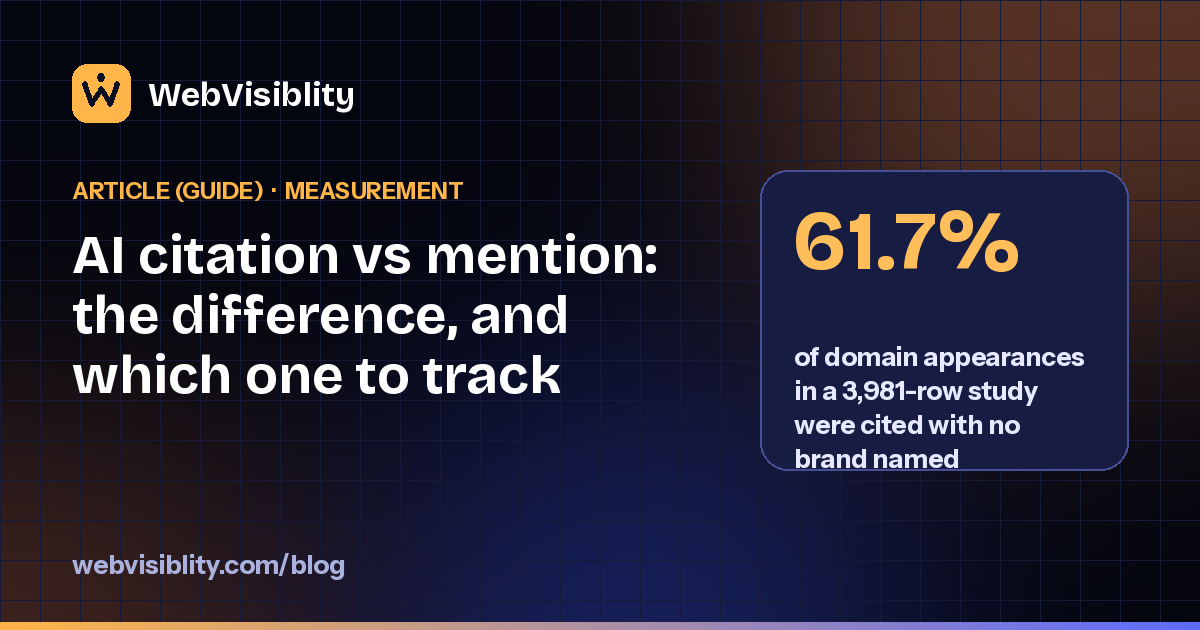
- A citation is not a mention. In a Semrush and Kevin Indig study of other engines, 61.7% of domain appearances were citations with no brand name in the answer.
- Use Citation Share and trends over weeks, not raw totals, because the engine can change how many sources it shows.
The short answer. Set it up, because it is free and it is first-party data. Then read it for what it is: a sampled count of the pages Microsoft's AI products cited, grouped by the phrases they searched for. It does not tell you whether the answer named your company, how you ranked inside it, or what ChatGPT, Gemini or Perplexity say. Pair it with a weekly log of real buyer questions.
What Microsoft launched, and when#
Microsoft announced AI Performance in Bing Webmaster Tools as a public preview on 10 February 2026. It shows how publisher content appears across Microsoft Copilot, AI-generated summaries in Bing and select partner integrations. [Microsoft Bing Blog, Feb 2026] It has grown since:
| Date | What was added | What it does |
|---|---|---|
| 10 Feb 2026 | AI Performance (public preview) | Total citations, average cited pages, grounding queries, page-level citations, trends |
| 16 Jun 2026 | Intents, Topics, Citation Share, Compare (preview) | Classifies queries, groups them into topics, shows your share of citations, compares periods |
| 13 Oct 2026 | Topics Portfolio (beta) | Shows your presence across topic clusters, with citation volumes as ranges |
Sources for the table: [Bing Blog, Feb 2026], [Bing Blog, Jun 2026], [Bing Blog, Oct 2026]. The features are labelled preview or beta, so names and numbers may change.
What each metric means#
Microsoft defines the first-release metrics this way. [Bing Blog, Feb 2026]
- Total citations: how many times your content was shown as a source in AI answers during the date range. Microsoft says this does not indicate placement or presentation in a given answer.
- Average cited pages: the average number of unique pages from your site shown as sources per day. It reflects overall patterns, not ranking, authority or the role of a page in an answer.
- Grounding queries: the key phrases the AI used when retrieving content that was then cited. Microsoft says the data shown is a sample of overall citation activity.
- Page-level citations: citation counts for individual URLs. This reflects how often a page is cited, not its importance or placement.
Grounding is Microsoft's word for the source material and web evidence an AI system uses to support and cite its answer. The June update adds two things worth knowing. Intents sorts grounding queries into broad categories such as informational, commercial, navigational and research. Citation Share is your citations as a percentage of all citations shown across all sites for the same grounding query. [Bing Blog, Jun 2026] In the October beta, citation volumes inside Topics Portfolio are shown as ranges rather than exact numbers. [Bing Blog, Oct 2026]
Microsoft also says the new capabilities do not turn AI visibility into a single ranking or score. [Bing Blog, Jun 2026] That is a useful warning to read twice.
Why it is worth having#
Most AI products tell site owners nothing. You cannot open a report from ChatGPT or Gemini that says which of your pages they cited last month. Google's Search Console counts clicks and impressions for links, and our guide on how to see AI Overviews in Search Console explains why that still leaves the words of the summary unseen. Bing's report is different: it is a first-party list of the exact pages and the phrases behind each citation.
That makes it useful in three ways:
- Confirm that your pages are reachable. If Bing cites nothing, check robots.txt and indexing first. See which AI crawlers to allow. Microsoft says Bing respects robots.txt and other supported controls. [Bing Blog, Feb 2026]
- See which pages the AI trusts enough to cite, and copy what they do well to weaker pages.
- Read the grounding queries as research. They show how the AI rephrases a buyer question before it searches. That is a better source of page topics than guessing.
Three limits that matter#
1. It covers Microsoft's surfaces only
The report covers Copilot, Bing AI summaries and select partners. It says nothing about what ChatGPT, Gemini, Claude or Perplexity cite. We do not make claims here about how other products source their answers, because Microsoft's pages do not describe them. If your buyers mostly use another tool, this report covers a minority of their behaviour. Check which tools they use first. See how B2B buyers use AI to shortlist vendors.
2. A citation is not a mention
The report counts citations: your page was shown as a source. It does not say whether the written answer named your company. Other data suggests the two often differ. In a study by Semrush with Kevin Indig, covering 3,981 domain appearances for 115 prompts across 14 countries on ChatGPT, Gemini, Google AI Overviews and Google AI Mode, 61.7% were citations without a brand mention, 13.2% were both cited and mentioned, and 25.1% were mentioned without a citation. [Semrush, Jun 2026] Copilot was not among the engines in that study, so we cannot say the same split holds in Bing. But it is a reason to check the actual answers before reporting a citation count as a win.
3. Counts move when the engine changes
A raw total can rise or fall without anything you did. Kevin Indig analysed an export from HubSpot's AI Search Sensor covering nearly 210 million prompt runs across ChatGPT, Gemini and Perplexity. He found that Perplexity's cited URLs per prompt rose 80% between July and mid-September 2026 while brand mentions rose 25%, and that Gemini cut the number of cited pages per answer from 11.5 to 5.4 between June and July. [Search Engine Land, Nov 2026] HubSpot sells the tool, the data is aggregate, and the author notes the prompt mix was not strictly fixed, so treat the exact figures with care. The lesson fits Bing too: when the number of sources an answer shows changes, your total changes with it. That is why Microsoft's Citation Share, which compares you with other cited sites for the same query, is the better number to track than the total.
A 10-minute routine#
- Open the report and note the date range. Use the same range each time, such as the last 28 days.
- Write down total citations and the top five cited pages. Add them to a sheet with the date.
- Open the grounding queries and copy the five that match your buyers' questions. Ignore brand-name queries.
- Check Citation Share for those queries. A rising share on the same queries is a stronger signal than a rising total.
- Ask Copilot the same buyer questions in a fresh session. Record whether your company is named in the words, not only linked.
- Repeat every four weeks and keep the questions fixed. Our guide on how to measure AI visibility explains why repeated checks matter.
If you already keep a weekly log for Google, add Bing as a separate tab. Our Google AI Overviews roadmap shows the columns.
Our view#
The report is worth the setup time and is not a reason to relax. First-party data from an AI product is rare, and page-level and query-level detail is useful. But it counts sources, from a sample, on Microsoft's surfaces. Reading it as "our AI visibility" would be the mistake. Reading it as "which pages Microsoft's AI trusted this month, and for which phrases" is accurate and useful.
For a related change on the Bing side, see our briefing on Microsoft's ads inside Bing's AI Overviews.
Want to see which AI tools name your company, and which only cite you?
Send me five questions your buyers ask. I will check what the AI answers, whether your company is named or only linked, and which page to fix first.
- I check who is named instead of you
- I separate citations from mentions
- I give you a short list of fixes
Sources: Microsoft Bing Blog, Introducing AI Performance in Bing Webmaster Tools (February 2026) · Microsoft Bing Blog, New AI visibility insights: Intents, Topics, Citation Share, Compare (June 2026) · Microsoft Bing Blog, Topics Portfolio (October 2026) · Semrush, Why 62% of AI citations don't lead to brand mentions (June 2026) · Search Engine Land, AI model changes can create the illusion of visibility gains (November 2026)
Questions and answers
What is the AI Performance report in Bing Webmaster Tools?
It is a report in Bing Webmaster Tools that shows when your site is cited as a source in AI-generated answers across Microsoft Copilot, AI summaries in Bing and select partner integrations. It launched in public preview on 10 February 2026. (Bing Blog, Feb 2026) It shows total citations, average cited pages, grounding queries, page-level citation counts and trends over time.
Is the Bing AI Performance report free?
Bing Webmaster Tools is described by Microsoft as free. (Bing Blog, Jun 2025) The AI Performance report sits inside it. Microsoft labels the features preview or beta, so check the current state when you sign in.
What is a grounding query?
It is a phrase the AI used when retrieving content that it then cited in an answer. Microsoft says the grounding queries shown are a sample of overall citation activity. (Bing Blog, Feb 2026) They are often a rewrite of the buyer's question, so they are useful for finding page topics.
What is Citation Share in Bing Webmaster Tools?
Citation Share is the percentage of citations attributed to your site out of all citations shown across all sites for the same grounding query. (Bing Blog, Jun 2026) It tells you how much of the citation space you hold for a query, not only whether you were cited.
Does a Bing citation mean Copilot named my company?
No. A citation means a page was shown as a source. It does not say the answer's text named your company. In a Semrush and Kevin Indig study of four other engines, 61.7% of domain appearances were citations with no brand mention. (Semrush, Jun 2026) Copilot was not in that study, so ask Copilot your buyer questions and read the answers.
Does Bing's report show what ChatGPT or Perplexity cite?
No. It covers Microsoft Copilot, AI summaries in Bing and select partners. (Bing Blog, Feb 2026) For Perplexity, see our guide on how to get cited in Perplexity and how to monitor visibility in Perplexity.
How often should I check it?
Every four weeks is enough for most B2B teams, using the same date range and the same buyer questions each time. Checking daily invites noise, because the number of sources shown per answer can change when an engine updates. (Search Engine Land, Nov 2026)
B2B marketers who build tools to measure how ChatGPT, Gemini, Claude and Perplexity talk about companies. About us